
8–12 Week Gait Training for Seniors: Clinic Backed, Evidence First
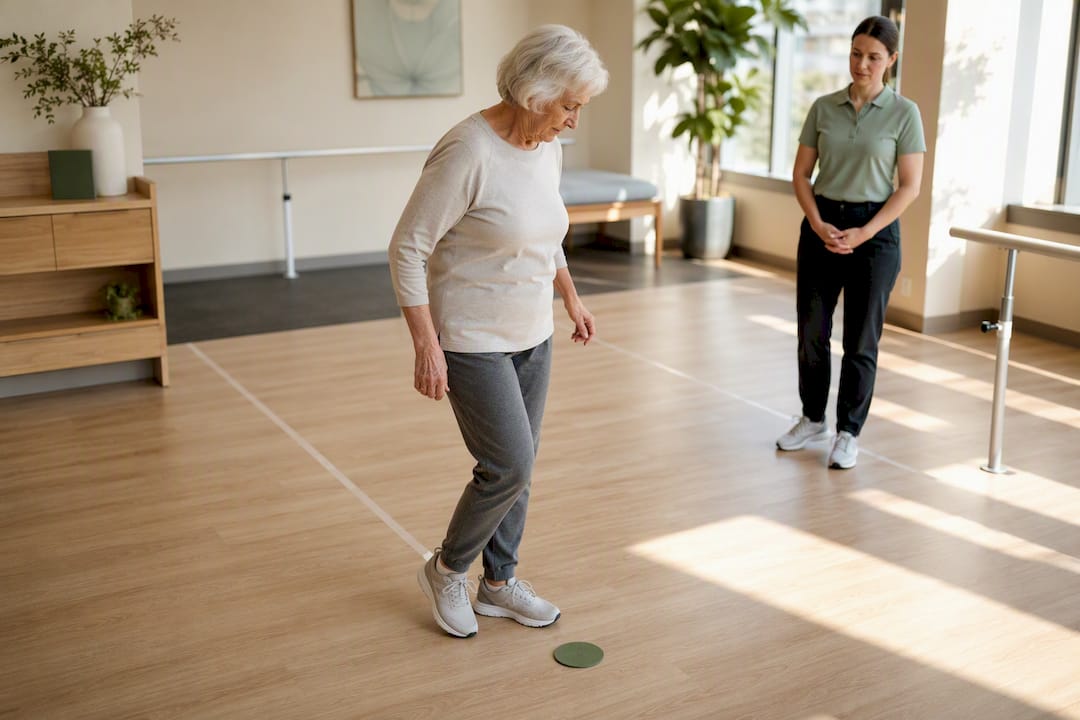
Gait training, which combines supervised balance drills, strength work, and progressive walking practice, reduces fall frequency in older adults, but it should never start with random exercises pulled from a video. The right first step is a simple screening test or a clinician assessment. From there, a program can be tailored to your actual risk level, not a generic checklist.
TL;DR:
Structured, supervised gait training programs targeting balance, strength, and coordination have the strongest evidence for reducing falls in older adults.
Home screening tests like the Timed Up and Go and chair stand can identify specific risk factors, but a full clinical assessment is necessary if scores are poor or falls have occurred recently.
Exercises such as heel-to-toe walking, single-leg stands, sit-to-stand, and dual-task walking should be progressed gradually and performed near stable support to prevent injury.
Environmental safety modifications, including secure rugs, brighter lighting, grab bars, and appropriate footwear, are essential to support exercise gains and prevent falls at home.
Consulting a healthcare professional is recommended if fall history is recent, screening results are poor, or if specific medical issues like dizziness or vision changes are present before starting or progressing gait training.
Table of Contents
What Is Gait Training and Who Needs It?
Gait training is task-oriented practice that trains the body to walk more safely and confidently. It blends three things: balance challenges, muscle strengthening (especially in the hips and legs), and repeated walking drills that mimic real-life movement, like turning corners or stepping over a curb. It is not the same as a general fitness routine. The goal is stability and confidence during actual walking, not just building muscle for its own sake.
You should prioritize gait training, or ask a clinician to evaluate you, if any of the following apply:
You have fallen in the past year, even a minor stumble that did not result in injury. You have noticed your walking has slowed down or feels less steady than it did six months ago. You recently left a hospital stay and feel weaker or less coordinated than before admission. You feel dizzy when standing up or turning your head. You have started avoiding walks, stairs, or outings because you are afraid of falling.
That fear matters more than most people realize. Research on fear of falling and activity restriction shows that anxiety about falling can shrink a person’s world just as much as an actual fall can, leading to deconditioning that increases real fall risk over time.
Certain symptoms deserve a same-week call to your doctor rather than a home exercise plan: falling more than once in recent months, new fainting or lightheadedness, sudden vision changes, or a gait change that appeared suddenly rather than gradually. These can signal something beyond simple deconditioning, and a home program is the wrong first move.
What Does the Research Say About Exercise and Falls?
Exercise works. Not as a vague wellness suggestion, but as a measurable intervention with numbers behind it.
A significant portion of adults over 65 fall each year, and the CDC reports that millions of older adults are treated in emergency departments annually for fall-related injuries. That scale is why exercise-based fall prevention has been studied so extensively.
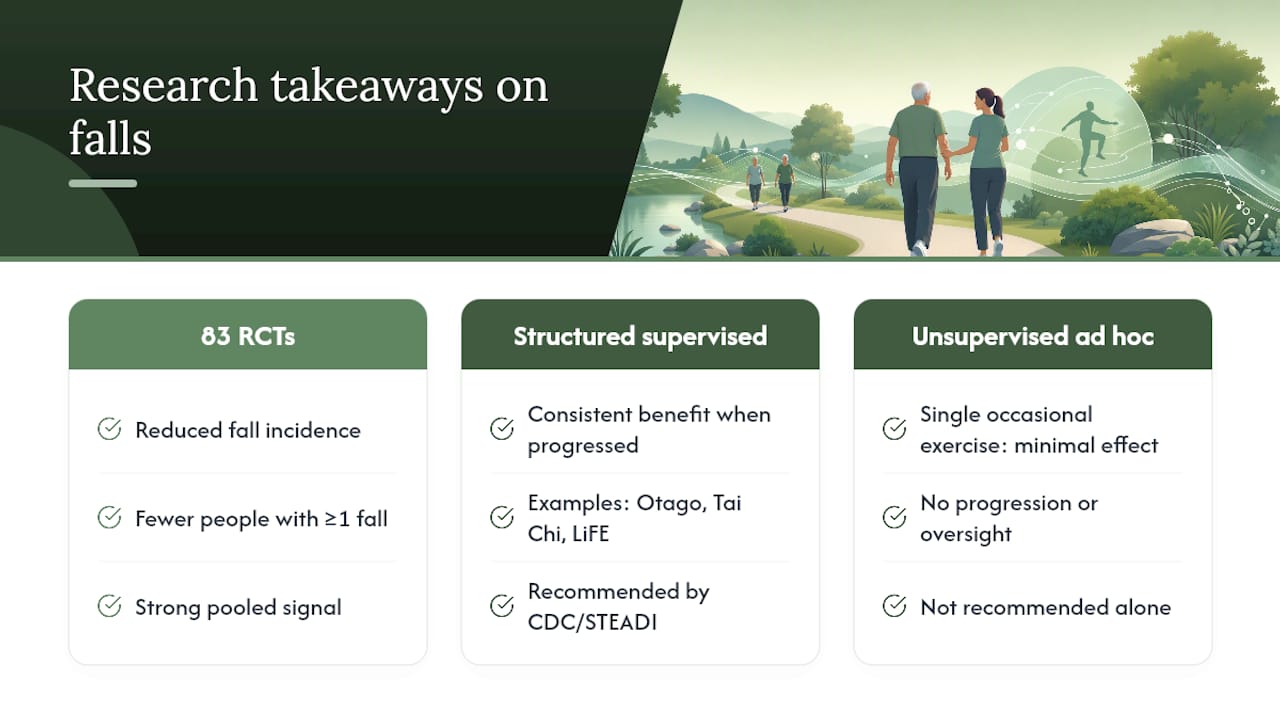
The Numbers: The 2024 USPSTF evidence review, which pooled results from 83 randomized trials involving older adults, found that exercise interventions reduced fall incidence and the number of people who experienced at least one fall, demonstrating a beneficial effect on fall prevention.
Those numbers describe a group effect, not a guarantee for any one person. Some individuals in these trials improved dramatically; others saw more modest change. The CDC’s Falls Compendium catalogs 34 single interventions and 16 multifaceted programs, including Otago, LiFE, Tai Chi, and perturbation training, and its central message is that matching the intervention to your specific risk factors beats any one-size-fits-all routine.
The evidence is also clearer for supervised, structured programs than for scattered, unsupervised drills. Trials behind Otago and Tai Chi-based programs consistently show benefit when delivered with proper progression and oversight, according to the CDC’s STEADI compendium. A single balance exercise done occasionally, with no plan to increase difficulty, is unlikely to move the needle much. Trial heterogeneity, meaning differences in study populations, exercise types, and duration, means these pooled numbers are best read as a strong directional signal rather than a precise personal prediction.
How Do You Screen for Fall Risk at Home?
Three quick tests, all recommended by the CDC’s STEADI algorithm, can tell you where you stand before you start any exercise plan.
Timed Up and Go (TUG): Sit in a standard chair, then stand up, walk 10 feet, turn around, walk back, and sit down. Time the whole sequence. Taking longer than 12 seconds is generally flagged as a risk signal worth discussing with a clinician.
30-Second Chair Stand: Cross your arms over your chest and stand up and sit down as many times as you can in 30 seconds, without using your hands. Fewer repetitions than expected for your age group points to leg weakness that directly affects walking stability.
4-Stage Balance Test: Progress through four standing positions, feet together, feet in a semi-tandem stance, feet in a full tandem stance (one foot in front of the other, touching), and standing on one leg. Struggling to hold any position for 10 seconds is a meaningful red flag.
A poor score on any of these does not mean you are doomed to fall. It means you have specific, addressable weaknesses. A full clinical evaluation goes further than these three tests. Physical therapists typically assess leg and hip strength, vision, vestibular (inner ear) symptoms, current medications that might cause dizziness, how well your cane or walker actually fits your body, and hazards in your own home, according to NIA guidance on balance problems.
If your screening scores are poor, or if you have already fallen, that is the point to ask for a referral to physical therapy or, if dizziness is prominent, vestibular rehabilitation. Skipping straight to advanced exercises without this step is one of the most common and preventable mistakes in home fall prevention.
Which Exercises Actually Improve Walking Stability?
Effective gait training programs pull from three categories, and a well-rounded plan touches all three rather than fixating on one.
Balance exercises train your body to hold and recover position:
Heel-to-toe walk: Walk in a straight line placing the heel of one foot directly in front of the toes of the other. Start near a wall or countertop for support, and remove the support once you can complete 10 steps confidently.
Single-leg stand: Hold onto a chair back and lift one foot slightly off the ground for 10 seconds. Progress by lightening your grip, then trying it with just a fingertip touch, then with no support at all.
Tandem stance: Stand with one foot directly in front of the other, like standing on a tightrope, and hold for 10 to 30 seconds per side.
Strength exercises target the muscles that actually control walking mechanics:
Sit-to-stand: Rise from a chair without using your hands, then sit back down slowly. Aim for 2 to 3 sets of 10 repetitions, most days of the week.
Heel raises: Hold a counter for support and rise onto your toes, then lower slowly. Calf strength directly affects push-off power during walking.
Hip abduction: Standing and holding support, lift one leg out to the side and lower it with control. Weak hip muscles are a common, overlooked cause of unsteady, wobbling gait.
Coordination and walking practice ties strength and balance together into the actual skill of walking:
Marching in place: Lift your knees to hip height while holding support, alternating legs, for 20 to 30 seconds.
Side-stepping and backward walking: Practice these in a hallway with a wall nearby. They challenge muscles your normal forward walk rarely uses.
Stepping over low obstacles: Use a rolled towel or a low household object to practice the higher, deliberate step needed to clear curbs and thresholds.
Dual-task walking: Walk while counting backward from 100 by threes, or while naming animals. This trains your brain and body to multitask, which matters more than most people expect.
That last point deserves emphasis. Walking safely is not purely physical. Real-world walking almost always involves thinking about something else, whether it’s a grocery list, a conversation, or watching for a curb. Dual-task training closes the gap between what happens in a quiet living room and what happens on a sidewalk.
The NIA recommends combining aerobic activity, strength work, and balance training, suggesting roughly three balance-focused sessions per week as a practical target for most older adults.
Pro Tip: Always practice near a sturdy chair or wall, never a wobbly table or a piece of furniture on wheels. Wear supportive, closed-back shoes rather than socks or slippers, and stop immediately if you feel dizzy or lightheaded. Those three habits prevent more injuries than any single exercise ever will.
Progression should always follow this order: only reduce your hand support, narrow your stance, add a mental task, or speed things up after the exercise feels stable and easy at the current level. Jumping ahead before you’re ready is where most home-practice injuries happen.
What Does a Realistic 8 to 12 Week Program Look Like?
A structured timeline helps you see progress and know when to push harder. Most clinic-backed programs run in three phases, and you can follow this template at home or bring it to a physical therapist as a starting conversation.
Each session should include a short warm-up (a few minutes of walking or gentle marching), a main set of 15 to 20 minutes covering balance, strength, and coordination work, and a brief cool-down with light stretching.
Weeks 1 through 4, foundation phase: Focus on supported balance exercises (single-leg stand and tandem stance with a wall or chair) and basic strength moves like sit-to-stand, 3 sessions per week. Expect exercises to feel effortful but manageable, not exhausting.
Weeks 5 through 8, building phase: Reduce support on balance exercises, add heel-to-toe walking and side-stepping, and increase sit-to-stand sets. Introduce simple dual-task walking, like counting while walking a hallway.
Weeks 9 through 12, integration phase: Combine coordination drills with obstacle stepping and more challenging dual-task practice. If screening scores like the TUG or chair stand have not improved by this point, that is a clear signal to bring your program to a physical therapist for reassessment rather than continuing unchanged.
Keep a simple log: date, exercises completed, any dizziness or near-falls, and how the session felt on a scale of easy, moderate, or hard. This log is genuinely useful at a PT appointment, since it shows patterns a single conversation can’t capture.
Pro Tip: Stop and reassess immediately if you experience a fall, new chest pain, or worsening dizziness during the program. Progress should feel gradual. A sudden setback is a message, not an obstacle to push through.
For a more detailed week-by-week breakdown, Contemporaryrehabservices’ 8 to 12 week balance training guide walks through session structure in more depth.
What Home and Safety Changes Matter Most?
Exercise only works if the environment around it doesn’t undo the progress. Several low-cost changes make a measurable difference, according to NIA guidance on preventing home falls:
Remove loose rugs and runners, or secure them firmly with non-slip tape.
Add brighter lighting in hallways, stairwells, and bathrooms, including nightlights for nighttime trips to the bathroom.
Install grab bars near the toilet and inside the shower, not just towel bars that can’t bear weight.
Keep walking paths clear of cords, boxes, and pet items that tend to migrate into hallways.
Footwear matters more than most people assume. Socks and slippers slide on hard floors and offer no ankle support, which makes them a genuinely risky choice during practice sessions. A supportive, closed-back shoe with a non-slip sole is worth the investment, even indoors.
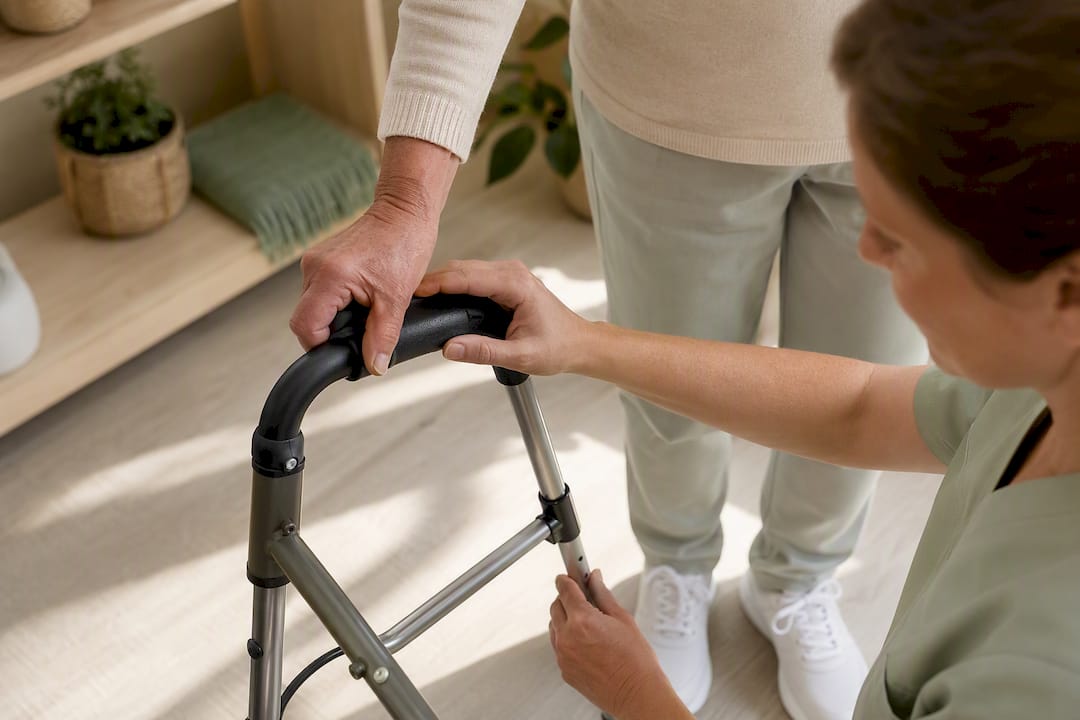
If you use a cane or walker, fit matters as much as the device itself. A cane that’s too tall or a walker with worn-down grips changes your posture and can actually increase instability rather than reduce it. Have a clinician check device height and grip fit, especially if the device was fitted more than a year ago or your height or posture has changed since then.
How Can Caregivers Support Safe Practice at Home?
Caregivers play a real role in making gait training both safer and more consistent, without needing any clinical background.
Set up a clear practice area with a sturdy chair or countertop within arm’s reach at all times.
Stand slightly behind and to the side during balance exercises, ready to offer a hand, rather than hovering directly in front where you can’t react quickly.
Use short, specific cues like “weight on your heels” rather than vague encouragement like “you’ve got this.”
Fold practice into daily routines: standing balance while brushing teeth, or a few extra steps walking to the mailbox.
Track simple metrics weekly, like how many sit-to-stands were completed or how long a single-leg stand lasted.
Pro Tip: Celebrate consistency over intensity. A senior who does 10 minutes daily almost always outpaces one who does an exhausting 45-minute session once a week, then skips the rest.
The Clinic Perspective on Individualized Gait Training
A cookie-cutter exercise sheet cannot account for a vestibular issue, a knee that’s weaker on one side, or a walker that no longer fits correctly. Individualized gait training starts with matching the plan to what an assessment actually finds, not what a general checklist assumes.
At an initial visit, bring your current medication list, a brief history of any falls or near-falls, the shoes you normally wear, and your cane or walker if you use one. That combination lets a therapist evaluate strength, balance, and device fit together, rather than treating them as separate problems.
For more background on what these evaluations cover, see our guides on physical therapy for balance disorders and the role of PT for older adults.
— CRS Wellness
Get a Personalized Gait Training Plan at Contemporaryrehabservices
If your screening scores flagged a risk, or you’ve simply noticed your walking isn’t what it used to be, the honest next step is a real assessment, not another article. Specialized clinics offer one-on-one gait and balance evaluations from physical therapy teams, so your plan is built around your actual strength, balance, and device needs rather than a generic routine.
The clinic provides both in-person physical therapy and telehealth PT sessions, which means you can start with a virtual conversation if getting to an office feels like the bigger obstacle right now. Contemporaryrehabservices accepts Medicare, Aetna, Cigna, Emblem, and United Healthcare, along with direct payment, so cost doesn’t have to be a guessing game before you even book. The full range of manual therapy and rehabilitation services, including joint mobilization and neuromuscular re-education, is available for readers whose gait issues connect to a broader pain or mobility concern.
To your first visit, bring your medication list, a brief fall history, your everyday shoes, and any cane or walker you currently use. If you’re in Nassau County or Queens, the Williston Park or Albertson locations are both set up for hands-on assessment. If your home screening scores came back concerning, booking a supervised evaluation now is a far safer move than pushing ahead with a home program alone.
Sources
For deeper reading, the CDC’s STEADI algorithm offers the clinical screening tools referenced throughout this guide. The USPSTF evidence review details the fall-reduction data behind exercise interventions. The NIA’s exercise guidance outlines recommended activity types and frequency for older adults.
This article is general information, not a substitute for advice from a qualified doctor. Consult a qualified healthcare professional about your own circumstances before acting on anything here.
FAQ
What Is a Normal Walking Speed for a 70-Year-Old?
Walking speed varies by health status and sex, but a pace that lets you cross a street comfortably within a standard crossing signal is generally considered adequate. A speed that has noticeably slowed compared to your own baseline a year ago is a more useful signal than comparing yourself to a population average, and it’s worth mentioning at your next checkup.
How Many Minutes a Day Should a Senior Walk?
NIA recommends combining aerobic activity, muscle-strengthening, and balance work, suggesting roughly three balance-focused sessions per week as a practical target for most older adults, according to NIA activity guidelines. Shorter, more frequent walks are a reasonable starting point if that total feels out of reach right away.
What Are Good Home Exercises for Gait Training?
Heel-to-toe walking, single-leg stands near a wall, sit-to-stand repetitions, and marching in place cover the core categories of balance, strength, and coordination. Start with support nearby and only remove it once each move feels stable and controlled.
Can Gait Training Be Done at Home?
Yes, many exercises are safe to practice at home once you’ve screened for risk using tests like the Timed Up and Go or 4-Stage Balance Test. If those scores are poor, or you’ve had a recent fall, working with a physical therapist first, whether in person or via telehealth, is the safer path before progressing solo.
When Should I See a Physical Therapist Instead of Practicing Alone?
See a physical therapist if you’ve fallen in the past year, feel unsteady during daily tasks, or score poorly on a home screening test. A therapist can also check that any cane or walker you use actually fits, which a home routine can’t evaluate on its own.
Recommended
Comments