
Physical Therapy for Parkinson's Disease: What PT Does

Physical therapy (PT) for Parkinson’s disease is a specialized, evidence-based treatment that uses targeted movement, exercise, and hands-on guidance to help you maintain mobility, manage motor symptoms, and stay as independent as possible. It is not a cure, but it is one of the most clinically supported tools available for slowing functional decline. The American Physical Therapy Association’s clinical practice guidelines back strong recommendations for moderate- to high-intensity aerobic exercise, resistance training, and balance programs, all of which improve motor symptom severity and quality of life.
A physical therapist working with someone who has Parkinson’s typically focuses on:
Gait and walking patterns to reduce shuffling and improve stride length
Balance and fall prevention to keep you safe during daily activities
Strength training to counter the muscle weakness Parkinson’s accelerates
Flexibility and posture to address stiffness and forward-leaning posture
Aerobic conditioning to support cardiovascular health and endurance
Table of Contents
Key PT techniques used for Parkinson’s disease
Several specialized approaches have emerged specifically for Parkinson’s, and knowing what they are helps you ask the right questions when you meet a therapist.
LSVT BIG is one of the most recognized. It trains you to make exaggerated, large-amplitude movements to combat hypokinesia, the characteristic small, shuffling steps and reduced arm swing that Parkinson’s causes. The idea is to recalibrate your brain’s sense of “normal” movement size so that what feels big to you is actually a functional, safe stride.
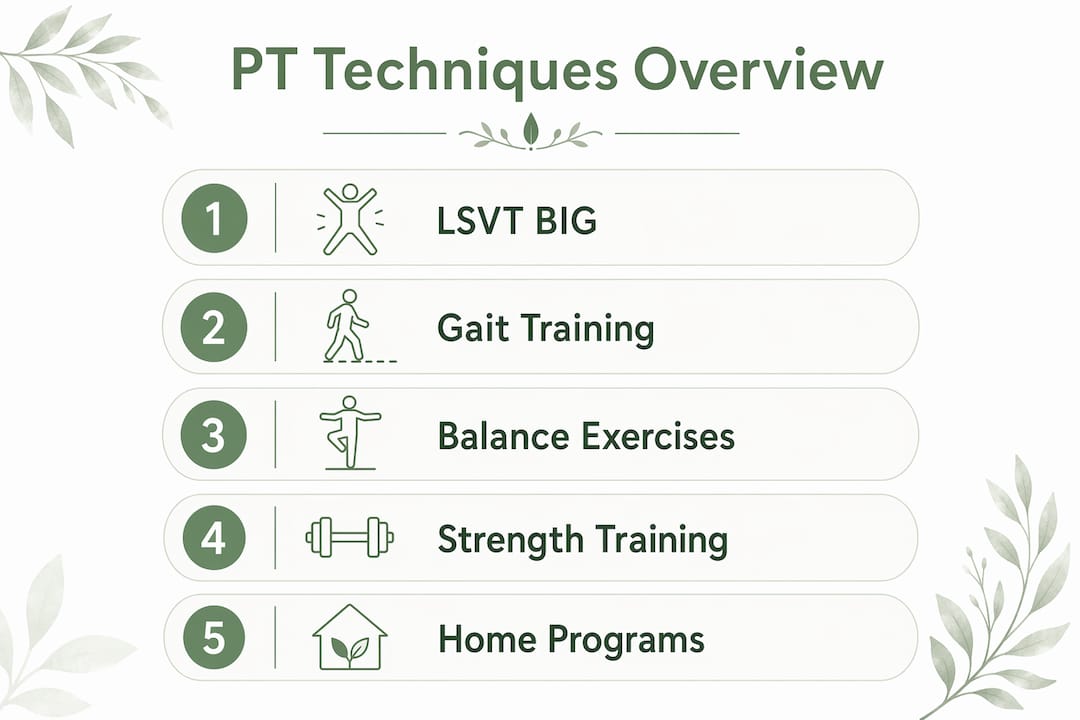
Gait and balance training is another cornerstone. Balance training two to three times weekly, including activities like tai chi and dance, directly reduces fall risk and maintains stability. These sessions often involve stepping over obstacles, walking on varied surfaces, and practicing weight shifts.

Resistance and strength training uses light weights, resistance bands, or pool-based exercises tailored to your disease stage. Muscle strengthening is vital because Parkinson’s accelerates muscle weakness beyond what normal aging causes.

Aerobic exercise at moderate intensity, such as brisk walking or stationary cycling, is recommended 3–4 times per week to support cardiovascular fitness and motor symptom management.
Flexibility and stretching address the muscle tightness and rigidity that make daily tasks harder. Reciprocal movement patterns, like pedaling a recumbent bike, reinforce the alternating limb coordination that Parkinson’s tends to disrupt.
“Physical therapy is more than exercise. Professional assessment and continuous feedback ensure patients maximize benefits without injury risks.” — Boston University neurorehabilitation experts, as cited by Stanford Medicine
How physical therapy benefits people with Parkinson’s disease
The benefits of PT for Parkinson’s go well beyond simply “staying active.” Clinical evidence supports a range of measurable improvements:
Reduced motor symptom severity through aerobic and resistance training, as supported by APTA clinical guidelines
Improved balance and gait, directly lowering the risk of falls, which are a leading cause of injury in Parkinson’s
Greater independence in daily tasks like dressing, cooking, and getting up from a chair
Better posture and reduced pain from muscle rigidity
Improved mental health, since regular structured exercise is linked to reduced depression and anxiety
Prolonged delay of disability progression, giving you more functional years
One often-overlooked benefit is timing. Exercise done when medications are at peak effectiveness produces greater mobility gains than exercise done when symptoms are poorly controlled. Coordinating your PT sessions around your medication schedule is a practical strategy your therapist can help you plan.
When should you seek physical therapy for Parkinson’s?
The short answer: as early as possible. Early initiation of PT at diagnosis allows a therapist to establish a baseline, identify subtle impairments before they worsen, and design a long-term maintenance plan. Waiting until symptoms become obvious reduces PT’s potential to slow decline.
That said, there are specific signs that make starting or resuming PT especially urgent:
New balance problems or a recent fall
Changes in your walking pattern, such as shorter steps or freezing
Increased stiffness or difficulty turning in bed
Recovery after a hospitalization or surgery
A change in your medication regimen that affects movement
PT is also valuable at every stage of the disease, not just early on. Re-evaluations throughout disease progression allow your therapist to adjust goals and intensity as your needs change. Setting personalized movement goals with your therapist, such as walking a certain distance or climbing stairs safely, gives both of you a clear target to work toward.
On insurance: Medicare covers medically necessary PT with no annual dollar cap, following the repeal of the therapy cap under the Bipartisan Budget Act of 2018. You may still encounter a review threshold for combined PT and speech therapy above which your therapist must document medical necessity. Most private insurers, including Aetna, Cigna, and United Healthcare, also cover PT for Parkinson’s when prescribed by a physician.
How do you find a physical therapist specialized in Parkinson’s?
Not every physical therapist has training in neurological conditions, so it pays to look specifically for someone with relevant credentials and experience.
Ask your neurologist for a referral to a therapist with neurological specialization.
Look for therapists certified in LSVT BIG or with a Neurologic Certified Specialist (NCS) designation.
The Parkinson’s Foundation maintains resources to help you locate providers familiar with Parkinson’s care.
When you meet a potential therapist, ask directly: How many Parkinson’s patients do you currently treat? Are you familiar with LSVT BIG? How do you adjust programs as the disease progresses?
Confirm that the clinic accepts your insurance before your first visit.
Therapists with neurological expertise provide integrative, evidence-based care tailored to Parkinson’s progression, which produces meaningfully better outcomes than general PT. Local specialty clinics in Nassau County and Queens, like Contemporaryrehabservices in Albertson, NY, offer this level of focused neurological rehabilitation.
Expert guidance on PT for Parkinson’s from Contemporaryrehabservices
At Contemporaryrehabservices, the approach to Parkinson’s rehabilitation reflects what the clinical evidence actually supports, not a one-size-fits-all exercise routine.
Pro Tip: Schedule your PT sessions during the window when your Parkinson’s medications are working best. Movement quality is noticeably better during peak medication hours, and your therapist can help you identify that window.
Key principles the team at Contemporaryrehabservices follows:
Frequent, direct feedback during every session to correct movement patterns and prevent compensatory habits that could cause injury
Progressive intensity so that exercises become appropriately challenging as your strength and endurance improve
Consistent stretching, ideally in short bouts throughout the day rather than one long session, to address Parkinson’s muscle tightness more effectively
Safety first: PT should never cause persistent pain or breathlessness; mild muscle soreness is normal, but anything beyond that signals a need to adjust
Integration with your full care team, including your neurologist and, when relevant, occupational and speech therapists
Regular re-assessments to track progress and update your program as your condition evolves
The APTA’s clinical practice guidelines emphasize reducing care variation by selecting therapists with specialized Parkinson’s training, and that is exactly the standard Contemporaryrehabservices holds itself to.
How long and how often will you need PT?
Session frequency and duration depend on your disease stage, goals, and insurance coverage. A common starting point is two to three sessions per week for four to eight weeks, followed by a re-evaluation. Some people benefit from ongoing maintenance PT, while others transition to a supervised home program with periodic check-ins.
Individual sessions typically run around an hour. The first session is usually an evaluation, covering your movement history, current impairments, fall history, and goals. From there, your therapist builds a program specific to you. For chronic disease management like Parkinson’s, the goal is not a fixed endpoint but a sustainable, evolving plan.
How do therapists track your progress?
Therapists use standardized tools to measure where you started and how you are improving. Common assessments include the Timed Up and Go (TUG) test, the Berg Balance Scale, and the 6-Minute Walk Test. These give objective numbers, not just impressions, so both you and your therapist can see real change over time.
Your therapist may also track your self-reported confidence with balance, your fall frequency, and your ability to complete specific daily tasks. Progress notes are shared with your neurologist to keep your entire care team aligned.
Home exercise programs and caregiver involvement
What happens between sessions matters as much as the sessions themselves. Your therapist will design a home exercise program tailored to your current level, typically including stretching, balance exercises, and aerobic activity. Caregivers play a real role here: they can provide verbal cues, assist with safety during exercises, and help you stay consistent on days when motivation is low.
Simple strategies make a difference. Keeping a short stretching routine near your morning routine, using a stationary bike for aerobic exercise, or practicing heel-to-toe walking in a hallway are all realistic daily habits. Your therapist can show caregivers exactly how to assist without taking over, which preserves your independence while keeping you safe.
Potential risks and limitations of PT for Parkinson’s
PT is generally safe, but a few realities are worth knowing. Fatigue is the most common challenge, especially early in a new program. Overexertion can temporarily worsen symptoms, which is why therapy regimens must be continually adapted based on your feedback. Falls during therapy sessions are rare when a qualified therapist is present, but they are a risk if exercises are done unsupervised before you have the strength and balance to do them safely.
PT also has limits in what it can achieve. It does not slow the underlying neurological progression of Parkinson’s, and it works best as part of a broader care plan that includes medication management, occupational therapy, and speech therapy when needed. Expecting PT alone to manage all symptoms sets an unrealistic bar. Used as one part of a coordinated approach, though, it is among the most effective non-pharmacological tools available.
Contemporaryrehabservices: specialized Parkinson’s PT in Nassau County
If you or someone you care about is managing Parkinson’s disease in Queens or Nassau County, Contemporaryrehabservices offers the kind of focused, neurological PT that clinical guidelines recommend. Based in Albertson, NY, the clinic accepts Medicare, Aetna, Cigna, Emblem, and United Healthcare plans, so accessing specialized care does not have to mean navigating complex out-of-pocket costs.
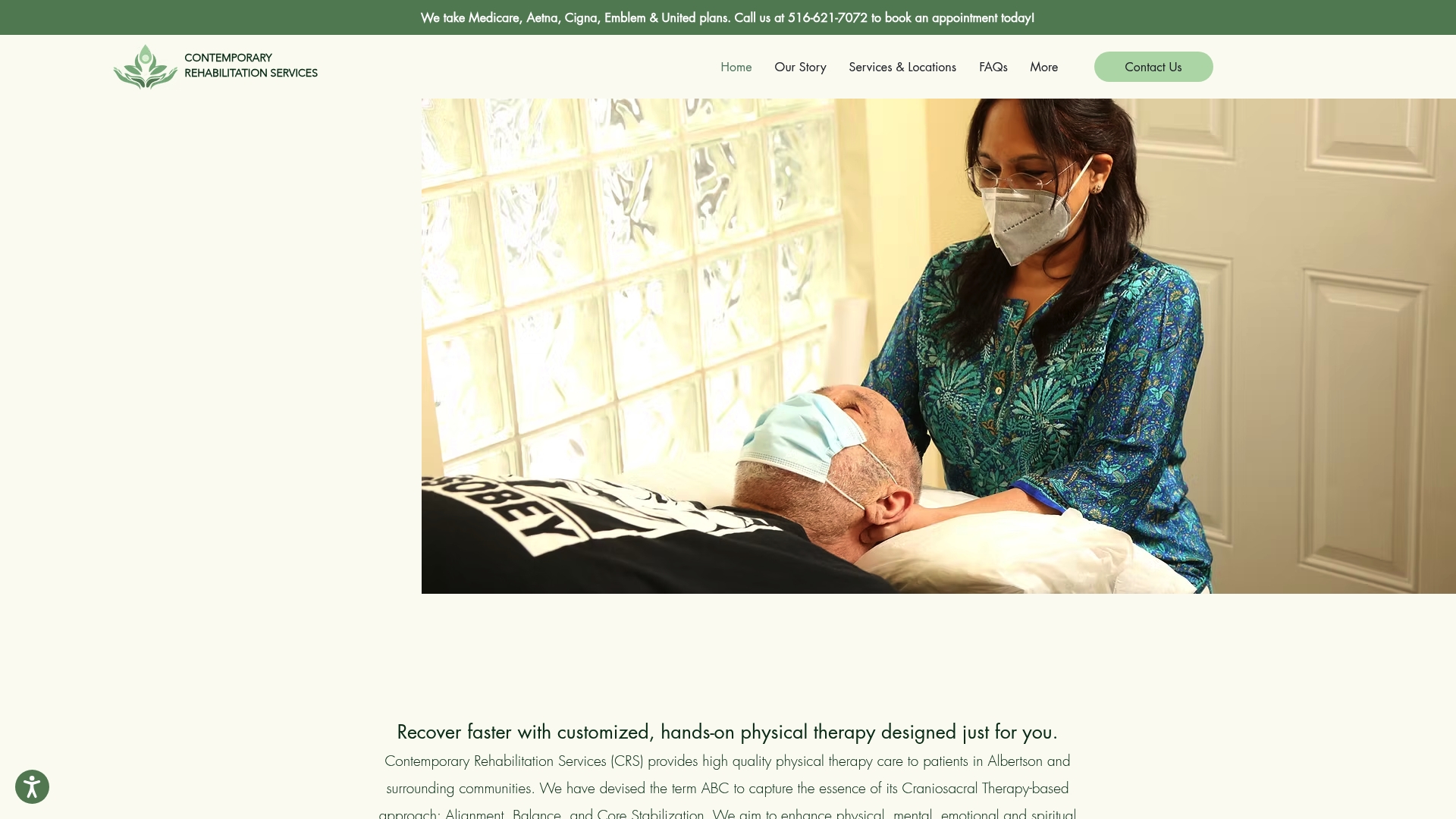
The team at Contemporaryrehabservices works directly with your neurologist to align therapy with your medication schedule, track measurable progress, and adjust your program as your needs change. Whether you are newly diagnosed and looking to establish a baseline or further along and managing specific mobility challenges, the clinic’s physical therapy services are designed to meet you where you are. Contact Contemporaryrehabservices to schedule an evaluation and take a concrete first step toward better movement and greater confidence.
Key Takeaways
Physical therapy for Parkinson’s disease works best when started early, tailored to disease stage, and integrated with medication timing and a full care team.
Point | Details |
Start PT early | Early intervention establishes a baseline and identifies impairments before they worsen. |
Coordinate with medication | Exercise during peak medication hours produces greater mobility gains. |
Use specialized techniques | LSVT BIG, balance training 2–3 times weekly, and aerobic exercise 3–4 times per week are evidence-backed approaches. |
Track progress objectively | Tools like the Timed Up and Go test and Berg Balance Scale give measurable data to guide program adjustments. |
Contemporaryrehabservices | Offers specialized Parkinson’s PT in Albertson, NY, accepting Medicare, Aetna, Cigna, Emblem, and United Healthcare. |
Recommended
Comments