
Ankle Fracture Physical Therapy: Stages, Timeline and What to Expect

Physical therapy after an ankle fracture starts once your surgeon confirms the bone has begun to heal and you are out of the cast or boot. It then moves in stages: swelling control and gentle motion, safe weight bearing, strength, balance, and finally a return to your normal activities. At Contemporary Rehab Services in Albertson, we work one-on-one with patients across Queens and Nassau County, and we accept Medicare, Aetna, Cigna, Emblem and United Healthcare, so you can start rehab with a plan built around your fracture and your goals.
This guide explains what each stage looks like, how long recovery usually takes, and what to ask your surgeon before your first session.
TL;DR
Formal rehab usually begins after your surgeon confirms healing on X-ray and clears you out of the cast or boot. Putting weight on the ankle too early can interfere with healing.
Rehab moves through phases: motion and swelling control, progressive weight bearing, strengthening, balance work, then return to activity.
Progress depends on milestones such as swelling control, heel raises and walking pattern, not just the calendar.
Some swelling can linger for up to two years, and diabetes can slow the timeline.
We offer in-person and telehealth physical therapy plus hands-on manual therapy from our Albertson clinic.
Table of Contents
When physical therapy starts after an ankle fracture
The timing is set by your surgeon, not by your physical therapist. Physical therapy begins after the fracture has started to heal and the walking boot or cast has been removed, because loading the ankle too early may prevent proper healing. Once an X-ray confirms healing, the doctor removes the cast and the physical therapist helps you safely progress to weight bearing, then works on strength, range of motion and balance.
In practice, the starting point varies with the type of injury:
Surgery with plates and screws (ORIF). One published surgical protocol keeps patients non-weight bearing in a splint for the first two weeks, with outpatient PT only after the surgeon clears it at roughly four weeks. Another orthopedic return-to-work protocol, published in December 2024, begins PT after six weeks of immobilization.
A fracture treated without surgery. A nonoperative protocol says weight bearing is usually allowed 4 to 6 weeks after injury, and PT starts 2 to 6 weeks after injury, focusing first on motion and swelling.
These are examples, not a schedule for you. Fixation quality, bone quality and how the fracture is healing all affect when you can put weight on the foot, and the surgeon’s X-ray decides. If you are not sure what your restrictions are, ask for them in writing before you book.
What to do before and between appointments
Before a suspected fracture has been examined, do not test it by walking on it. Get it assessed by a doctor or urgent care so you know whether it is broken and whether it is stable.
After a diagnosed fracture, follow your surgeon’s instructions on weight bearing and medication. One hospital’s postoperative instructions say to avoid all NSAIDs (anti-inflammatory pain relievers such as ibuprofen) for six weeks after a fracture, surgical or not, to minimize the risk of delayed bone healing. Ask your surgeon what pain medication is right for you.
Expect your leg to feel different when the cast comes off. MedlinePlus notes the muscles will be weaker and smaller and the foot stiff, and that you may be referred to a physical therapist. That is the normal starting point for rehab, not a setback.

The stages of ankle fracture rehab
Protocols differ slightly between surgeons, but they share the same logic. The phases below follow the published ORIF and nonoperative protocols; your own plan may move faster or slower.
Phase 1: protect the repair and control swelling (surgery to about 6 weeks)
In one hospital protocol, Phase 1 covers swelling control, a splint and then a walking boot, with gentle ankle up-and-down motion four times a day from weeks 2 to 6. Hip, quad, core and isometric ankle work (tightening muscles without moving the joint) keep the rest of the leg from losing strength. The same protocol says most patients are non-weight bearing for six to eight weeks, using crutches or a scooter.
This phase is mostly your surgeon’s territory. Elevation, protecting the incision and doing only the movements you have been cleared for matter more than any exercise.
Phase 2: regain motion and walk normally (about weeks 6 to 12)
Once you are out of the boot, which that protocol says usually happens at 7 to 8 weeks, the goals are full pain-free range of motion by about week 10 and a normal gait. Work typically includes:
Ankle mobility exercises in all directions.
Strengthening the muscles that stabilize the outside of the ankle, especially the peroneal tendons.
Weight shifting, split-stance loading and single-leg standing.
Balance practice on a wobble board.
Progressive weight bearing in a boot can be gradual. The nonoperative protocol above starts at 25% of body weight and adds 25% every one to two weeks until full.
This is also where hands-on work earns its place. A stiff joint, tight calf and scarred soft tissue limit how far you can move, no matter how many exercises you do. Joint mobilization, myofascial therapy and neural mobilization are among the manual techniques we offer for exactly these restrictions.
Phase 3: strength, balance and return to activity (about weeks 12 to 16 and beyond)
The later phase adds advanced strengthening, closed-chain work (where your foot stays planted, such as lunges and heel raises), balance on uneven surfaces, and, once motion is normal and you are cleared, jogging. Before sports, the hospital protocol calls for hop and key testing, and the nonoperative protocol allows return to sport once you can do a single heel rise or single-leg hop on the injured side, which may take six months to a year.
For a similar progression after a ligament injury, see our ankle sprain rehab plan. If your goal is returning to sport, our guide to physical therapy for athletes covers the performance side.
Milestones matter more than the calendar
Good rehab advances when you meet criteria, not when a date arrives. One surgeon’s protocol sets explicit gates: controlled swelling, bilateral standing heel raises, and full weight bearing in a boot before moving to an athletic shoe. The December 2024 protocol sets targets of 90% of the strength of the other leg and standing on one leg with eyes closed for 20 seconds.
That same protocol warns that increased swelling and pain can mean the bone is not fully healed, in which case weight bearing and therapy demands should be reduced. If your ankle gets more swollen or painful after a session, tell your therapist and your surgeon right away.
A simple way to track yourself between visits:
Can you stand on both toes at once for a heel raise on each side?
Is swelling the same or better at the end of the day than last week?
Is your walking pattern even, without a limp, for the full length of a block?
Can you balance on the injured leg for 20 seconds?
Your therapist uses these same questions in more detail to decide when to progress you.
How long recovery takes

Plan in months, not weeks. Bones take an average of 7 weeks to reach about 70% of normal strength, which is why full activity comes later than the day the boot comes off. Patient instructions from one hospital say it can take two to three weeks to feel comfortable in regular shoes and up to a year to reach a final result.
Two things are worth knowing in advance:
Swelling lasts longer than rehab. One protocol notes most patients have some ankle swelling for 24 months. That is common and does not mean rehab failed.
Other health conditions change the pace. The December 2024 protocol delays patients with diabetes by 2 to 4 weeks and progresses them very slowly. Tell your therapist about diabetes or any condition that affects healing.
Before returning to work or sports, MedlinePlus lists full calf strength and full ankle range of motion as the requirement. For the overall goals of rehab, a 2024 Cochrane review describes them as restoring mobility, reducing pain and improving participation in work, caring and leisure activities.
If you had bunion surgery instead
Bunion surgery rehab follows the same principle: your surgeon’s restrictions come first. One minimally invasive protocol allows weight bearing as tolerated in a stiff-soled postoperative shoe for the first two weeks, limited to daily essentials, with a toe alignment splint worn for three months. The same protocol allows a supportive athletic shoe at 4 to 6 weeks, low-impact activity at 6 weeks and running or jumping at 12 weeks, using pain as a guide. Your own timing depends on the procedure your surgeon performed, so bring those instructions to your first visit.
What a good ankle rehab plan includes
When you choose a physical therapist after a fracture, look for a plan that covers the whole chain, not just the ankle:
A review of your surgeon’s restrictions and a written progression tied to milestones.
Hands-on treatment for stiff joints, tight tissue and swelling.
Gait retraining, so you stop limping before the habit sets in.
Strength and balance work that matches what you need to do: climbing subway stairs, walking a long block, getting back on a court.
A home program you can do between visits.
Our exercise guides support that home program, and our broader article on how physical therapy speeds injury recovery explains why steady, supervised progression helps. If you are weighing how to pace yourself, step-by-step injury recovery gives the general framework.
Our perspective
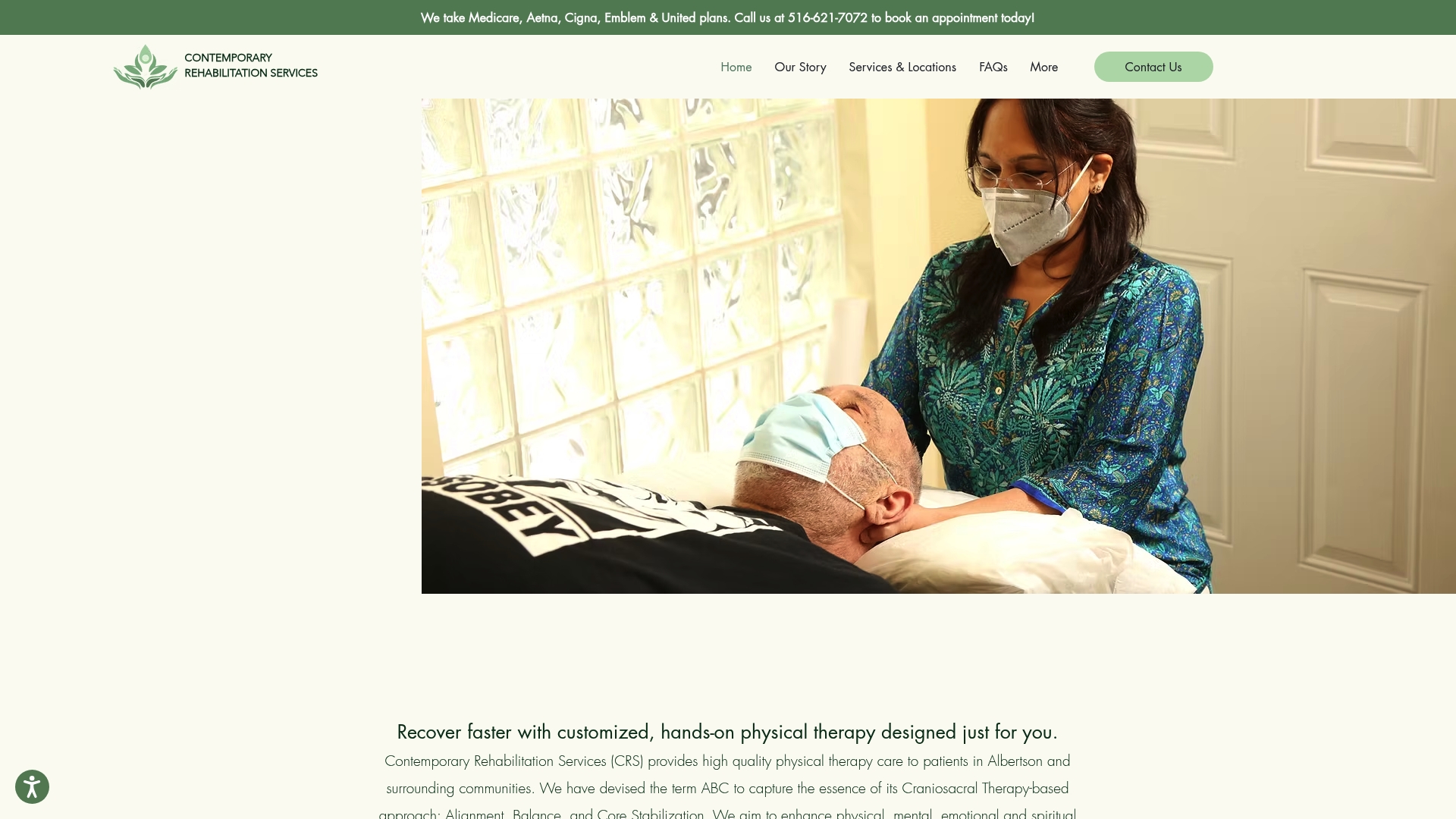
After a fracture, the cast comes off and many people are told to just start walking. What they find is a stiff, swollen ankle, a weak calf and a limp that is already becoming a habit. That is the moment hands-on, individualized care matters most. At Contemporary Rehab Services, you work one-on-one with a mother-daughter team. Sessions blend manual therapy, including joint mobilization, myofascial therapy and neuromuscular re-education, with a rehabilitation program built around your fracture, your surgeon’s restrictions and what you need to get back to. Our ABC Approach to rehabilitation keeps the plan individual rather than a standard sheet of exercises. We also treat the whole person. Craniosacral and visceral therapy are part of our toolkit when pain, tension or guarding spreads beyond the ankle. And if getting to Albertson is hard while you are still on crutches, telehealth sessions let us coach your exercises from home. Our goal is simple: a recovery that feels guided from the first visit to the day you stop thinking about your ankle. CRS Wellness
Start ankle rehab in Albertson, Queens or Nassau County
If your surgeon has cleared you for physical therapy, we can start with an evaluation, review your restrictions and build your phase-by-phase plan. We offer in-person and telehealth physical therapy as well as hands-on manual therapies such as joint mobilization, myofascial therapy and neuromuscular re-education. We accept Medicare, Aetna, Cigna, Emblem and United Healthcare, as well as cash payments.
We serve patients in Albertson and nearby communities including Mineola, Williston Park, Roslyn, Westbury and Carle Place, as well as Queens.
FAQ
Can you walk on a fractured ankle?
Some people can, which is why fractures get missed, but you should not. Get it examined first, and once it is diagnosed, follow your surgeon’s weight-bearing instructions. Early loading can interfere with healing, and many surgical protocols keep you non-weight bearing for six to eight weeks.
When can I start physical therapy after an ankle fracture?
When your surgeon clears you, usually after X-rays show healing and the cast or boot comes off. Depending on the injury and treatment, that is often somewhere between two and six weeks after injury or surgery. Your surgeon sets the date.
How long does ankle fracture rehab last?
Formal rehab commonly runs about 12 to 16 weeks, while returning to sport can take six months to a year. Some swelling may remain for up to two years. Diabetes and other conditions can slow the process.
Do I need to see a physical therapist, or can I just do exercises at home?
Your therapist guides which exercises are safe at each phase, adds hands-on treatment for stiffness and checks your walking pattern. Home exercises are part of the plan, and we give you a program to follow between visits. If you are unsure whether your ankle is ready for a step, ask us before you try it.
Does insurance cover physical therapy after a fracture?
We accept Medicare, Aetna, Cigna, Emblem and United Healthcare, plus cash payments. Call us with your plan details and we can tell you how to get started.
Sources
Broken Ankles: Diagnosis and Treatment, NewYork-Presbyterian
Rehabilitation for ankle fractures in adults, Cochrane review (PubMed)
Open reduction internal fixation ankle fracture rehab protocol
Ankle Fractures and Foot Fractures return-to-work protocol, December 2024
Post-surgical rehabilitation protocol for minimally invasive bunion surgery
Recommended
Comments