
Costochondritis Physical Therapy: What Treatment Involves

Costochondritis is inflammation of the cartilage that joins your ribs to your breastbone, and physical therapy is one of the treatment options that doctors list for it. A therapist looks at why your chest wall is irritated, eases the stiff joints and tight muscles around it, and gives you movements and breathing habits that keep the pain from coming back. At our clinic in Albertson, we see people from Queens and Nassau County for one-on-one, hands-on care, in person or by telehealth, and we accept Medicare, Aetna, Cigna, Emblem and United Healthcare.
One point comes before everything else: chest pain is never something to self-diagnose. Costochondritis is a diagnosis a doctor makes after ruling out the heart and lungs. Once that is done, physical therapy is a sensible next step.
TL;DR
Costochondritis causes sore, tender spots along the front of the rib cage, often worse with deep breaths, coughing or twisting. Get chest pain checked by a doctor first.
A published case series of eight patients who had pain for about six months reported that manual therapy plus home exercises over three to four weeks cut pain by an average of about five points on a 10-point scale.
Most cases settle within a few weeks, and physical therapy is especially useful when pain lingers or keeps returning.
Treatment is hands-on work plus a home program, and your pace of activity is adjusted to your symptoms rather than stopped completely.
We accept Medicare, Aetna, Cigna, Emblem and United Healthcare, and you can be seen in Albertson or by telehealth.
Table of Contents
What costochondritis is, in plain terms
Your ribs attach to the breastbone through strips of cartilage. Each attachment is a small joint that moves a little every time you breathe, reach or turn. When one or more of these joints become inflamed or irritated, pressing on the area hurts, and so can a deep breath, a cough, a sneeze or a stretch.
According to the American Academy of Family Physicians, costochondritis most commonly occurs in adults between 40 and 50 years of age, with a slight predominance in women. The same review says most people have complete resolution within a few weeks with conservative therapy.
Typical signs include:
Sharp, aching or pressure-like pain on the front of the chest, often on the left side
Tenderness when you press on the cartilage next to the breastbone
Pain that changes with breathing, position or arm movement
Pain that is worse after a coughing spell, a heavy lift, or a new workout
The cause is often unclear. Repeated strain, a bout of coughing, a change in training, long hours hunched over a desk or a minor chest impact can all play a part. That uncertainty is why a hands-on evaluation matters: the aim is to find what is loading your chest wall so it can be changed.
Rule out the serious causes first
Chest pain can come from the heart, lungs or other organs, and costochondritis can feel like them. Call 911 or go to an emergency room right away if your chest pain comes with pressure or squeezing, shortness of breath, pain spreading to the arm, jaw or back, sweating, dizziness, nausea, a fever, or if it begins after an injury. If you have chest pain and you do not know the cause, have your doctor evaluate it before you begin therapy.
We also expect your pain to behave like a mechanical problem. A published case report of a patient sent to physical therapy for costochondritis who was later diagnosed with lung cancer notes that a lack of sustained improvement over 30 days is a concern and that ongoing examination is necessary even when symptoms are improving. In practice, that means if your pain is not clearly improving after about a month, or if it is getting worse, you should go back to your physician.

Can physical therapy help costochondritis?
Physical therapy is among the treatment options the AFP review lists for costochondritis, alongside heat, anti-inflammatory medicines, lidocaine patches, capsaicin cream and acupuncture. The review also notes that a targeted stretching program directed by a physical therapist showed a small reduction in pain in patients whose symptoms had lasted more than a year.
The most detailed look at hands-on care comes from a peer-reviewed case series of eight people with costochondritis. Their symptoms had lasted an average of about six months. They were treated with manual therapy and a home exercise program, seeing a therapist about five times over three to four weeks. On average, their pain scores fell by about 5 points on the 0-to-10 numeric pain rating scale, their scores on a patient-reported function measure rose by about 5 points, and all returned to their previous activities without restrictions. It was a small case series, so it shows what is possible rather than what every person will get, but it describes the kind of care we think makes sense: treat the cause, pair each hands-on technique with something you can do at home, and expect measurable change within weeks.
So physical therapy tends to fit best in these situations:
Your doctor has ruled out a heart or lung cause and has diagnosed chest wall pain
The pain has lasted beyond a few weeks or keeps coming back
You feel stiffness in your upper back, ribs or shoulders alongside the chest soreness
Pain limits breathing deeply, sleeping, lifting, or exercising
You want to return to activity with a plan rather than guessing
What happens at a costochondritis evaluation
Your first visit is mostly about understanding you. Plan on about the time it takes to cover these areas.
Your history. We ask when the pain started, what triggers it, what eases it, and what you do all day: desk work, lifting, caring for children, sports, sleep position. We also ask what your doctor has already checked.
Posture and breathing. We watch how your ribs and upper back move when you breathe and reach. Many people with chest wall pain breathe high in the chest, or hold their shoulders rounded forward, which keeps the rib joints under steady load.
Hands-on assessment. We press along the rib cartilage to find the sore spots, and we test how freely the joints of your mid-back and ribs glide, and how the muscles of the chest, shoulder blade and neck respond.
Movement and strength. We look at shoulder mobility, upper-back extension and the way you lift or push, since a stiff thoracic spine (the middle section of your back where the ribs attach) can force the chest wall to do extra work.
In the case series above, the authors chose to treat the thoracic spine before the ribcage and to pair each manual technique with a home exercise so the benefit carried over between visits. We find that order sensible: calm the areas that feed the problem, then address the sore joints directly.
Because our sessions are one-on-one, the person who evaluates you is the person who treats you, and your plan is individualized rather than a standard sheet of exercises.
What treatment looks like
Treatment is built around what your evaluation finds. Our clinic offers several hands-on approaches that suit chest wall pain, and a typical plan mixes a few of them with your home program.
Manual therapy for the ribs and upper back
Manual therapy is skilled hands-on work to improve how joints and soft tissues move. For costochondritis, that can mean joint mobilization, gentle, graded movements applied to stiff joints in the mid-back and ribs, and myofascial therapy, which works on the fascia (the connective tissue wrapped around muscles) and tight muscles in the chest, shoulder and upper back. Sessions should be firm enough to be productive, never forceful on irritated cartilage.

Neuromuscular re-education and breathing
Neuromuscular re-education retrains how your muscles coordinate. For the chest wall, that often means teaching your ribs to expand evenly with each breath and teaching your shoulder blades and upper back to share the work of lifting and reaching, so the cartilage joints are not taking all the strain.
Craniosacral and visceral approaches
We also offer craniosacral therapy, a very light-touch technique, and visceral therapy, which uses gentle hands-on work for the tissues around the organs and their connections to the rib cage and diaphragm. Some of our patients find these calming when pain makes them guard their breathing. We decide whether to include them after your evaluation.
Your home program
Home work is what makes the gains last. Your program may include gentle chest and upper-back mobility, posture changes, breathing drills and a gradual return to strengthening. Because costochondritis is sensitive, the rule we give is simple: movements should leave you no worse after an hour or the next morning. If an exercise brings on sharp pain, stop and tell us at your next visit rather than pushing through. Stop at once, and get medical help, if exercise ever brings on dizziness, faintness, pressure in the chest or shortness of breath.
Heat, ice and relief between visits
The AFP review lists local heat as a treatment option. Many people find warmth eases the muscle guarding around sore ribs, and our guide on heat versus ice with 15 to 20 minute home protocols explains how to apply each safely. Ask your doctor about anti-inflammatory medicines, which depend on your health and other medications.
If your rib or back pain also comes with bone-density concerns, this guide to osteoporosis pain relief options covers conservative approaches to discuss with your doctor alongside therapy.
Should you keep exercising?
The usual answer is yes, in a modified way, once a doctor has cleared your chest pain. Complete rest tends to leave the chest wall stiffer, but heavy pushing, bench pressing, intense rowing and high-impact work can keep it irritated. During a flare:
Reduce the activity that provokes the pain rather than stopping all movement.
Keep walking and other easy movement that does not increase your symptoms.
Swap high-load chest and shoulder exercises for lighter versions, then build back gradually.
Avoid long stretches in a slumped posture, and change positions often during desk work.
Pay attention to sleep position: a pillow hugged to the chest or a slightly supported side-lying position can ease pressure for some people.
We help you set these limits with numbers. For instance, a runner might cut mileage in half and avoid arm swing that tugs on the chest, then increase by a small amount each week as pain allows.
How long does recovery take?
Most people improve quickly. The AFP review reports that a large observational study found 91% of patients with new-onset costochondritis had pain resolution after three weeks of rest and anti-inflammatory medicine, with recurrence of about 4% over two years. It also notes that stubborn cases may respond to corticosteroid injections, which are a medical decision for your physician.
That is why a good time to start physical therapy is when you have been cleared by your doctor and:
Pain is not clearly improving after the first few weeks
Flare-ups return whenever you resume lifting, training or long desk days
You have had symptoms for months, like the people in the case series above
You want guidance on getting back to activity safely
If you are unsure whether you are at that point, our article on signs you need physical therapy is a good checklist.
What to expect from a course of care
The case series above averaged about five visits over three to four weeks. Your own plan depends on how long you have had symptoms, how stiff your upper back and ribs are, and how demanding your work and activities are. We set goals together: sleeping through the night, breathing deeply without a catch, lifting your child or a grocery bag, returning to the gym.
You may feel a little sore after a session as tissues adjust. If so, our guide on pain after physical therapy explains what is normal and when to call us. For a broader look at how therapy fits into pain care, see the role of PT in pain management.
Costochondritis care in Albertson, Queens and Nassau County
Our clinic is a boutique practice in Albertson, serving Queens and Nassau County, and we also offer virtual sessions for people who cannot easily travel. Insurance matters when you may need several visits, so we accept Medicare, Aetna, Cigna, Emblem and United Healthcare, as well as cash payments. Call before your first visit to confirm how your specific plan applies.
Chest wall pain frightens people, and understandably so. Once your doctor has told you your heart and lungs are fine, the next question is usually, “Why does it still hurt, and what do I do?” We think the answer starts with your body as a whole, not just the sore spot under your finger. The ribs do not work alone. They move with the spine, the shoulders, the diaphragm and the way you breathe. That is why our sessions are one-on-one, with a mother-daughter team who bring years of experience and who blend manual therapy with an individualized rehabilitation plan. We use joint mobilization, myofascial therapy, neuromuscular re-education, and, where it suits the person, visceral and craniosacral therapy, because different people need different hands-on approaches. We also use our own ABC Approach to rehabilitation and our exercise guides, so that what happens in the clinic continues at home. The goal is that you leave with less pain, a clear plan and the confidence to move again. CRS Wellness
Our perspective
Ready to get your ribs moving comfortably again?
If your doctor has told you that you have costochondritis, or your chest wall pain is lingering after other causes have been ruled out, we can evaluate you in person in Albertson or through telehealth physical therapy. You can also see the hands-on therapies we offer, including craniosacral therapy, myofascial therapy and joint mobilization.
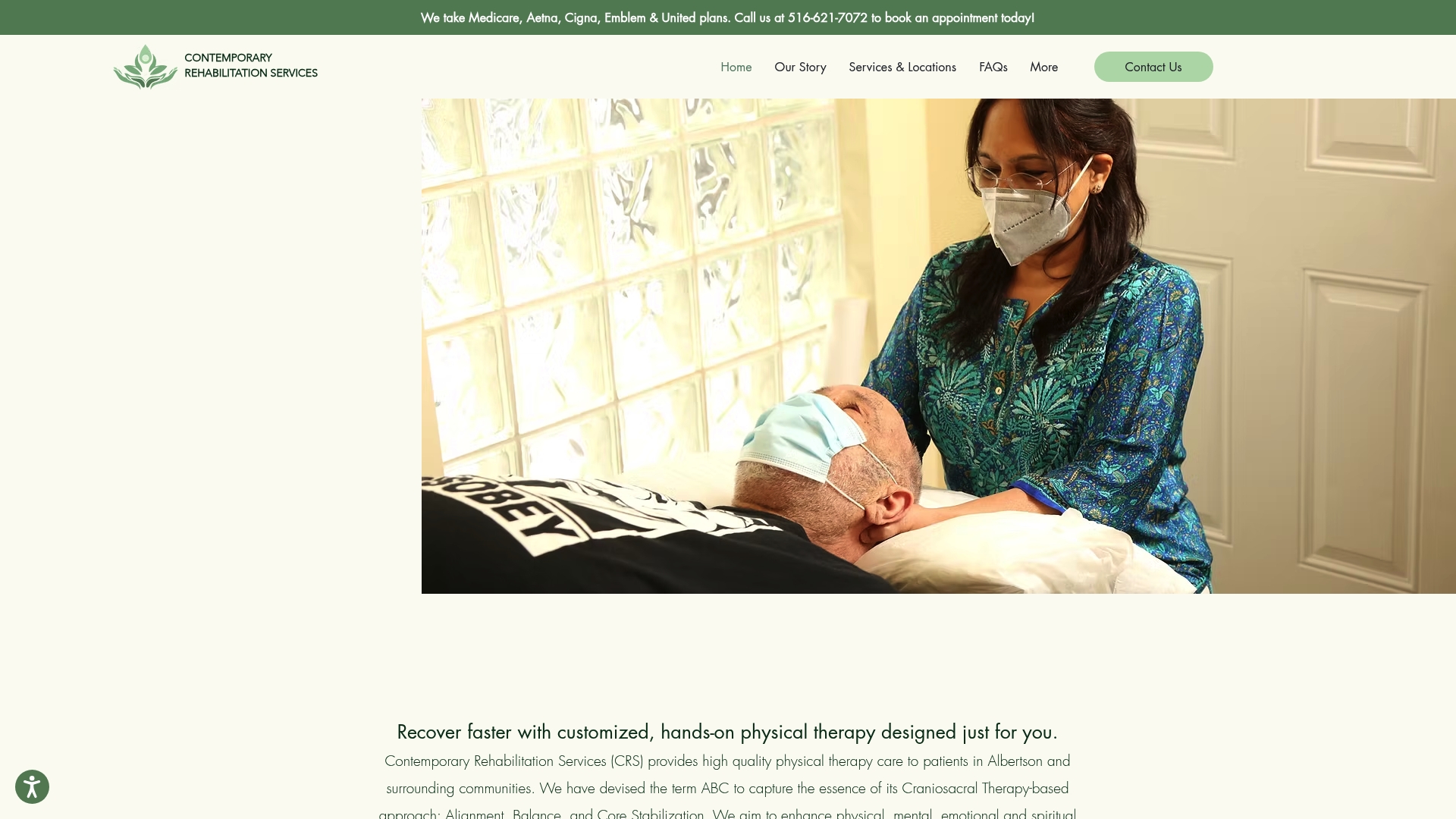
Bring a list of your symptoms, what your doctor has told you and the activities you want back, and we will build the plan from there.
FAQ
Should you exercise with costochondritis?
Usually, yes, in a modified form, after a doctor has ruled out other causes of chest pain. Keep easy movement going and cut back on activities that sharpen the pain, such as heavy pressing or high-impact training. Stop and seek care if exercise brings on dizziness, pressure in the chest or shortness of breath.
Does costochondritis ever fully heal?
For most people, yes. The AFP review reports that most patients have complete resolution within a few weeks, and a large study found about 4% recurrence over two years. Some people have symptoms that last longer, and those cases are a good reason to add physical therapy.
What triggers costochondritis flare-ups?
The cause is often unknown, but flare-ups commonly follow coughing, a new or heavier workout, repeated lifting or pushing, or long periods in a slouched posture. Your therapist can identify which of these loads your chest wall and help you adjust it.
How many physical therapy visits will I need?
It varies by person. In a published case series of eight patients, people were seen about five times over three to four weeks. We set your plan after your evaluation and review it as you improve.
Sources
Recommended
Comments