
Hip Joint Mobilization: What It Is and What to Expect

Hip joint mobilization is a hands-on physical therapy technique in which a therapist moves the hip joint in slow, controlled, graded ways to ease pain and restore motion. The best-known version is long-axis distraction, a gentle pull along the length of the leg that creates a little space in the joint. It works best when a therapist first works out why your hip is stiff, then matches the technique and the force to you. At Contemporary Rehab Services in Albertson, joint mobilization is part of our manual therapy services for patients across Nassau County and Queens, and we accept Medicare, Aetna, Cigna, Emblem and United Healthcare.
TL;DR
Hip joint mobilization is skilled, passive movement of the hip joint, applied by a therapist at varying speeds and amounts of force, to reduce pain and improve range of motion.
Long-axis distraction (a gentle traction pull down the length of the leg) is the technique people search for most. Research supports it for pain, motion and function, with force matched to the goal.
For hip osteoarthritis, manual therapy is typically paired with strengthening and stretching, usually 1 to 3 visits a week for up to 6 to 12 weeks, according to the 2025 clinical practice guideline.
A hands-on exam comes first, because hip pain can come from many structures and some health histories change how the hip should be treated.
You can book in-person or virtual care with us, and we bill the major insurance plans listed above.
Table of Contents
What hip joint mobilization actually is
Your hip is a ball-and-socket joint. The rounded top of the thigh bone (the femoral head) sits in a deep cup in the pelvis. A strong capsule of connective tissue surrounds it, and dozens of muscles cross it. When the capsule or surrounding tissue tightens, the ball can’t glide smoothly in the socket, and bending, rotating or even walking can feel stiff or sore.
The 2025 clinical practice guideline from the Academy of Orthopaedic Physical Therapy, published in the Journal of Orthopaedic & Sports Physical Therapy, defines joint mobilization as a range of skilled passive movements, both thrust and non-thrust, applied at varying speeds and amplitudes within or at the end of a joint’s range of motion. In plain terms: you relax, and your therapist moves the joint for you. A thrust technique is a small, quick movement. A non-thrust technique is slower and more rhythmic. Which one is used depends on how irritable your hip is that day.
Mobilization is different from stretching. In a stretch, you pull a muscle. In mobilization, the therapist works on the joint itself and the tissue around it, which is why it can reach stiffness that stretching alone does not.

Long-axis distraction: the technique behind the search
Long-axis distraction is the technique most people mean when they look this up. You lie on your back, your leg is supported, and the therapist gently pulls the leg along its length, away from the pelvis. A 2024 clinical examination paper explains that the leg is moved in a caudal direction, which separates the joint surfaces. That can widen the joint space and spread the load across the cartilage.
Researchers have offered a few explanations for why it helps. An orthopaedic manual therapy clinical pearl notes that authors have theorized that traction improves the stretch of the ligament and capsule tissue and stimulates the nerve endings that dampen pain.
Two details matter for you as a patient:
Position and direction are chosen on purpose. A physical therapy paper by Reiman and Matheson points out that, because of the shape of the hip, lying-down long-axis distraction is essentially an inferior glide, and that sideways (lateral) distraction may suit some people better for overall capsule mobility. They also note that gentle distraction in mid-range may calm pain, while distraction at the end of abduction or rotation may improve mobility.
Force is matched to the goal. The 2025 guideline authors suggest that higher forces for long-axis distraction may be better for increasing range of motion, while lower forces may be better suited to decreasing pain. A good therapist adjusts as your hip responds.
What the research says about results
A 2019 critically appraised topic in the Journal of Sport Rehabilitation found moderate evidence of favorable outcomes when hip mobilizations were used to improve hip range of motion and function. The evidence suggests mobilization can decrease pain while increasing motion and function, and that it outperformed traditional approaches such as stretching, exercise or heat alone in the studies reviewed.
A 2022 systematic review of 10 studies and 768 participants looked at how much manual therapy is used and what it achieved. Here is what it found:
Large effects were seen with long-axis distraction, mobilization and thrust manipulation. Mobilization with movement showed large effects for pain and range of motion.
The most common dosing was 10 to 30 minutes per session, 2 to 3 times a week, for 2 to 6 weeks.
Long-axis thrust techniques had moderate-certainty evidence for large pain reductions that were still present at 3 months and 1 year.
The 2025 guideline synthesis adds that four studies support long-axis distraction for increasing motion, decreasing pain and improving function over 1 to 12 weeks, and that no harms of manual therapy were reported.
These are research findings and group averages. Your own response depends on your hip, your history and what is driving your symptoms, which is why the first visit is an evaluation and not a technique.
Hip joint mobilization for osteoarthritis
Hip osteoarthritis is wear and thinning of the joint cartilage, and it is one of the most common reasons people in their 50s and beyond come in with hip stiffness and groin or thigh pain. If that is you, the key point is that mobilization is one tool inside a larger plan.
The 2025 guideline recommends manual therapy for hip OA at about 1 to 3 times per week for up to 6 to 12 weeks. It also says that as motion improves, stretching and strengthening should be added to build on and keep those gains in range of motion, flexibility and strength. Mobilization opens the door, and exercise keeps it open.

The American Academy of Orthopaedic Surgeons updated its hip osteoarthritis guideline in January 2024. Its moderate-strength recommendation says physical therapy can be considered for people with mild to moderate symptomatic hip OA to improve function and reduce pain. Its 2017 edition had gone further, stating that strong evidence supported physical therapy for improving function and reducing pain in mild to moderate hip OA.
For a fuller picture of how a hip OA plan is built week to week, see our guide to hip osteoarthritis physical therapy.
Why your therapist examines you first
Hip pain is not always a hip joint problem. The 2019 appraisal notes that more than 45 muscles attach around the hip, so the true source of pain or limited motion can be easily misjudged. Pain you feel in the groin, buttock, outer hip or thigh could come from the joint, a tendon, a bursa, the lower back or the pelvis.
The 2025 guideline says clinicians may adjust their technique and force according to your bony hip shape and how irritable your tissues are. Two people with the same diagnosis can need very different handling.
A hands-on evaluation typically looks at:
Which movements are limited, and whether the limit is a hard stop or a pain-guarded stop
Whether a specific movement, repeated or assisted, reduces your symptoms and improves motion
How your hip moves compared with the other side
How your back, pelvis and knee are contributing
Your history, medications and goals
Tell your therapist about any of the following, because they change how the hip should be handled: a past fracture, recent surgery, blood thinners (anticoagulant medication), symptoms that are getting worse, unusually loose joints, or a systemic illness. Reiman and Matheson list these as contraindications or cautions for hip mobilization work. If you have sudden severe hip pain after a fall, cannot put weight on the leg, or have fever with a hot swollen joint, see a physician or go to urgent care before any therapy.
What a hip mobilization session can look like
Every plan is individual, but a typical visit follows a clear shape. Here is what you can expect from skilled manual therapy for the hip:
Conversation and movement check. You describe where it hurts, what you can’t do and what you want back, such as walking the neighborhood, climbing stairs or getting into the car.
Positioning. You lie comfortably, often face up, with your leg supported. Many techniques also use a belt to stabilize the pelvis.
Mobilization. The therapist applies slow, graded movement or traction. You should feel a stretch or a pulling sensation, not sharp pain. Speak up if anything is uncomfortable, because force is adjusted to you.
Retest. Your motion and symptoms are rechecked so you and your therapist can see what changed.
Exercise. Strengthening and movement work follows, because the gains hold better when the muscles around the hip can use the new motion.
As a rough reference, the research above used sessions in the 10 to 30 minute range for the manual work, two to three times a week, over several weeks. The right schedule for you depends on your evaluation.
Related hip problems that look similar
Not every stiff hip is arthritis. Outer hip pain that is worse lying on your side can be bursitis, and our hip bursitis physical therapy plan explains how that differs. If your pain is broader, our hip pain physical therapy guide covers the typical course. After surgery, the milestones in hip replacement physical therapy apply. For the bigger picture on why hands-on care helps, read about the benefits of manual therapy.
Hip mobilization with Contemporary Rehab Services
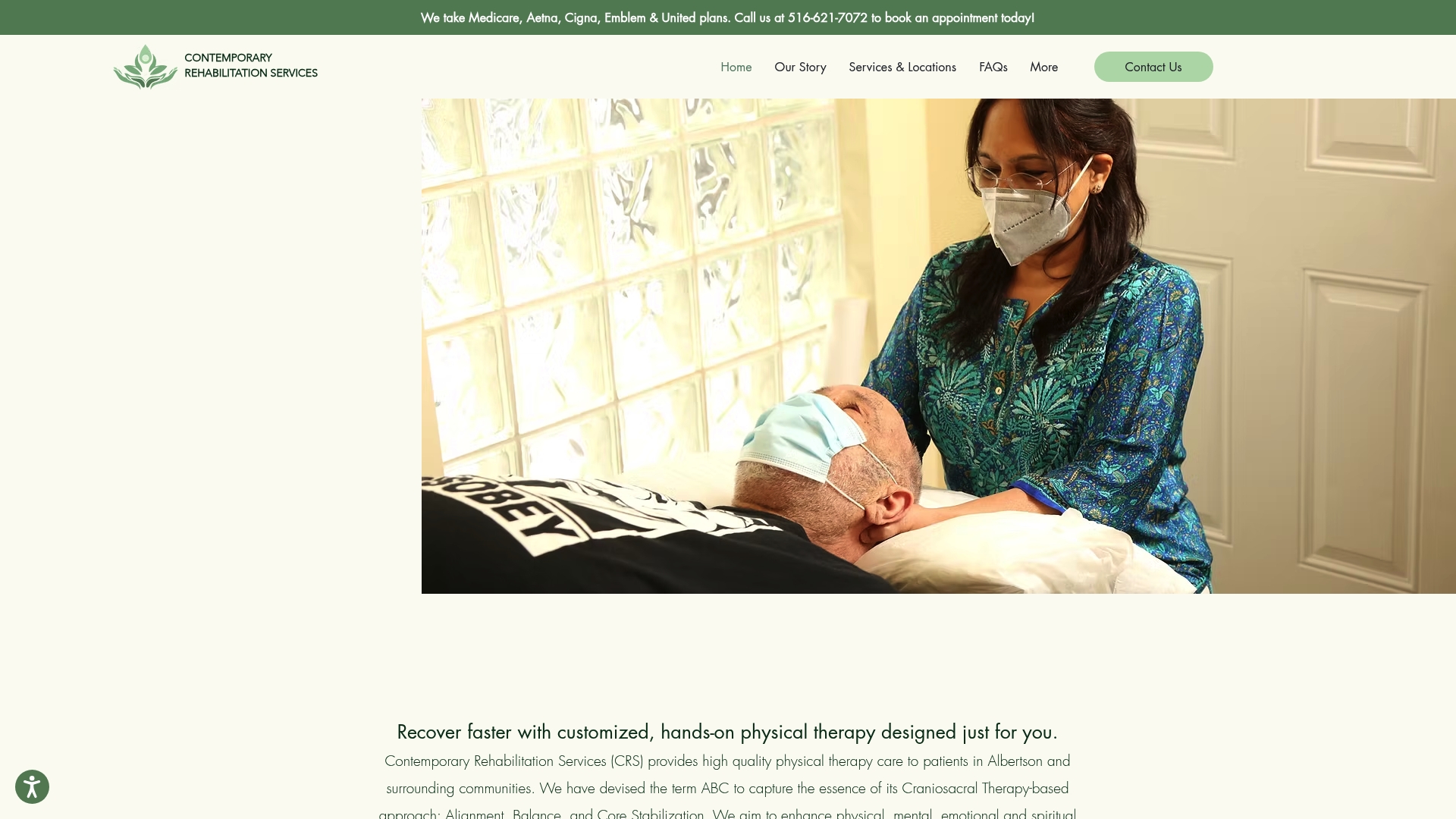
We are a boutique physical therapy clinic in Albertson, New York, serving Queens and Nassau County. Joint mobilization is one of the manual therapy services we offer, alongside myofascial therapy, neural mobilization, visceral therapy, neuromuscular re-education and craniosacral therapy. Sessions are one-on-one with our mother-daughter team, and we offer both in-person and virtual physical therapy. We accept Medicare, Aetna, Cigna, Emblem and United Healthcare, and we also take cash payments.
If your hip is stiff, sore or slowing you down, see our services or book a physical therapy visit.
Prices are not published on our site, so contact the clinic to confirm your coverage and your cost before your first visit.
Our perspective
When someone comes to us with a hip that won’t move the way it used to, the question we ask first is why. A stiff hip can be the joint, the muscles around it, the lower back or a combination. Mobilization is a good answer when the joint is part of the story, and our hands-on approach lets us feel that difference instead of guessing. We build care around one-on-one time. Our mother-daughter team blends holistic and integrative manual therapy with individualized rehabilitation programs, so the hip is treated as part of a whole body. Joint mobilization sits next to myofascial therapy, neuromuscular re-education and the rest of our services, and we use them together when your evaluation calls for it. The goal is never just a looser hip in the treatment room. It is a hip that moves well when you are back on your feet in Albertson, Mineola, Roslyn or Queens, doing what you need to do. CRS Wellness
FAQ
Is hip joint mobilization painful?
It should not be. You may feel a stretch or pulling in the hip, and some people feel a little sore afterward, much like after exercise. Tell your therapist if anything is sharp or uncomfortable, because the force and position can be changed right away.
How many sessions will I need?
It depends on your evaluation. Studies on hip manual therapy commonly used 2 to 3 sessions a week for 2 to 6 weeks, and the 2025 guideline for hip osteoarthritis describes 1 to 3 times a week for up to 6 to 12 weeks. Your therapist will set a schedule around your goals and how your hip responds.
What is long-axis distraction for the hip?
It is a gentle traction technique. While you lie down, the therapist pulls the leg along its length so the ball of the hip glides slightly away from the socket. This can ease pain and improve motion, and the amount of force is chosen to suit your goal.
Can hip mobilization help hip arthritis?
It can be part of a plan. Guidelines place manual therapy alongside stretching and strengthening for hip osteoarthritis, and the 2024 AAOS guideline says physical therapy can be considered for mild to moderate symptoms. A hands-on evaluation shows whether mobilization fits your hip.
Does insurance cover hip physical therapy?
We accept Medicare, Aetna, Cigna, Emblem and United Healthcare, plus cash payments. Coverage depends on your specific plan, so contact our Albertson clinic and we can help you confirm it before you start.
Sources
A New Clinical Examination Algorithm to Prescribe Hip Mobility Exercises (PMC, 2024)
Reiman and Matheson, Restricted Hip Mobility: Clinical Suggestions (PMC, 2013)
The Effects of Hip Mobilizations on Patient Outcomes (Journal of Sport Rehabilitation, 2019)
The influence of manual therapy dosing on outcomes in hip osteoarthritis (PMC, 2022)
AAOS Updates Clinical Practice Guideline for the Management of Osteoarthritis of the Hip (2024)
AAOS, Management of Osteoarthritis of the Hip clinical practice guideline (2017)
Recommended
Comments