
Whiplash Physical Therapy: What Recovery Looks Like

Whiplash is a neck sprain or strain caused by a sudden back-and-forth movement of the head, most often in a car accident. Physical therapy is one of the best-supported ways to recover from it: a therapist assesses which tissues are hurting, restores motion early, and builds your neck strength back step by step. If you are dealing with neck strain after a collision in Queens or on Long Island, our one-on-one, hands-on approach at Contemporary Rehab Services in Albertson is built for exactly this kind of recovery.
TL;DR
Whiplash symptoms can start hours after a crash or the next day, so neck pain, stiffness or headache after an accident deserves a medical check.
Most neck sprains settle in four to six weeks, but some people have pain for months, and a therapist can help you avoid the slow path.
Current guidance favors early, gentle movement and active exercise over collars and long bed rest.
Hands-on care such as joint mobilization, myofascial therapy and craniosacral therapy can sit alongside exercise in a plan built for you.
Seek urgent care first for severe pain, arm or leg weakness, balance problems, or bowel or bladder changes.
Table of Contents
What whiplash actually is
The neck is a stack of small bones, discs, ligaments and muscles that holds up a head weighing roughly as much as a bowling ball. When a collision whips the head forward and back, the soft tissues stretch past their normal range. The result is a sprain (a stretched ligament) or a strain (a stretched muscle or tendon), and often both.
You do not need a dramatic crash. Low-speed rear-end impacts in stop-and-go traffic on the Long Island Expressway, the Northern State or the Belt Parkway can be enough to irritate the neck. Many patients describe it simply as “neck strain after a car accident” and are surprised how much it affects sleep, driving and work.
Symptoms and when they show up
According to Mayo Clinic, whiplash symptoms may include:
Neck pain and stiffness
Pain that gets worse when you move your neck
Reduced range of motion
Headache
Pain in the shoulders, upper back or arms
Tingling or numbness in the arms
Tiredness and dizziness
Some people also notice blurred vision, ringing in the ears, trouble sleeping, irritability, trouble concentrating or memory problems.
Timing matters because the pain often is not immediate. Mayo Clinic says symptoms most often begin within days, and the American Academy of Orthopaedic Surgeons (AAOS) says neck-sprain symptoms may start hours after the injury or the next day, with pain sometimes peaking a day or so after the injury. If you felt fine at the scene and woke up stiff the next morning, that is a common pattern, not a sign you are overreacting.
Get checked first: warning signs
A neck injury after a collision should be evaluated by a physician to rule out broken bones or other damage. Mayo Clinic Health System advises seeking immediate care for severe pain, weakness in the arms or legs, balance problems, or bowel or bladder changes.
AAOS also lists constant or persistent pain, severe pain not relieved by over-the-counter medicine, pain that radiates into the arms or legs, and headache combined with numbness, tingling or weakness in a limb as signs that need prompt medical attention. Go to an emergency room or call 911 for those. Once serious injury is ruled out, physical therapy is the next step.
Can whiplash get worse over time?
The pain itself can build over the first day or two, which is why many people feel worse on day two than at the scene. Over the following weeks, the bigger risk is not the injury worsening but the neck stiffening up, muscles guarding, and daily habits shifting around the pain. That is where a therapist makes a difference: restoring normal motion before those patterns settle in.
How physical therapy helps whiplash
A review in the Mayo Clinic professional update on whiplash-associated disorders describes active physical therapy programs that may reduce pain and disability. They include:
Range-of-motion work to get the neck turning and bending again
Cervical strengthening and endurance training
Coordination training, so the deep neck muscles control movement smoothly
Functional training for the tasks you do at work and at home
The same update says early physical activity and good posture beat rest and cervical collars, and reports strong evidence that immobilization does not work for acute whiplash-associated disorders. Mayo Clinic’s treatment guidance agrees that a day or two of rest may help but too much bed rest can slow healing.
A 2016 clinical practice guideline, published in a peer-reviewed journal and indexed by PubMed, suggests multimodal care, manipulation or mobilization, and range-of-motion home exercise for recent-onset mild to moderate neck disorders. For more significant cases it suggests supervised graded strengthening and, for grade-III whiplash-associated disorders, multimodal care. In plain terms: a mix of hands-on treatment and exercise, matched to how severe your injury is.
The Journal of Orthopaedic & Sports Physical Therapy reported in 2017 that for neck pain after motor-vehicle collisions, education and an early return to normal, non-painful activity support recovery, while manual therapy and exercise can help control pain and improve function.
What a whiplash plan looks like at the clinic
Every neck is different, so a whiplash plan starts with an assessment: how far you can turn, where it hurts, whether pain travels into the arm, how your shoulder blades and upper back are moving, and what you need to get back to (driving, desk work, lifting a child). From there, a plan commonly combines several pieces.

Hands-on manual therapy
Manual therapy means the therapist uses their hands to ease stiff joints and tight tissue. At Contemporary Rehab Services this can include joint mobilization, gentle, controlled movements that restore motion to stiff joints, and myofascial therapy, which works on the connective tissue (fascia) wrapped around muscles. Our article on myofascial release for neck pain explains what it feels like and who it helps, and the benefits of manual therapy covers how it fits with movement work.
When whiplash pain travels into the arm, neural mobilization, gentle movements that help irritated nerves glide more freely, may be part of the plan. We also offer neuromuscular re-education, which retrains the muscles to fire in the right order so the neck is supported during everyday movement.
Craniosacral therapy
Craniosacral therapy is a very light-touch hands-on approach applied to the head, spine and pelvis. Many whiplash patients carry tension in the base of the skull and upper neck, and headaches are a common whiplash symptom, so patients often ask about it.

A 2019 systematic review and meta-analysis of 10 randomized trials with 681 chronic-pain patients found craniosacral therapy produced greater improvements in pain and disability than usual care, sham treatment or active manual treatment in several comparisons, including at six months against sham. The same review looked at safety across five trials and found no serious adverse events. Minor reactions such as temporary soreness, headache, tiredness, drowsiness or emotional responses were reported, and they were spread similarly across groups. If you feel tired or tender after a session, that is worth mentioning to your therapist so the next session can be adjusted.
For more detail, read our write-up of the craniosacral therapy trial results for neck pain.
Exercise you can do at home
Mayo Clinic lists gentle home exercises that may be prescribed after a clinical assessment: turning the neck side to side, tilting the ear toward the shoulder, bending the chin toward the chest, and rolling the shoulders. A warm shower or moist heat beforehand can make them easier. Heat or cold for about 15 minutes every three hours may also give relief.
The key word is “after assessment.” The right dose, number of repetitions and progression depend on your injury, and doing too much too soon is a common reason for flare-ups. Your therapist sets that dose and adjusts it at each visit.
Sleep and daily positions
Sleep is often the first thing whiplash disrupts. How you support your head overnight matters, and this guide to sleeping posture for neck pain is a practical place to start. At sessions we also go through your car seat setup, your desk and how you lift, because those daily positions load the neck for hours.
Whiplash recovery timeline
How long does whiplash take to heal? The published numbers vary because injuries vary.
Source | What it says |
Most neck-sprain symptoms resolve in four to six weeks; severe injuries may take longer | |
Most people feel better within a few weeks, but some have pain for months or years | |
Many symptoms resolve within three months; published estimates cite up to 50% with pain lasting months or years |
Mayo Clinic names three early signs that point toward ongoing pain: severe pain at the start, markedly restricted neck motion, and pain that radiates into the arms. If any of those describe you, starting physical therapy early is a sensible choice, because it is the stage where guided movement matters most.
A realistic way to think about it:
First days: protect the neck, keep moving gently, get medically cleared.
Weeks one to six: restore motion, calm muscle guarding, begin light strengthening. Most people notice steady gains here.
Beyond six weeks: progress to endurance and strength, and address lingering headaches, arm symptoms or sleep problems with a plan that targets them directly.
If you are past the six-week mark and still hurting, you are not failing. It means the plan needs to look at more than the neck, such as the upper back, shoulder blades, jaw and the nerves that run down the arm. Our guide to physical therapy for chronic neck and back pain covers that longer road.
Whiplash headaches and other lingering symptoms
Headaches that start at the base of the skull and creep over the head are a frequent whiplash complaint. They often come from the upper neck joints and muscles rather than the head itself. Our cervicogenic headache physical therapy guide lays out a phased clinic approach. If you also have dizziness, blurred vision or trouble concentrating, tell your therapist and your physician, because they help shape the plan and sometimes need a separate medical look.
A step-by-step path from crash to recovery
See a physician promptly to rule out fracture or other serious injury, especially if you have any of the warning signs above.
Rest briefly, then keep moving. A day or two of relief is fine. Avoid collars and long bed rest unless your physician specifically prescribes them.
Book a physical therapy evaluation while the injury is recent. Early assessment sets your starting point and your exercise dose.
Follow a progressive plan. Hands-on work reduces pain and stiffness so exercise becomes easier; exercise then builds the strength that protects you afterward.
Return to normal activity in stages: driving, work, the gym, lifting. Our step-by-step injury recovery guide explains how progress is staged. When a crash involves the back as well as the neck, the role of PT for spinal injuries is worth a read.
Our perspective
We treat whiplash as a whole-body problem that shows up in the neck. The collision loads the joints, muscles, fascia and nerves together, and a plan that treats only one of those tends to leave the others guarding. That is why our sessions are one-on-one with an experienced mother-daughter team, and why we blend manual therapy with rehabilitation exercise. Joint mobilization and myofascial therapy ease stiffness, neuromuscular re-education restores control, and craniosacral therapy offers a gentle option for the head and neck tension many patients carry after an accident. Our ABC Approach to rehabilitation keeps each plan individualized, and we publish exercise guides so your home program stays clear and consistent between visits. The best whiplash outcomes we aim for are simple: you move freely, sleep through the night and drive without dreading the next turn of your head. CRS Wellness
Physical therapy for whiplash in Albertson, Queens and Nassau County
Contemporary Rehab Services is a boutique physical therapy clinic in Albertson, NY, serving Queens and Nassau County. We accept Medicare, Aetna, Cigna, Emblem and United Healthcare plans, as well as cash payments. If getting to the clinic is hard while your neck is sore, we also offer telehealth physical therapy sessions, so your exercise program can start without a drive.
To book an evaluation, visit our physical therapy page or see the full list of hands-on and rehabilitation services, including craniosacral therapy, myofascial therapy and joint mobilization.
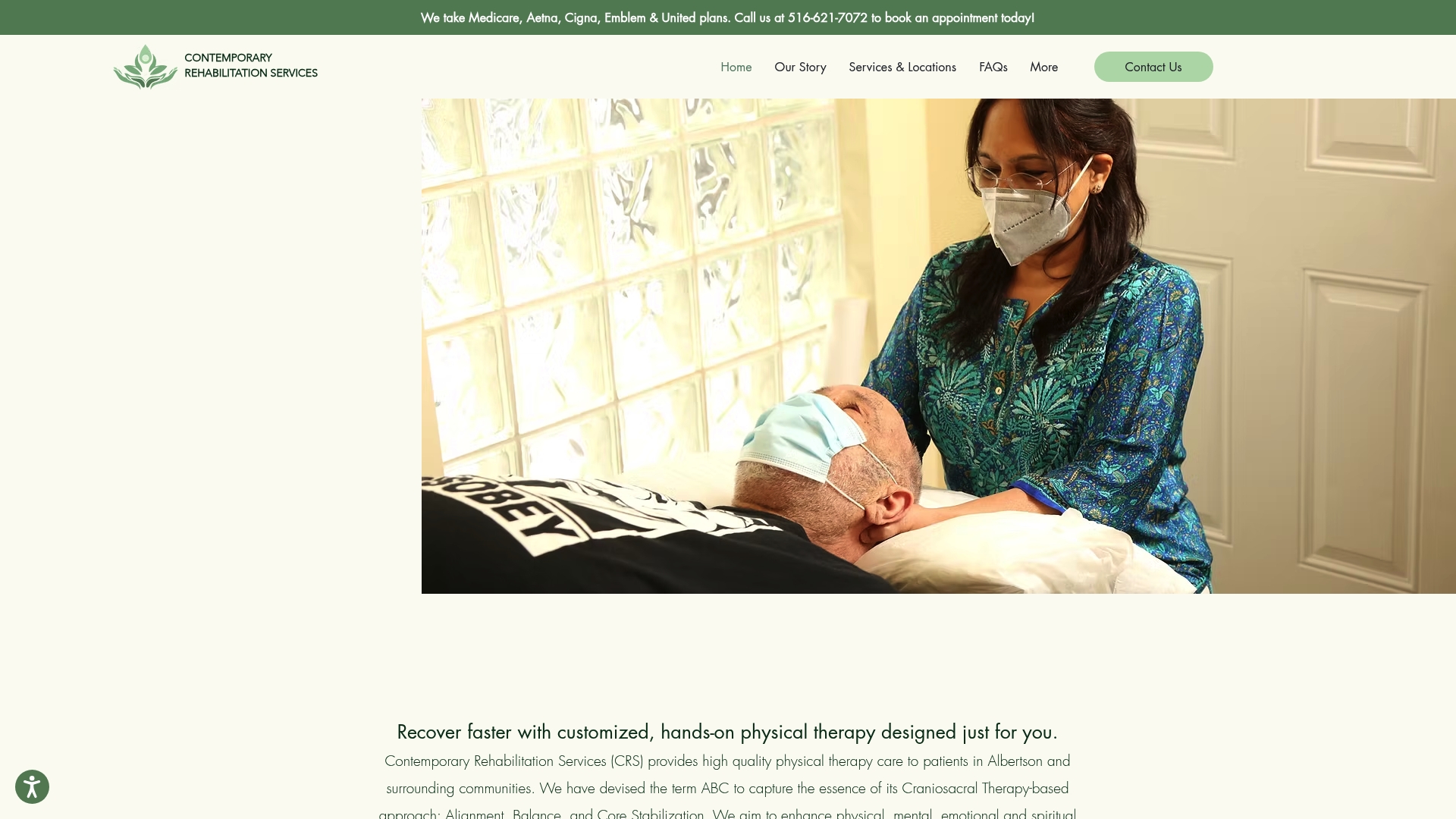
If you want a plan that is built around your neck and your daily life, our team is ready to start with a thorough evaluation.
FAQ
Is physical therapy good for whiplash?
Yes. Active physical therapy programs that include range-of-motion work, strengthening and coordination training may reduce pain and disability, according to the Mayo Clinic professional update cited above. Manual therapy and exercise are both supported for neck pain after collisions. A therapist also tailors the dose to your injury, which is hard to do on your own.
When should I start physical therapy after a car accident?
Once a physician has ruled out fracture or other serious injury, earlier is generally better, because current guidance favors early, gentle movement over rest. Many people begin within the first week or two. Your therapist will decide how much hands-on work and exercise suits your stage of healing.
Can craniosacral therapy help whiplash?
Craniosacral therapy is a gentle hands-on approach, and a 2019 review of 10 randomized trials in chronic-pain patients found greater improvements in pain and disability in several comparisons. We use it for patients who carry tension in the head and neck after an accident, alongside movement work. Your therapist can explain what a session involves.
What are the first signs of whiplash?
Neck pain and stiffness, headache, pain with movement, and shoulder or upper-back soreness are the most common, and they may not appear until the next day. Arm tingling, dizziness and trouble sleeping can also occur. Severe pain, weakness, balance problems or bowel and bladder changes need emergency care right away.
Sources
Recommended
Comments