
How to Communicate With Therapists Effectively
- tjdontplay
- 7 hours ago
- 8 min read

Effective communication with therapists is the process of expressing your thoughts, feelings, and needs clearly so your therapist can provide the right support. Most people enter therapy with the best intentions but struggle to put their inner experience into words. That gap between what you feel and what you say is where therapy either deepens or stalls. Learning how to communicate with therapists is not a soft skill. It is the core mechanism that drives real progress in treatment.
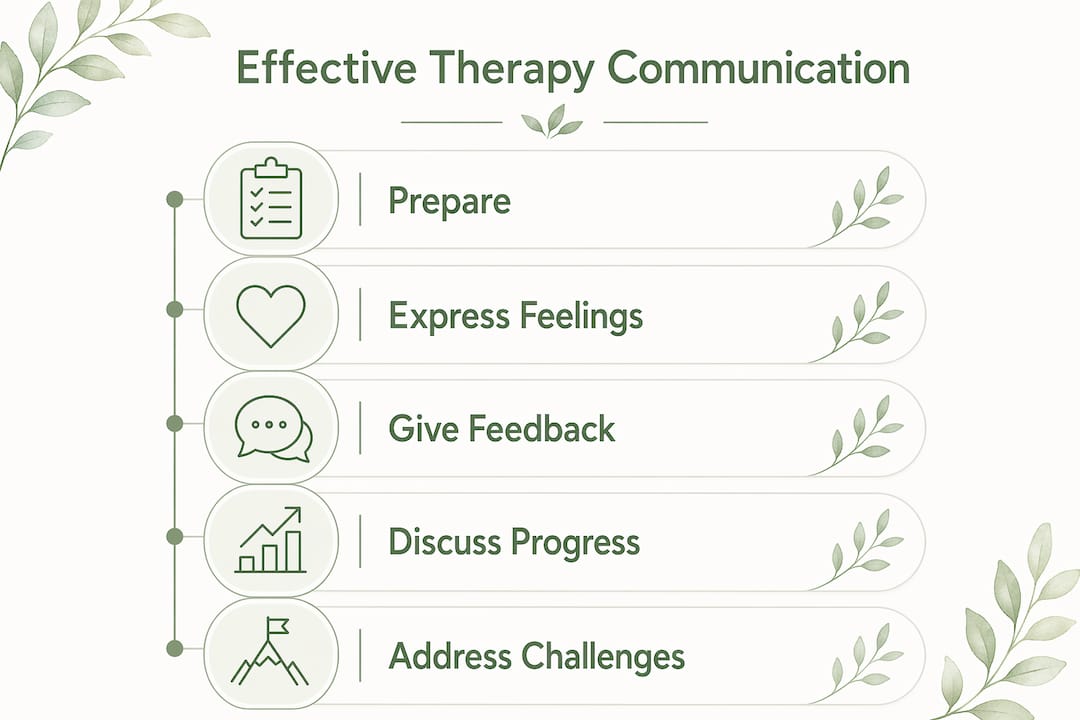
How to communicate with therapists: preparing for your first conversation
Starting therapy feels easier when you walk in with one clear sentence. Before your first session, write down a simple “why now” statement. Something like, “I sought therapy because my anxiety has been affecting my sleep for three months.” That one sentence prevents the blank-mind freeze that many people experience when they sit down and the therapist asks, “What brings you in?”
You do not need a formal agenda or clinical vocabulary. Concrete, plain language works better than polished explanations. Your therapist is trained to work with raw, unfiltered material. Trying to sound articulate often gets in the way of saying what is true.
A few practical steps to prepare:
Write down the main issue in one or two sentences before each session.
Note any specific moments from the past week that felt significant.
Bring notes to sessions to organize your thoughts and reduce the pressure to remember everything on the spot.
Identify one goal you want to work toward, even if it is vague at first.
If you feel stuck, start with, “I don’t know where to begin, but something feels off.”
Pro Tip: Write your “why now” sentence on your phone and read it in the waiting room. It resets your focus before you walk through the door.
Setting clear goals early shapes every conversation that follows. Therapists can adjust their approach much faster when they understand what you are working toward. You do not need to know the destination. You just need to point in a direction.
What are the best techniques to express feelings in therapy?
The most effective method for expressing emotions in therapy is the I-statement. Concrete I-feel statements like “I felt hurt after that argument” give your therapist specific, workable data. Vague narratives like “things have just been hard” leave both of you guessing.

Specificity is the difference between a productive session and a session that circles without landing. Instead of “I feel bad,” try “I feel a tight knot in my chest every Sunday night before the work week starts.” That level of detail tells your therapist where to look.
Talking about your feelings toward your therapist is equally valuable. Discussing emotional reactions to your therapist helps you understand the same patterns that show up in your relationships outside the room. If your therapist said something that annoyed you, saying so is not rude. It is the work.
“Communicating fears or apprehensions about a topic opens dialogue focused on trust and vulnerability, rather than avoidance. Talking about the barrier to a difficult topic often yields more clinical progress than forcing the topic prematurely.”
Some techniques that help you express needs clearly:
Replace “I don’t know” with “I haven’t figured out how to say this yet.”
Use body sensations as anchors: “I notice my shoulders tense when we talk about my father.”
If a topic feels too raw, say, “I want to talk about this, but I’m not ready yet.” That statement itself opens the door.
Ask your therapist to slow down or revisit a point if something lands hard.
Silence is also a form of communication. Silence in therapy carries meaning and is worth working through with your therapist rather than rushing past. A good therapist will sit with you in that silence and help you name what is underneath it.
Pro Tip: If you censor a thought because it feels “too weird” or “inappropriate,” say it anyway. Sharing uncomfortable thoughts is where real therapeutic work begins. Filtering yourself limits what therapy can do for you.
How do you give feedback and discuss progress with your therapist?
Reviewing your progress regularly keeps therapy on track. Standard practice calls for reviewing therapeutic goals every 6–8 weeks to confirm that treatment remains purposeful. If your therapist has not initiated that conversation, you can request it directly.
The best time to raise concerns or discuss progress is at the start of a session. Discussing progress early in the session gives both of you enough time to explore what is working and adjust what is not. Saving it for the last five minutes means the conversation gets cut off before it goes anywhere useful.
Here is a simple process for giving feedback:
Name what you have noticed: “I feel like we keep returning to the same topic without moving forward.”
Frame it as a question, not a complaint: “Is there a different way we could approach this?”
Observe how your therapist responds. A good therapist responds to feedback with curiosity, asks for more detail, and adjusts. A therapist who becomes defensive or dismissive is showing you something important about the fit.
Track your own symptoms between sessions. Journaling or using a simple mood log gives you concrete data to bring to the review.
Ask directly: “Do you think I’m making progress? What does that look like from your side?”
Feedback approach | What it signals |
“I feel stuck lately” | Opens a collaborative review of current methods |
“That technique hasn’t helped” | Invites the therapist to adjust or explain the rationale |
“I want to set a new goal” | Shifts focus and refreshes the treatment direction |
“I felt dismissed last session” | Tests the therapist’s responsiveness and emotional safety |
Clients who proactively track progress and ask about outcomes hold more influence over their own care. That is not a power struggle. It is informed participation in your own treatment.
Pro Tip: Before your 6–8 week check-in, write down three things that have changed since you started therapy. Positive or negative, that list gives you and your therapist a real starting point for the conversation.
What are common communication challenges in therapy?
Session anxiety is one of the most common barriers to open communication. Many people feel pressure to say the “right” thing or worry they are wasting the therapist’s time. That pressure is worth naming out loud. Saying “I feel anxious about what to say today” is a legitimate and productive way to start a session.
Fear of judgment stops many people from sharing the thoughts they most need to share. The therapeutic relationship is built on confidentiality and non-judgment, but knowing that intellectually does not always quiet the fear. Naming the fear directly, “I’m worried you’ll think less of me if I say this,” moves the conversation forward faster than staying silent.
Recognizing when communication has broken down is also part of the work. Watch for these signs:
You leave sessions feeling unheard or misunderstood consistently.
Your therapist justifies their approach instead of exploring your concern.
You find yourself editing what you say to avoid a certain reaction.
Topics you raise get redirected without acknowledgment.
You feel worse after most sessions with no sense of why.
“A therapist who handles honest feedback well thanks the client and asks for elaboration. A therapist who becomes defensive or dismissive is not responding to the client’s need. That pattern itself becomes important clinical information.”
Metacommunication is the most underused tool in therapy. Metacommunication means talking about how you are communicating, not just what you are communicating. Saying “I notice I keep changing the subject when we get close to this topic” is metacommunication. It gives your therapist a direct window into your process. For guidance on navigating feedback and collaboration in therapeutic relationships, the principles apply across many therapy settings.
Resistance toward your therapist is normal and worth discussing openly. Disliking a technique, feeling bored, or even feeling irritated with your therapist are all valid experiences. Bringing them into the room is how therapy deepens rather than plateaus.
Key Takeaways
Clear, specific communication with your therapist is the single most reliable way to improve your therapy outcomes and keep treatment moving in the right direction.
Point | Details |
Prepare before each session | Write a one-sentence “why now” statement to prevent blank-mind freeze at the start. |
Use concrete I-statements | Replace vague descriptions with specific feelings tied to real moments or body sensations. |
Review goals every 6–8 weeks | Request a progress check-in if your therapist has not initiated one within that window. |
Raise concerns early in sessions | Bring up feedback at the start, not the last few minutes, so there is time to explore it. |
Use metacommunication | Talk about how you are communicating, not just what you are saying, to deepen the work. |
What I’ve learned about honesty in the therapy room
Therapy moves at the speed of honesty. That is the clearest way I can put it. The clients who make the fastest progress are not the ones who come in with the most insight. They are the ones who say the uncomfortable thing out loud, even when their voice shakes.
Most people treat their therapist like a teacher they want to impress. They summarize their week neatly, use the right vocabulary, and avoid saying anything that might sound irrational. That approach protects the ego and stalls the work. The thought you are most tempted to censor is usually the one your therapist most needs to hear.
Raising a concern early in therapy is far more productive than waiting until you feel stuck. A therapist worth their training will not take feedback personally. They will get curious. If they do not, that reaction is itself a piece of information about whether the fit is right.
The therapeutic relationship is a two-way partnership. You are not a passive recipient of someone else’s expertise. You bring the raw material. Your therapist brings the tools. When both parties communicate openly, the results go deeper than either could reach alone. That partnership is worth maximizing your therapy benefits from the very first session.
— Tj
Therapy services built around your communication needs
Contemporaryrehabservices is a boutique physical therapy clinic in Albertson, NY, serving patients across Queens and Nassau County. The team works closely with each patient to build a treatment plan that reflects their specific goals and concerns, not a generic protocol.
Clear communication is built into every step of care at Contemporaryrehabservices. Whether you are starting therapy for the first time or looking to get more from an existing plan, the clinic’s personalized approach gives you the space to ask questions, raise concerns, and stay informed. Contemporaryrehabservices accepts Medicare, Aetna, Cigna, Emblem, and United Healthcare plans. Explore the full range of therapy options available and schedule a consultation to discuss your goals directly with a therapist who listens.
FAQ
How do I start talking to a therapist when I don’t know what to say?
Write one sentence before your session explaining why you sought therapy. If you still feel stuck, tell your therapist exactly that. “I don’t know where to start” is a perfectly valid opening.
How often should I discuss progress with my therapist?
Reviewing therapeutic goals every 6–8 weeks is standard practice. Request a check-in directly if your therapist has not raised it within that window.
Is it okay to tell my therapist I don’t like something they said?
Yes. Sharing that reaction is part of the therapeutic work. A skilled therapist will respond with curiosity and use your feedback to adjust their approach.
What are I-statements and why do they matter in therapy?
I-statements are phrases that describe your feelings tied to a specific experience, such as “I felt anxious after that conversation.” They give your therapist concrete, specific information to work with instead of vague summaries.
What should I do if I feel my therapist is not hearing me?
Raise it at the start of your next session using a collaborative question: “I felt like my concern wasn’t fully addressed last time. Can we revisit it?” If the pattern continues, it may be worth evaluating therapy results and considering whether the fit is right.
Recommended