
Save on Private Pay Physical Therapy: 2026 U.S. Costs, Episode Totals

Most private pay physical therapy sessions typically cost between moderate and higher price ranges per visit, with your first appointment usually costing more due to the full evaluation and treatment plan, because it includes a full evaluation and treatment plan. The two biggest swing factors are where you’re treated (in-clinic, in-home, or telehealth) and how long your session runs. Below, you’ll find the full breakdown by visit type, realistic totals for common treatment plans, and several ways to bring the number down.
TL;DR:
In-clinic, in-home, and telehealth sessions vary significantly in cost, with in-home visits being the most expensive and telehealth offering substantial savings.
Longer sessions in boutique clinics typically deliver more therapist attention, often resulting in fewer total visits and potentially lower overall costs.
Higher rates in specialized therapy services reflect advanced certifications, which can be justified for conditions requiring expert-level care.
Total treatment costs depend heavily on the number of visits needed, with minor injuries costing around $450 to $1,200 and post-surgical rehab reaching $1,500 to $4,500.
Patients can reduce out-of-pocket expenses by requesting upfront self-pay rates, using HSAs or FSAs, and combining telehealth with in-person sessions for efficiency.
Table of Contents
Private Pay Physical Therapy Cost Per Session: Evaluation vs Follow-Up
In-Home, Telehealth, and Specialized Therapy: How Setting Changes the Price
The Main Cost Drivers You Can’t Ignore When Shopping for Private Pay PT
How a Boutique Clinic Like CRS Wellness Prices Self-Pay Care
What the Industry Doesn’t Say Out Loud About Cash-Pay Pricing
Private Pay Physical Therapy Cost Per Session: Evaluation vs Follow-Up
Your first visit costs more than every visit after it, and that’s by design, not padding. An initial evaluation involves a physical assessment, a review of your medical history, movement testing, and the creation of a personalized treatment plan. That work takes longer and requires more clinical judgment than a standard follow-up, which is why cash-pay evaluations typically fall between $100 and $400 depending on your region and the complexity of your condition, according to industry pricing guides.
Follow-up visits are priced by session length and clinic model:
30-minute follow-up: roughly $60 to $100 at high-volume clinics
45-minute follow-up: roughly $90 to $150 at most private-pay practices
60-minute one-on-one session: roughly $125 to $250 at boutique or cash-based clinics
A quick benchmark: cash-based clinics generally book full 60-minute, one-on-one sessions, while high-volume insurance clinics often see two or three patients simultaneously in a 45-minute slot. That’s the core tradeoff behind the price gap. You’re not paying more for the same visit. You’re paying for a different visit structure entirely, one where the therapist’s attention doesn’t get split three ways in the same hour.
This matters more than it looks on paper. A $60 insurance-clinic visit that includes 12 minutes of actual hands-on time with your therapist may deliver less value per dollar than a $150 session where you get the therapist’s full attention start to finish. Ask directly how much one-on-one time is built into the session before you compare rates side by side.

In-Home, Telehealth, and Specialized Therapy: How Setting Changes the Price
Where you receive treatment shifts the price as much as how long the session runs.
In-home visits typically add a premium over standard clinic rates, reflecting travel time and reduced scheduling efficiency. A 60-minute in-home session is often priced noticeably higher than standard clinic visits, depending on your region and how far the therapist has to travel.
Telehealth visits run cheaper, often 30% to 50% less than in-person care according to cost analyses from 2026, making them a smart fit for exercise-led follow-ups, home program check-ins, and progress reviews that don’t require hands-on manual work. Telehealth isn’t right for every phase of recovery, but it’s underused as a way to stretch a treatment budget between in-person sessions.
Specialized services command higher rates because they demand advanced training:
Pelvic floor therapy sessions often run $150 to $275 per visit
Post-surgical manual therapy, including techniques like myofascial release or joint mobilization, often falls in the $125 to $250 range
Craniosacral therapy and visceral therapy sessions are frequently priced similarly to specialized manual therapy, given the additional certification involved
Many clinics also offer package pricing, bundling 5 or 10 visits at a modest per-session discount. Before you buy a package, ask what happens to unused visits if your treatment plan changes, and whether the discount actually beats booking individually.
The Main Cost Drivers You Can’t Ignore When Shopping for Private Pay PT
Four factors explain almost every price difference you’ll see between clinics.
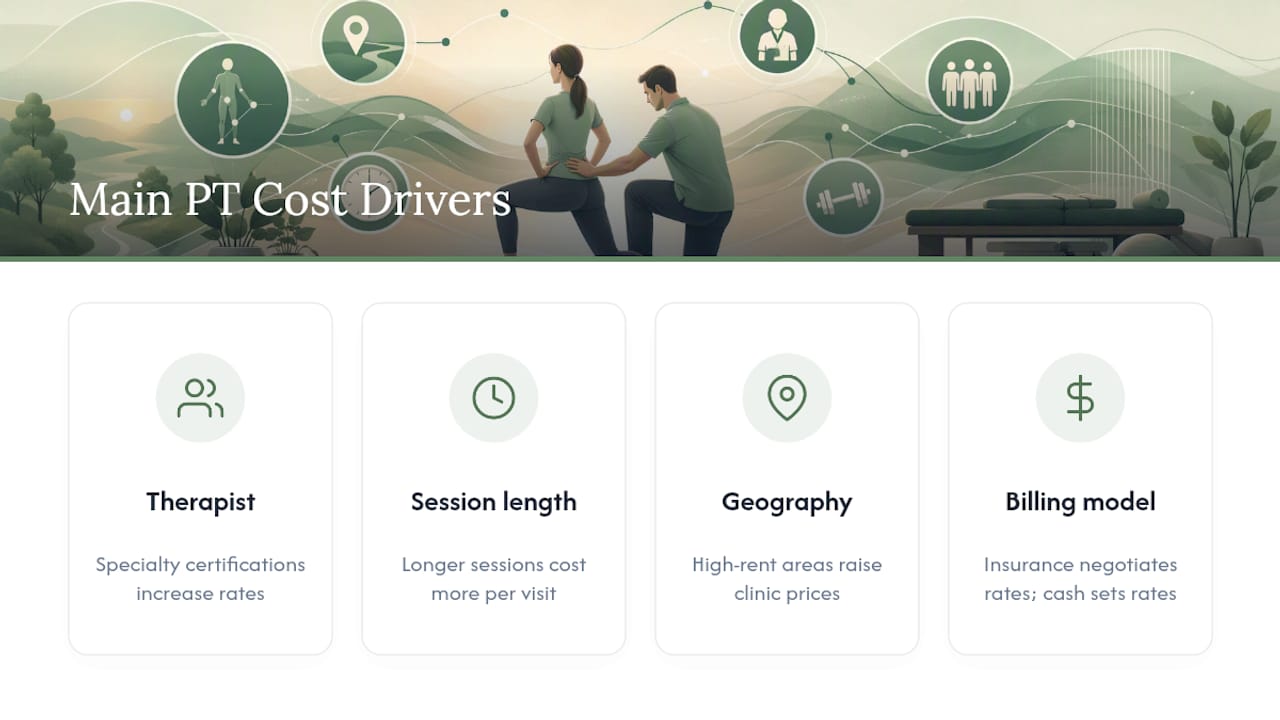
Therapist experience and credentials. A therapist with a specialty certification in orthopedics, sports medicine, or pelvic health typically charges more than a general outpatient therapist, and that premium usually reflects real additional training.
Session length. Longer sessions cost more per visit but often cost less per minute of actual therapist attention, which is the calculation that matters most.

Geography and overhead. Clinics in high-rent metro areas or affluent suburbs carry higher operating costs, and regional wage data from the Bureau of Labor Statistics shows clinician earnings vary meaningfully by state and metro area, which flows directly into what clinics charge.
Clinic billing model. Insurance-based clinics negotiate rates with payers and often need higher patient volume to stay profitable under those contracts. Cash-based clinics set their own rates and can offer longer, uninterrupted sessions without that volume pressure, a distinction detailed in this comparison of cash-based and insurance-based physical therapy.
Pro Tip: Ask any clinic for their self-pay rate sheet in writing before your first visit. A clinic confident in its pricing will hand it over without hesitation.
What a Full Treatment Plan Actually Costs
Per-visit pricing only tells half the story. What you actually spend depends on how many visits your condition requires.
Minor injury or acute strain (3 to 6 visits): Expect a total episode cost of roughly $450 to $1,200, factoring in one evaluation plus a handful of follow-ups.
Typical rehab plan, such as post-injury or chronic pain management (8 to 12 visits): Total costs commonly range from $900 to $2,800 depending on session length and setting.
Post-surgical rehabilitation (12 to 20 visits): Total costs often run $1,500 to $4,500, reflecting both the longer course and the higher rate typical of manual therapy techniques.
For a rough weekly estimate, two visits a week at $125 each puts you at roughly $250 a week, or $1,000 across a 4-week block. Cash-based clinics frequently report resolving cases in 8 to 12 visits total, compared with 18 to 24 visits often reported in higher-volume insurance settings, according to the same cash-based vs. insurance-based analysis. Fewer, more focused visits can offset a higher per-session rate over the full course of care. Your therapist should reassess progress every few visits and adjust the plan, which is often where total cost estimates shift up or down from the initial projection.
How to Lower Your Out-of-Pocket Physical Therapy Cost
You have more leverage over your final bill than most patients realize.
Ask for the self-pay rate up front, including any bundle or package discount, before you book your first visit.
Use an HSA or FSA debit card for sessions. This doesn’t lower the sticker price, but it pays for care with pre-tax dollars, which effectively reduces your real cost by whatever your tax bracket happens to be.
Request a superbill after each visit if you have out-of-network benefits. Reimbursement varies by plan, but patients commonly recoup 40% to 70% of the billed amount when insurers accept superbills, according to reporting on cash-pay physical therapy.
Mix in telehealth visits for exercise-focused follow-ups to cut per-visit cost without giving up hands-on care entirely.
Ask about payment plans if a longer post-surgical course puts real strain on your budget in any given month.
Pro Tip: Keep every superbill and dated receipt in one folder as you go. Submitting them in a batch at the end of your treatment plan is far less painful than chasing paperwork one visit at a time.
If Medicare covers part of your care, understanding your copay and deductible exposure before choosing self-pay for certain visits can prevent overpaying twice for the same treatment.
When Private Pay Physical Therapy Makes Financial Sense
Private pay isn’t the right call for everyone, but it’s a smart one for specific situations.
High-deductible health plan holders often pay close to the full cash rate anyway before insurance kicks in, so comparing the self-pay price directly against your deductible exposure, a factor KFF’s 2024 Employer Health Benefits Survey shows varies widely by plan, can reveal private pay is no more expensive.
Short-course conditions, like a minor strain expected to resolve in a handful of visits, often cost less overall in cash when insurance copays and administrative delays are factored in.
Patients who want dedicated one-on-one time with a therapist, rather than a rotating caseload model, tend to find private pay delivers more value per visit.
Before committing, call your prospective clinic and your insurer on the same day, and ask each to estimate your total cost for the same treatment plan. Comparing real numbers beats guessing every time. For a broader look at matching therapy type to your insurance situation, it’s worth reading before you make a final call.
How a Boutique Clinic Like CRS Wellness Prices Self-Pay Care
CRS Wellness treats patients across Queens and Nassau County, including Albertson, Searingtown, Roslyn Heights, and Williston Park, and structures self-pay pricing around full one-on-one sessions rather than overlapping caseloads. That model applies to manual therapy techniques including craniosacral therapy, myofascial release, joint mobilization, and visceral therapy, alongside standard rehabilitation programs.
Patients who prefer to bill insurance can use Medicare, Aetna, Cigna, Emblem, or United Healthcare, and CRS Wellness provides superbills for out-of-network reimbursement requests. Medicare beneficiaries should also understand what outpatient therapy coverage includes and how cost sharing applies to their specific plan before deciding between self-pay and insurance billing for any given visit.
Ready to Talk Pricing? Here’s What to Ask CRS Wellness
Getting a straight answer about cost shouldn’t require three phone calls and a spreadsheet. CRS Wellness offers both self-pay and insurance-based visits, and every self-pay patient can request a superbill for potential out-of-network reimbursement or pay directly through an HSA or FSA card.
Before you book, ask three questions: what the initial evaluation costs, what a standard follow-up visit runs, and whether package pricing is available if your treatment plan calls for multiple visits per week. A clinic that answers all three clearly, without vague ranges or hedging, is one worth trusting with your recovery. If you’re weighing your broader insurance costs alongside a self-pay decision, this guide to understanding Medicare costs from a benefits partner covers premiums and deductibles in plain terms.
If you’re in Albertson or the surrounding Nassau County area, you can book an evaluation with CRS Wellness and get a direct answer on your self-pay rate before your first visit, not after.
What the Industry Doesn’t Say Out Loud About Cash-Pay Pricing
Most guides to private pay physical therapy treat the per-session number as the whole story, and that’s the part worth pushing back on. The real comparison isn’t $75 against $150. It’s what happens inside that visit. A high-volume clinic billing insurance at a lower copay often needs to see two or three patients an hour to make the economics work, which means your “cheaper” visit may include ten minutes of hands-on therapist time surrounded by exercises you could do at home.
Boutique, cash-based care flips that math. A higher per-visit rate paying for forty-five uninterrupted minutes with a licensed therapist, rather than fifteen minutes split three ways, frequently resolves a condition in fewer total visits. That’s not a marketing claim. It’s a structural difference in how the two models allocate a clinician’s time, and it’s the single biggest reason cash-based clinics report shorter treatment courses despite charging more per session.
Where the conventional advice falls short is in treating self-pay as a last resort for the uninsured. For a patient with a high-deductible plan, a short-course injury, or a strong preference for consistent one-on-one care, private pay is often the more rational financial choice, not the more expensive one. The number that matters isn’t the sticker price. It’s the total cost to get you back to normal movement, and that number depends far more on session structure than on which column the payment comes from.
— CRS Wellness
This article is general information, not a substitute for advice from a qualified doctor. Consult a qualified healthcare professional about your own circumstances before acting on anything here.
Sources
Recommended
Comments