
Heal Shoulder Bursitis: Exercise First Physical Therapy, 6–12 Week Recovery

Physical therapy, supervised, exercise-centered rehab, is the first-line, evidence-backed treatment for shoulder bursitis. If pain lets you move your arm, start gentle pain-controlled range of motion right away. If it does not, call a physical therapist for an assessment before you push through it. A corticosteroid injection can serve as a short-term bridge to get you moving, but exercise is what actually resolves the problem.
TL;DR:
Physical therapy, focusing on active, phased exercises, is more effective for shoulder bursitis than passive treatments like massage or ultrasound.
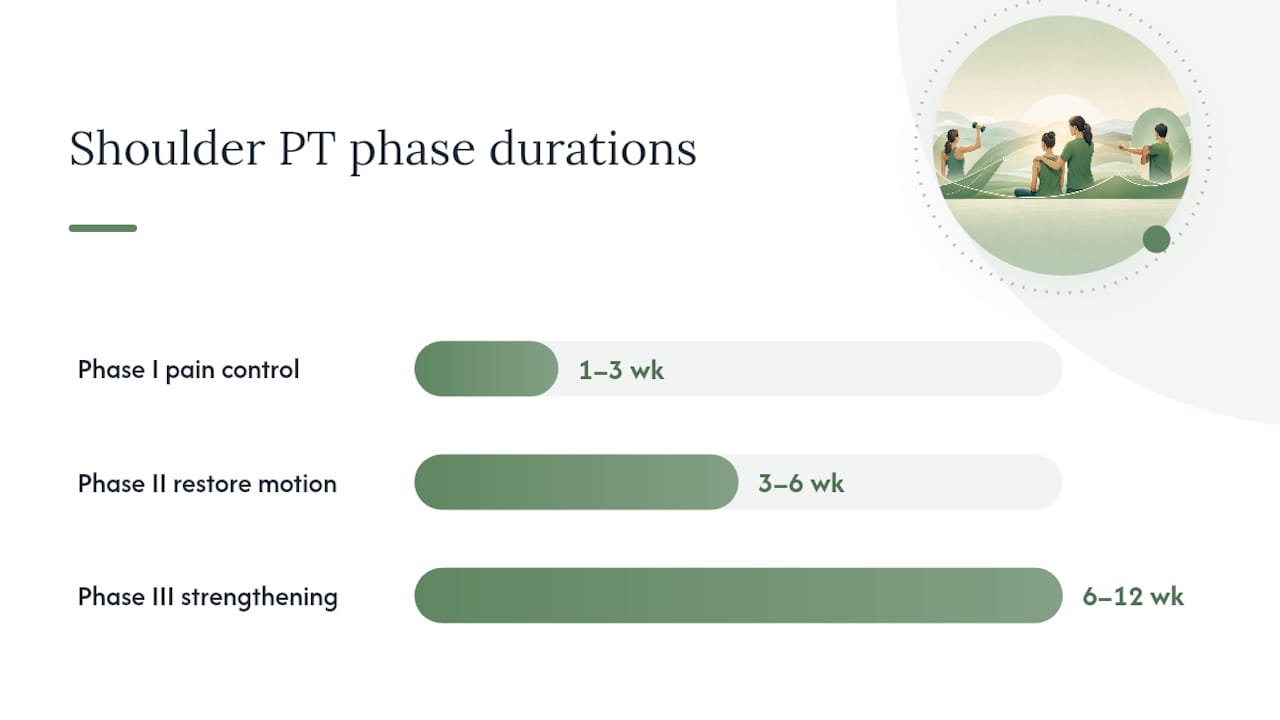
Progression in therapy should follow specific stages: pain control in weeks 1-3, restoring motion in weeks 3-6, and strengthening from weeks 6-12.
Exercises must be carefully dosed with pain kept below 3 to 4 out of 10, increasing reps, then resistance gradually over 3 to 5 days a week.
Overuse of heavy overhead presses, pushing through sharp pain, or unassisted overhead movements can worsen the condition and should be avoided.
Most individuals recover within 6 to 12 weeks with consistent effort, and adjuncts like injections support but do not replace active rehab.
Table of Contents
What Is Shoulder Bursitis and Why Does Physical Therapy Help?
Shoulder bursitis usually means the subacromial or subdeltoid bursa, a small fluid-filled cushion sitting between your rotator cuff tendons and the bone on top of your shoulder, has become irritated and swollen. It happens most often from repetitive overhead motion, a direct fall onto the shoulder, or years of poor shoulder mechanics that let the tendons and bursa get pinched with every reach.
It is easy to confuse with other shoulder problems, so here is the practical distinction:
Rotator cuff tear: often produces sharp weakness lifting the arm, not just pain, and sometimes a specific tearing sensation from an injury.
Frozen shoulder: causes a progressive, global loss of motion in every direction, even when someone else moves the arm for you.
Bursitis: typically causes pain with specific overhead or reaching movements, tenderness over the top of the shoulder, and motion that is limited by pain rather than true stiffness.
Nonoperative care, rest, anti-inflammatories, physical therapy, and sometimes an injection, resolves the large majority of cases, with surgery reserved for the rare patient who fails months of conservative treatment. Physical therapy does more than calm the bursa down. It corrects the shoulder blade timing and rotator cuff weakness that caused the irritation in the first place, which is why it prevents the problem from simply coming back in three months.
What Does a Phased Shoulder Bursitis Physical Therapy Plan Look Like?
A structured protocol beats guesswork, and it beats “rest and hope” by a wide margin. The BESS Subacromial Shoulder Pain patient care pathway recommends exercise therapy as the default first-line treatment, with injections offered only through shared decision-making and referral considered if conservative care stalls around 6 to 12 weeks. Here is how that plays out in a clinic setting.
Phase I, weeks 1 to 2 or 3 (pain control): The goal is calming the bursa and protecting motion, not building strength. Expect pendulums, passive and assisted range of motion, ice, activity modification, and possibly a short NSAID course. Success looks like less pain at rest and the ability to move the arm without guarding.
Phase II, weeks 3 to 6 (restoring motion and control): Active range of motion returns, along with scapular control drills and light isometric rotator cuff work. You are ready to advance here once you can lift the arm partway without sharp pain and your shoulder blade stops hiking up to compensate.
Phase III, weeks 6 to 12 (strengthening and return to activity): Resisted rotator cuff work, closed-chain loading, and functional patterns specific to your job or sport. This phase is where most of the durable strength gains happen, and systematic reviews show these gains hold up at both 6 to 12 weeks and out to 52 weeks.
Pro Tip: Track your progress by function, not just pain. “I can reach the top shelf without wincing” tells your therapist more than a pain number alone, and it is a better predictor of readiness for the next phase.
Refer out or consider adjuncts if symptoms persist past 6 to 12 weeks, if weakness progresses instead of improving, or if you plateau despite consistent effort on a well-run program.
Exercises for Shoulder Bursitis: Step-by-Step by Phase
These are the exercises we walk patients through at Contemporaryrehabservices, organized by the phase they belong to. Dosing matters here as much as form does.
Phase I: pain control
Pendulum swings: Lean forward, let the affected arm hang loosely, and swing it in small circles using body momentum, not shoulder muscles. Do 1 to 2 minutes, 3 to 4 times daily. This is about gentle joint movement, not stretching.
Passive/assisted range of motion: Use your unaffected arm, a cane, or a pulley to guide the sore arm through forward and outward motion, only to the point of mild stretch. Aim for 10 reps, twice daily.
Phase II: restoring motion and scapular control
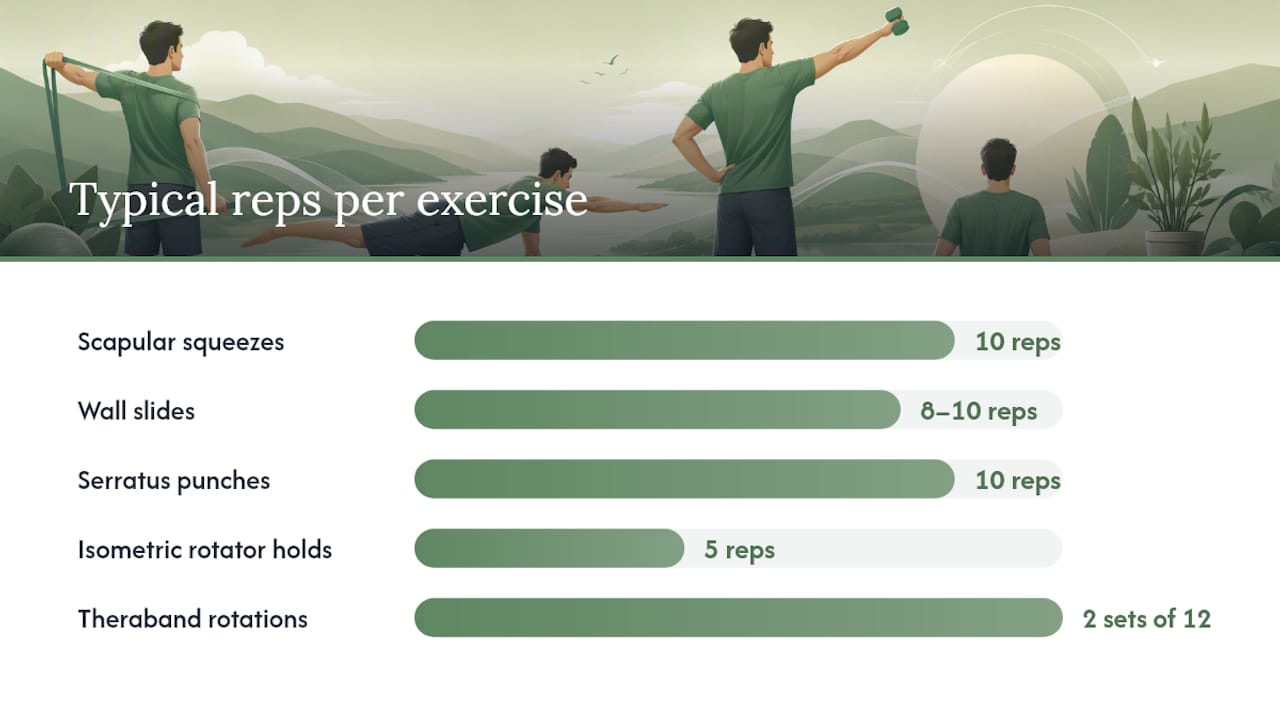
Scapular squeezes: Sit tall, pull your shoulder blades down and together as if pinching a pencil between them, hold 5 seconds. Do 10 reps, 2 to 3 sets, once pain allows.
Wall slides: Stand with your back and arms against a wall, slide your arms upward while keeping contact, then lower with control. Start with 8 to 10 reps and stop the set if your shoulder blade lifts off the wall.
Serratus punches: Lying on your back with your arm extended toward the ceiling, punch upward a few inches without bending the elbow. Do 2 sets of 10, this targets the muscle that stabilizes your shoulder blade against the ribcage.
Isometric rotator cuff holds: Press your forearm into a wall or doorframe in internal and external rotation directions, hold 5 to 10 seconds, no joint movement. Do 5 reps each direction, this builds strength without stressing the healing bursa.
Phase III: progressive loading
Theraband internal/external rotation: Elbow tucked at your side, resistance band anchored, rotate the forearm in and out against light resistance. Start with a light band for 2 sets of 12, and only add resistance once that feels easy.
Wall crawl or walk-up: Walk your fingers up a wall to progressively increase overhead reach, going only as high as you can without shrugging your shoulder toward your ear.
Cane or pulley active-assisted range of motion: Same setup as Phase I but with more active effort from the affected arm, and less assistance from the other side, over time.
Closed-chain and functional carry patterns: Wall push-ups progressing to modified floor push-ups, plus carrying a light bag or grocery weight at your side to rebuild real-world tolerance.
A network meta-analysis of 54 studies found shoulder-specific exercise therapy reduces pain for up to 52 weeks, and adding extra treatments on top of a good exercise program provided little additional long-term benefit. The exercises above are the actual mechanism doing the work, not a warm-up act before some other treatment.
What to avoid: skip unassisted overhead presses, heavy bench pressing, and any movement that reproduces sharp pain rather than mild pulling. If an exercise hurts sharply, regress to the prior phase’s version rather than pushing through, and drop the resistance before you drop the exercise entirely.
How Do You Progress Bursitis Rehab Exercises Safely?
Progressing too fast is the most common way people re-irritate a healing bursa, and progressing too slowly is the most common way they stay stuck for months. Both are avoidable with a few rules.
Use the 0 to 10 pain rule. Pain up to about 3 or 4 out of 10 during exercise that settles within an hour is acceptable “working” discomfort. Pain that spikes sharply, lingers overnight, or climbs session over session means you back off.
Progress in this order: reps, then sets, then resistance, then complexity. Do not jump straight to a heavier band or a harder position just because the current one feels easy on day one.
Train 3 to 5 days a week for the home program, with clinic sessions layered in based on severity, often 1 to 3 times weekly early on and tapering as you improve.
Look for these readiness markers before adding load: near-full active range of motion, a shoulder blade that stays stable during single-arm tasks, and baseline pain at or below 2 out of 10.
Check in with a therapist, in person or via telehealth, if you are unsure whether a plateau is normal or a sign to change the plan. Objective eyes catch compensations you cannot feel yourself.
Do Manual Therapy and Injections Actually Help Shoulder Bursitis?
Exercise remains the backbone of treatment, but a few adjuncts have a real, if limited, role. Manual therapy, hands-on joint mobilization and soft tissue work, adds measurable short-term pain relief when combined with an exercise program, though its advantage fades over the long run compared with exercise alone.
Corticosteroid injections work best as a short-term facilitator that reduces pain enough for you to participate fully in PT, not as a standalone fix.
A randomized clinical trial found that adding progressive resistance-band training after an injection cut one-year re-treatment rates from 82.9% down to 12.1% compared with injection alone.
Ultrasound, laser therapy, and shockwave (ESWT) have limited evidence as standalone treatments and work best as supportive additions alongside an active exercise program, never as a replacement for it.
Repeated injections into the same shoulder carry diminishing returns and some tissue risk, so treat each one as a deliberate, shared decision with your provider rather than a default refill.
When Should You Worry About Shoulder Bursitis Symptoms?
Most shoulder bursitis is straightforward, but a handful of signs mean you need more than a home exercise program.
Seek urgent evaluation for fever, redness and warmth over the joint, a recent significant trauma, or severe unremitting night pain, these can signal infection or fracture rather than simple bursitis.
Consider imaging, starting with ultrasound or X-ray and reserving MRI for more complex cases, if pain persists past 6 to 12 weeks of good therapy, if you suspect a rotator cuff tear, or if the exam findings do not add up. Our imaging decision guide breaks down which scan fits which scenario.
Ask for a referral if conservative care fails, weakness keeps getting worse instead of better, or the diagnosis stays unclear after a full course of PT.
How Contemporaryrehabservices Approaches Shoulder Bursitis Recovery
At Contemporaryrehabservices, shoulder bursitis rehab follows the same phased, guideline-backed structure outlined above, adapted to how you actually move and where your pain shows up. We accept Medicare, Aetna, Cigna, Emblem, and United Healthcare, plus direct payment, so cost does not have to be a barrier to starting early.
A first visit includes a full movement assessment, a look at your scapular mechanics, and a home program you start the same day.
Session frequency typically runs 1 to 3 times weekly depending on severity, tapering as your milestones improve.
Milestones follow the phase markers above: pain control in the first couple of weeks, restored motion by week 6, and strength and return to activity by week 12.
If your recovery looks more like a rotator cuff issue once we assess it, our rotator cuff physical therapy roadmap covers that phased plan in detail, and our 8 to 16 week rotator cuff rehab plan shows what a longer clinic-guided timeline looks like in practice.
Why Active Rehab Beats Passive Treatment for Bursitis
Passive treatments feel good in the moment, ice, a massage, a few minutes of ultrasound, but they do not fix the movement pattern that irritated the bursa in the first place. Active rehab does. Recovery in 6 to 12 weeks is realistic for most people, but only with honest adherence to progressive loading, not sporadic effort. Passive care earns its place as a short bridge early on, never as the whole plan.
— CRS Wellness
Ready for a Guided Shoulder Bursitis Recovery Plan?
If reading a phased exercise list feels like a lot to manage alone, that is normal, shoulder bursitis rehab works best with someone watching your scapular mechanics and adjusting load week to week. Physical therapy sessions are available both in-person and via telehealth across locations in Long Island, with various payment options accepted so patients can begin treatment without immediate concern for coverage.
A typical path starts with a full evaluation where we map your specific pain triggers against the phased protocol above, then build your home program from there. If you are near Nassau County, our Albertson physical therapy location or Williston Park physical therapy location can get you scheduled directly, or you can explore our full range of manual therapy and PT services if you want to understand how craniosacral work or joint mobilization might fit alongside exercise. Book your evaluation through Contemporaryrehabservices to get a plan built around your shoulder, not a generic handout.
Sources
This guide draws on the BESS Subacromial Shoulder Pain pathway, a PLOS One network meta-analysis on exercise therapy, a randomized trial on resistance training after injection, and Cleveland Clinic’s patient guidance on shoulder bursitis.
FAQ
What Is the Fastest Way to Heal Shoulder Bursitis With Exercise?
The fastest reliable path combines early pain-controlled range of motion with a structured progression into scapular control and rotator cuff strengthening, not rest alone. Skipping phases or jumping straight to heavy strengthening usually backfires and re-irritates the bursa, slowing you down overall.
What Should You Avoid Doing With Shoulder Bursitis?
Avoid unassisted overhead lifting, sleeping directly on the affected shoulder, and pushing through sharp pain during exercise. Prolonged rest without any motion work also slows recovery, since some pain-controlled movement early on helps the bursa settle rather than stiffen.
What Is the Standard PT Protocol for Shoulder Bursitis?
A standard protocol runs in three phases: pain control with gentle range of motion in weeks 1 to 3, active motion and scapular control in weeks 3 to 6, and progressive rotator cuff strengthening with return to activity in weeks 6 to 12. Both in-person and telehealth physical therapy sessions can be structured around this phased approach.
How Long Does It Take for Shoulder Bursitis to Heal Completely?
Most people see meaningful improvement within 6 to 12 weeks of consistent exercise therapy, with systematic reviews confirming benefits sustained out to 52 weeks when strengthening continues. Full resolution depends on adherence to the home program and addressing any underlying scapular or postural contributors, not just waiting it out.
Recommended
Comments