
Shoulder Labrum Physical Therapy: Phases, Exercises, Timeline

Physical therapy is the usual first step for a torn shoulder labrum, and it is also the path you follow after a surgical repair. The work moves in stages: calm the shoulder, restore motion, rebuild the muscles that steady the joint, then return to the activities you care about. The timing depends on whether you have surgery. If you live in Queens or Nassau County and want hands-on, one-on-one care through that process, our Albertson clinic is built for it.
TL;DR
Most SLAP tears (a tear at the top of the labrum) start with nonsurgical care: physical therapy, anti-inflammatory medicine, and sometimes an injection. Surgery is considered if pain does not improve.
Therapy for a SLAP tear can run 3 to 6 months, focusing on flexibility and strengthening the muscles around the shoulder.
After a repair, the surgeon’s protocol comes first: a sling, limited motion, then strengthening, and a return to full activity commonly around 4 to 6 months for non-overhead athletes. Overhead athletes often need longer.
Instability exercises center on the rotator cuff and shoulder blade muscles, and the right ones depend on your tear and your history.
We treat patients in person in Albertson and by telehealth, and we accept Medicare, Aetna, Cigna, Emblem, and United Healthcare.
Table of Contents
What the shoulder labrum does
Your shoulder is a ball-and-socket joint, but the socket is shallow. The labrum is a rim of cartilage around the socket that deepens it and gives the ball of the upper arm a more secure place to sit. A SLAP tear, as AAOS defines it, is an injury to the superior (top) part of that rim.
Labral tears come from a fall, a dislocation, a sudden pull on the arm, or years of repeated overhead motion. Common signs include a deep ache, catching or clicking, a feeling that the shoulder is slipping, and pain when you reach overhead or lift. These symptoms overlap with rotator cuff problems and impingement, which is one reason a hands-on evaluation matters. If your pain is broader, our guides on shoulder pain physical therapy and shoulder impingement cover related conditions.
A new injury with a dislocation, sudden weakness, numbness, or severe pain after a fall should be seen by a physician or urgent care promptly. Imaging and a diagnosis come from a physician, and your therapy plan is built around that diagnosis.

When physical therapy comes first
Not every labral tear needs an operation. AAOS notes that initial treatment for most SLAP injuries is nonsurgical. That means physical therapy, anti-inflammatory medication, and at times a corticosteroid injection. Surgery enters the conversation if pain does not improve with that care.
A few factors shape the decision, and your orthopedic surgeon weighs them with you:
The type and size of the tear.
Whether the shoulder is unstable or only painful.
Your age, work, and sport, especially overhead or throwing demands.
How you respond to several weeks of well-directed therapy.
The goal of nonsurgical rehab is not to “heal” the cartilage by exercise alone. It is to make the shoulder work well around the tear: strengthen the muscles that stabilize the joint, reduce stress on the labrum, and restore motion so daily life and sport are comfortable again.
The phases of nonoperative shoulder labrum rehab
Protocols vary by clinic and by patient, but the logic is consistent. Think of it as four overlapping phases.

Phase 1: Settle the shoulder
The first job is reducing pain and irritation. You limit the movements that provoke the shoulder, such as heavy overhead reaching or lifting, and keep the arm moving gently within a comfortable range. After a dislocation or subluxation (a partial slip of the ball out of the socket), Johns Hopkins Medicine advises resting first, then starting range-of-motion exercises once pain and swelling subside.
Phase 2: Restore motion
A stiff capsule (the connective tissue around the joint) can make a labral problem feel worse. Therapy commonly includes work on capsule flexibility and range of motion. This is where hands-on techniques help most. Gentle joint mobilization and soft tissue work can ease stiffness so you can move into exercise with less guarding. If stiffness is your main complaint, see what joint mobilization for shoulder stiffness involves.
Phase 3: Build stability
This is the core of labrum rehab. The rotator cuff and the muscles around the shoulder blade act as dynamic stabilizers, holding the ball centered in the socket. A 2026 review on labral tears with instability describes nonoperative rehab as typically running 2 to 6 weeks, progressing from pain-free motion to rotator cuff and periscapular (shoulder blade) stabilization, then return-to-sport work. For a SLAP tear without instability, AAOS describes a longer course of 3 to 6 months. Your own timeline depends on your tear and how the shoulder responds.
Our rotator cuff physical therapy roadmap lays out how strengthening is progressed, which closely parallels this phase.
Phase 4: Return to activity
Late rehab adds the demands of your real life: lifting overhead, carrying, swimming, racquet sports, throwing, or work tasks. Loads and speeds go up gradually, and the shoulder is checked for control, not just strength.
Shoulder instability exercises: what they look like
“Shoulder instability exercises” is one of the most searched phrases around this topic, and the honest answer is that the right set depends on the direction your shoulder slips, your range of motion, and whether a labral tear is involved. What stays consistent is the order of progression:
Pain-free motion. Gentle pendulum and assisted range-of-motion work, as comfort allows.
Rotator cuff activation. Light resistance-band work for the muscles that rotate the arm, kept in a controlled range.
Shoulder blade control. Rows, retraction, and similar movements that give the arm a stable base.
Closed-chain work. Exercises where the hand is fixed against a surface, such as wall or floor support, which train the joint to stay centered under load. The CHOP protocol places this after staged motion and rotator cuff and scapular strengthening.
Sport- or work-specific drills. Overhead patterns, throwing mechanics, or lifting, introduced last.
Two cautions apply. First, exercises that reproduce the pinching, catching, or slipping feeling are not “working through it”; they are a signal to change the exercise. Second, if you have had a repair, the same movements can be restricted for weeks. Copying a generic exercise list from the internet is the most common way people irritate a healing shoulder, which is why an individualized program is worth having.
One data point shows why stability work matters. The 2026 review reports that return to play after nonoperative treatment of anterior instability can reach 90% in season, yet about 37% may have recurrent instability in that same season. Good rehab, careful progression, and clear return criteria are how athletes and active adults reduce that risk.
Rehab after shoulder labrum repair
If you and your surgeon decide on repair, your protocol comes from the surgeon, and therapy follows it closely. Protocols differ, so use the figures below as an illustration of the pattern, not as a schedule for your shoulder.
Period after surgery | What typically happens | Source |
Weeks 0 to 6 | Sling use (commonly 2 to 6 weeks, depending on the injury and procedure); passive or assisted motion only; no biceps contraction or weight bearing through the arm in one SLAP protocol | |
Weeks 0 to 3 | Forward elevation and abduction kept below 90 degrees in that protocol; below 120 degrees in weeks 3 to 6 | |
From about week 6 | Active motion and progressive strengthening begin; AAOS says strengthening commonly starts 6 to 10 weeks after surgery | |
About 3 months | Plyometrics and sport-specific training can be introduced after labral repair | |
4 to 6 months | Progressive return to full activity for non-overhead athletes if criteria are met; overhead athletes may take longer |
Throwing athletes may begin early interval throwing around 3 to 4 months after SLAP surgery, and the surgeon decides when sports are safe. The 2026 review describes return-to-sport training starting around 4.5 months, with the final clearance guided by a structured assessment by a skilled physical therapist.
The most important thing to know is that published protocols vary a lot. A 2024 review of rehabilitation found substantial variability and a need for more research. That is a good reason to follow your surgeon’s instructions and have a therapist who adjusts the plan to how your shoulder actually behaves.
What to wear while the repair heals
A sling and limited arm movement make dressing harder than people expect. Loose, front-opening tops and clothing designed for easy on and off help you avoid pulling the arm through tight sleeves. This guide to shoulder labrum surgery clothing covers what to wear and when.
What about the hip labrum?
Many people searching this topic have a hip labral tear instead, often with femoroacetabular impingement (FAI), where the ball and socket of the hip pinch against each other. The principles are similar: control irritation, restore motion, build strength.
A few points from published guidance:
A university non-operative prescription generally calls for 6 to 8 weeks of supervised therapy, starting with pain control and isometric work while avoiding hip flexion, then progressing to motion, strength, balance, and sport-specific activity. Running waits until hip abductor strength matches the other side.
Another guideline says a supervised 6 to 12 week course should be enough to see whether you respond.
Typical hip impingement rehab exercises in that guideline include clamshells, fire hydrants, bridges, planks, and step-ups, progressing to single-leg bridges, banded side steps, step-downs, lunges, and squats, with depth and resistance increased as comfortable. Activities that provoke pinching at the front or side of the hip are avoided.
A 2023 meta-analysis found that 54% of people with nonarthritic hip-related pain responded satisfactorily to nonoperative treatment.
If you have hip pain with catching or locking, a physician evaluation comes first, and your therapy is shaped by that diagnosis.
Why hands-on, one-on-one care helps
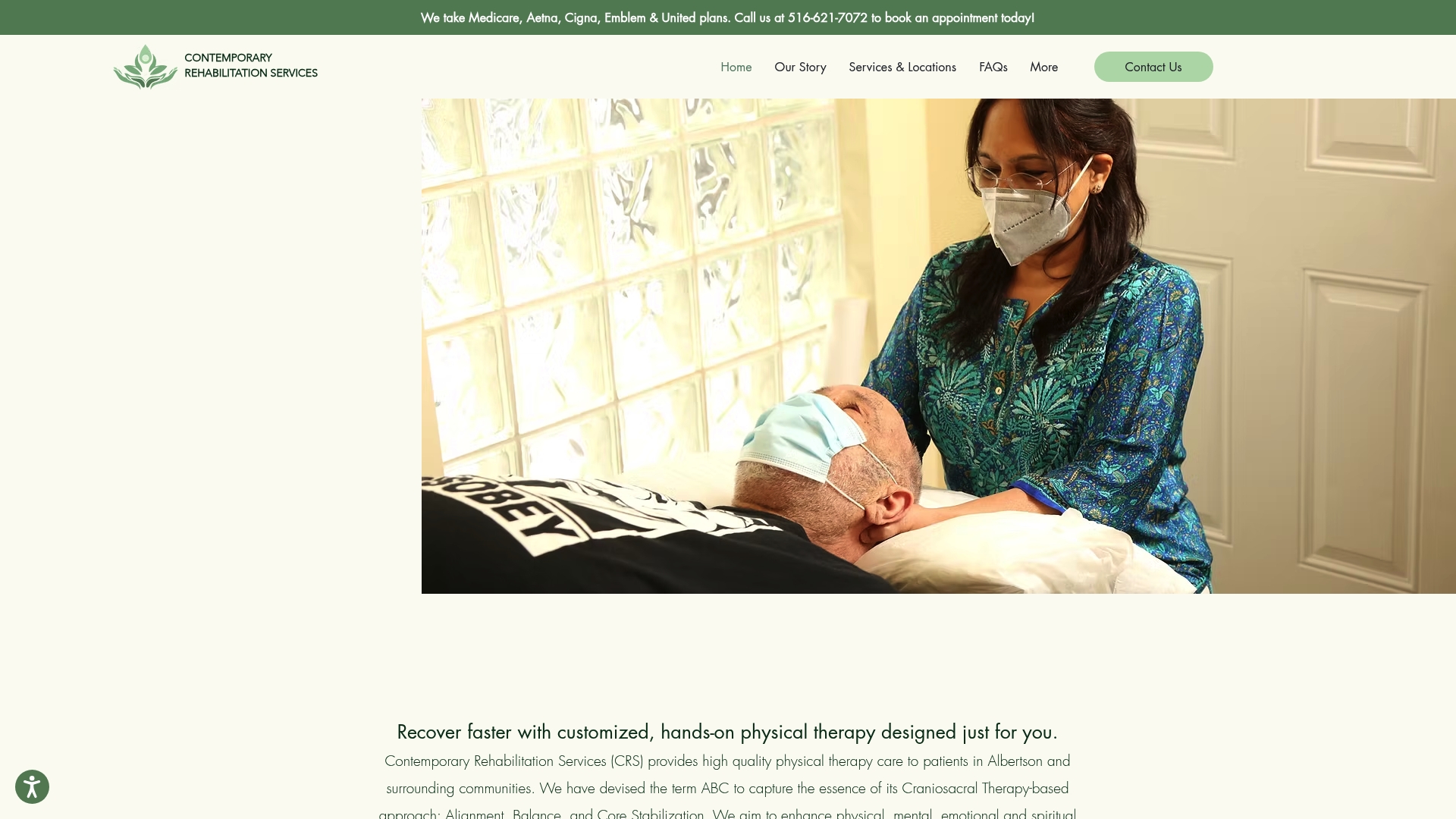
Labral rehab is more than a sheet of exercises. A therapist has to judge which movements your shoulder tolerates today, when to progress, and when to back off. Hands-on care can ease stiffness and guarding so you can do the exercises well, and one-on-one sessions mean the plan changes as you do.
At Contemporary Rehab Services, our services include joint mobilization, myofascial therapy, neural mobilization, neuromuscular re-education, visceral therapy, and craniosacral therapy, delivered as individualized rehabilitation programs for pain relief and injury recovery. Sessions are one-on-one with our mother-daughter team. If you cannot travel to Albertson for every visit, telehealth PT sessions are available.
Getting started with us
We are a boutique physical therapy clinic in Albertson, serving Queens and Nassau County. We accept Medicare, Aetna, Cigna, Emblem, and United Healthcare, and we also take cash payments. If your shoulder hurts, feels unstable, or you are preparing for or recovering from labrum surgery, you can see our physical therapy and telehealth options or browse all of our services to find the right fit.
Bring your imaging report, your surgeon’s protocol if you have had a repair, and a list of the activities you want back. That gives us what we need to build your plan.
Our perspective
Most people come to us after weeks of guessing. They stop lifting, avoid reaching, and wonder whether every twinge means more damage. A torn labrum feels frightening, but a shoulder that has a clear plan is easier to trust. We believe the best rehab is personal. Two people with the same MRI finding can have very different shoulders, jobs, and goals, so we work one-on-one, combining manual therapy with an individualized program. Our approach blends holistic and integrative hands-on techniques with exercise, and we use our ABC Approach to keep each plan organized and progressive. Hands-on work matters here. Gentle joint mobilization, myofascial work, and neuromuscular re-education can ease the stiffness and guarding that hold people back, so the strengthening phase goes better. That is how we help patients in Albertson, Queens, and across Nassau County get back to lifting, swimming, working, and playing with more confidence. CRS Wellness
FAQ
How long is rehab for a torn labrum?
It depends on whether you have surgery. Nonoperative therapy for a SLAP tear can run 3 to 6 months. After repair, a common target for returning to full activity is 4 to 6 months for non-overhead athletes, and longer for overhead athletes.
Can a shoulder labrum tear heal without surgery?
Many people improve without surgery. AAOS says initial treatment for most SLAP injuries is nonsurgical, and surgery is considered if pain does not improve. Therapy focuses on strengthening the muscles that support the joint so the shoulder works well and hurts less.
What exercises help shoulder instability?
Program design depends on the direction of instability and your tear. In general, you move from pain-free motion to rotator cuff and shoulder blade strengthening, then closed-chain and sport-specific work. A therapist should tailor and progress the exercises so they do not provoke slipping or pinching.
Does physical therapy help a torn hip labrum?
It can. A 2023 review found that 54% of people with nonarthritic hip-related pain responded satisfactorily to nonoperative treatment. Supervised programs commonly run 6 to 12 weeks, and a physician evaluates the hip first.
Can I do shoulder labrum rehab by telehealth?
Yes for many parts of rehab, especially guided exercise, movement checks, and progress reviews. We offer telehealth PT sessions alongside in-person care in Albertson, so you can combine both as your plan requires.
Sources
SLAP Repair (Type II and IV) Rehabilitation Protocol, CHOP, 2023
Management of Labral Tears Associated with Glenohumeral Instability, 2026 review
Current Evidence Based Recommendations on Rehabilitation, 2024 review
Physical Therapy Prescription Non-operative Hip Labral Tear, University of Utah
Non-Operative Labral/FAI Hip Rehabilitation Guideline, Sanford Health, 2026
Rate of response to non-operative treatment for hip-related pain, 2023 meta-analysis
Recommended
Comments