
Fascia Release Explained: How It Helps Pain and Mobility

Myofascial release (MFR) is a hands-on physical therapy technique that applies sustained, gentle pressure to tight areas of the connective tissue surrounding your muscles, helping restore movement and reduce pain. If you’re dealing with persistent muscle tension, stiffness, or pain that hasn’t responded to rest or standard exercise, this therapy may be exactly what your body needs.
People who commonly benefit include:
Those with chronic muscle pain or low back pain that lingers despite other treatments
Patients with non-specific neck pain or tension headaches tied to myofascial tightness
Anyone experiencing post-surgical stiffness or scar tissue restrictions
Athletes with reduced mobility, recurring tightness, or slow recovery between training sessions
If your pain is limiting daily function or has persisted for more than a few weeks, the best next step is a consultation with a licensed physical therapist or your primary care provider.
Table of Contents
What is fascia release, and how is it different from massage?
Fascia is a continuous sheet of connective tissue that wraps around every muscle, bone, nerve, and organ in your body. Think of it as a three-dimensional web that holds everything in place while allowing smooth, coordinated movement. When fascia is healthy, it glides freely. When it becomes stiff, thickened, or develops adhesions — a process sometimes called densification — it can pull on surrounding structures, restrict motion, and generate pain that feels distant from the actual problem area.
Understanding fascia’s role in mobility helps explain why a tight hip can cause knee pain, or why a shoulder restriction can contribute to neck discomfort. Fascia transmits mechanical force across the body, so a restriction in one area rarely stays local.
Myofascial release differs from classic massage in a few important ways. Traditional massage uses oil or lotion and relies on sliding strokes to increase circulation and ease surface muscle tension. Trigger-point therapy targets specific, localized knots in muscle tissue with direct compression. MFR, by contrast, uses direct skin contact without oils to create what therapists call “tissue drag” — a slow, sustained engagement of the fascial layer that allows the therapist to feel and influence deeper tissue restrictions. The pressure is held longer, the pace is slower, and the goal is the connective tissue itself, not just the muscle beneath it.
How does myofascial release work in a clinical setting?
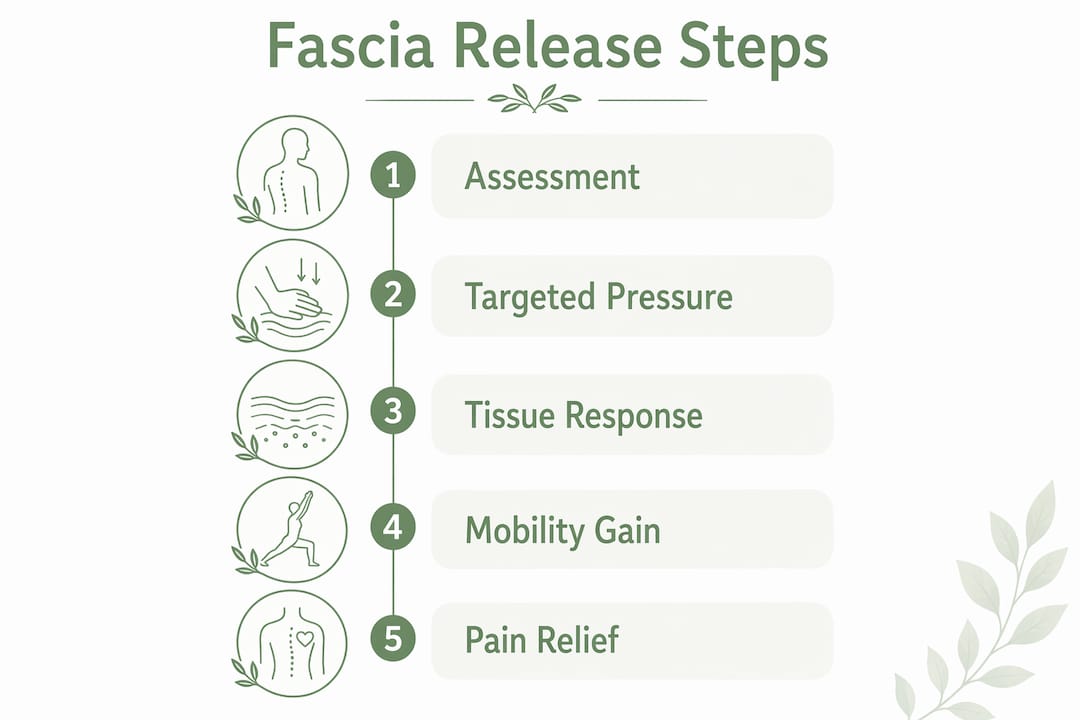
The clinical process follows a clear sequence, though the specifics vary by therapist and patient presentation.
Assessment. The therapist observes your posture, watches how you move, and uses hands-on palpation to locate areas of fascial restriction. Pain location and restriction location are often different — a skilled therapist identifies the source, not just the symptom.
Identification of restricted areas. Using palpation and movement testing, the therapist maps out where the fascia feels dense, adhered, or resistant to normal tissue glide.
Application of sustained pressure. The therapist applies slow, deliberate pressure into the restricted area, holding it for 90 seconds or longer until a softening or release is felt in the tissue. No oil is used, so the therapist can maintain the tissue drag needed to engage the fascial layer effectively.
Progressive release and reassessment. After each release, the therapist reassesses movement and tissue quality, then moves to adjacent or related areas.
Active exercise or home program. Most sessions end with targeted movement exercises to reinforce the mobility gains made during hands-on work.
The physiological explanation for why this works centers on mechanical loading of fascia, which stimulates mechanoreceptors — sensory cells embedded in connective tissue — and influences the nervous system’s regulation of muscle tone and pain perception. Short-term improvements in pain and range of motion are well-supported. Whether sustained pressure produces lasting structural changes to fascial tissue is less certain, and current evidence suggests MFR’s most reliable effects are neurological and movement-based rather than purely mechanical.
What should you expect during a typical session?
Your first appointment usually begins with a detailed intake: the therapist asks about your pain history, prior injuries, surgeries, and current movement limitations. This is followed by a standing or seated postural assessment and a few functional movement tests to identify where restrictions are affecting your mechanics.

For the hands-on portion, wear comfortable, form-fitting clothing — or be prepared to undress to your comfort level with appropriate draping. Because MFR requires direct skin contact without oils, the therapist will work directly on skin in the areas being treated. Privacy and modesty are maintained throughout, and you should always feel comfortable communicating your preferences.
Sessions typically run 45–60 minutes. Relief can sometimes be felt after a single visit, but most patients with chronic restrictions need several sessions before changes become durable. A realistic course of care for a moderate presentation is often 4–8 sessions, spaced weekly or biweekly, with progressive exercise integration between visits. Your therapist will reassess at each appointment and adjust the plan based on how your tissue responds.
What conditions and benefits does myofascial release address?
MFR is used across a wide range of musculoskeletal and soft-tissue conditions. Common indications include:
Chronic low back pain and non-specific lumbar stiffness
Neck pain and cervicogenic headaches related to myofascial tension
Post-surgical scar adhesions, including restrictions following breast surgery or abdominal procedures
Fibromyalgia and widespread myofascial pain syndrome
Sports injuries and recurring muscle tightness in athletes
Limited joint range of motion caused by fascial restrictions rather than joint pathology
The practical benefits of fascia release that patients notice most often are reduced pain sensitivity, improved range of motion, and a sense of greater ease in movement. Soft-tissue glide improves, which means muscles can lengthen and contract more freely. That improved mobility then makes active rehabilitation exercises more effective, because the tissue is no longer working against itself.
MFR works best as a complement to active therapies, not a replacement for them. Reviews consistently emphasize that hands-on fascial work is most valuable when it reduces symptom burden enough for patients to engage fully in exercise, motor control retraining, and progressive loading. Passive treatment alone rarely produces lasting change.
What does the clinical research show?
The evidence for myofascial release is genuinely encouraging for short-term outcomes, with important caveats about long-term results and study quality.
A systematic review of MFR in chronic low back pain pooled data from randomized controlled trials totaling 397 patients and reported meaningful improvements in both pain and physical function following MFR protocols. Short-term gains in pain reduction and range of motion appear consistently across studies. Long-term functional outcomes are less uniform, partly because protocols vary widely in technique, pressure duration, and number of sessions.
Study Type | Condition | Main Outcome | Short-Term Result | Long-Term Result |
Pooled RCTs (397 patients) | Chronic low back pain | Pain and function | Meaningful improvement | Inconsistent across trials |
Multiple trials (systematic review) | Various musculoskeletal | Range of motion | Consistent gains | Less certain |
Clinical trials (varied) | Neck pain, headache | Pain sensitivity | Positive short-term | Operator-dependent |
What the numbers mean: Across randomized trials in chronic low back pain, MFR produced short-term pain and function benefits in a pooled sample of 397 patients — a clinically meaningful signal, even with protocol variation across studies.
Three caveats are worth keeping in mind. First, MFR protocols differ significantly between studies, making direct comparisons difficult. Second, outcomes depend heavily on the therapist’s palpation skill and clinical reasoning. Third, the strongest evidence positions MFR as an adjunct to active rehabilitation, not a stand-alone cure.
Is myofascial release safe? Risks and contraindications to know
For most people, myofascial release is safe when performed by a trained clinician. Common short-term side effects include mild soreness, temporary increased sensitivity in treated areas, and occasional light bruising. These typically resolve within 24–48 hours.
Absolute contraindications — situations where MFR should not be performed — include:
Active infection or fever in or near the treatment area
Uncontrolled bleeding disorders or patients on anticoagulant therapy without medical clearance
Recent fractures or acute bone injuries
Open wounds or skin infections at the treatment site
Certain post-surgical timelines — always confirm with your surgeon before beginning manual therapy after an operation
Relative contraindications (proceed with caution and provider guidance) include osteoporosis, inflammatory conditions in an acute flare, and pregnancy in certain positions or trimesters.
Seek immediate medical attention if you notice new neurologic symptoms such as numbness, tingling, or weakness after a session, unexplained swelling, or any systemic symptoms like fever or dizziness. Stop treatment and contact your primary care provider if these appear.
How to do self-myofascial release safely at home
Self-myofascial release (SMFR) with the right tools can meaningfully reduce muscle soreness and restore some range of motion between professional sessions. The key is using appropriate pressure and knowing when to stop.

Foam roller for large muscle groups. Place the roller under your target area — upper back, hamstrings, calves, or IT band — and use your body weight to apply gentle pressure. Roll slowly (about one inch per second), pause on tender spots for 20–30 seconds, and breathe steadily. Avoid rolling directly over the lumbar spine or any bony prominence. Two to three minutes per area is enough.
Small massage ball for localized trigger points. A lacrosse ball or tennis ball works well for the glutes, plantar fascia, or the muscles between the shoulder blades. Place the ball against a wall or the floor, position the target area over it, and hold steady pressure on the tender spot for 30–60 seconds. The goal is a gradual softening of the discomfort, not sharp pain.
Percussive devices for short-duration adjunct use. Percussion massagers like a Theragun or Hypervolt can help warm up tissue before activity or reduce post-exercise soreness. Use them on large muscle groups for 30–60 seconds per area at a moderate intensity setting. They are less precise than manual palpation and should not be used over joints, the spine, or acutely injured tissue.
SMFR gives temporary relief and is a useful complement to professional care, but it lacks the precision of a trained therapist’s palpation. A therapist can identify the actual source of referred pain and address fascial restrictions that a foam roller simply cannot reach.
Pro Tip: If SMFR increases your symptoms, causes numbness or tingling, or leaves you more restricted than before, stop immediately and schedule a professional evaluation. More pressure is not always better.
How do you find a qualified myofascial release therapist?
Choosing the right clinician matters as much as choosing the right therapy. Here is what to look for:
Licensure: Your therapist should be a licensed physical therapist (PT), licensed massage therapist (LMT), or licensed occupational therapist (OT) with documented manual therapy training.
Manual therapy certification: Look for additional credentials such as Certified Manual Physical Therapist (CMPT), Fellow of the American Academy of Orthopaedic Manual Physical Therapists (FAAOMPT), or completion of recognized MFR training programs.
Relevant experience: Ask specifically about experience treating your condition — chronic back pain, post-surgical recovery, fibromyalgia, or sports injuries each require different clinical reasoning.
Before booking, ask the clinic these questions:
Do you perform direct skin-contact MFR, or do you work through clothing?
How long are your sessions, and how many do you typically recommend for my condition?
Will you provide a home exercise program alongside hands-on treatment?
Do you accept my insurance, and can you provide documentation for reimbursement?
On the insurance side, MFR delivered by a licensed PT is often covered under major commercial plans when medically necessary. Contemporaryrehabservices in Albertson, NY accepts Medicare, Aetna, Cigna, Emblem, and United Healthcare, serving patients across Nassau County and Queens. If you’re in the area and want to know whether your plan covers myofascial therapy services, the clinic can verify your benefits before your first visit.
For readers in Nassau County, Contemporaryrehabservices serves patients in Albertson, Great Neck Plaza, and surrounding neighborhoods. Booking an in-person evaluation is the most direct way to find out whether MFR is appropriate for your specific presentation.
What happens after a session, and how long before you feel better?
Immediately after a session, drink plenty of water, move gently, and avoid intense exercise for the rest of the day if your tissues feel tender. Light walking or gentle stretching is fine. If soreness develops, a cold pack applied for 10–15 minutes can help. Most post-treatment soreness resolves within 24–48 hours.
Some patients notice immediate relief after a single session — a reduction in tightness, improved range of motion, or a sense of ease in movement they haven’t felt in months. For others, the first session feels more like a reset, with noticeable change building over subsequent visits. A typical course of 4–8 sessions with progressive exercise integration is a reasonable expectation for moderate chronic presentations.
If you complete six to eight sessions without meaningful improvement, that is a signal to reassess. Return to your provider, discuss whether the diagnosis is correct, and consider whether a different modality or a referral to another specialist is warranted. Persistent or worsening symptoms always warrant medical review.
Key Takeaways
Myofascial release produces consistent short-term improvements in pain and range of motion, and works best when combined with active rehabilitation rather than used as a stand-alone treatment.
Point | Details |
What MFR is | Sustained, gentle pressure on fascial tissue to reduce tightness and restore movement. |
Who benefits most | Patients with chronic low back pain, neck pain, post-surgical stiffness, fibromyalgia, or restricted mobility. |
Evidence base | Pooled RCTs in 397 chronic low back pain patients showed meaningful short-term pain and function gains. |
Safety profile | Generally safe; common side effects are mild soreness resolving in 24–48 hours; contraindicated with active infection, fracture, or open wounds. |
Best used alongside | Active rehabilitation — exercise, motor control retraining, and progressive loading — for durable results. |
A clinician’s perspective on integrating myofascial release
Here is what I find most underappreciated about myofascial release: it is not a treatment you do to a patient — it is a treatment you do with them. The hands-on work matters, but what it actually accomplishes is creating a window of reduced pain and improved tissue mobility during which the patient can move better. That window is where the real rehabilitation happens.
The patients who get the most out of MFR are the ones who use that window actively. They do their home exercises, they engage in the motor control work, and they progressively load the tissue as it becomes more responsive. The patients who plateau are often those who come in for passive treatment and leave without reinforcing the gains through movement.
At Contemporaryrehabservices, the approach starts with a thorough movement and palpation assessment. MFR is applied where the tissue genuinely needs it, not as a blanket protocol. Then the session pivots to active work — because a physical therapy rehabilitation program that combines hands-on release with targeted exercise consistently outperforms either approach alone.
If you are unsure whether myofascial release is appropriate for your situation, an in-person evaluation is the right starting point. A qualified therapist can assess your movement, identify where fascial restrictions are actually contributing to your symptoms, and build a plan that addresses the source rather than just the location of your pain.
Useful sources and further reading
The following resources were used in preparing this guide and are worth consulting for deeper information.
Myofascial Release (MFR): An Overview — HSS.edu: A clear clinical overview from Hospital for Special Surgery covering indications, technique, and what to expect.
A Review of the Application of Myofascial Release Therapy — PMC: Systematic review summarizing RCT evidence across conditions including chronic low back pain; source for the 397-patient pooled sample cited above.
Myofascial Release Therapy — Cleveland Clinic: Patient-facing explainer covering definition, session details, and common uses.
Myofascial Release and Fascial-Targeted Mechanical Interventions — Frontiers in Physiology: Detailed review of mechanisms, modality types, and evidence quality; source for mechanoreceptor and sustained-pressure details.
Fascial Therapy — AMTA: Explains the distinction between MFR and oil-based massage, including the role of tissue drag and skin contact.
NCCIH: Massage Therapy — What You Need to Know: National Institutes of Health resource on evidence, safety, and finding qualified practitioners.
This article is general health information, not medical advice. Consult a licensed physical therapist or your primary care provider to determine whether myofascial release is appropriate for your specific condition.
Recommended
Comments