
Top 5 Clifton Park PT Alternatives: Compare and Choose
- tjdontplay
- 2 days ago
- 11 min read

If you’re looking for cliftonparkpt.com alternatives in or near Clifton Park, NY, the strongest options are OrthoNY (Clifton Park), Core Physical Therapy, ATI Physical Therapy, Athletico, and Contemporaryrehabservices. For most patients who want hands-on, one-on-one care with flexible insurance options, OrthoNY’s Clifton Park location is the top local pick because it combines orthopedic integration with direct PT access.
TL;DR: OrthoNY offers on-site imaging, broad insurance acceptance, and direct physical therapy access in Clifton Park, making it the most practical single choice for the majority of local patients.
Here’s the shortlist at a glance:
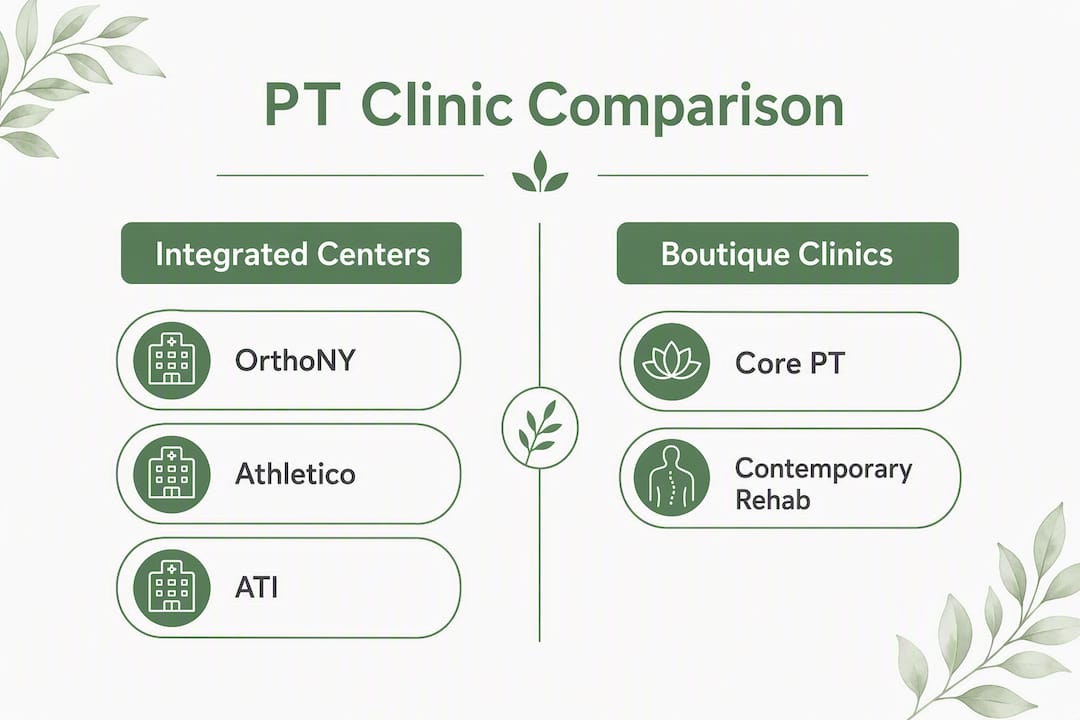
OrthoNY (Clifton Park): Integrated orthopedic center with on-site imaging and sports medicine coordination
Core Physical Therapy (Clifton Park): Locally staffed clinic with a named team of DPT-credentialed therapists
ATI Physical Therapy: National chain with regional locations serving the Saratoga/Albany corridor, strong telehealth options
Athletico: Regional/national provider with multi-specialty services; confirm current area availability before booking
Contemporaryrehabservices (Albertson, NY): Boutique manual therapy clinic serving Nassau County and Queens, with virtual PT available
Table of Contents
Which local clinics are the best alternatives to cliftonparkpt.com?
The table below compares the top Clifton Park PT options across the dimensions that matter most when choosing a provider.
Dimension | Integrated orthopedic center | Boutique manual-therapy clinic | Regional multi-site chain |
Example category | OrthoNY Clifton Park | Core PT / boutique independents | ATI / Athletico |
Drive time to Clifton Park | On-site (Clifton Park) | Local (Clifton Park area) | Varies; nearest may be 10 min |
Specialties | Post-surgical, sports, ortho, manual therapy | Manual therapy, chronic pain, sport-specific | Post-surgical, sports, neuro, pelvic health |
Medicare accepted | Yes | Verify per clinic | Yes (most locations) |
Aetna / Cigna / UnitedHealthcare | Yes | Verify per clinic | Yes (most locations) |
Direct access (no referral) | Yes | Yes | Yes |
One-on-one care model | Varies by session type | Typically yes | Varies; some double-booking |
Telehealth available | Limited | Varies | Yes |
Weekend hours | Limited; verify | Varies | Some locations |
Local provider listings show that Cigna is the most widely accepted insurer among Clifton Park-area PT providers, with Aetna and Medicare also broadly covered. Still, always verify your specific plan directly with the clinic before booking.
OrthoNY (Clifton Park)
OrthoNY’s Clifton Park location is an integrated orthopedic center that coordinates physical therapy with on-site imaging and direct surgeon access. That setup shortens the gap between diagnosis and treatment, which matters most for post-surgical patients or anyone dealing with a complex orthopedic issue.
Pros: On-site imaging coordination; faster specialist referrals; broad insurance acceptance including Medicare
Cons: Less emphasis on extended one-on-one manual sessions; may feel higher-volume
Approximate drive time from central Clifton Park: on-site.
Core Physical Therapy (Clifton Park)
Core PT publishes its full Clifton Park team, including Gary Mott PT, DPT; Lauren McAleese PT, DPT; Rick Klatt PT, MS; Torey McHale PT, DPT; Courtney Osaheni, DPT; and Talin McBride, PT. That transparency about who treats you is a genuine differentiator.
Pros: Named, credentialed local team; community-focused practice
Cons: Smaller facility; insurance participation should be confirmed directly
Approximate drive time: local Clifton Park.
ATI Physical Therapy
ATI operates a broad network across the Saratoga/Albany corridor. Multi-site operators like ATI typically promote online scheduling, telehealth, and wide insurer networks as their primary advantages.
Pros: Online booking; telehealth options; strong insurance coverage
Cons: Session continuity (same therapist each visit) varies by location
Athletico
Athletico is a regional-to-national provider with multi-specialty services covering sports injury, post-surgical rehab, and pelvic health. Availability near Clifton Park should be confirmed directly, as location footprints shift.
Pros: Broad specialty menu; strong sports medicine focus
Cons: Confirm current Saratoga County availability before scheduling
How do you choose the right PT clinic in Clifton Park?
The single most important criterion: match your specific condition to a clinic’s documented specialty, then confirm insurance coverage and scheduling availability before you commit. Everything else is secondary.
Phone scripts to confirm the essentials
Use these short scripts when you call a clinic:
Insurance and authorization:“I have [insurer name]. Do you accept that plan, and will I need prior authorization before my first visit? Can you estimate my expected copay?”
Care model:“Will I see the same therapist for most of my visits, and how long is a typical one-on-one session?”
Wait time:“How soon can I get an initial evaluation? Do you have any openings this week?”
Red flags to watch for
Clinician cannot confirm their DPT credential or specialty certification
Vague answers about session length or whether you’ll see the same therapist
No clear explanation of billing or expected out-of-pocket costs
Consistently long waits for an initial evaluation (more than two weeks for a non-urgent case)
Unclear or inconsistent hours, especially for evening or weekend appointments
Insurance verification checklist
Confirm your insurer is in-network with that specific clinic location (not just the chain).
Ask whether your plan requires prior authorization for outpatient PT.
Request an estimate of your copay or coinsurance per session.
Ask how the clinic handles prior-auth submissions and what happens if a claim is initially denied.
Verify whether your plan has a session cap for the calendar year.
When insurers require medical necessity documentation, clinics often submit targeted CPT codes or seek retroactive authorizations. Asking the clinic directly how they handle this process saves you from surprise bills later.
Pro Tip: For choosing physical therapy by insurance, always ask the clinic to run a benefits check before your first appointment, not after. Most will do it at no charge.
What services and specialties should you look for at a PT clinic?
The APTA recommends evaluating providers by clinician certifications and specialty training, not just location. Here’s what the key specialties actually mean for your care:
Post-surgical/orthopedic rehab: Structured recovery after joint replacement, ACL repair, or spinal surgery. Look for DPT credentials and experience with your specific procedure.
Sports medicine PT: Addresses acute injuries, return-to-sport progressions, and performance-related movement issues. McKenzie Method certification is a meaningful credential here.
Manual therapy: Hands-on techniques including joint mobilization, myofascial release, and muscle energy techniques. Boutique clinics often advertise these as their core differentiator, and they can matter significantly for complex chronic pain cases.
Vestibular rehab: Specialized treatment for dizziness, vertigo, and balance disorders. Requires specific vestibular certification beyond a general DPT.
Pelvic health PT: Addresses pelvic floor dysfunction, incontinence, and post-partum recovery. Confirm the therapist holds a pelvic health specialty certification.
Neurological rehab: For conditions like stroke, Parkinson’s disease, or multiple sclerosis. Neuromuscular re-education and functional movement training are the core tools.
Certifications and training that signal real expertise
DPT (Doctor of Physical Therapy): The current entry-level clinical degree; prefer it over older MS or BS credentials for new patients
McKenzie Method (MDT): Mechanical diagnosis and therapy for spine and extremity conditions
Schroth Method: Scoliosis-specific exercise approach
Vestibular certification (CCVR or equivalent): Required for balance and dizziness treatment
Pelvic health certification (PRPC or equivalent): Confirms specialized pelvic floor training
Service modalities worth asking about
On-site imaging coordination (available at integrated centers like OrthoNY) reduces the time between diagnosis and treatment. Telehealth PT works well for exercise progression and follow-up visits but is less suited to hands-on manual work. In-home visits are available at some boutique practices and can be valuable for patients with mobility limitations.
Pro Tip: Ask whether the clinic can coordinate directly with your orthopedic surgeon or primary care provider. Clinics that share records electronically reduce your administrative burden considerably.
What should you expect at your first PT visit?
New York permits Direct Access to physical therapy, meaning you can start PT without a physician referral in most cases. Your insurer may still require prior authorization for reimbursement, so verify that before your first appointment.
First-visit checklist
Photo ID and insurance card
Referral or prescription (if your insurer requires one)
List of current medications and recent imaging (X-rays, MRI reports)
Comfortable, loose-fitting clothing that allows access to the area being treated
Completed intake forms (many clinics send these digitally in advance)
Booking tips
Call or book online and ask specifically about the initial evaluation slot, not a follow-up slot.
Confirm whether the evaluating therapist will also be your primary treating therapist.
Ask about same-week availability if your condition is acute.
If the clinic is located in a shopping center or mall, confirm the entrance and parking details in advance. In-mall clinic logistics can affect access and visiting hours in ways that aren’t obvious from the website.
Timeline expectations
Acute injuries (ankle sprain, muscle strain) typically resolve in 4–8 visits over 4–6 weeks. Post-surgical rehab often runs 12–24 visits over 2–4 months, depending on the procedure. Chronic pain conditions vary widely but usually show meaningful progress within 6–10 visits when the treatment plan is well-matched to the diagnosis.
Copay expectations depend on your plan. Most commercial plans (Aetna, Cigna, UnitedHealthcare) run $20–$50 per visit for in-network PT; Medicare Part B covers outpatient PT at 80% after the deductible is met.
Boutique one-on-one care versus integrated orthopedic centers: which fits you?
Patients who need fast imaging, surgical coordination, or multi-specialty input in one place are better served by an integrated orthopedic center. Patients managing chronic pain, complex soft-tissue conditions, or post-injury recovery who want extended hands-on treatment time typically get more from a boutique manual-therapy model.
Integrated orthopedic centers offer on-site imaging and direct specialist coordination, which shortens the diagnostic-to-treatment loop for post-surgical patients. Boutique clinics emphasize longer one-on-one sessions, manual techniques like myofascial release and joint mobilization, and customized home programs.
The practical trade-off: Integrated centers reduce navigation time between facilities and speed up specialist referrals. Boutique clinics deliver more hands-on treatment time per session and tend to guarantee the same therapist across visits, which research consistently links to better outcomes for manual-therapy-driven plans.
One underused selection metric is continuity of care: whether you’ll see the same primary therapist for most of your sessions. Clinics that can commit to that consistency tend to deliver better outcomes for manual-therapy-driven plans, because the therapist builds a detailed picture of how your body responds over time.
Pro Tip: During your intake call, ask directly: “Will I see the same therapist for at least the majority of my visits?” A confident “yes” is a meaningful quality signal. Vague answers suggest a higher-volume model.
What do patient reviews say about local PT clinics?
Local directories and listings provide a starting point for ratings across Clifton Park-area providers, but the most useful reviews are recent ones that mention specific therapists by name. A clinic with strong aggregate ratings but reviews that are two or three years old tells you less than a handful of recent, detailed accounts.
When reading reviews for any of these Clifton Park PT options, look for patterns rather than outliers. Recurring mentions of a specific therapist’s skill, clear communication about billing, and consistent session length are positive signals. Repeated complaints about double-booking, billing surprises, or high staff turnover are worth taking seriously.
OrthoNY’s Clifton Park location draws reviews that frequently mention the convenience of coordinated orthopedic care. Core PT’s reviews tend to highlight the named, consistent therapist team. ATI and Athletico reviews across their networks commonly praise online booking ease and insurance handling, though session-to-session therapist consistency receives more mixed feedback.
How do clinic facilities and equipment compare?
Integrated orthopedic centers like OrthoNY typically maintain larger facilities with dedicated spaces for post-surgical rehab, sports conditioning equipment (cable machines, balance platforms, functional movement rigs), and coordination with on-site imaging. That breadth suits patients who need a range of modalities in one visit.
Boutique and independent clinics, including Core PT, generally operate in smaller, quieter spaces. The trade-off is intentional: fewer patients at a time, more therapist attention per session, and a treatment environment that feels less clinical. For manual therapy work, a quieter room with a dedicated table matters more than a full gym floor.
Multi-site chains like ATI standardize their equipment across locations, which means you can generally expect consistent access to modalities like electrical stimulation, ultrasound, and exercise equipment regardless of which branch you visit. That standardization is useful if you need to transfer between locations.
Which clinics offer specialized physical therapy services?
Sports injury rehab is available at OrthoNY (Clifton Park), ATI, and Athletico, all of which advertise sports medicine as a core service. For ACL reconstruction recovery, rotator cuff repair, or return-to-sport progressions, any of these three is a reasonable starting point.
Neurological conditions (stroke recovery, Parkinson’s, MS) require therapists with specific neuromuscular re-education training. Confirm this specialty explicitly before booking, as not every therapist at a multi-specialty clinic holds neurological rehab experience.
Vestibular and pelvic health services are more narrowly available. Ask directly whether the clinic has a certified vestibular therapist on staff, and request the same confirmation for pelvic health. These are not general PT skills; they require post-graduate certification.
Phoenix Physical Therapy, with over 150 community-based outpatient clinics, also covers occupational therapy and workers’ compensation services alongside standard PT, which can be relevant for patients with workplace injuries in the broader region.
What are the clinician qualifications at each clinic?
Core Physical Therapy publishes its Clifton Park team by name and credential: Gary Mott PT, DPT; Lauren McAleese PT, DPT; Rick Klatt PT, MS; Torey McHale PT, DPT; Courtney Osaheni, DPT; and Talin McBride, PT. That level of transparency is uncommon and worth noting when comparing physical therapy sites in the area.
OrthoNY’s Clifton Park therapists hold DPT credentials and work within an orthopedic group, which means ongoing exposure to post-surgical and sports medicine cases. Patient-centered guidance recommends asking about DPT credentials, average session length, and therapist continuity during the booking call.
ATI and Athletico employ DPT-credentialed therapists across their networks, with specialty certifications varying by location. Before booking, ask the specific branch whether they have a therapist credentialed in your area of need (McKenzie, vestibular, pelvic health).
For any clinic, the APTA’s guidance is clear: evaluate providers by specialty training and certifications, not just proximity. A DPT credential is the baseline; specialty certifications above that are what distinguish therapists for complex or condition-specific cases.
Key Takeaways
For most Clifton Park patients, the best single alternative to cliftonparkpt.com is OrthoNY’s Clifton Park location, combining orthopedic integration, direct PT access, and broad insurance coverage in one place.
Point | Details |
Top local pick | OrthoNY Clifton Park offers integrated ortho care, direct access, and broad insurance coverage including Medicare. |
Insurance verification | Cigna is most widely accepted locally; always confirm your specific plan before booking to avoid surprise costs. |
Care model matters | Ask whether you’ll see the same therapist each visit; continuity of care improves outcomes for manual therapy plans. |
Specialty matching | Match your condition to a clinic’s documented specialty (vestibular, pelvic health, post-surgical) before committing. |
Contemporaryrehabservices | Boutique manual therapy and virtual PT in Nassau County/Queens; accepts Medicare, Aetna, Cigna, Emblem, and UnitedHealthcare. |
Why this shortlist works for Clifton Park patients
This list was built around three practical filters: local availability within a reasonable drive of Clifton Park, documented specialty coverage that matches the most common reasons patients seek PT (orthopedic, sports, manual therapy, and chronic pain), and confirmed insurance participation for the major plans used in the Saratoga County area.
The selection prioritizes clinics that are transparent about their therapist credentials and care model. A clinic that publishes its team by name and credential, confirms insurance before your first visit, and commits to therapist continuity is almost always a safer choice than one that keeps those details vague. That principle shaped every entry on this list.
Readers who want a deeper look at how to evaluate PT providers by certification, insurance, and treatment style can find additional guidance at how to choose the right PT path.
Contemporaryrehabservices: a hands-on alternative for manual therapy and virtual PT
If you’re open to a boutique physical therapy route that prioritizes one-on-one manual care over a high-volume clinic model, Contemporaryrehabservices in Albertson, NY offers something the larger chains don’t: extended hands-on sessions using craniosacral therapy, myofascial release, joint mobilization, neuromuscular re-education, and visceral therapy, all under one roof.
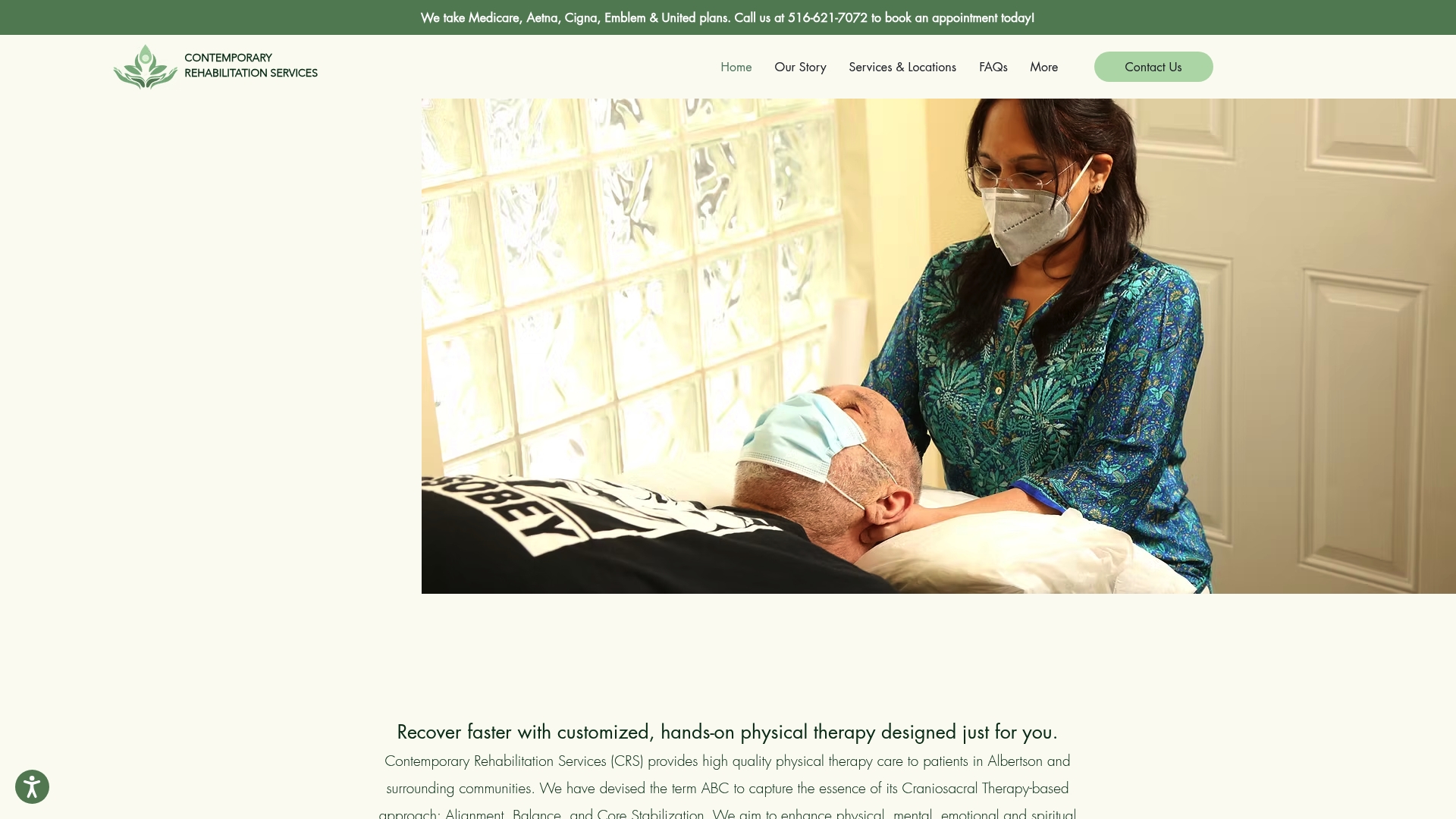
Contemporaryrehabservices accepts Medicare, Aetna, Cigna, Emblem, and UnitedHealthcare, and offers both in-person and virtual physical therapy sessions. The clinic serves Nassau County and Queens, making it a practical option for patients who want a more personalized care model than a regional chain provides. Virtual PT is available for patients who need follow-up care or live outside the immediate area.
The clinic is transparent about its accepted plans and can confirm coverage before your first visit. To see the full range of therapy services offered, or to book an initial evaluation, visit the services page directly.
Note: Contemporaryrehabservices publishes this article. The editorial shortlist above was built on independent criteria; the clinic is presented here as a separate, transparent option for readers who want a boutique manual therapy alternative.
Sources and further reading
American Physical Therapy Association (APTA) — Guidance on evaluating PT providers by specialty certifications and clinical training
OurHealthNetwork — Clifton Park PT Listings — Local provider directory with insurance network data and ratings for the Clifton Park area
Recommended
Comments