
Clinic Tested: Craniosacral Therapy for Concussion and the Evidence

Craniosacral therapy (CST) may offer some patients welcome relief from lingering concussion symptoms, but it is not a proven or guideline-backed standard of care. The CDC’s concussion guidance centers on monitored rest, gradual return to activity, and targeted rehabilitation, while small studies like the Kratz pilot and the Wetzler case series report patient-reported gains worth noting. If you are considering CST, think of it as a possible adjunct to standard care, never a substitute for emergency evaluation or established concussion treatment.
TL;DR:
Craniosacral therapy may provide temporary symptom relief mainly through relaxation and tension release, but it lacks strong evidence as an effective concussion treatment.
Most positive reports involve combined techniques, making it difficult to determine CST’s specific benefit for concussion recovery.
No concussion-specific studies have used randomized controlled trials, and broader reviews show no sound evidence supporting CST for any condition.
Emergency head injury signs requiring immediate care include worsening headache, repeated vomiting, and unequal pupils, which should never be delayed by manual therapy.
CST should be considered an adjunct, not a substitute, to guideline-based concussion management, and patients should track outcomes and communicate with healthcare providers.
Table of Contents
When does a head injury need emergency care instead of manual therapy?
What happens during a session, and how do you choose a therapist?
How does CST fit alongside standard concussion rehabilitation?
How Contemporary Rehab Services approaches craniosacral therapy for concussion
Ready to explore craniosacral therapy as part of your recovery plan?
How does craniosacral therapy work for concussion?
Craniosacral therapy grew out of osteopathic practice and was later popularized through training programs like the Upledger Institute, which teaches practitioners to use light touch along the skull, spine, and sacrum. The theory holds that subtle restrictions around the membranes surrounding the brain and spinal cord, along with the flow of cerebrospinal fluid, can be gently released by hand. Practitioners describe this as supporting the body’s own regulatory rhythms rather than manipulating bone or tissue directly.
For concussion symptoms specifically, the plausible benefits are mostly indirect. Gentle, sustained touch can calm an overactive nervous system, and many patients find the sessions deeply relaxing, which may lower pain perception and improve sleep. CST often addresses tension in the neck and upper back, areas that frequently tighten after a head or whiplash injury and that can themselves drive headaches and dizziness. The therapeutic relationship, the quiet setting, and the slow pace of a session may also contribute to how a patient feels afterward, separate from any direct effect on brain tissue.
One complication worth understanding before you draw conclusions from an anecdote: many of the positive reports in the literature come from protocols that combine CST with visceral manipulation and neural mobilization rather than CST used alone. When three techniques are delivered together, it becomes difficult to say which one, if any, produced the improvement. That blending is common in clinical practice, but it means claims about CST’s specific contribution should be read with some caution.

What does the clinical research actually show?
The research base for CST and concussion is small, and the studies that exist come with real limitations.
A 2017 case series published in PMC followed 11 retired professional football players who received a concentrated program combining craniosacral therapy, visceral manipulation, and neural manipulation. The study reported statistically significant improvements in pain intensity, cervical range of motion, memory scores, reaction time, and sleep. It was single-blinded, had no control group, and used a multi-technique protocol, so the findings are best read as a promising signal rather than confirmation that CST itself caused the changes.
A separate pilot study by Kratz and colleagues looked at patients with post-acute concussion and post-concussion syndrome, starting from a chart review of a large set of records and narrowing to a subset for detailed analysis, with a smaller subset completing a patient-reported outcomes survey. Most respondents reported improvement, and many noticed changes within a few sessions. The design, however, was retrospective and relied on self-report, with meaningful limits on who was included, which keeps it well short of proof.
Broader context comes from a 2024 systematic review that examined CST across musculoskeletal and non-musculoskeletal conditions generally. It found no sound clinical evidence supporting the therapy and noted that earlier studies reporting benefit were often seriously flawed, typically through small sample sizes, lack of blinding, or absent control groups.
Taken together, the picture is one of preliminary, hypothesis-generating signals rather than established proof:
Small case series and pilot studies report patient-level improvements in pain, sleep, and cognitive measures.
None of the available concussion-specific studies used randomization or a true control group.
A broader systematic review found no sound evidence for CST across conditions generally.
Well-controlled trials with objective endpoints, not just patient report, are still needed before CST can be called effective.
When does a head injury need emergency care instead of manual therapy?
Before considering any manual therapy, it helps to know which symptoms mean you need a hospital, not a treatment table. The CDC identifies specific danger signs after a head injury that call for immediate emergency evaluation.
A headache that keeps getting worse rather than improving.
Repeated vomiting or ongoing nausea.
Slurred speech, unusual drowsiness, or trouble waking up.
One pupil larger than the other, seizures, or sudden confusion and agitation.
One documented fact from the research: the CDC’s clinical guidance names worsening headache, repeated vomiting, and unequal pupils among the signs requiring immediate emergency care, underscoring why no hands-on therapy should delay a medical evaluation when these appear.
CST also carries situational contraindications. Anyone with a known intracranial bleed, an unstable cervical spine, a recent skull surgery, an active infection, uncontrolled seizures, or a high bleeding risk from anticoagulant medication should talk with a physician before scheduling cranial work. Published reports describe few serious adverse events tied to CST, but formal safety data specific to acute head injury remain limited, so caution and clinician input matter more than reassurance from case reports.
What happens during a session, and how do you choose a therapist?
A typical CST session runs about 60 minutes, often scheduled weekly, though some small case series have used more intensive formats, including multiple sessions per day over a short stretch. You can expect to lie fully clothed on a treatment table while the therapist uses light, sustained contact at the skull, spine, and sometimes the sacrum, feeling for subtle rhythms and areas of tension. Many practitioners combine this with visceral or neural mobilization techniques in the same visit, which is part of why isolating CST’s specific effect is difficult in the research.
Because training and credentials vary widely among practitioners, a short screening conversation before booking is worth the time.
Ask what their baseline clinical license is, such as physical therapist, occupational therapist, or massage therapist.
Ask about their specific CST training level and certifying body.
Ask whether they have experience treating mild traumatic brain injury or post-concussion syndrome.
Ask whether they are willing to communicate with your physician or physical therapist about your progress.
Ask about session length, cost, and whether your insurance covers the visit.
Pro Tip: Ask for a time-limited trial, such as 4 to 6 sessions, with a simple symptom log or headache diary so you and the therapist can judge together whether it is actually helping.
How does CST fit alongside standard concussion rehabilitation?
Guideline-based concussion care prioritizes patient education, gradually increasing activity as symptoms allow, and targeted rehabilitation for problems that persist, including vestibular, ocular-motor, and cervical physical therapy. These approaches have a stronger evidence base than CST for symptoms like dizziness, visual strain, and neck-related headache.
A reasonable window for trying CST exists after red flags have been ruled out and once standard rehabilitation options have at least been discussed with your provider. For patients whose symptoms involve neck stiffness or vestibular dysfunction, pairing CST with targeted vestibular exercises or a structured vestibular rehab program may offer more complete symptom relief than either approach alone.
Set shared outcome measures with your provider before starting, such as a headache scale or sleep log.
Agree on a defined trial period rather than open-ended sessions.
Keep your physician or physical therapist informed of any changes, positive or negative.
How Contemporary Rehab Services approaches craniosacral therapy for concussion
The clinic offers in-person and telehealth physical therapy alongside craniosacral therapy, myofascial therapy, and vestibular-focused rehabilitation, and accepts major insurance plans. The clinic’s approach starts with a guideline-first evaluation, screens for red flags before any hands-on work begins, and builds coordinated care plans with measurable goals rather than open-ended sessions. When symptoms suggest something beyond manual therapy’s scope, the clinic prioritizes referral to the appropriate specialist.
A measured view on using CST after concussion
Concussion recovery is not one-size-fits-all, and patients deserve options that respect both their symptoms and their safety. A sound approach treats CST as one tool among several, chosen through shared decision-making, tracked against clear goals, and never allowed to delay emergency care or guideline-based rehabilitation when those are what the evidence actually supports.
— CRS Wellness
Ready to explore craniosacral therapy as part of your recovery plan?
If you are weighing craniosacral therapy against other concussion care options, Contemporary Rehab Services offers a coordinated path: an initial intake that screens for red flags, a defined trial of CST alongside physical therapy when appropriate, and outcome tracking so you and your provider can see whether it is working.
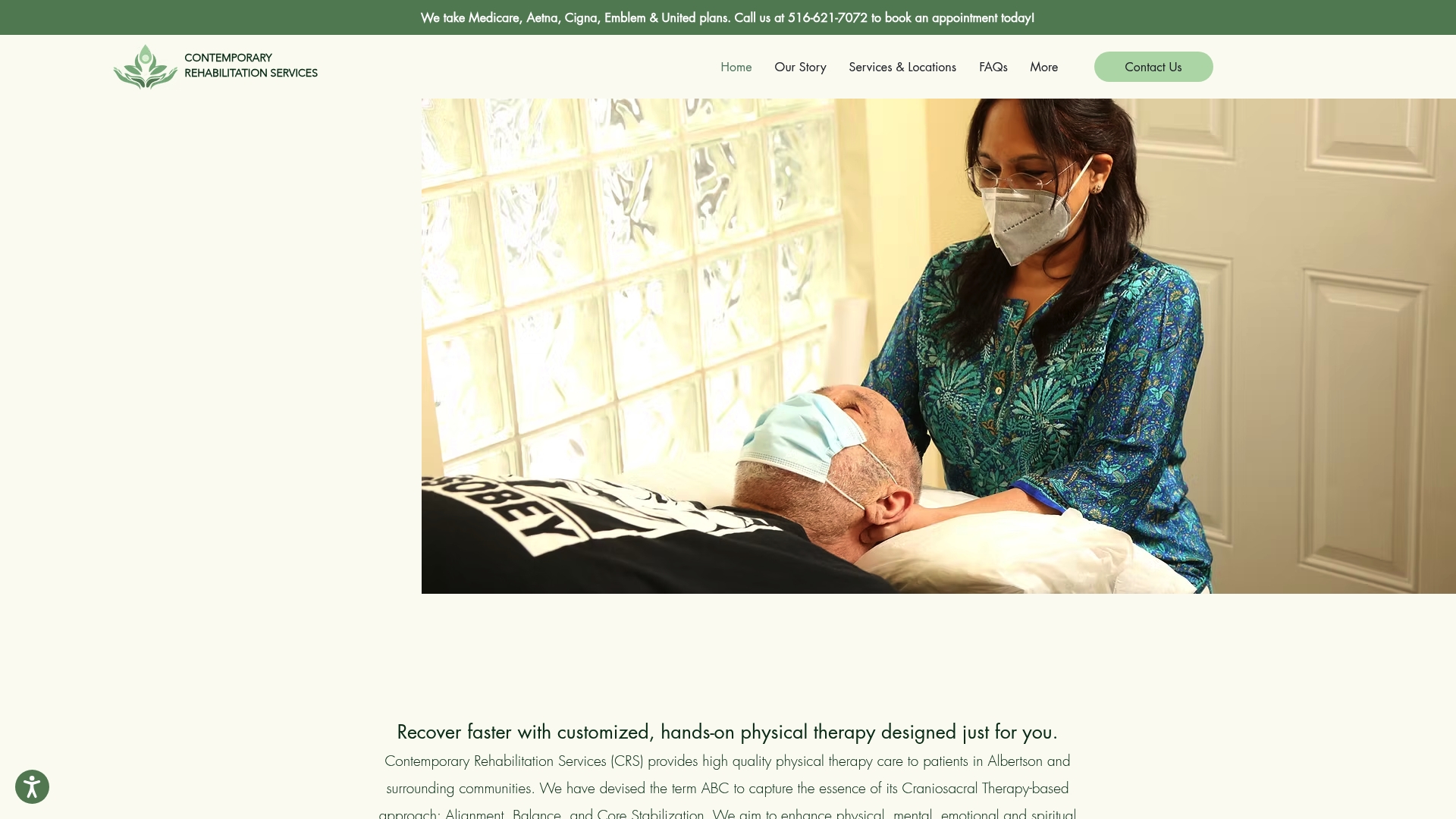
In-person and telehealth physical therapy, craniosacral therapy, and vestibular rehabilitation are all available at the clinic.
Medicare, Aetna, Cigna, Emblem, and United Healthcare are accepted, along with direct payment.
A typical trial includes a baseline symptom review, a set number of sessions, and a follow-up check on measurable goals.
Review the full service offerings or visit the clinic’s main page to schedule an initial evaluation. If you notice any worsening headache, repeated vomiting, or confusion, seek emergency care before booking any therapy session.
Sources
For readers who want to verify these claims directly, the CDC’s concussion guidance outlines emergency warning signs, while the 2024 systematic review summarizes the overall evidence gap for CST. The Kratz pilot study and the Wetzler et al. case series remain the most concussion-specific research available, and a partner guide on concussion management offers additional clinical perspective on assessment and return-to-activity planning.
This article is general information, not a substitute for advice from a qualified doctor. Consult a qualified healthcare professional about your own circumstances before acting on anything here.
FAQ
What is the best therapy for a concussion?
There is no single best therapy for every concussion. Guideline-based care, including rest followed by gradual activity and targeted rehabilitation such as vestibular or cervical physical therapy, has the strongest evidence, while approaches like craniosacral therapy remain supplementary options with limited research support.
Who should not do craniosacral therapy?
People with a known intracranial bleed, an unstable cervical spine, a recent skull surgery, an active infection, uncontrolled seizures, or a high bleeding risk from blood-thinning medication should consult a physician before trying craniosacral therapy. Anyone showing concussion danger signs, such as worsening headache or repeated vomiting, needs emergency evaluation first.
What is the 4-hour rule for concussion?
This term is not part of standard CDC concussion guidance and definitions vary depending on the source. Rather than relying on an informal rule, follow the CDC’s published signs and symptoms guidance for when a head injury requires emergency care.
Can a head massage help a concussion?
Gentle touch and relaxation techniques, including craniosacral therapy, may offer some patients subjective relief from tension and stress after a concussion, but they are not proven treatments for the injury itself. Any worsening symptoms still require prompt medical evaluation rather than reliance on massage alone.
Recommended
Comments