
15 Trials Found No Clear Benefit From Craniosacral Therapy for TMJ

Short verdict: current high-quality evidence does not show a reliable, clinically meaningful benefit from craniosacral therapy for TMJ, though some patients report feeling better afterward. If your jaw pain is new, start with conservative, reversible care first. If you want to try craniosacral therapy, do so as an add-on, with a licensed provider, and with clear goals you can measure. Here is what the research, the safety data, and provider selection should tell you before you book a session.
TL;DR:
There is no reliable evidence that craniosacral therapy provides clinically meaningful benefits for TMJ or other musculoskeletal pain conditions.
Most studies are limited by small sample sizes, high risk of bias, and inconsistent application methods, making it difficult to confirm any specific effect.
Patients may experience short-term relief due to stress reduction and placebo effects, but these are not supported by high-quality research.
Craniosacral therapy should only be considered as an adjunct, not a primary treatment, after proven conservative measures like physical therapy and self-care.
It is important to choose licensed, experienced providers and set measurable goals, stopping therapy if clear improvements are not seen within six weeks.
Table of Contents
What craniosacral therapy is and how it may affect TMJ symptoms
Craniosacral therapy (CST) is a light-touch manual technique built on the idea that practitioners can feel and gently influence a subtle rhythm in the fluid surrounding your brain and spinal cord, sometimes called the “primary respiratory mechanism.” The theory holds that restrictions in this rhythm contribute to pain and dysfunction, including in the jaw, and that gentle manipulation can release them. This concept has never been confirmed through imaging or physiology studies, so it should be understood as a working theory rather than an established fact.
For TMJ specifically, a therapist trained in CST may work through techniques such as:
Gentle palpation of the skull, jaw, and neck to assess tension patterns.
Light craniofacial “mouth work,” where a gloved finger applies subtle pressure inside the cheek near the jaw joint.
Slow, low-force mobilizations meant to ease tightness around the temporomandibular joint and surrounding muscles.
Even without proof of a specific cranial mechanism, there are plausible reasons some patients feel relief. Slow, attentive touch can lower stress and muscle guarding, and the calm, unhurried pace of a CST session may itself reduce the jaw clenching that often drives TMJ pain. Placebo and contextual effects, the comfort of being heard and touched by a caring provider, also play a documented role in how people perceive pain relief across many manual therapies. None of this proves CST works through the mechanism its founders describe. It does explain why some people notice a difference even when controlled trials do not.
What the research says about craniosacral therapy for pain conditions
The strongest available evidence on CST does not come from TMJ-specific trials. It comes from broader reviews of musculoskeletal pain, and the findings are consistent enough to guide expectations.
A 2024 systematic review and meta-analysis of randomized controlled trials found that CST produced no statistically significant or clinically relevant benefit for conditions including headaches, neck pain, low back pain, pelvic girdle pain, and fibromyalgia. A separate 2024 systematic review and meta-analysis reached the same conclusion after evaluating 15 randomized controlled trials, reporting insufficient evidence that CST helps musculoskeletal or non-musculoskeletal conditions and flagging serious concerns about study quality and the biological plausibility of the underlying theory.

Fifteen randomized controlled trials were pooled in the 2024 meta-analysis, and the authors found no clinically meaningful improvement attributable to CST once study quality was accounted for, a signal that current trial data does not support the therapy as an effective standalone treatment.
Both reviews point to the same underlying problems:
Small sample sizes that make it hard to detect a true effect even if one exists.
Wide differences in how CST was applied, measured, and compared across studies, which researchers call heterogeneity.
High risk of bias, including trials without proper blinding, since it is difficult to disguise a hands-on treatment from participants or therapists.
Some individual trials and patient reports do describe improvement after CST sessions. Reviewers treat these results cautiously because the studies carry a high risk of bias and the gains may reflect the natural course of a condition or the comfort of receiving focused attention, rather than a specific effect of the technique itself. Earlier reviews and clinical summaries have reached similar conclusions for years, repeatedly noting that the CST literature has not matured into higher-quality trials despite the therapy’s long history of use.
None of this means CST is dangerous or worthless for every patient. It means the evidence does not currently support it as a proven treatment for TMJ pain, and claims of guaranteed relief should be treated skeptically. If you decide to try it, treat the experience as a personal trial: set a specific, time-limited goal, such as reduced jaw clicking or a wider pain-free opening within four to six weeks, and reassess honestly at the end of that window.
How craniosacral therapy fits alongside mainstream TMJ care
The National Institute of Dental and Craniofacial Research recommends a conservative-first approach to TMJ disorders, often summarized as “less is best.” That means starting with reversible measures such as self-care, jaw exercises, and heat or ice before considering anything more invasive, and avoiding irreversible dental or surgical changes unless the evidence clearly supports them for your specific case.
Manual therapy performed by a trained physical therapist sits in the middle of that pathway. Targeted jaw exercises, myofascial release, and joint mobilization have a more established track record for improving function and easing pain in TMJ-related musculoskeletal problems, and exercise remains a core part of standard PT management for many patients. CST shares some surface-level goals with this approach, easing muscle tension and improving comfort, but it is not the same discipline, and it should not replace exercise-based, hands-on physical therapy as the foundation of care.
Other complementary options carry limited but real supporting evidence:
Acupuncture has shown possible short-term benefit for TMD symptoms in small studies, though quality varies.
TENS (transcutaneous electrical nerve stimulation) has similarly modest, mixed evidence but is included among reasonable options.
CST might reasonably be considered as an adjunct once conservative, evidence-backed care is already underway, not as a first-line substitute for it.
Because there is no single recognized TMD specialty, the more useful filter is experience: look for clinicians with real musculoskeletal and TMJ treatment backgrounds rather than choosing a provider based on a therapy label alone. If you want a deeper look at how targeted physical therapy addresses jaw pain, TMJ physical therapy covers the exercise and manual therapy approaches most often used.
What a craniosacral therapy session for TMJ typically looks like
A first CST session for jaw pain usually follows a predictable pattern, even though the pacing is slower than most people expect from hands-on care.
Intake and history: your provider asks about your pain pattern, jaw clicking or locking, stress levels, sleep, and any prior dental or medical treatment.
Gentle cranial palpation: light contact on the skull, neck, and upper back to assess tension and mobility before any jaw-specific work begins.
Targeted craniofacial work: subtle pressure near the jaw joint and surrounding muscles, sometimes including light intraoral technique.
Home-care guidance: simple stretches, posture cues, or relaxation strategies to practice between visits.
Sessions typically run 30 to 60 minutes, and many providers suggest a trial course of visits to judge whether the approach is helping. That number is a common clinical convention, not a figure supported by controlled trial data, so treat it as a starting point for discussion rather than a fixed prescription.
Pro Tip: Track one or two specific measures, like pain-free mouth opening or clicking frequency, before starting and after each session so you and your provider can judge progress objectively rather than by impression alone.
When a licensed physical therapist provides CST as part of a broader manual therapy plan, it may be billable under standard PT and manual therapy codes rather than as a separate wellness service, which can simplify insurance coordination. Details on acceptance of specific insurance plans belong with the clinic offering the service, so ask directly before your first visit.
Safety, risks, and who should avoid craniosacral therapy
CST is a low-force technique, and serious complications are rare when it is performed by a trained clinician. Still, certain situations call for caution or a different approach entirely.
Recent significant head or neck trauma, including undiagnosed concussion, should be evaluated medically before any manual cranial work.
Unstable vascular conditions, such as an aneurysm or recent stroke, are a reason to avoid CST until a physician clears it.
Severe osteoporosis and active infection near the head, neck, or jaw are also reasons to pause or skip treatment.
Rare adverse outcomes have been reported with manual therapies broadly, which is why disclosing your full medical history and current medications matters before starting.
Seek prompt medical or dental evaluation, not CST, if you notice new neurologic symptoms, rapidly worsening pain, jaw locking that will not release, or any sign of infection such as fever or swelling.
Choosing a qualified provider for TMJ manual therapy
The right credentials matter more than the therapy label. Before booking, confirm the following:
The provider is a licensed physical therapist, osteopathic physician, or other credentialed clinician, not someone practicing outside a recognized scope.
They have specific training and experience treating TMJ or craniofacial conditions, not just general CST certification.
They are willing to coordinate care with your dentist or physician, especially if you have an existing diagnosis or ongoing dental work.
They propose clear, measurable goals for your treatment course rather than an open-ended plan.
On your first visit, ask what training they have in TMJ care, what specific improvement you should reasonably expect and by when, how they will measure progress, and what alternatives exist if CST does not help within that window.
Pro Tip: A provider who promises a guaranteed cure, pushes irreversible dental changes early, or resists talking to your dentist or physician is a signal to look elsewhere.
If you want more detail on how manual therapy techniques differ and complement each other, manual therapy for pain relief breaks down the range of hands-on approaches beyond CST alone.
Our approach to using craniosacral therapy responsibly
At CRS Wellness, we treat craniosacral therapy as one tool among several, never the whole plan. A typical TMJ program combines targeted exercise, manual therapy, and CST only when it fits a patient’s specific presentation and goals. We set measurable benchmarks from the start, track them honestly, and coordinate with a patient’s dentist or physician whenever their care overlaps with ours. That transparency, more than any single technique, is what keeps a treatment plan trustworthy.
— CRS Wellness
Getting help with TMJ pain at Contemporary Rehab Services
If jaw pain is affecting how you eat, sleep, or talk, a conservative, well-coordinated plan is worth pursuing before anything irreversible. Individualized treatment for TMJ and related conditions is available, built around a one-on-one approach rather than a one-size-fits-all protocol.
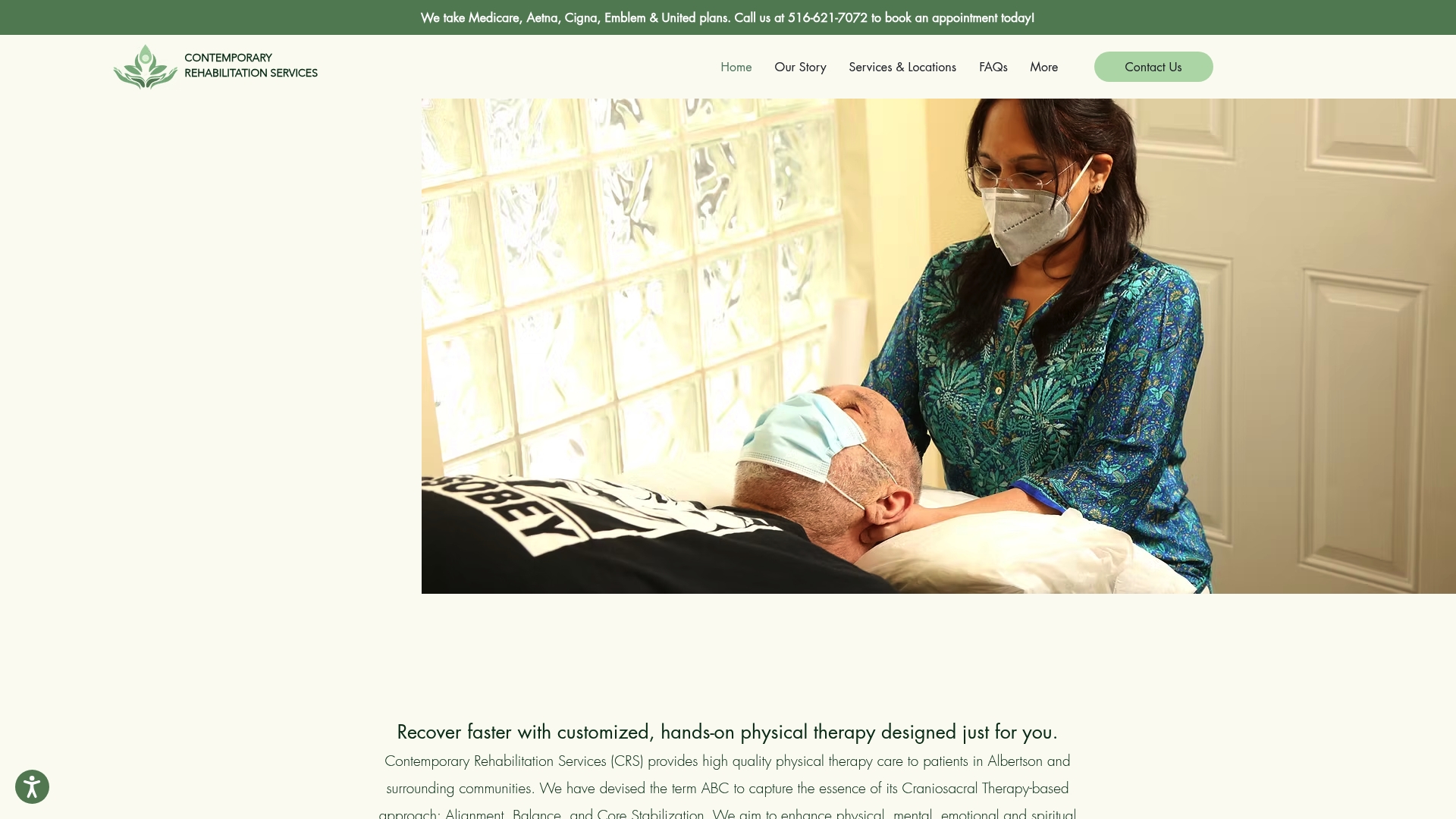
Services relevant to TMJ care may include craniosacral therapy as part of a broader individualized plan, physical therapy, myofascial therapy, joint mobilization to address muscle tension and joint mechanics, and telehealth sessions for guidance on home exercises and self-care between visits. Insurance acceptance and payment options should be confirmed directly with the provider. To see the full range of manual therapy services we offer, visit our service overview page, or book an appointment to start with an evaluation and a plan built around your specific symptoms.
This article is general information, not a substitute for advice from a qualified doctor. Consult a qualified healthcare professional about your own circumstances before acting on anything here.
Sources
FAQ
Who should not try craniosacral therapy?
People with recent significant head or neck trauma, unstable vascular conditions such as an aneurysm, severe osteoporosis, or an active infection near the head or neck should avoid CST until a physician clears them. Always disclose your full medical history and current medications before your first session.
Can craniosacral therapy help with migraines?
CST is sometimes tried for headache and migraine symptoms, but the best available systematic review found no statistically significant or clinically relevant benefit for headache conditions among the musculoskeletal issues studied. Any relief some patients report is more likely tied to relaxation or non-specific effects than a proven mechanism.
Does craniosacral therapy actually work for TMJ?
Current evidence does not show a reliable, clinically meaningful effect from CST for TMJ or related musculoskeletal pain, according to recent meta-analyses of randomized trials. Some patients report subjective improvement, but reviewers attribute this largely to study limitations, placebo response, or the natural course of symptoms rather than a specific treatment effect.
Is craniosacral therapy the same as myofascial release?
No, they are distinct techniques with different theoretical bases and touch pressure. Myofascial release targets tension in muscle and connective tissue with moderate pressure, while CST uses very light touch aimed at a proposed cranial rhythm, and the two are sometimes combined within a broader manual therapy plan such as the one described in our craniosacral therapy guide.
What does NIDCR recommend for TMJ treatment?
The NIDCR recommends starting with conservative, reversible measures like self-care, jaw exercises, and heat or ice, reserving manual therapy as an intermediate step, and avoiding irreversible dental or surgical procedures unless strongly supported by evidence.
Recommended
Comments