
Vestibular Rehab for Dizziness: What to Expect and Timeline
Updated: Sep 26

Vestibular rehabilitation, a targeted, exercise-based form of physical therapy, is the standard treatment for dizziness and balance problems, and it commonly reduces symptoms and fall risk. The Academy of Neurologic Physical Therapy’s clinical practice guideline and Cleveland Clinic both back this approach for people with vestibular hypofunction.
Your next step matters more than any exercise you could look up on your own:
Get evaluated by a physical therapist trained in vestibular rehabilitation before starting exercises on your own.
Bring a list of your symptoms, triggers, and any imaging or hearing tests you’ve already had.
Ask whether your specific dizziness pattern points to BPPV, a peripheral issue, or something that needs a referral first.
Key takeaways
Vestibular rehabilitation resolves BPPV in as few as one to three visits and reduces dizziness and fall risk for most other vestibular conditions within six to sixteen weeks.
Point | Details |
VRT is exercise-based | Gaze stabilization, habituation, and balance training form the three core pillars of treatment. |
BPPV responds fastest | Canalith repositioning can resolve BPPV in 1 to 3 visits and is up to 89% effective after one treatment. |
Most cases take weeks, not days | Non-BPPV vestibular issues typically need 6 to 8 weeks; complex cases can take 8 to 16+ weeks. |
Diagnosis comes before exercises | Get evaluated first, since different vestibular conditions need different exercises entirely. |
CRS Wellness offers direct access | CRS Wellness provides in-person and virtual vestibular rehab and accepts Medicare, Aetna, Cigna, Emblem, and United Healthcare. |
Table of Contents
What Is Dizziness Physical Therapy and How Does It Work?
Dizziness physical therapy, more precisely called vestibular rehabilitation therapy (VRT), retrains the brain and inner ear to work together again after they’ve fallen out of sync. It’s exercise-based, not passive. You do specific movements, repeatedly, so your nervous system relearns how to interpret motion signals correctly.
A lot of this hinges on the vestibulo-ocular reflex (VOR), the automatic connection between your inner ear and eye muscles that keeps your vision steady when your head moves. When the VOR misfires, the world seems to jump or blur every time you turn your head. Fixing that reflex is often the fastest route to feeling normal again.
Three mechanisms drive recovery, according to a PMC review of vestibular disorder treatment:
Adaptation: the brain recalibrates the VOR through repeated head and eye movement drills.
Substitution: other senses, like vision and proprioception, take over functions the inner ear can no longer handle alone.
Habituation: repeated exposure to a dizziness-triggering movement reduces the brain’s response to it over time.
Pro Tip: Recovery isn’t about avoiding what makes you dizzy. It’s about controlled, repeated exposure to it, at a dose your therapist sets, so your brain stops overreacting.
What Exercises and Clinic Visits Actually Look Like
A typical vestibular rehab program leans on a few well-studied exercise categories, tailored to what’s actually wrong with your system, according to StatPearls.
Gaze stabilization (VOR x1, VOR x2): you fix your eyes on a target while moving your head side to side or up and down, sometimes while the target itself moves too. It looks simple. It’s often the most nausea-inducing exercise in the whole program, at first.
Habituation drills: repeated exposure to specific triggers, like bending over or rolling in bed, at a controlled pace and dose.
Balance retraining: progressions from standing with feet together (Romberg), to tandem stance, to standing on foam or uneven surfaces, to walking while turning your head.
If your diagnosis is BPPV, benign paroxysmal positional vertigo caused by displaced calcium crystals in the inner ear, your therapist will likely use a canalith repositioning maneuver, a specific sequence of head and body movements that guides those crystals back where they belong. This is not something to try from a YouTube video. It has to be directed by a clinician who has identified which canal is affected, since the wrong maneuver can make things worse. Canalith repositioning can be up to 89% effective after a single treatment when done correctly.
A typical visit starts with a symptom and function check, moves into supervised practice of that week’s exercises, includes some hands-on coaching on form, and ends with a home program update. Home practice usually means two short sessions a day rather than one long one, tied to something you already do daily, like brushing your teeth, according to the California Brain & Spine Center. Consistency beats intensity here. For more on doing exercises safely between visits, see these home exercise safety tips.

Who Actually Benefits From Vestibular Rehab?
Vestibular rehab helps people across a range of diagnoses, though the strength of evidence varies by condition:
BPPV (displaced inner-ear crystals)
Unilateral or bilateral vestibular hypofunction (reduced inner-ear signal on one or both sides)
Post-concussion vestibular disorder
Vestibular migraine
Post-viral labyrinthitis or vestibular neuritis
Evidence is strongest for peripheral causes like BPPV and vestibular hypofunction, where the NeuroPT/APTA clinical practice guideline recommends offering VRT to adults with these impairments. Support is also solid for older adults managing fall risk, covered in more depth in our guide to PT for balance disorders. Evidence for some central causes, like certain migraine-related dizziness, is still emerging. If your evaluation turns up red flags or an unclear diagnosis, your therapist should refer you to an ENT or neurologist before proceeding.
How Long Does Vestibular Rehab Take to Work?
Timelines depend heavily on your diagnosis, not just how motivated you are. According to Cleveland Clinic, BPPV often resolves in just 1 to 3 visits once the correct repositioning maneuver is applied. Most other non-BPPV vestibular issues take several weeks, and complex or chronic cases, including some post-concussion or long-standing bilateral hypofunction cases, can take many weeks or longer.
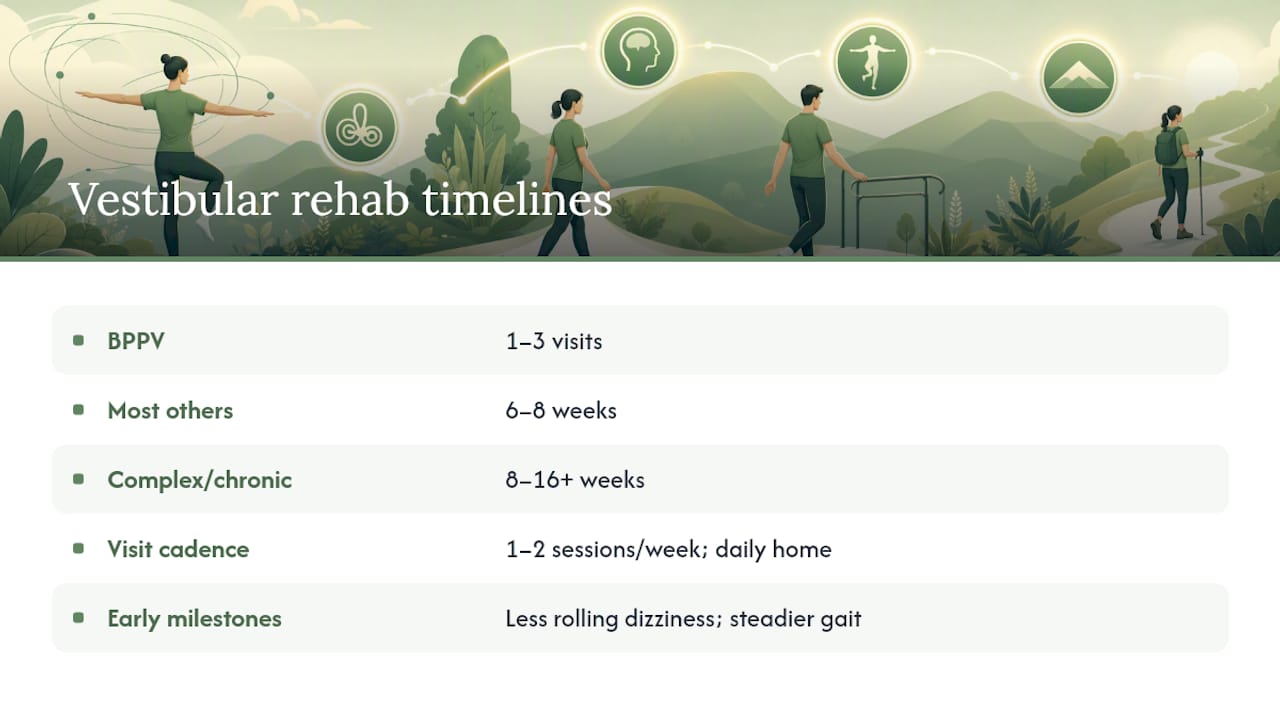
Visit cadence usually runs 1 to 2 clinic sessions per week, paired with short daily home drills. Between visits, your therapist tracks progress using dizziness questionnaires, gait and balance tests, and sometimes fall-risk screens. Realistic early milestones look like less dizziness when rolling in bed, steadier walking in a dim hallway, or fewer near-falls, not a complete absence of symptoms in week one.
Earlier initiation of therapy after acute vestibular neuritis tends to produce better long-term outcomes than delaying care, which is one more reason not to wait out a spinning room hoping it resolves on its own.
What Are the Risks and Warning Signs to Watch For?
A short-lived increase in dizziness during and right after certain exercises is common and expected. It’s a normal part of habituation, and your therapist should dose the intensity so it doesn’t overwhelm you. Some medications, particularly vestibular suppressants like meclizine, can actually blunt your brain’s ability to compensate, so review anything you’re taking with your therapist or prescriber.
Certain symptoms are not part of normal recovery and need urgent evaluation:
Sudden, severe headache unlike any you’ve had before
Repeated vomiting
New double vision
Sudden weakness or numbness
Fainting or loss of consciousness
What to Expect at Your First Vestibular Evaluation
Your first visit typically includes a detailed symptom history, oculomotor testing to check eye movement control, a gait and balance assessment, and a review of current medications. Bring your medication list, notes on what triggers your dizziness, and any prior audiology, CT, or MRI results if you have them.
CRS Wellness accepts Medicare, Aetna, Cigna, Emblem, and United Healthcare, and offers both in-person and virtual vestibular rehab sessions. If you’re frail or at high fall risk, mention this up front so your therapist can adjust positioning and supervision during testing.
What Most People Get Wrong About Recovering From Dizziness
The biggest misconception we see is that dizziness should be avoided until it disappears on its own. That instinct is understandable, and it’s usually the wrong move. Avoidance lets the brain’s overreaction to motion calcify instead of fade, and it often adds a second problem: deconditioning from months of moving less.
The conventional advice, “rest until it passes,” works for a stomach bug. It tends to backfire for vestibular issues, where controlled, repeated exposure is what actually retrains the system. That’s not intuitive, and it’s a big part of why so many people white-knuckle their way through months of dizziness that a structured program could likely shorten.
If you take one thing from the evidence, prioritize getting an accurate diagnosis first. BPPV, vestibular hypofunction, and vestibular migraine can all cause similar-feeling dizziness, but they respond to different exercises entirely. Doing the wrong drills for your specific problem wastes time and sometimes worsens symptoms. A proper evaluation before you start is not an extra step. It’s the step that makes everything after it work.
How CRS Wellness Can Get You Started With Vestibular Rehab
If you’ve been putting off dealing with your dizziness because you’re not sure where to start, CRS Wellness offers individualized vestibular rehabilitation programs, in person and by telehealth, and accepts Medicare, Aetna, Cigna, Emblem, and United Healthcare, so cost isn’t a mystery before you even book.
Scheduling takes two forms: book online or call the clinic directly. Your first visit includes a full vestibular evaluation, oculomotor and balance testing, and a personalized home program before you leave. Most patients return weekly or every other week for supervised progression while doing short daily drills at home in between.
If you’re in the Roslyn Heights or Albertson area and ready to stop guessing about what’s causing your dizziness, schedule an evaluation at our Albertson location or check our Roslyn Heights service page for appointment details near you.
Frequently Asked Questions About Dizziness Physical Therapy
How long does dizziness physical therapy take to work? BPPV often resolves in 1 to 3 visits. Most other vestibular conditions need 6 to 8 weeks of treatment, while complex or chronic cases can take 8 to 16 weeks or more.
Can vestibular rehab make my dizziness worse before it gets better? Short-term symptom increases during exercises are common and expected. Your therapist controls the dose so it stays manageable while your brain adapts.
Do I need a doctor’s referral before starting vestibular rehab? Requirements vary by insurance plan and state. Many physical therapy clinics, including CRS Wellness, can evaluate you directly, though your evaluation may lead to a referral to an ENT or neurologist if red flags appear.
Is vestibular rehab the same as balance training for older adults? They overlap. Balance training is one component of a full vestibular rehab program, which also includes gaze stabilization and habituation exercises specific to your diagnosis. See our balance exercise guide for more on the balance-specific piece, and consider strength training’s role in stability as a complementary approach.
This article is general information, not a substitute for advice from a qualified doctor. Consult a qualified healthcare professional about your own circumstances before acting on anything here.
Sources
Recommended
Comments