
Stop Marathon Icing: Heat vs Ice with 15 to 20 Minute Home Protocols
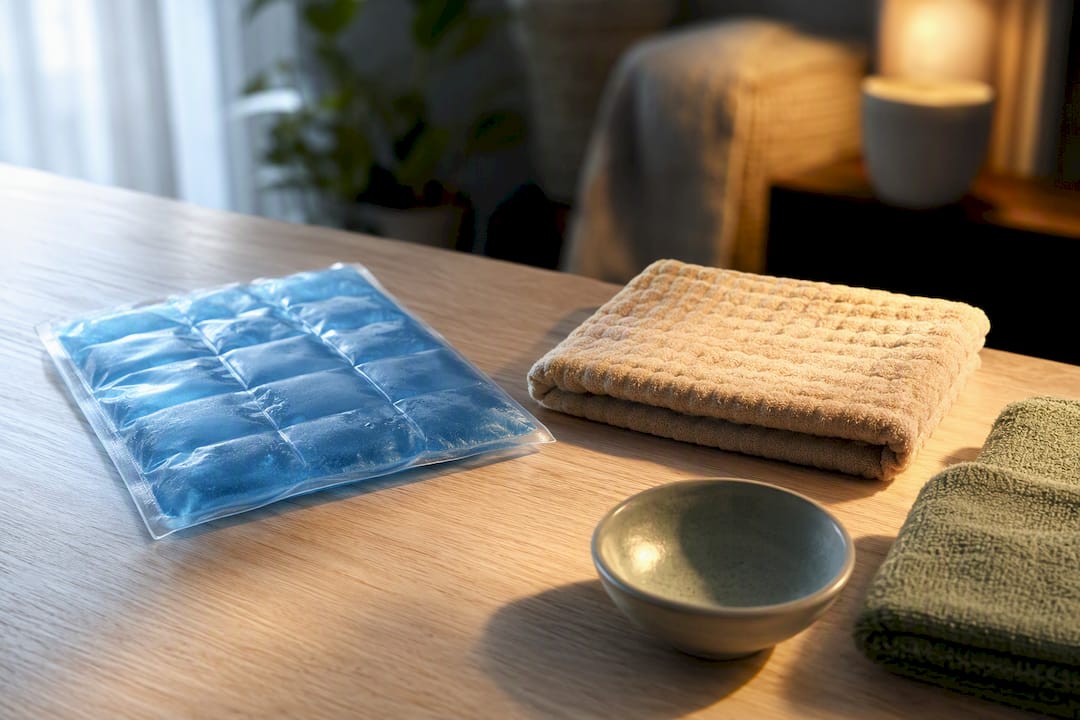
Use ice for a new injury with visible swelling, and use heat for stiffness or a chronic ache that needs loosening up. Always keep a cloth barrier between the ice pack or heating pad and your skin, and cap each session around 15 to 20 minutes. These are symptomatic tools, not a cure. If pain lingers or worsens, they work best alongside a real rehabilitation plan, not instead of one.
TL;DR:
Icing is most effective within the first 12 to 24 hours after injury to reduce swelling and sharp pain, but prolonged use can hinder healing signals.
Applying heat is suitable for chronic stiffness and muscle tightness, but it should be avoided during active inflammation or when swelling is visible.
Both therapies require a barrier between the skin and the appliance, with sessions limited to 15 to 20 minutes to prevent skin damage.
Transition from ice to heat once swelling decreases and the area no longer feels hot, typically after the initial few days.
Medical guidance strongly recommends avoiding heat on open wounds, active inflammation, or in conditions like circulatory or nerve disorders.
Table of Contents
Heat vs Ice: What Inflammation Tells You About Which One to Use
Inflammation is your body’s repair crew showing up at the scene. When you sprain an ankle or tweak your lower back, blood vessels dilate, fluid moves into the tissue, and you get the classic swelling, redness, and warmth. That’s acute inflammation, and it’s different from the dull, tight stiffness that builds up in a joint over months of overuse or arthritis.
The physiology explains why the two therapies work in opposite directions:
Ice constricts blood vessels, slows local metabolism, and numbs nerve endings, which is why it calms fresh swelling and sharp pain.
Heat dilates blood vessels, increases circulation, and makes connective tissue more pliable, which is why it eases tightness and helps muscles move more freely.
Both are supports, not solutions. The real driver of recovery is getting the joint or muscle moving again in a controlled way, which is exactly what a structured rehabilitation program is built to do.
When to Use Ice for Acute Injuries and Swelling
Ice is the right call within the first day or two after a new sprain, strain, or hard knock. It’s also useful after an intense workout when a joint puffs up or after most post-surgical procedures, once your surgeon clears it.
How to apply it safely:
Wrap the ice pack, gel pack, or bag of frozen vegetables in a thin towel. Never place ice directly against skin.
Apply for about 15 to 20 minutes at a time.
Leave enough time between sessions to let skin temperature normalize.
Repeat several times a day during the early phase if swelling is significant.
Combine with compression and elevation when the injury involves a limb.
The most common mistake is leaving ice on too long in one sitting, or icing continuously for days on end. Sports medicine reviews note that icing beyond roughly 12 to 24 hours can start interfering with the inflammatory signals your tissue needs to regenerate, so shorter, targeted sessions in the early window beat marathon icing.
Pro Tip: Check the skin under the ice pack every five minutes during your first session. If it turns white, waxy, or numb beyond mild coolness, remove the pack immediately. That’s an early frostbite warning, not a sign it’s “working.”
When to Use Heat for Stiffness, Chronic Pain, and Pre-Activity Warmup
Heat shines when the problem is tightness rather than swelling: a stiff neck after sleeping wrong, chronic low back pain, arthritic knees, or muscles you want loose before stretching or exercise. Clinical guidance points to a practical goal here: raising tissue temperature by roughly 9 to 12 degrees Fahrenheit below the skin is what actually improves how pliable soft tissue becomes before you load it.
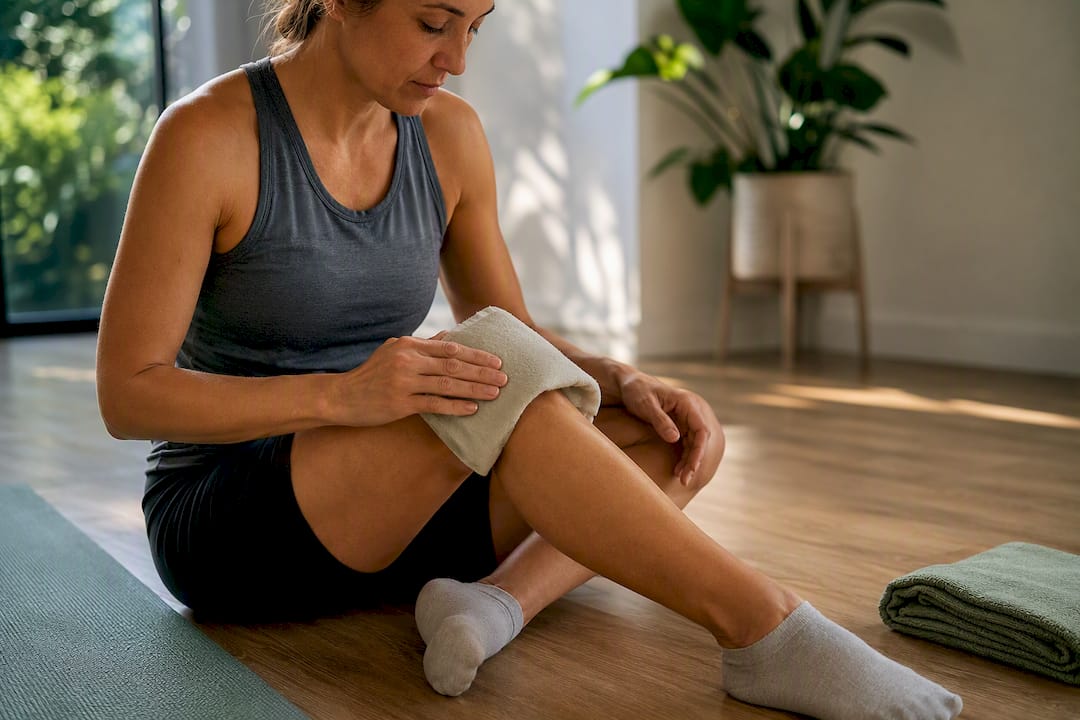
Moist heat (a warm, damp towel or hydrocollator pack) tends to penetrate deeper than dry heat from an electric pad.
Keep a towel barrier between the source and skin, and don’t exceed skin temperatures above 113°F.
Sessions of about 15 to 20 minutes are typically enough; longer than that offers diminishing returns and rising burn risk.
Never fall asleep on a heating pad.
Heat is the wrong choice on a joint that’s currently hot, red, or visibly swollen. Applying warmth to active inflammation can worsen it rather than calm it, according to Harvard Health’s guidance on cold versus heat therapy. Skip heat on open wounds, and use extra caution if you have reduced skin sensation.
Pro Tip: If you’re prepping for a stretching session or a round of soft tissue mobilization, apply heat about 10 minutes beforehand. Warm tissue stretches farther before it complains.
When to Switch From Ice to Heat, and How to Combine Them
The switch point isn’t a fixed hour on the clock. It’s a signal: once visible swelling has gone down and the area no longer feels hot to the touch, you can transition to heat.
Days 1 to 3 (or until swelling subsides): short, targeted ice sessions, especially after any activity that flares the area.
Once swelling resolves: shift to heat before movement, stretching, or strengthening work.
Ongoing chronic stiffness with no active swelling: heat becomes your primary tool, used before activity rather than after.
A typical moderate ankle sprain follows this arc: cold with compression and elevation for the first day or so, then moist heat before supervised range-of-motion and strengthening exercises once the swelling has settled. Contrast therapy, alternating cold and heat, sometimes helps with chronic conditions where circulation is the main goal, but it isn’t a substitute for the movement-based work that actually rebuilds strength and range.
Safety Rules, Contraindications, and When to Get Help
A few checks protect you regardless of which modality you’re using. Never place either ice or a heating source directly on skin, and inspect the skin during your first application of any new device. Stop immediately if you notice numbness, blistering, or unusual redness.
Diabetes with peripheral neuropathy: reduced sensation means you may not feel a burn or frostbite forming until real damage is done.
Circulatory disease: impaired blood flow changes how tissue responds to temperature extremes.
Open wounds or active skin infections: both heat and ice are off-limits until healed.
Fever or systemic illness: heat application can be counterproductive.
Anyone in these groups should get clinician clearance before using heat or ice unsupervised at home.
Seek medical attention promptly if pain keeps increasing rather than easing, redness spreads beyond the original area, you lose function in a joint or limb, or a fever develops alongside the injury. None of these are things a heating pad or ice pack should be asked to solve.
What the Clinical Evidence Actually Says
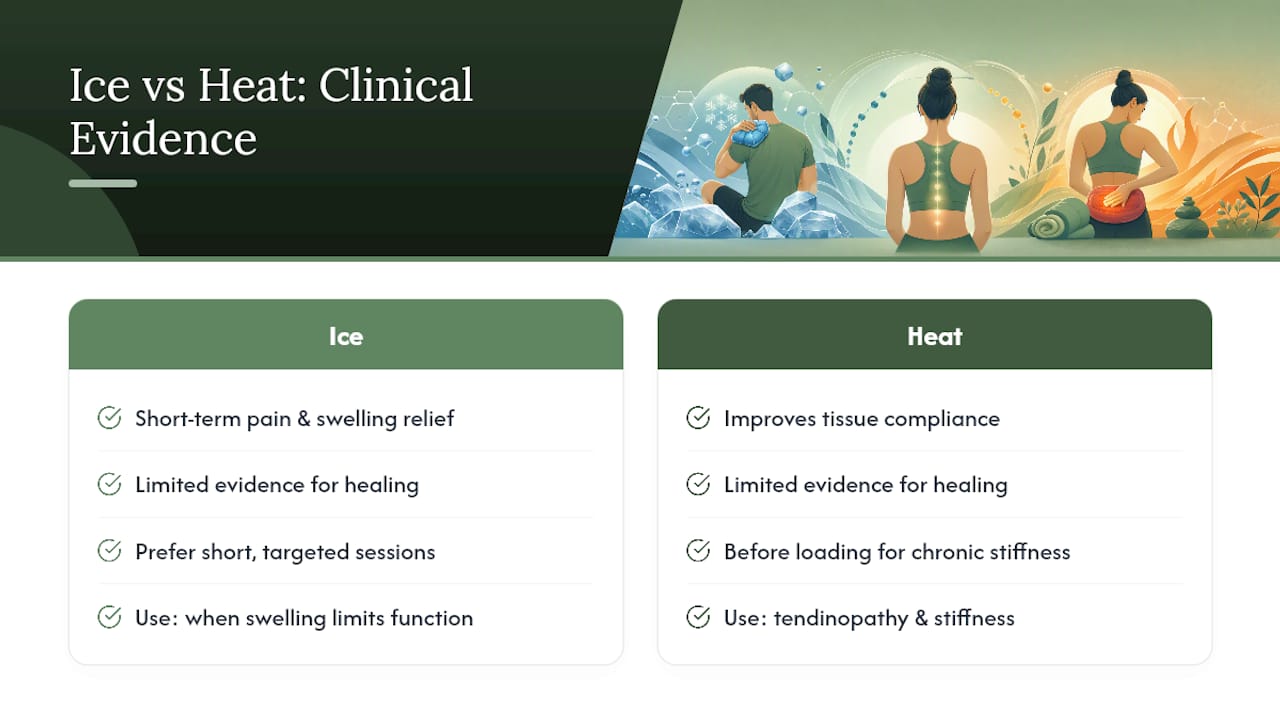
The honest answer is that both therapies are better at managing symptoms than at speeding up biological healing. A review in PubMed Central on physical modalities in rehabilitation concludes that ice and heat offer real symptomatic relief, but there’s limited evidence either one accelerates tissue repair on its own. A Cochrane-style review of cryotherapy for soft tissue injuries found only marginal support for ice improving outcomes beyond short-term pain and swelling control, and optimal icing duration remains genuinely unsettled in the research.
Guidance has shifted in recent years. The PEACE & LOVE framework, now widely referenced in sports rehabilitation, moved practice away from routinely suppressing inflammation and toward protecting the injury while loading it appropriately, with ice reserved for cases where swelling is actively limiting function.
Short, targeted icing (typically several minutes per session) is increasingly favored over prolonged icing, because it balances pain relief against preserving the inflammatory signals tissue needs to repair itself.
For chronic stiffness and tendinopathy, heat before loading tends to produce better immediate functional gains than cold does, largely because it increases how compliant the tissue is before you ask it to stretch or bear weight.
How CRS Wellness Uses Heat and Ice in Practice
At CRS Wellness, temperature-based care is a starting point, not the plan itself. A typical pathway looks like assessment first, then brief modality use to calm pain or loosen tissue, then progressive loading through hands-on techniques like joint mobilization or myofascial work. Patients often ask which one to use at home before their first visit, and the honest answer is usually “both, at different stages.” Anyone with neuropathy or circulatory concerns gets supervised modality use rather than an unsupervised heating pad at home.
— CRS Wellness
Ready to Move Past Guesswork? Book an Evaluation
Home ice packs and heating pads handle a lot, but they can’t tell you why your knee keeps swelling up or why your shoulder stays stiff no matter how much heat you throw at it. That’s where a hands-on evaluation earns its place. An experienced physical therapy clinic offers services that may be covered by various insurance plans, along with cash payment options, so getting an individualized plan doesn’t have to mean an out-of-pocket surprise.
If self-care isn’t resolving your pain, or if you noticed any of the red flags mentioned above, the next step is a proper assessment rather than another week of trial and error. Readers near Nassau County can book directly through the Albertson clinic page, while those closer to Queens have local options through the Great Neck Plaza and Great Neck Estates location pages. This route fits people who need an individualized plan and insurance-covered physical therapy, not a one-size-fits-all stretch routine.
Sources
Guidance in this article draws on peer-reviewed rehabilitation research, sports medicine consensus on icing duration, and Harvard Health’s practical safety recommendations for home use of heat and cold.
This article is general information, not a substitute for advice from a qualified doctor. Consult a qualified healthcare professional about your own circumstances before acting on anything here.
FAQ
Why is heat not good for swelling?
Heat dilates blood vessels and increases circulation, which can pull more fluid into an already swollen area and worsen the inflammation rather than calm it.
Why is ice no longer routinely recommended for every injury?
Prolonged icing beyond the early window may blunt the inflammatory signals tissue needs to repair itself, which is why current guidance favors short, targeted icing sessions instead of continuous cold.
At what point do you switch from ice to heat for an injury?
Switch once visible swelling has gone down and the area no longer feels hot to the touch, typically within the first few days after a mild to moderate injury.
Should I use heat or ice on a sprained ankle?
Use ice with compression and elevation for the first day or two while swelling is present, then shift to heat before range-of-motion and strengthening exercises once the swelling subsides.
Recommended
Comments