
Joint Mobilization for Shoulder Stiffness: What to Expect

Joint mobilization is a hands-on physical therapy technique in which a therapist gently glides or stretches the shoulder joint to ease pain and restore motion. For a stiff shoulder, it is most useful alongside exercise, and it works best when the treatment is matched to how irritable your shoulder is right now. Below, we explain what the therapist does with their hands, what the research supports and what it does not, and how to tell whether it fits your situation.
TL;DR
Joint mobilization is a clinician-applied gliding or stretching movement of the shoulder joint, graded from gentle (for pain) to firmer (for mobility).
Studies link it to better pain, range of motion and function, but the evidence certainty is limited, so it is best paired with a targeted exercise program.
Treatment intensity should follow how irritable your shoulder is. A very painful shoulder needs a gentler approach than a stiff but calm one.
Mobilization is usually a short-term tool, measured at each visit, not an open-ended routine.
If your shoulder has been getting steadily stiffer, especially when you try to rotate your arm outward, a hands-on evaluation is the right first step.
Table of Contents
What joint mobilization actually is
Your shoulder is built for range. The ball of the upper arm bone sits in a shallow socket, much like a golf ball on a tee, and it relies on small gliding and rolling movements inside the joint to let your arm lift, reach and rotate. When the capsule around the joint tightens or the joint stops gliding the way it should, the arm runs out of range early. You feel it when you reach for a seat belt, fasten a bra, or lift a pan off a high shelf.
Joint mobilization is the therapist’s way of working on that glide directly. The Cochrane review on manual therapy and exercise for frozen shoulder describes mobilization as clinician-applied movement of joints or other structures, while exercise is purposeful movement or muscle work you do under supervision or at home. The two are different tools, and good treatment usually uses both.
It is not the same as a high-velocity “crack” or spinal-style manipulation. Mobilization is slower, controlled and adjustable. You can tell the therapist to ease off at any moment.
Mobilization with movement
One variation you may hear about is mobilization with movement (MWM). A 2021 systematic review defines MWM as a sustained gliding force applied by the therapist while you actively move your shoulder. Because you contribute the movement, it feels less like something being done to you and more like a guided assist. A therapist might hold a glide on the joint while you lift your arm, so the motion that normally pinches or catches suddenly feels easier.
How it helps a stiff shoulder
The honest answer is that therapists and researchers describe several possible effects, and not all of them are proven. In practical terms, mobilization is thought to:
reduce pain, which makes it easier to move and to tolerate exercise
improve the glide of the joint surfaces, which can restore range of motion
give the therapist real-time information about which direction of movement is restricted
The 2021 review noted that some of the biological explanations for why this works are still partly hypothesized. What the clinical results show is more reliable than the theory, and we cover them below.
Techniques your therapist may use
The techniques below are common ones for the glenohumeral joint, which is the main ball-and-socket joint of the shoulder. A clinical guide on shoulder mobilization associates each glide with a type of movement limit, which is how therapists often choose where to start.
Technique | What it feels like | Movement it commonly targets |
Long-axis distraction | A gentle traction, as if the arm is being lengthened | General tightness of the joint |
Anterior glide | A glide of the joint toward the front | External rotation (turning the arm outward) |
Posterior glide | A glide of the joint toward the back | Internal rotation (reaching behind your back) |
Inferior glide | A glide of the joint downward | Abduction (lifting the arm out to the side) |
Your therapist does not pick from this list by habit. The choice depends on which movements are limited, how your symptoms react, and what the rest of the exam shows. The same guide describes the therapist positioning and stabilizing the shoulder, then applying a controlled oscillating or sustained force, with gentler, pain-focused grades and firmer, mobility-focused grades chosen according to how the shoulder responds.
What a session looks like
A first visit is mostly an evaluation. Expect questions about when the stiffness began, what makes it worse, whether night pain wakes you, and which daily tasks have become hard. Then the therapist measures how far your arm moves on its own and how far it moves when they move it for you, and feels the quality of the end of each motion.
This step matters. A hand-on chapter in a hand therapy certification text emphasizes establishing baseline mobility, assessing end feel, and taking measurements before and after treatment. That is how you and your therapist know whether a technique is helping, rather than relying on how the shoulder feels in the moment.
A typical treatment segment then goes like this:
You lie on your back, side or stomach with your arm supported so the muscles can relax.
The therapist stabilizes the shoulder blade or upper arm and applies the glide in a chosen direction.
You tell them what you feel. Mild stretching is expected. Sharp pain is a signal to change the grade or direction.
They re-measure the motion, then pair it with movement or exercise so the new range is used right away.
You leave with a short home program matched to what the session changed.
For stubborn cases we often combine mobilization with other manual approaches, such as soft tissue mobilization for tight surrounding muscle, and you can read more about how manual therapy supports pain relief and mobility.
Who may benefit, including frozen shoulder
Stiff shoulders have more than one cause. Frozen shoulder (adhesive capsulitis), rotator cuff problems, bursitis, and stiffness after an injury or period in a sling can all limit motion, and they do not all call for the same plan.
The U.S. clinical practice guideline on adhesive capsulitis from the American Physical Therapy Association’s orthopedic section says clinicians may use glenohumeral mobilization to reduce pain and increase motion and function, and it rates the supporting evidence as weak. That wording is worth taking at face value: mobilization is a reasonable option, not a guaranteed cure.
The same guideline describes frozen shoulder as a gradual, progressive loss of both active and passive movement in elevation and rotation, particularly passive external rotation. If you notice that even when someone else lifts or turns your arm it will not go, that pattern is a reason to be examined rather than to keep stretching on your own.
If your pain is more about a specific tendon or structure, these related guides may help: rotator cuff physical therapy, shoulder bursitis, and shoulder pain physical therapy. Arm symptoms such as tingling in the hand can come from the neck or the thoracic outlet, which is covered in our thoracic outlet guide.

What the research shows
The evidence is encouraging and imperfect at the same time.
Mobilization with movement. The 2021 meta-analysis of MWM identified 25 studies, with 21 contributing to eight meta-analyses. The authors reported improvements in pain, range of motion and disability across shoulder disorders. They also cautioned that high variation between studies and generally high risk of bias reduce how confident anyone can be.
Mobilization plus exercise. A 2023 systematic review and meta-analysis on frozen shoulder found that exercise alone and exercise combined with joint mobilization both improved range of motion and patient-reported outcomes. The combination produced larger gains in flexion, extension, internal rotation, external rotation and abduction range. For pain and subjective function, though, exercise alone showed larger reported effects than the combined program. The authors suggested adjusting the balance of exercise and mobilization to the person’s symptoms and measured range.
In plain terms: mobilization tends to add motion, exercise carries much of the pain and function benefit, and a good plan blends them according to what your shoulder needs. A Duke manual therapy research group takes a similar view, arguing that manual therapy should be used alongside exercise after the shoulder, collarbone joint, shoulder blade, neck, ribs and the wider chain of movement have been examined.
That last point is why a stiff shoulder is rarely just a shoulder problem. Limited upper back motion or a tight neck can make the joint work harder.
Matching treatment to how irritable your shoulder is
More force is not better. The orthopedic section guideline recommends matching treatment to irritability:
High irritability (constant pain, night pain, pain at rest): pain-relieving strategies and only low-level shoulder exercise.
Moderate irritability: progressive manual therapy and mild stretching.
Low irritability (stiff but calm): progressive stretching, manual therapy, resistance exercise and higher-demand activity.
This is the reason we do not run every patient through the same routine. Pushing hard on an angry shoulder can set you back. A 2017 clinical review of frozen shoulder physical therapy warns that aggressive stretching beyond the pain threshold early in the condition can worsen outcomes.
When to get examined first
See a physical therapist or physician before starting any mobilization or stretching program if:
the stiffness has come on gradually over weeks and keeps getting worse
you cannot lift your arm even with help
the shoulder became stiff after a fall, fracture or surgery, so your surgeon or physician should clear the plan
you have night pain that wakes you regularly
you have numbness, tingling or weakness in the arm or hand
Sudden chest pain, pain spreading down the left arm with shortness of breath, or severe unexplained shoulder pain with fever are emergencies. Call 911 rather than booking therapy.
Our list of signs you need physical therapy can help you decide whether it is time.
How many sessions and how progress is judged
No honest source gives a single number that fits everyone. A few anchors help.
The California workers’ compensation shoulder guideline states that mobilization has been described as effective for frozen shoulder, rotator cuff tendinopathy and general shoulder pain, but limits the treatment period to a few weeks because results decrease over time. The hand therapy chapter recommends short, frequent mobilization sessions, again with measurements before and after.
What that means for you:
Mobilization is a lead-in. The aim is to open up motion so exercise can do the long-term work.
Each visit should have a measurable check: how far the arm lifts, how far it turns outward, and how that compares with last time.
If your range is not improving after a reasonable trial, the plan should change, not simply repeat.
Overall recovery for a stiff shoulder is often measured in weeks to months, depending on the cause and the stage. Your therapist can give you a realistic estimate after the first evaluation.
What to do between sessions
What you do at home matters as much as the hands-on time. The 2017 frozen shoulder review lists early home exercises that may include gentle pendulums, passive lifting while lying on your back, passive external rotation and active-assisted movement, all in a relatively pain-free range. Later phases add stretching and strengthening, progressing from isometric holds to resistance bands and free weights.
The California guideline notes that, except in situations such as unstable fractures, early pendulum or passive motion may be advised, and that active exercise is preferred for longer-term functional restoration while passive movement is useful early to prevent or overcome stiffness.
A few practical rules:
Stay inside a range that feels like a stretch, not a sting. Pain that lingers for hours afterward means you did too much.
Short and frequent beats long and rare. Several brief sets across the day work better than one heroic session.
Use warmth if it helps you relax before moving. Our guide to heat versus ice explains timing.
Keep moving the neck and upper back too. Some people find slow, shoulder-friendly yoga sequences for the shoulders a pleasant way to add gentle mobility once their therapist agrees the movements suit their stage.
A German evidence-based guideline on shoulder stiffness reports moderate to strong evidence that exercise programs bring short-term pain and function benefits, with some cited studies showing benefits at six months or one year. It also notes that protocols differ by disease phase, which is another reason to have your program set by someone who has examined your shoulder.
Our perspective on stiff shoulders
We see many people who have waited months, hoping a stiff shoulder would loosen on its own, or who have been handed a sheet of exercises with no hands-on assessment. Both situations are understandable, and both are fixable.
Our approach is one-on-one. As a mother-daughter team, we spend the session with you, not splitting attention across a room. We start by working out why the shoulder is stiff: the joint capsule, the muscles around it, the shoulder blade, the neck and upper back, or a mix. Then we choose hands-on techniques, which can include joint mobilization, myofascial work and neuromuscular re-education, and tie them to a home program built around our ABC Approach to rehabilitation.
We tend to be conservative with force. A shoulder that is guarded and painful usually gains more from gentle, well-chosen work than from pushing through. We also believe you should leave each visit knowing what changed, what we measured, and what to do before the next one.
— CRS Wellness
Book a shoulder evaluation in Albertson
If you live in Queens or Nassau County and your shoulder has stopped moving the way it used to, we can examine it, explain what is limiting it, and build a plan you can follow. Our in-person clinic is in Albertson, NY, and we also offer virtual sessions when travel is a barrier. We accept Medicare, Aetna, Cigna, Emblem and United Healthcare, as well as cash payment. You can see all of our hands-on and rehabilitation services on our services page.
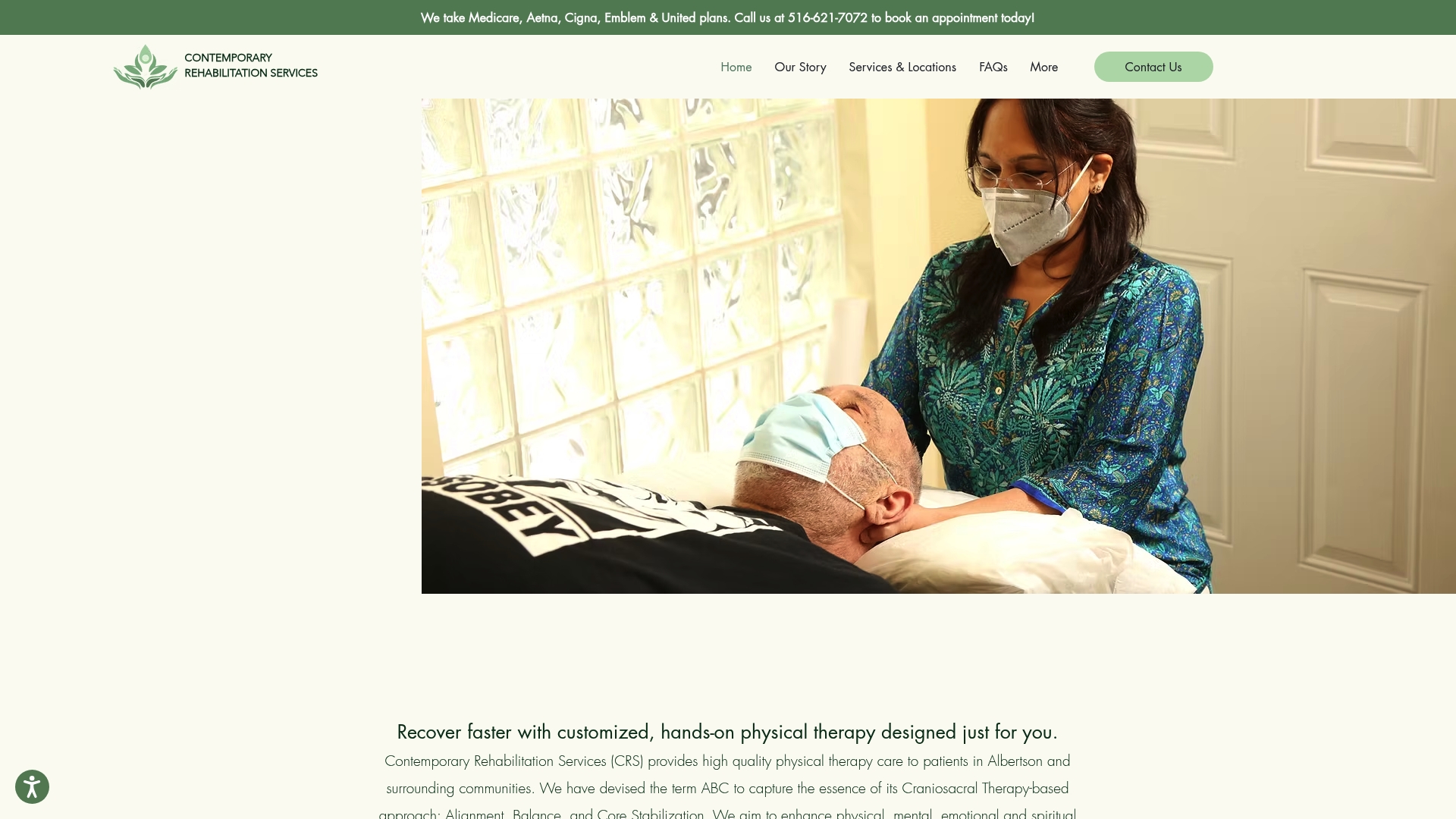
To start, visit Contemporary Rehab Services and request an appointment. Bring a list of your symptoms, any imaging reports, and the daily tasks that bother you most.
FAQ
Is joint mobilization painful?
It should not be sharp or intense. You may feel a stretch or mild ache as the therapist works toward a restricted range, and the intensity is adjustable. If something hurts more than you expected, tell your therapist right away so they can change the grade or direction.
Can joint mobilization fix a frozen shoulder by itself?
Not by itself. The orthopedic section guideline says mobilization may help reduce pain and increase motion in adhesive capsulitis, but it rates the evidence as weak. A 2023 review found the best range-of-motion results when mobilization was combined with exercise, so a home program is part of the treatment.
How is mobilization different from manipulation?
Mobilization uses slow, controlled glides or stretches that you can stop or modify at any time. Manipulation usually refers to a quick, small thrust. Most stiff-shoulder plans rely on mobilization, with the grade matched to how irritable the shoulder is.
How soon will I notice a difference?
Some people notice easier movement or less pain within a visit or two, which the therapist can confirm with before-and-after measurements. Lasting change usually comes from the combination of hands-on work and consistent exercise over several weeks. Your therapist can give a more specific timeline after examining you.
Does insurance cover it?
Physical therapy that includes joint mobilization is typically billed as part of a visit. We accept Medicare, Aetna, Cigna, Emblem and United Healthcare, plus cash payments. Contact our office with your plan details and we will explain how your coverage applies.
Sources
Effects of exercise intervention with and without joint mobilization in adhesive capsulitis, 2023
Manual therapy and exercise for adhesive capsulitis (Cochrane review)
Shoulder Pain and Mobility Deficits: Adhesive Capsulitis, clinical practice guideline, 2013
Shoulder Disorders Guideline, California Division of Workers’ Compensation
Joint Mobilization, hand therapy certification text, chapter 30
Recommended
Comments