
How to Schedule PT Appointments: Fast, Local Booking
Updated: Sep 11

You can schedule a physical therapy appointment right now by submitting an online booking form or calling the clinic directly with your insurance card and a preferred time in hand. That’s the fastest route to a confirmed slot.
Before you reach out, here’s what to have ready:
Your insurance card (member ID, group number, primary cardholder name)
A preferred date and two backup times
The name of your referring physician, if your plan requires one
A one-sentence description of your main symptom and how long you’ve had it
Contemporaryrehabservices (CRS Wellness) accepts Medicare, Aetna, Cigna, Emblem, and UnitedHealthcare at multiple Nassau County locations, including Albertson, Williston Park, East Williston, and Searingtown. Licensed physical therapists conduct a full evaluation at your first visit and document a personalized treatment plan from day one.
Table of Contents
How do you schedule a PT appointment step by step?
Each booking channel works a little differently. Pick the one that fits your situation.
1. Online form or self-schedule portal Go to the clinic’s website, find the appointment request or self-schedule page, select your preferred location and time, and fill in your insurance and contact details. Online booking typically takes 4–8 minutes from search to confirmation when real-time availability and intake forms are provided. You’ll usually receive a confirmation email or text within minutes. This is the best option for off-hours booking — evenings and weekends included.

2. Phone call Call the front desk, ask for a new-patient evaluation slot, and give your insurance information and two or three preferred times. Expect a confirmed slot in one call. Phone is the right choice when you have a complex situation, need same-day care, or want to ask about specific therapist availability.
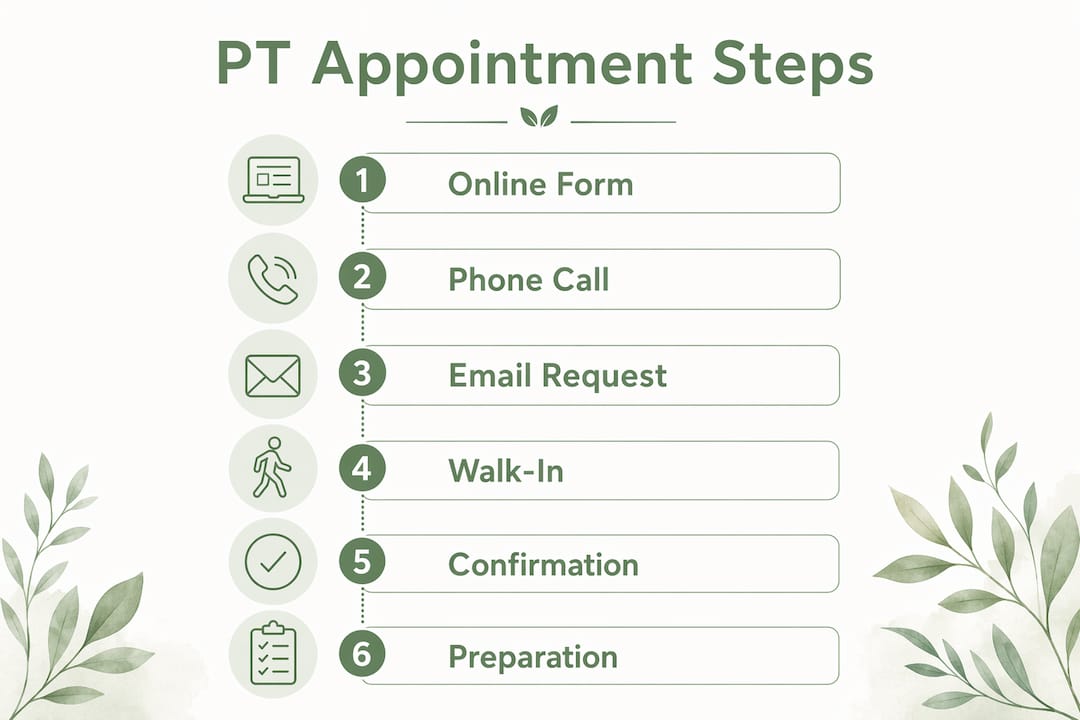
3. Email request Send a short message with your name, contact number, insurance plan, and preferred times. Response times vary — typically within one business day. Use this channel only when speed is not a priority.
4. Walk-in Some clinics accept walk-ins for brief consultations, but evaluation slots are usually reserved. Call ahead to confirm availability before showing up.
Channel | Speed to confirm | Best use case |
Online form/portal | 4–8 minutes | New patients, off-hours, convenience |
Phone | Same call | Complex cases, same-day needs |
Up to 1 business day | Non-urgent requests | |
Walk-in | Varies | Quick questions, not full evals |
Pro Tip: Call the clinic right when it opens — front desks often fill same-day cancellation slots in the first 30 minutes of the day. Online portals, meanwhile, capture requests around the clock, so submitting late at night can land you an early slot before the phones even ring.
Do you need a referral or prior authorization before booking?
Direct-access laws allow patients in most U.S. states to see a physical therapist without a physician referral. However, your insurance plan may still require prior authorization before it will cover the visits, regardless of state law.
Before you book, confirm these three things:
Referral requirement: Call the member services number on the back of your insurance card and ask whether PT requires a physician referral or a prescription.
Prior authorization: Ask whether the clinic or you need to submit a prior authorization request before the first visit. Some plans (including certain Medicare Advantage plans) require this.
Visit limits: Ask how many PT visits your plan covers per calendar year and whether a deductible applies.
Medicare Part B generally covers PT when it is medically necessary and ordered by a physician or qualified provider. Aetna, Cigna, Emblem, and UnitedHealthcare each have their own authorization thresholds — the fastest way to confirm is to call the number on your card or log into your insurer’s member portal.
Pro Tip: When you call your insurer, write down the representative’s name and the reference number for the call. If a billing dispute arises later, that note is your evidence.
What should you say when calling or filling out the booking form?
Clear, specific language speeds up the scheduling process on both ends.
New patient phone script: “Hi, I’d like to schedule a new-patient evaluation for physical therapy. I have [insurance plan] and I was referred by [physician name], or I understand you accept direct-access patients. My main concern is [symptom] that I’ve had for [duration]. Can I get the next available evaluation slot?”
Established patient phone script: “Hi, this is [your name], a current patient. I’d like to schedule my next available treatment appointment with [therapist name if possible]. I’m available [two or three times].”
Online form “reason for visit” field:
New patient: “Right knee pain for 6 weeks; difficulty climbing stairs.”
Established patient: “Follow-up treatment for lower back rehab program.”
If you need same-day care, say so directly: “I’m in significant pain and hoping for a same-day or next-day slot.” Clinics often hold a cancellation slot for urgent cases. For interpreter services or accessibility accommodations, mention them when you call — clinics appreciate advance notice.
What happens at your first PT appointment?
Your first visit is an evaluation, not a treatment session. Budget 40–60 minutes at minimum, and some new-patient evaluations run longer depending on the complexity of your condition.
The therapist will typically:
Review your medical history, current symptoms, and any imaging you bring
Perform movement and strength tests to identify functional limitations
Ask about your daily activities and what you want to get back to doing
Document a treatment plan with specific, measurable goals
Follow-up treatment slots are shorter, usually 30–60 minutes, and focus on hands-on therapy and exercise progression. The evaluation slot is protected time — it’s worth requesting it by name when you book rather than asking for a general “appointment.”
Therapists find it most useful when patients frame goals as specific activities rather than just pain levels. “I want to return to gardening three times a week” gives a therapist far more to work with than “I want less pain.” Those functional goals directly shape the treatment plan and how often you’ll need to come in.
What is the Medicare 8-minute rule and why does it matter?
The Medicare 8-minute rule is a billing standard that requires a therapist to provide at least 8 minutes of a timed therapeutic service in a single session for that service to be billed to Medicare. Sessions with multiple timed services are billed in 15-minute units, and the total time across all services determines how many units can be charged.
This rule applies to Medicare billing specifically. It affects how your session time is documented and billed, not the quality of care you receive. If you have questions about how your session time will be allocated between evaluation and treatment, ask the front desk when you book.
Pro Tip: Ask the scheduler how long your first visit is expected to run and what portion is evaluation versus hands-on treatment. This helps you plan your day and sets realistic expectations for what Medicare will cover.
How should you prepare for your first PT visit?
Arriving prepared lets the therapist spend more time treating you and less time gathering background information. Bringing imaging reports and a medication list at your first visit speeds diagnostic decisions and reduces check-in friction.
Checklist for your first visit:
Insurance card and a photo ID
Medication list (including supplements)
Imaging reports: MRI, X-ray, or CT scans related to your condition
Any assistive devices you currently use (brace, cane, orthotics)
Emergency contact information
Completed intake forms (submit these 24–48 hours before your visit if the clinic sends them in advance)
Write down two or three functional goals before you go. Think about the activities pain or limited mobility has taken away from you — returning to those activities is exactly what your therapist will build the plan around.
Pro Tip: Save your appointment confirmation to your phone calendar the moment you receive it. Set a second reminder 2 hours before the visit so you have time to gather your documents.
How do cancellation and no-show policies typically work?
Most PT clinics require at least 24–48 hours’ notice to cancel or reschedule without a fee. Some use a two-strike no-show policy, where a second missed appointment without notice can result in a fee or removal from the schedule. Ask about the specific policy when you book.
Best practices to avoid fees and keep your progress on track:
Set a calendar reminder 48 hours before each appointment.
Call as early as possible if you need to cancel — clinics fill slots faster in the morning.
Ask to be placed on a standby or cancellation list if your preferred time is unavailable.
Confirm your appointment when the clinic sends a reminder text or email, since clinics may release unconfirmed slots if they don’t hear back.
Clinics that use automated 48- and 24-hour reminders combined with a clear no-show policy see no-show rates drop to 4–6%, compared to 12–18% without such systems. Confirming your reminder is the single easiest thing you can do to protect your slot.
Pro Tip: When you reschedule, ask to keep the same therapist. Continuity of care matters — a therapist who knows your history can adjust your program faster than starting fresh with someone new.
How often will you need to come in, and when will you see progress?
The typical PT cadence varies with condition and goals, ranging from several sessions per week for acute or post-surgical care to fewer visits weekly for maintenance or performance programs.
Many patients notice measurable improvement within a few weeks when they attend consistently and follow their home exercise program. Consistency matters more than frequency alone.
One of the highest-leverage things you can do at your evaluation: book your next 4–6 weeks of appointments before you leave. Patients who leave with recurring follow-ups already scheduled tend to complete significantly more visits than those who plan to call back later. Your PT treatment plan is only as effective as the visits you actually attend.
Condition type | Typical frequency | Expected progress window |
Acute injury / post-surgical | 2–3x per week | 4–8 weeks |
Chronic pain / mobility issues | 1–2x per week | 6–12 weeks |
Maintenance / performance | 1x per week | Ongoing |
When does telehealth PT make sense, and how do you book it?
Telehealth PT works well for initial triage visits, exercise technique checks, follow-ups when travel is a barrier, and situations where you need guidance on a home program. It’s not a substitute for hands-on manual therapy, but it’s a practical option for many follow-up scenarios.
To book a virtual visit:
Look for a “telehealth” or “virtual visit” option on the clinic’s online booking form.
If it’s not listed, call the front desk and ask directly — many clinics offer same-day telehealth slots that don’t appear online.
Confirm that your insurance plan covers telehealth PT before the visit. Coverage varies by plan and state.
Have a quiet, private space and a video-capable device ready at least 10 minutes before your session starts.
Specialty-scope visits, such as pelvic floor physical therapy, may also be available via telehealth for initial consultations, though hands-on evaluation is typically required for a complete assessment.
Key Takeaways
Booking a PT appointment quickly comes down to three things: use the online form or call with your insurance details ready, confirm your coverage before the visit, and book your follow-up slots at the evaluation.
Point | Details |
Fastest booking method | Use the online form (4–8 minutes) or call the front desk with insurance info and preferred times. |
Insurance check first | Confirm referral and prior authorization requirements with your insurer before your first visit. |
First visit length | Budget 40–60 minutes for the evaluation; follow-up treatment slots are typically shorter. |
Book recurring slots early | Patients who schedule 4–6 weeks of follow-ups at evaluation complete significantly more visits. |
Contemporaryrehabservices | CRS Wellness accepts Medicare, Aetna, Cigna, Emblem, and UnitedHealthcare across Nassau County locations. |
What clinics wish more patients knew about scheduling
The patients who get the most out of physical therapy tend to do one thing differently from the start: they treat the evaluation slot as the most important appointment in the entire course of care, not just a formality before the “real” treatment begins.
Clinics protect evaluation slots because a thorough first assessment shapes everything that follows. When you call and ask for a “general appointment,” you may end up in a shorter follow-up slot that doesn’t allow enough time for a proper evaluation. Always ask specifically for a new-patient evaluation.
Completing your intake forms before you arrive, and bringing imaging rather than promising to send it later, lets the therapist walk into the room already oriented to your case. That’s 10–15 minutes of evaluation time redirected toward actual hands-on assessment. The step-by-step guide to starting PT covers this in more detail if you want a fuller picture before your first visit.
The other underrated move: confirm your insurance at booking, not after. Surprises at checkout create friction that discourages follow-up attendance, and consistent attendance is what drives outcomes.
Ready to book at Contemporaryrehabservices?
Contemporaryrehabservices (CRS Wellness) is a boutique physical therapy clinic serving Nassau County and Queens, NY, with locations in Albertson, Williston Park, East Williston, and Searingtown. The clinic accepts Medicare, Aetna, Cigna, Emblem, and UnitedHealthcare, as well as cash payments.
To request an appointment, visit the Albertson location page or call the front desk directly. When you reach the scheduler, ask for a new-patient evaluation slot, give your insurance information, and offer two or three preferred times. You can also browse the full range of therapies offered to confirm the service you need is available before you call.
Useful sources and further reading
Direct access and referral rules: ChoosePT — Preparing for Your Visit covers what to bring and how to frame your goals; Verywell Health — What to Expect at Your First PT Appointment explains direct-access rules and insurer authorization.
Medicare billing and coverage: The Centers for Medicare & Medicaid Services (CMS) publishes current Part B outpatient therapy coverage rules at cms.gov.
Scheduling best practices and clinic software: WebPT Online Scheduling outlines how real-time portals reduce front-office time and improve patient access; Deelo Blog — Physical Therapy Practice Software covers no-show policies, recurring booking, and adherence data.
First-visit preparation: MedStar Health — Preparing for Your First PT Appointment lists documents and imaging to bring.
Visit length expectations: Xcel Sports Medicine — How Long Does a PT Appointment Last? provides a clear breakdown of evaluation versus follow-up session lengths.
Recommended
Comments