
Physical Therapy Copay Explained: What Patients Need to Know

A physical therapy copay is the fixed dollar amount you pay at each covered PT visit, collected at check-in before your session begins. Most insurance plans assign a flat copay per visit, though some plans use coinsurance (a percentage) or require you to meet a deductible first. Before your first appointment, take three steps right now:
Check your insurance card or member portal for the “specialist,” “PT,” or “rehab” copay line.
Confirm the clinic is in-network with your specific plan, not just your insurer.
Ask the clinic’s billing team for a pre-service estimate so you know your likely per-visit and episode total before treatment begins.
Getting these three things right is the single most effective way to avoid surprise bills.
Key Takeaways
A physical therapy copay is a fixed per-visit fee, and verifying your plan’s copay, deductible, and in-network status before your first appointment is the single most effective way to avoid surprise bills.
Point | Details |
Copay is a flat fee per visit | PT copays typically range from $20 to $60 per session; initial evaluations are usually billed at a higher rate. |
Copays usually don’t reduce your deductible | In most plans, copays count toward your out-of-pocket maximum but not your deductible. |
In-network status changes everything | Out-of-network care can mean higher coinsurance, balance billing, or no coverage at all. |
Medicare uses coinsurance, not copays | After the Part B deductible, Medicare pays 80% and you owe roughly 20% coinsurance per visit. |
Contemporaryrehabservices verifies benefits upfront | The clinic confirms your copay, in-network status, and prior-authorization needs before your first visit. |
Table of Contents
What do copay, coinsurance, deductible, and out-of-pocket maximum actually mean?
Do PT copays count toward your deductible or your out-of-pocket maximum?
Why in-network vs. out-of-network status changes your copay and total cost
Simple worked cost examples: per-visit copay, coinsurance, and an episode total
Step-by-step: how to verify your PT benefits before your first visit
Practical ways to lower your PT costs if the copay is a barrier
How Contemporaryrehabservices helps you verify benefits and reduce surprises
What patients can expect from the intake process at Contemporaryrehabservices
Contemporaryrehabservices is ready to help you check your benefits today
What do copay, coinsurance, deductible, and out-of-pocket maximum actually mean?
These four terms describe different ways your plan shares costs with you. Mixing them up is one of the most common reasons patients are caught off guard by a bill.
Term | What it is | PT example |
Copay | A fixed dollar amount per covered visit | You pay $35 at every PT appointment |
Coinsurance | Your percentage of the allowed charge, usually after the deductible | You pay 20% of a $120 allowed rate = $24 per visit |
Deductible | The amount you must pay out-of-pocket before insurance starts sharing costs | You owe the first $1,500 of covered services each year |
Out-of-pocket maximum | The annual ceiling on your total cost-sharing; after you hit it, insurance pays 100% | Once you’ve paid $4,000 total, all covered PT is free for the rest of the year |
A few things worth knowing:
UnitedHealthcare explains that copays are flat dollar amounts and are distinct from coinsurance, which is percentage-based.
Your plan may use one, two, or all three cost-sharing tools at once. A deductible-first plan means you pay the full negotiated rate until your deductible is met, then copays or coinsurance kick in.
PT is commonly categorized as specialist or rehabilitative care, so the relevant copay line on your plan documents is usually labeled “specialist” or “PT/rehab,” not the lower primary care copay.
For a deeper look at insurance terms in plain language, the PT terminology guide from Contemporaryrehabservices walks through each one with patient-friendly examples.
How physical therapy copays typically work in practice
Most patients with copay-based plans pay the same flat fee at every visit, but a few billing realities can change that picture.
Initial evaluation vs. follow-up visits. Your first PT appointment is almost always billed at a higher rate than follow-ups. The initial evaluation uses a different CPT code (typically 97161, 97162, or 97163 depending on complexity), and some plans apply a higher copay or coinsurance to that code. Verywell Health notes that initial evaluations are usually billed at a higher rate than subsequent sessions, so ask your clinic what to expect on day one.
Three common billing scenarios:
Copay-only plan. You pay a flat fee (often $20–$60) at each visit regardless of services rendered. This is the simplest scenario.
Deductible-first plan. You pay the full negotiated rate per visit until your deductible is met, then your copay or coinsurance applies. Common in high-deductible health plans (HDHPs).
Coinsurance plan. After the deductible, you pay a percentage (often 20%–30%) of the allowed charge rather than a flat fee.
From scheduling to explanation of benefits (EOB), here is the typical flow:
You schedule and confirm in-network status.
You pay your copay or estimated cost-share at check-in.
The clinic submits a claim to your insurer using CPT codes for the services provided.
Your insurer processes the claim and mails or posts an EOB showing what was billed, what was allowed, and what you owe.
If there is a balance beyond your copay, the clinic sends a statement.
Pro Tip: Ask the clinic’s billing staff which CPT codes they plan to bill before your first visit. Some plans cover manual therapy codes (97140) at a different rate than therapeutic exercise (97110). Knowing this in advance prevents unexpected balances.
Do PT copays count toward your deductible or your out-of-pocket maximum?
This is one of the most frequently misunderstood points in physical therapy insurance coverage, and the answer has real financial consequences.
The short answer: In many plans, copays do not count toward your deductible, but they do count toward your out-of-pocket maximum. UnitedHealthcare’s guidance confirms that copays generally do not reduce your deductible balance but do accumulate toward your annual out-of-pocket cap.
Why this matters in practice:
If you are early in the plan year and have not met your deductible, a copay-based plan protects you with a predictable flat fee. A coinsurance plan, by contrast, may leave you paying the full negotiated rate until the deductible is satisfied.
Once your out-of-pocket maximum is reached, your copays stop and insurance covers 100% of covered services for the rest of the year. Patients with long PT courses (12–24 sessions) sometimes hit this ceiling, especially if they have other medical expenses in the same year.
Plan rules vary. Some plans do count copays toward the deductible. Read your Summary of Benefits and Coverage (SBC) carefully.
How to verify your plan’s rules:
Pull up your SBC on your insurer’s member portal and search for “copay” and “deductible” in the same paragraph.
Call the member services number on the back of your insurance card. Ask: “Does my PT copay count toward my deductible? Does it count toward my out-of-pocket maximum?”
After your first visit, review the EOB. It will show your running deductible and out-of-pocket totals.
Save screenshots of your plan language and every EOB. If a billing dispute arises, these documents are your evidence.
Why in-network vs. out-of-network status changes your copay and total cost
Choosing an out-of-network PT provider can multiply your costs significantly, sometimes without any warning until the bill arrives.

In-network providers have a negotiated rate with your insurer. Your plan applies your standard copay or coinsurance to that contracted rate, which is always lower than the provider’s full charge. Healthcare that HMO plans typically require you to use in-network providers and may not cover out-of-network care at all, while PPO plans usually cover out-of-network care at a higher cost-share. For PPO rules, Healthcare.gov’s PPO glossary clarifies that out-of-network care is covered but at a higher patient cost.
Out-of-network consequences include:
A higher deductible and coinsurance percentage (often 40%–50% instead of 20%).
Balance billing, where the provider charges you the difference between their full rate and what your insurer paid.
No coverage at all if you have an HMO or EPO plan.
Before your first visit, run through this checklist:
Call your insurer and ask: “Is [clinic name] in-network under my specific plan and benefit tier?”
Ask the clinic’s billing staff: “Are you contracted with [my plan name and ID prefix]?” Plan names and network tiers can differ even within the same insurer.
Confirm whether your plan requires a physician referral or prior authorization for PT. Missing this step can result in a denied claim even at an in-network provider.
Warning: A clinic being listed on your insurer’s website does not always mean every therapist at that clinic is in-network. Confirm the specific therapist’s credentialing status, especially at larger group practices.
Simple worked cost examples: per-visit copay, coinsurance, and an episode total
These three scenarios use realistic figures to show how your out-of-pocket costs add up across a typical PT course. ValuePenguin reports that the average full price for a one-hour PT session is about $137, while insured patients pay roughly $40 per session on average.
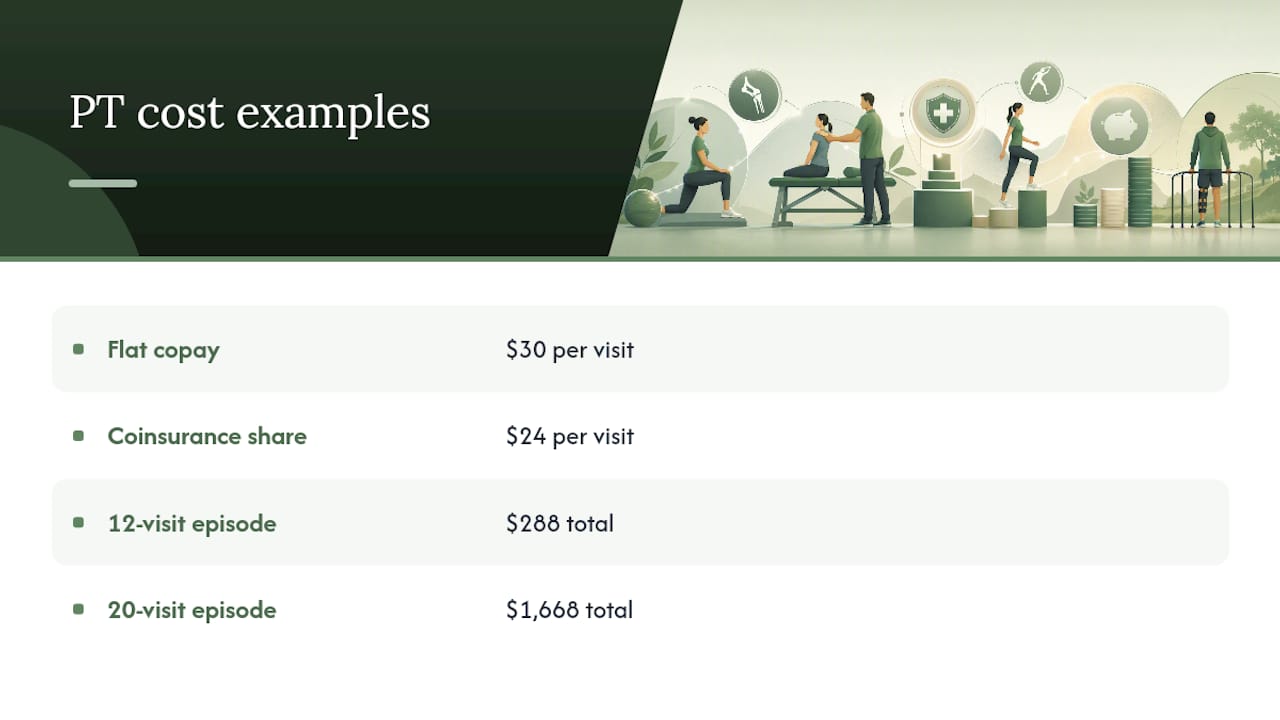
Example 1: Flat copay plan, $30 per visit
Assume a negotiated rate of $120 per visit. You pay $120 per visit until you’ve spent $1,500, which takes about 12–13 visits. A 20-visit course in this scenario costs roughly $1,500 + (7 × $24) = $1,668.
At $120 allowed per visit, your share is $24 per visit. A 12-visit course costs about $288 total, assuming the deductible was met earlier in the year.
Assumptions for all examples: in-network provider, no visit cap, prior authorization obtained, no additional modality codes billed separately. Verywell Health notes that PT copays typically fall in the $20–$60 range, and RehabThrive documents that a typical PT course runs 12–24 sessions, so these examples reflect realistic episode lengths.
How Medicare and Medicaid handle PT copays and coverage
Medicare and Medicaid follow different rules than commercial insurance, and knowing the basics before your first visit prevents costly surprises.
Medicare Part B covers outpatient physical therapy as a medically necessary service. There is no copay structure; it is always percentage-based coinsurance under Part B.
Medicare does not impose a hard annual dollar cap on PT, but a documentation threshold applies once cumulative therapy spending reaches a certain level. At that point, your therapist must include a functional progress note with each claim to justify continued medical necessity. This is an administrative step, not a coverage cutoff.
If you have a Medicare Supplement (Medigap) plan, it may cover some or all of the 20% coinsurance, reducing your out-of-pocket cost to near zero.
For a full breakdown of what Medicare covers and what documentation your therapist needs to provide, the Medicare coverage for PT guide from Contemporaryrehabservices covers the current rules in detail.
Medicaid varies by state. Some states charge little or no copay for PT services, particularly for beneficiaries with low income or disability status. Others apply a small per-visit copay. Contact your state Medicaid office or check your state’s Medicaid member handbook for the exact rules in your area.
Always present both cards at check-in.
Step-by-step: how to verify your PT benefits before your first visit
Spending 20 minutes on verification before your first appointment can save you hundreds of dollars in unexpected bills.
Check your insurance card and member portal. Look for a line labeled “physical therapy,” “rehab services,” or “specialist” under your benefits summary. Note the copay or coinsurance amount and whether a deductible applies first.
Call member services. Use the number on the back of your card. Ask these specific questions:
“Is physical therapy covered under my plan?”
“What is my copay or coinsurance for outpatient PT?”
“Has my deductible been met for this plan year?”
“Does [clinic name] participate in my network?”
“Do I need a referral or prior authorization?”
Contact the clinic’s billing team. Ask: “Are you in-network with [plan name and ID prefix]?” and “What CPT codes will you bill for an initial evaluation and a follow-up visit?” The step-by-step eligibility guide from Contemporaryrehabservices walks through exactly what to say.
Request a pre-service estimate. Ask the clinic to run a benefits check and provide a written estimate of your expected cost per visit and for the full course of care. Most clinics can do this within one business day.
Pro Tip: Screenshot your plan’s benefit summary page and save every EOB in a dedicated folder. If your insurer later denies a claim or applies the wrong copay, these documents are the foundation of any appeal.
Practical ways to lower your PT costs if the copay is a barrier
A high copay should not stop you from getting care. Several options can reduce what you pay.
Use your HSA or FSA. Physical therapy is an eligible expense under both Health Savings Accounts and Flexible Spending Accounts. Pay your copay directly from these accounts to use pre-tax dollars, effectively reducing your real cost by your marginal tax rate.
Ask about self-pay or cash discounts. Some clinics offer a reduced rate for patients who pay out-of-pocket rather than billing insurance. This can be worth comparing against a high deductible plan’s negotiated rate.
Ask about payment plans. Most clinics, including Contemporaryrehabservices, can spread balances over several months. Ask the billing team before your first visit, not after the bill arrives.
Check for sliding-scale fees. Community health centers and some nonprofit PT clinics offer income-based pricing. The APTA’s patient resources include a provider search that can help you find licensed PTs in your area.
Consider outpatient vs. hospital-affiliated settings. PT provided in a hospital outpatient department is often billed at a higher facility rate than a freestanding clinic, which can mean a higher coinsurance dollar amount even at the same percentage.
Appeal a denied claim or incorrect copay. If your insurer applies the wrong cost-sharing tier or denies a claim, you have the right to file a formal appeal. Request a written explanation of the denial, then submit a written appeal with supporting documentation from your physician and therapist.
Check state Medicaid or CHIP eligibility. If your income has changed, you may qualify for Medicaid, which often carries lower or no PT copays. Visit your state’s Medicaid portal or HHS.gov for eligibility information.
How Contemporaryrehabservices helps you verify benefits and reduce surprises
Contemporaryrehabservices, a boutique physical therapy clinic serving Nassau County and Queens, NY, handles benefit verification as part of the intake process so patients arrive knowing their costs.
The clinic’s billing team confirms in-network status with your specific plan before your first visit, runs a benefits check to identify your copay or coinsurance amount, and flags whether a deductible still needs to be met. They also check prior-authorization requirements so nothing delays your care.
To get a fast benefits check, bring or send:
Your insurance card (front and back).
Your member ID and group number.
Any referral from your physician, if your plan requires one.
A recent EOB if you have one, which shows your current deductible and out-of-pocket totals.
Contemporaryrehabservices accepts Medicare, Aetna, Cigna, Emblem Health, and United Healthcare. You can also verify a therapist’s license through FSBPT’s license lookup for additional peace of mind. Location pages for Albertson, Roslyn, and other Nassau County sites include direct contact details for the billing team.
What patients can expect from the intake process at Contemporaryrehabservices
At Contemporaryrehabservices, we know that billing uncertainty is one of the biggest reasons people delay getting care they genuinely need. Our goal is to remove that uncertainty before you walk through the door.
When you contact us, we verify your benefits, confirm your in-network status, and give you a clear picture of your expected cost per visit. If your plan requires prior authorization, we handle that coordination with your insurer. We also work with patients on payment plans when a balance remains after insurance. Bring your insurance card, any referral paperwork, and your questions. We will take it from there.
Contemporaryrehabservices is ready to help you check your benefits today
Getting physical therapy should not feel like navigating a billing maze. Contemporaryrehabservices offers in-person and virtual PT sessions in Nassau County and Queens, NY, with a dedicated billing team that verifies your copay, coinsurance, and prior-authorization requirements before your first visit. Whether you are covered by Medicare, Aetna, Cigna, Emblem Health, or United Healthcare, the clinic will confirm your exact cost-share and provide a written estimate so you know what to expect.

Ready to get started? Visit Contemporaryrehabservices to request a benefits check or schedule your initial evaluation. You can also browse the full range of therapy services offered to find the right fit for your condition. The billing team is available to answer insurance questions before you commit to a single appointment.
Sources
These authoritative resources provide the official definitions and plan rules behind the guidance in this article. Your insurer’s member portal and your Summary of Benefits and Coverage (SBC) are always the final word on your specific plan.
This article is general information, not a substitute for advice from a qualified financial advisor. Consult a qualified financial professional about your own circumstances before acting on anything here.
Recommended
Comments