
Vestibular Rehabilitation Therapy: Clinic Backed Plan in 4–6 Weeks

Vestibular rehabilitation therapy is an exercise-based treatment that often reduces dizziness and improves balance when a clinician tailors it to your specific diagnosis. Clinical practice guidelines and peer-reviewed reviews support measurable gains in balance scores and daily function for many vestibular conditions, including inner ear disorders and post-concussion dizziness. The right next step is a professional evaluation that matches exercises to your exact deficit, since a program built for one condition can feel ineffective, or even provoke symptoms, when applied to another.
TL;DR:
Vestibular rehabilitation therapy requires a tailored program based on diagnosis, focusing on habituation, adaptation, and substitution to improve balance and reduce dizziness.
An initial evaluation involves history, positional and reflex testing, and balance analysis to determine the appropriate mix of exercises like gaze stabilization, balance progressions, and gait training.
Typical exercise dosing spans 12 to 40 minutes daily, with improvement usually seen within 4 to 12 weeks depending on the severity and underlying condition.
Safety warnings include sudden hearing loss, severe headache, or neurological signs which require urgent medical care, while mild dizziness during exercise is common and manageable.
Table of Contents
What vestibular rehabilitation therapy is and how it works
Vestibular rehabilitation therapy, often shortened to VRT, is a structured program of head, eye, and body movements designed to retrain the way your brain processes balance signals from your inner ear. When the vestibular system is damaged by illness, injury, or age, your brain often still has the capacity to compensate. VRT gives it the practice it needs to do so.
The therapy works through three overlapping mechanisms described in the vestibular rehabilitation literature:
Habituation reduces your brain’s dizziness response to specific movements or visual patterns through repeated, controlled exposure.
Adaptation recalibrates the vestibulo-ocular reflex, the automatic eye movement that keeps your vision steady when your head moves, so gaze stays clear during motion.
Substitution trains your brain to lean more heavily on vision and body-position sense (proprioception) when the inner ear signal is permanently weakened or lost.
The goals that guide every program are consistent: steadier gaze during head movement, more reliable standing and walking balance, less frequent or less intense vertigo, and an easier time with daily tasks like turning your head in traffic or walking on uneven ground. Because the underlying cause, your specific symptoms, and your baseline fitness all differ from the next patient’s, a generic exercise sheet rarely works as well as a program built around your own test results. A clinician who has assessed your particular pattern of weakness can decide whether you need more habituation work, more adaptation drills, or a heavier focus on substitution strategies, and can adjust the plan as your compensation improves.
Who typically needs VRT and when it is not the right first step
VRT tends to help people with a fairly specific set of conditions. The most common candidates include unilateral vestibular hypofunction (reduced function in one inner ear, often from vestibular neuritis or labyrinthitis), bilateral vestibular loss, dizziness that persists after a concussion, motion sensitivity that limits travel or screen use, and chronic imbalance or falls in older adults.
A few signs suggest VRT is a reasonable option worth discussing with a clinician:
Dizziness or unsteadiness that has lasted more than a few days without resolving.
Vertigo triggered by specific head positions or movements.
A sense of imbalance that affects walking, driving, or confidence in daily activities.
Frequent near-falls or falls in someone over 65.
VRT is not the immediate answer for everyone. Sudden, severe dizziness accompanied by new hearing loss, slurred speech, double vision, numbness, or weakness needs urgent medical evaluation rather than a home exercise program, since these can signal a stroke or another neurological emergency. Clinicians typically decide whether VRT is appropriate using a combination of your symptom history, physical testing, and functional assessment, rather than relying on your description of “dizziness” alone, since that single word can describe several very different underlying problems.
How an initial evaluation leads to your exercise program
A vestibular evaluation follows a fairly predictable sequence, and understanding it helps you know what to expect at your first visit.
History taking. Your clinician asks about when symptoms started, what triggers them, how long episodes last, and whether you have hearing changes, headaches, or recent head trauma.
Positional testing. Maneuvers like the Dix-Hallpike test or the supine roll test reproduce specific eye movements (nystagmus) that help identify benign paroxysmal positional vertigo (BPPV) and which inner ear canal is involved.
Gaze and reflex testing. Your therapist checks how well your eyes track targets and stay fixed during head movement, which reveals how well your vestibulo-ocular reflex is functioning.
Balance and gait analysis. Standing on different surfaces, walking in a straight line, and turning your head while moving show how you compensate functionally, not just on paper.
Musculoskeletal screening. A check of your neck and upper back mobility matters because stiffness or pain there can limit how safely you perform repositioning maneuvers and head-movement exercises, and screening for these restrictions is part of safe program design.
The results from each step guide whether your program emphasizes habituation (for motion-provoked symptoms that have settled into a stable but uncomfortable pattern), adaptation (for a true vestibular deficit that needs recalibration), or substitution (when the inner ear damage is unlikely to recover further and your brain needs new strategies). Most programs blend more than one approach, and the mix shifts as you improve.
Core exercise categories you can expect to practice
Most VRT programs draw from four overlapping categories of exercise, each targeting a different part of the balance system.
Habituation exercises involve repeating a specific movement or visual scene that provokes mild dizziness, done in small, controlled doses until your brain’s response fades. These are used selectively, for patients whose symptoms are triggered by predictable movements or busy visual environments, and they are not the primary treatment for BPPV, which responds better to repositioning maneuvers.
Gaze stabilization exercises, often called VOR X1 and VOR X2 drills, retrain your eyes to stay fixed on a target while your head moves. In the X1 version, you hold a card with a letter or symbol at arm’s length and move your head side to side or up and down while keeping the letter in focus. The X2 variant adds complexity by moving both your head and the target in opposite directions, which demands more from the vestibular system. Progression usually means increasing speed, duration, or background complexity, for instance adding a patterned background behind the target once a plain one becomes easy.
Balance and postural progressions typically move through stages: standing on a firm, flat surface with feet together, then standing on a compliant surface like a foam pad, then narrowing your base of support, and eventually adding dual tasks such as counting backward while standing. A conceptual framework for sequencing these exercises groups them into categories like static standing, compliant surfaces, weight shifting, and modified center-of-gravity tasks, with each stage building on mastery of the previous one rather than following a fixed calendar.
Gait and functional training brings balance work into real movement: walking while turning your head left and right, stepping over small obstacles, and practicing dual-task walking, like carrying a tray while scanning a room. These exercises matter because standing balance does not always translate directly into walking confidence.
A related strategy, substitution training, teaches you to rely more deliberately on vision and body-position sense when inner ear input cannot fully recover. This can include practicing balance with your eyes open versus closed to sharpen the difference, or using a cane or walker during early recovery when fall risk is high. Our guide to balance exercises for stability and fall prevention walks through several of these progressions in more detail.
Habituation: repeated exposure to a provoking movement to reduce the dizziness response over time.
Gaze stabilization (VOR X1/X2): head-and-eye coordination drills that keep vision steady during motion.
Balance progressions: static stance, compliant surfaces, narrowed base, then dual-task challenges.
Gait training: head turns while walking, obstacle stepping, and carrying tasks during movement.
Substitution strategies: greater reliance on vision and proprioception, sometimes paired with an assistive device.
Pro Tip: Isolated eye exercises without head movement, like smooth pursuit alone, rarely build lasting gaze stability on their own. Pairing head motion with eye focus work tends to produce better results.
How much exercise you need and how long recovery takes
Dosing in vestibular rehabilitation is more specific than “do a few exercises daily.” According to dosing guidance from the Academy of Neurologic Physical Therapy, gaze-stabilization exercises should total at least 12 minutes per day for acute or subacute patients and at least 20 minutes per day for chronic cases, while patients with bilateral vestibular loss often need 20 to 40 minutes per day spread across multiple weeks. These totals are usually split into two to four shorter sessions rather than one long block, since repeated short bouts tend to be easier to sustain and tolerate.
A meta-analysis found a statistically significant improvement in dizziness handicap scores favoring vestibular rehabilitation in concussion patients, with other reviews reporting increased odds of dizziness resolution in peripheral vestibular dysfunction compared to controls. That gap represents a meaningful drop in how much dizziness interferes with daily life, not just a statistical nudge, based on the 2025 systematic review and meta-analysis summary.
Timelines vary by diagnosis. Many straightforward unilateral vestibular hypofunction cases improve substantially within 4 to 6 weeks of consistent exercise. Bilateral loss or more complex presentations, including some post-concussion cases, often take 5 to 12 weeks or longer to reach a plateau. Clinic-backed senior balance programs commonly run on an 8 to 12 week structured cadence, which gives enough time for gradual progression without overloading an older patient’s tolerance. Our detailed breakdown of exercise duration and timelines covers sample daily schedules if you want to see what this looks like in practice.
Progress is tracked less by how you feel on any given day and more by objective measures: your DHI score, how long you can hold a tandem stance, and how your gait pattern changes on reassessment. Expect check-ins every few weeks rather than daily symptom chasing, since vestibular compensation is often a gradual, sometimes nonlinear process.

BPPV, the Epley maneuver, and other repositioning techniques
Benign paroxysmal positional vertigo, or BPPV, happens when small calcium crystals that normally sit in a different part of the inner ear drift into one of the semicircular canals, where they trigger brief, intense spinning sensations with specific head positions, like rolling over in bed or looking up. Positional tests such as the Dix-Hallpike maneuver and the supine roll test reproduce this spinning and the eye movement that goes with it, which tells your clinician exactly which canal is affected.
Treatment for BPPV centers on canalith repositioning maneuvers rather than general exercise. The Epley maneuver is the standard first-line treatment for the most common form, posterior canal BPPV, and involves a sequence of head and body position changes that guide the displaced crystals back out of the canal. When the Epley does not fit a patient’s anatomy or mobility limits, clinicians turn to alternatives like the Semont maneuver or the Gans maneuver, along with modified versions for patients with neck or back restrictions.
The Epley maneuver treats posterior canal BPPV through a sequence of guided head and body positions.
The Semont and Gans maneuvers serve as alternatives when the Epley is not well tolerated or indicated.
Home Epley maneuvers, done correctly, can be effective for appropriate patients under clinical guidance, according to research on BPPV management in older adults.
Brandt-Daroff exercises are sometimes recommended but are considerably less effective than repositioning maneuvers for resolving BPPV itself.
Occasionally, crystals shift into a different canal during a maneuver, a phenomenon called canal-switch that occurs in an estimated 6 to 8% of repositioning attempts according to research on BPPV complications. This is why clinicians retest your eye movements immediately after a maneuver rather than assuming success, and why new or different symptoms after treatment warrant a follow-up visit rather than waiting it out. Medications are generally not recommended as a primary BPPV treatment, since they can mask the symptoms a clinician needs to see during repositioning without addressing the underlying crystal displacement.
Safety guidelines and symptoms that need urgent care
Vestibular exercises are generally safe, but a short list of warning signs should prompt immediate medical attention rather than a wait-and-see approach. According to NIDCD guidance on sudden hearing and balance changes, sudden severe dizziness paired with new hearing loss, a severe or unusual headache, or any focal neurological sign like weakness, numbness, or slurred speech may represent a medical emergency, and early evaluation can affect outcomes in conditions like sudden sensorineural hearing loss.
Short of an emergency, mild nausea or a brief uptick in dizziness during an exercise session is a common and expected part of habituation and adaptation training, since you are deliberately challenging a system that is still compensating. This usually settles within a few minutes of rest.
A few practical steps make home practice safer:
Keep a sturdy chair or counter within reach during balance exercises, especially early in treatment.
Have a family member or caregiver nearby for exercises that carry higher fall risk.
Avoid practicing on stairs until your clinician confirms your balance has improved enough to do so safely.
Stop an exercise and rest if dizziness becomes severe rather than mild, and report this at your next session.
A useful outside reference on warning signs tied to ear-related emergencies covers related red flags worth knowing if your dizziness involves ear pain, drainage, or sudden hearing changes.
What a clinic-backed home program actually looks like
Translating guideline dosing into a daily routine is often where patients get stuck, so it helps to see a realistic example. A typical structured home program might look like this:
Morning session (10 to 15 minutes): gaze stabilization drills (VOR X1 progressing to X2) plus a brief static balance exercise.
Midday session (5 to 10 minutes): a shorter repeat of gaze exercises, useful for patients who tolerate shorter, more frequent bouts better than long ones.
Evening session (10 to 15 minutes): balance progression work, such as standing on a compliant surface or practicing tandem stance, followed by a short gait exercise like walking with head turns.
Across a day, this adds up to the 12 to 40 minute range recommended for gaze-stabilization work depending on whether your case is acute, chronic, or bilateral, a structure we outline in more depth in our clinic guidance on dizziness exercise duration. For older adults working through a structured fall-prevention plan, an 8 to 12 week cadence with weekly progression checkpoints, similar to what we describe in our senior balance training program, gives enough time to build confidence without rushing.
Adherence tends to improve with a few simple habits: keeping a brief symptom journal to track good and bad days, progressing exercise difficulty only after a stage feels manageable rather than on a fixed schedule, setting a consistent time of day for practice, and contacting your clinic promptly if symptoms worsen rather than pushing through. Our guide to home PT exercises for lasting recovery covers additional strategies for staying consistent.
We offer physical therapy sessions that can be arranged in person or via telehealth, allowing for flexible evaluations and follow-ups. We accept various insurance plans and direct payments to reduce financial barriers to starting a program.

Contraindications and who should be screened carefully first
VRT is not appropriate for every dizzy patient without some upfront screening. Acute, unstable cardiovascular conditions, recent spinal surgery, uncontrolled seizures, or severe orthopedic restrictions in the neck can all limit which exercises and maneuvers are safe to perform, particularly positional testing and repositioning maneuvers that require specific head and neck movements.
Patients with significant cervical spine disease or vertebral artery concerns need a modified approach to positional testing, since standard maneuvers assume a normal range of neck motion. Similarly, patients with severe bilateral vestibular loss sometimes need a slower, more conservative introduction to balance challenges than someone with a single-sided, partially compensated deficit, since they have less residual vestibular input to draw on during the early stages.
Patient selection also depends on cognitive status and motivation, since a home exercise program requires some ability to understand instructions and follow through consistently between visits. Clinicians typically adjust expectations and supervision levels rather than excluding these patients outright, often starting with more supervised sessions before transitioning to independent home practice. The goal of screening is not to rule people out of treatment but to match the intensity and type of exercise to what a given patient’s body and circumstances can safely handle.
Why individualized progression prevents setbacks
The biggest mistake we see in vestibular recovery is treating exercise dosage like a race. Patients who push into advanced balance challenges before mastering the basics often experience flare-ups that set back their confidence as much as their physical progress, and that confidence cost is sometimes harder to rebuild than the symptom itself.
Careful screening of neck and back mobility before repositioning maneuvers or head-movement drills is not a formality. A patient with unaddressed cervical stiffness who attempts an Epley maneuver or a fast VOR X2 drill without that screening risks both reduced effectiveness and unnecessary discomfort.
What tends to separate steady recovery from a frustrating stall is pairing solid exercise science with realistic education: telling a patient plainly that mild dizziness during practice is expected, that progress is rarely a straight line, and that a 6 to 12 week timeline is normal rather than slow. Patients who understand this upfront stick with their programs longer, and the ones who stick with it are the ones who see the DHI improvements the research describes.
— CRS Wellness
How to start vestibular therapy with CRS Wellness
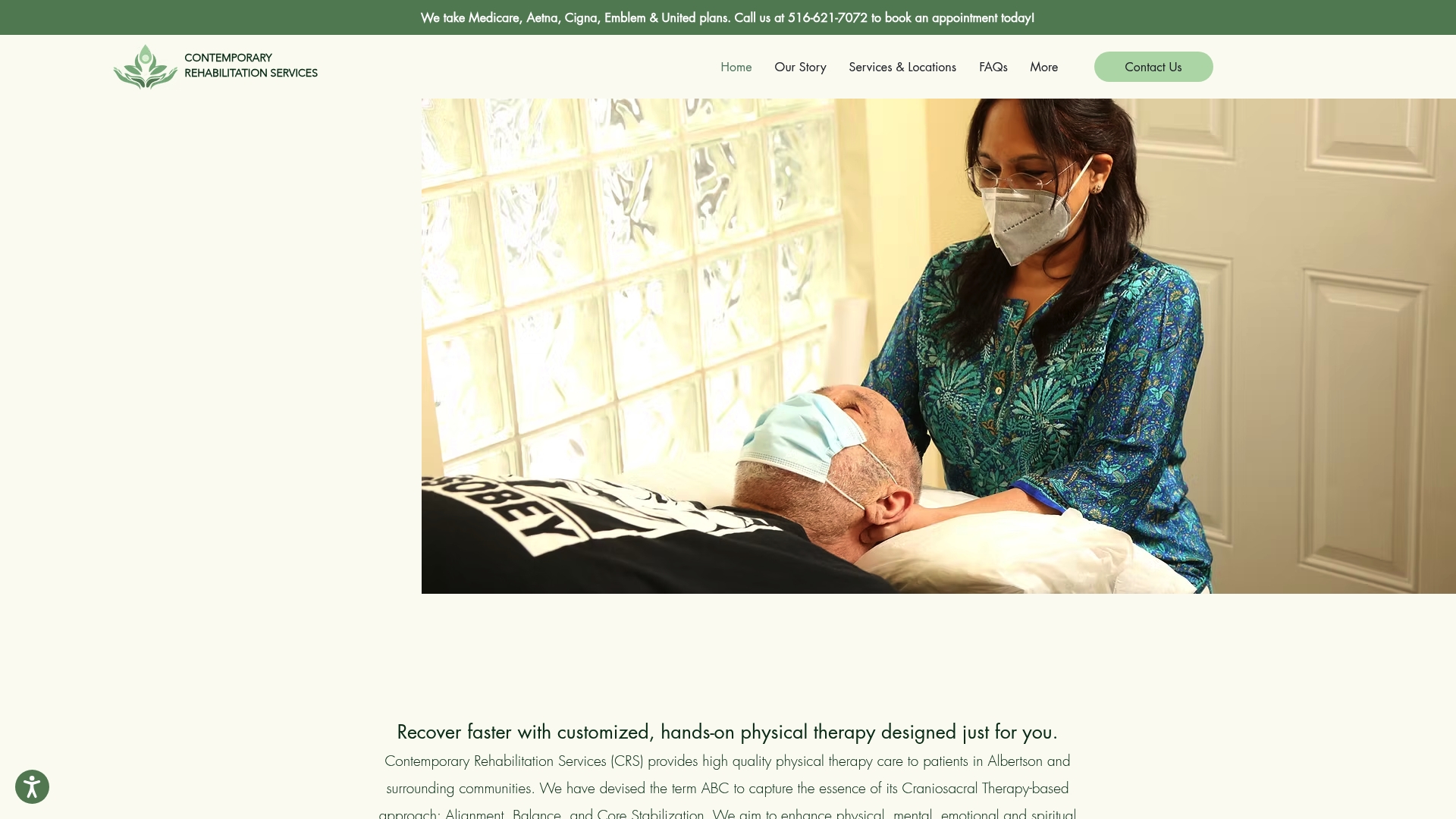
If dizziness or balance problems are affecting your daily life, a one-on-one evaluation is the fastest way to find out which exercises will actually help you, rather than guessing from a generic list online. We provide in-person physical therapy along with telehealth PT sessions for follow-up visits, and our approach pairs vestibular exercise programming with manual therapy techniques, including craniosacral therapy, myofascial work, and joint mobilization, when neck or upper back restrictions are part of the picture.
We accept Medicare, Aetna, Cigna, Emblem, and United Healthcare, along with direct payment options, and our full range of services is listed for anyone who wants to see what a combined manual therapy and vestibular rehab plan looks like.
Bring a list of your symptoms, triggers, and any medications to your first visit.
Wear comfortable clothing that allows easy movement for balance and positional testing.
Expect your first session to include history taking, positional testing, and a baseline functional assessment.
Use telehealth follow-ups for exercise progression check-ins once your home program is underway.
Patients in and around our Albertson office and our Williston Park location can schedule an in-person evaluation to get a program built around their specific diagnosis rather than a one-size-fits-all handout.
This article is general information, not a substitute for advice from a qualified doctor. Consult a qualified healthcare professional about your own circumstances before acting on anything here.
FAQ
What exercises do you do for vestibular rehab?
Vestibular rehab typically includes gaze-stabilization drills like VOR X1 and X2, balance progressions that move from stable to compliant surfaces, and gait exercises such as walking while turning your head. The specific mix depends on whether your clinician has identified a unilateral deficit, bilateral loss, or a motion-sensitivity pattern on evaluation.
How do I reset my vestibular system?
There is no single reset switch, but repeated, guided exposure to head movement and visual motion helps your brain recalibrate through adaptation and habituation. This works best as a structured program built from an evaluation rather than random exercises, since the wrong drills for your specific deficit can feel unhelpful or provoke unnecessary symptoms.
How to calm the vestibular nerve?
Short-term relief often comes from resting in a comfortable position and avoiding sudden head movements during a flare, but longer-term calming of vestibular symptoms usually requires graded exercise exposure rather than only avoidance. If positional vertigo is the cause, a canalith repositioning maneuver like the Epley maneuver often resolves symptoms more directly than general calming strategies.
What triggers vestibular dysfunction?
Common triggers include inner ear infections, head injury or concussion, migraine, aging-related changes in balance function, and displaced inner ear crystals that cause BPPV. A clinical evaluation, including positional testing and a symptom history, usually identifies which of these applies to your case.
Is vestibular rehabilitation therapy covered by insurance?
Coverage depends on your specific plan and diagnosis, and Medicare covers vestibular function testing when it is ordered by a treating physician and used to guide patient management, according to CMS coverage policy. We accept Medicare, Aetna, Cigna, Emblem, and United Healthcare, so checking your specific benefits ahead of your visit is worthwhile.
Sources
Recommended
Comments