
PT for Neurological Conditions: What Patients Should Know

Neurological physical therapy, commonly called neuro PT, is a specialized rehabilitation program that targets injuries or diseases of the brain, spinal cord, and peripheral nerves to restore mobility, balance, and coordination. If you or someone you care for has been diagnosed with a condition like stroke, multiple sclerosis, Parkinson’s disease, or a traumatic brain injury, understanding what is PT for neurological conditions can help you make confident decisions about care. Neuro PT is not the same as general physical therapy. It uses neuroplasticity, the brain’s ability to rewire itself through practice, as the foundation for recovery. The goal is to rebuild the communication between your brain and your body, not just strengthen muscles.
What is PT for neurological conditions?
Neurological physical therapy is a distinct specialty within physical therapy for neurology. Standard PT addresses muscles, joints, and soft tissue. Neuro PT goes further by targeting the nervous system itself, working to restore the pathways that control movement, balance, and coordination.
Therapists who specialize in this field often hold the Neurologic Clinical Specialist (NCS) credential, a designation that signals advanced training in neuroplasticity-focused protocols. This matters because the techniques used in neuro PT, such as neuromuscular re-education and gait retraining, require a different clinical skill set than treating a sprained ankle or recovering from knee surgery.
The primary goals of neuro PT are consistent across conditions: improve functional mobility, reduce fall risk, rebuild strength and coordination, and support independence in daily activities. A session typically lasts up to 45 minutes and is built around your specific deficits and tolerance level. Every plan is personalized because no two nervous systems recover the same way.

Which neurological conditions benefit most from physical therapy?
Physical therapy for neurology covers a wide range of diagnoses. The conditions that respond best to neuro PT share a common thread: they all disrupt the nervous system’s ability to control movement and posture.
Conditions commonly treated with neuro PT include:
Stroke: Muscle weakness, spasticity, and impaired coordination on one side of the body are the most common deficits. PT focuses on retraining movement patterns and improving walking ability.
Traumatic brain injury (TBI): Balance problems, dizziness, and cognitive-motor deficits are addressed through graded physical challenges and vestibular exercises.
Multiple sclerosis (MS): Fatigue, spasticity, and balance loss respond well to carefully paced exercise programs that avoid overheating.
Parkinson’s disease: Gait freezing, postural instability, and reduced arm swing are targeted with rhythmic movement training and balance work.
Spinal cord injury: Depending on the level and completeness of injury, PT works on whatever motor function remains and trains compensatory strategies.
Peripheral neuropathy: Sensory loss in the feet and legs increases fall risk significantly. PT addresses proprioception and balance to keep patients safe.
Each of these conditions produces different symptoms, so customized treatment plans are not optional. They are the standard of care. A patient with MS needs a very different program than a patient recovering from a stroke, even if both present with balance problems.
What techniques are used in neurological PT sessions?
Neuro PT sessions are structured, progressive, and built around your specific deficits. The techniques used are grounded in evidence and chosen based on your evaluation findings.
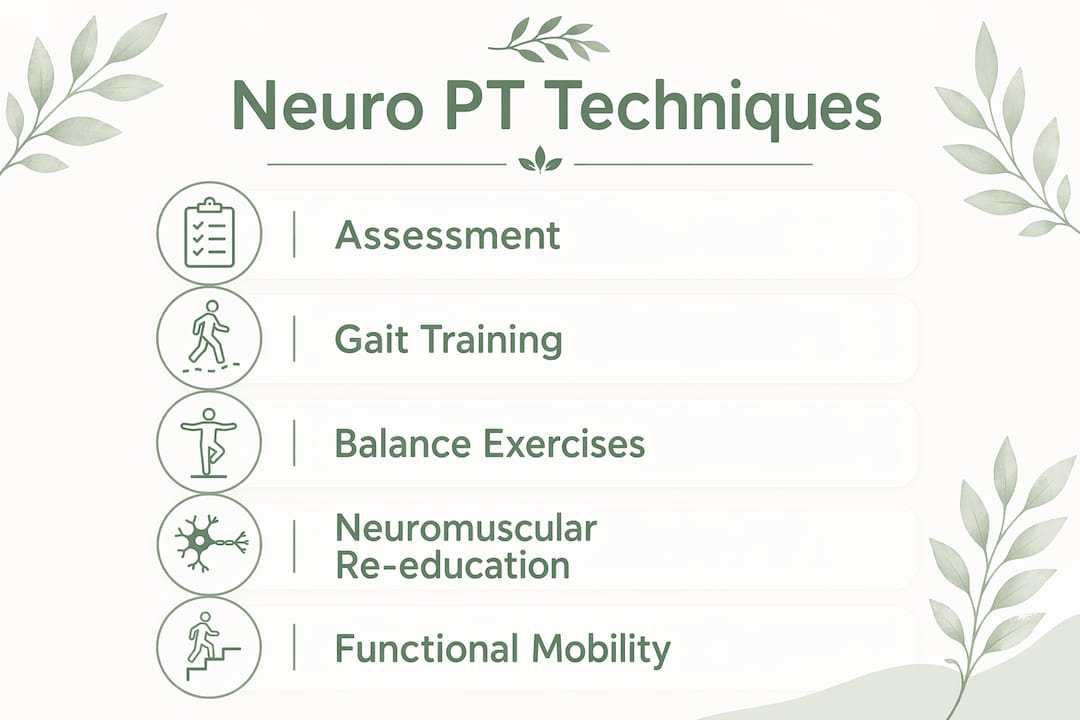
Gait training: Your therapist guides you through walking exercises that retrain the mechanics of each step. This may use parallel bars, a treadmill, or body-weight support systems depending on your strength level.
Balance and coordination exercises: Standing on unstable surfaces, reaching tasks, and dual-task activities challenge your balance system and build confidence. These directly reduce fall risk.
Neuromuscular re-education: This technique retrains the nervous system to activate muscles in the correct sequence. It is the core of neuro PT interventions and addresses the root cause of movement dysfunction.
Tilt-table therapy: Patients with orthostatic hypotension, a drop in blood pressure when standing, use a motorized table to gradually reintroduce upright positioning. This is common after prolonged bed rest following a TBI or spinal cord injury.
Assistive device training: Walkers, canes, and ankle-foot orthoses are only effective when used correctly. Your therapist teaches you how to use these tools safely and efficiently.
Home exercise programs: Your therapist prescribes exercises you practice between sessions. Consistent repetition at home is what drives neuroplasticity.
Sessions progress based on your tolerance and response. What feels challenging in week one should feel manageable by week four. That progression is intentional.
Pro Tip: Write down two or three specific activities you want to return to, such as walking to the mailbox or cooking a meal, and share them with your therapist at your first session. Goal-directed therapy produces better outcomes than generic exercise programs.
How does neuro PT improve both physical and cognitive function?
Neuroplasticity is the mechanism behind every gain made in neuro PT. The brain rewires through therapy and practice, forming new neural connections when old pathways are damaged. This is why repetition matters so much in neuro PT. Every time you practice a movement, you reinforce the neural pathway that controls it.
The benefits of PT for neurological disorders extend beyond the physical. Cognitive spill-over effects from complex, goal-oriented physical tasks include improvements in attention, focus, and memory. This is not a side effect. It reflects how deeply the motor and cognitive systems are connected in the brain.
Current clinical practice uses a biopsychosocial model that addresses physical, emotional, and environmental factors together. Your therapist does not just assess your walking speed. They consider your home environment, your emotional state, your daily roles, and your personal goals. This goal-oriented clinical reasoning produces more sustainable outcomes than a purely physical approach.
Key benefits patients and caregivers can expect from neuro PT include:
Improved walking speed, stability, and endurance
Reduced spasticity and muscle stiffness
Lower fall risk through better balance and body awareness
Greater independence in daily activities like dressing, bathing, and cooking
Improved attention and mental focus as a result of complex movement practice
Reduced risk of secondary complications like pressure ulcers and contractures
“Physical therapy is more than muscle strengthening. It is about retraining brain-body communication pathways through collaborative patient-therapist efforts.” — Cleveland Clinic
Active participation is the single most important factor in cognitive-motor improvement. Passive treatments produce limited gains. When you engage fully in each task, your brain responds.
Why is early and ongoing neuro PT essential for long-term outcomes?
Starting neuro PT early produces better recovery trajectories. Waiting too long after a neurological event limits recovery potential and raises the risk of serious complications like contractures, pressure ulcers, and severe deconditioning. The nervous system is most responsive to rehabilitation in the early weeks and months after injury or diagnosis.
Ongoing therapy matters just as much as early intervention. Systematic review evidence confirms that consistent neuro PT produces cumulative progress and reduces secondary complications like spasticity and fall-related injuries over time. Stopping therapy prematurely is one of the most common reasons patients plateau or regress.
Caregivers play a direct role in outcomes. Patients who receive support from family members in completing their home exercise programs progress faster than those who practice alone. If you are caring for someone in neuro PT, ask the therapist to show you how to assist safely with exercises at home.
Key points for managing long-term neuro PT:
Start as soon as medically cleared after a neurological event or diagnosis
Treat home exercises as non-negotiable between clinic sessions
Expect non-linear progress. Plateaus are normal and do not mean therapy has stopped working
Focus on functional goals, such as walking a specific distance or returning to a hobby, rather than perfect movement
Communicate openly with your therapist about what is and is not working
Pro Tip: Keep a simple daily log of your home exercises and any changes in symptoms. Bring it to each session. This gives your therapist real data to adjust your program and keeps you motivated by showing progress over time.
Balance-focused physical therapy is a critical component of long-term neuro PT for patients with Parkinson’s, MS, and stroke, where fall risk remains elevated for years after the initial event.
Key Takeaways
Neurological physical therapy restores function by retraining brain-body communication through neuroplasticity-driven, personalized rehabilitation programs that address both motor and cognitive deficits.
Point | Details |
Neuro PT is a distinct specialty | It targets nervous system pathways, not just muscles, requiring NCS-credentialed therapists. |
Early intervention matters | Starting PT soon after a neurological event significantly improves long-term recovery outcomes. |
Techniques are condition-specific | Gait training, neuromuscular re-education, and tilt-table therapy are matched to each patient’s deficits. |
Cognitive benefits are real | Complex movement tasks improve attention, focus, and memory through neuroplasticity. |
Ongoing therapy prevents decline | Consistent sessions and home exercise programs reduce spasticity, fall risk, and secondary complications. |
What I’ve learned working with neurological patients
After years of working with patients who have strokes, TBIs, and Parkinson’s disease, the thing that surprises most people is how much of neuro PT is mental. Patients often arrive expecting to do exercises. What they find is that they are relearning how to think about movement.
The biggest mistake I see is patients waiting for motivation before they engage fully. Motivation follows action in neuro PT, not the other way around. The patients who make the most progress are the ones who show up consistently, even on the hard days, and who treat their home program as seriously as their clinic sessions.
I also want to be direct about something that most articles skip: progress is not always visible week to week. A patient might feel like nothing is changing for three weeks and then suddenly walk a full block without stopping. That is neuroplasticity working on its own timeline. Caregivers need to understand this too, because their encouragement during plateaus is one of the most powerful tools in the entire rehabilitation process.
The importance of specialized care cannot be overstated. A therapist without neurological training will not know how to progress a Parkinson’s patient safely or how to use cognitive rest principles to protect a TBI patient from setbacks. Ask specifically for a neurologically trained therapist. You deserve that level of expertise.
— Tj
Neurological PT at Contemporaryrehabservices
Contemporaryrehabservices is a boutique physical therapy clinic in Albertson, NY, serving patients across Queens and Nassau County. The clinic specializes in neurological rehabilitation, offering personalized treatment plans built on evidence-based methods for conditions including stroke, Parkinson’s disease, MS, TBI, and spinal cord injury.
Every patient at Contemporaryrehabservices receives a comprehensive evaluation before treatment begins. Plans are adjusted as you progress, and the team works closely with caregivers to support home exercise adherence. The clinic accepts Medicare, Aetna, Cigna, Emblem, and United Healthcare plans. To learn more about available treatments or to schedule an evaluation, visit the neurological therapy services page directly.
FAQ
What is neurological physical therapy?
Neurological physical therapy is a specialized rehabilitation program that targets the brain, spinal cord, and peripheral nerves to restore mobility, balance, and coordination. It uses neuroplasticity-based techniques to rebuild the communication pathways between the brain and the body.
How does PT help with neurological conditions?
PT addresses the movement deficits caused by nervous system damage through gait training, neuromuscular re-education, balance exercises, and assistive device training. Consistent therapy reduces fall risk, improves functional independence, and can produce cognitive benefits like better attention and focus.
What should I expect in my first neurological PT session?
Your first session is a comprehensive evaluation. Your therapist will assess your strength, balance, coordination, gait, and daily function to build a personalized treatment plan. Sessions typically last up to 45 minutes and are adjusted based on your tolerance and progress.
How soon after a neurological event should PT start?
PT should begin as soon as you are medically cleared, ideally within days to weeks of a stroke, TBI, or other neurological event. Early intervention produces better recovery outcomes and reduces the risk of secondary complications like contractures and severe deconditioning.
Does insurance cover neurological physical therapy?
Many major insurance plans cover neurological PT when it is medically necessary. Contemporaryrehabservices accepts Medicare, Aetna, Cigna, Emblem, and United Healthcare, making specialized neuro PT accessible to patients across Queens and Nassau County.
Recommended
Comments