
Visceral Manipulation Safety for Patients: Evidence, Risks, Screening

Visceral manipulation is generally low-risk when a trained clinician performs it, and most people feel nothing worse than mild soreness or brief fatigue afterward. But it’s not right for everyone. Certain serious conditions such as active infection, recent abdominal surgery, cancer, and unstable vascular issues all make it unsafe, so proper screening before your first session is a necessary precaution. If you have any of these concerns, talk to your provider and get medical clearance first.
TL;DR:
Proper screening is essential to avoid visceral manipulation if you have active infections, recent surgeries, cancer, or vascular instability.
The research evidence on visceral manipulation is limited, with most studies showing short-term pain relief but inconsistent quality and rare reports of serious adverse events.
Mild reactions such as soreness, fatigue, or digestive changes are common within 48 hours and usually resolve with rest and hydration.
Treatment should be avoided immediately in cases of severe, worsening pain, high fever, unexplained bleeding, or signs of internal emergency.
Always verify that your provider has specialized visceral training and collaborates with your healthcare team for safe and effective care.
Table of Contents
Visceral Manipulation Safety: What the Research Evidence Shows
Absolute Contraindications: When to Avoid Treatment Entirely
Relative Contraindications: Conditions That Need Extra Caution
What Actually Happens During and After a Visceral Therapy Session
The Contemporary Rehab Services Take on Screening and Integrated Care
Visceral Manipulation Safety: What the Research Evidence Shows
The honest answer is that visceral manipulation looks safe in most reported cases, but the research behind that conclusion is thinner than you’d expect from a therapy this widely practiced. A systematic review of fascial therapies targeting the visceral system found mixed results across trials, with some studies showing short-term pain reduction and others showing little difference from control treatment. The certainty of evidence for most outcomes ranges from low to very low, which is the technical way of saying: promising signals, but not proof.
A separate review in the Journal of Osteopathic Medicine reached a similar verdict. Trials are small, protocols vary widely from one study to the next, and many carry a high risk of bias.
Here’s what tends to hold across the research:
Short-term relief is reported in some trials, especially for pain-related outcomes.
Study quality is inconsistent, with small sample sizes and heterogeneous techniques.
Adverse-event reporting is spotty at best, with many trials skipping it entirely.
Serious complications appear almost exclusively in isolated case reports, not controlled trials.
Most studies don’t systematically track side effects, which makes it hard to say how rare serious events really are, even though the ones documented in case reports (organ hematoma, perforation) remain uncommon.
Common Reactions After a Visceral Therapy Session
Many people who undergo visceral manipulation notice mild, short-term reactions within the first day or two, such as localized soreness, general fatigue, or temporary digestive changes like mild bloating.
These reactions usually show up within a few hours and resolve in 24 to 48 hours. If soreness or fatigue lingers well beyond that window, or worsens instead of easing, that’s worth a call to your provider.
Simple self-care handles most of it:
Rest and avoid strenuous activity for the rest of the day.
Drink water, since mild dehydration can intensify soreness.
Move gently. Walking is better than sitting still.
Use an over-the-counter analgesic if your provider says it’s appropriate for you.
Pro Tip: Keep a one-line note after each session (how you felt at 24 and 48 hours). Patterns you’d otherwise forget become obvious to your therapist at your next visit.
Absolute Contraindications: When to Avoid Treatment Entirely
Some conditions rule out visceral manipulation outright, at least until they’re resolved or medically stabilized. These aren’t judgment calls. They’re firm stop signs that professional guidance consistently flags across sources.
Active infection or systemic fever, including suspected appendicitis, peritonitis, or diverticulitis.
Known or suspected malignancy at or near the treatment site.
Recent abdominal or pelvic surgery, until the surgeon has cleared you for manual therapy.
Active internal bleeding, aneurysm, or other unstable vascular lesions.
Unstable trauma or suspected acute organ rupture.
These overlap consistently across professional clinical guidance on contraindications, which is reassuring. It means practitioners aren’t guessing. A clinician who skips asking about any of these before treating your abdomen or pelvis is skipping a step that matters.
Relative Contraindications: Conditions That Need Extra Caution
Not every risk factor means treatment is off the table. Some conditions just require a more careful approach, physician clearance, or a therapist with specific training in that population.
Pregnancy. Techniques need to come from a practitioner experienced in prenatal visceral work, and physician clearance is often appropriate, especially in the first trimester or with a complicated pregnancy history. If pelvic or abdominal discomfort during pregnancy is your main concern, physical therapy alongside simple symptom tracking can help you and your provider spot patterns early.
Active inflammatory bowel disease flares (Crohn’s disease, ulcerative colitis). Medical stabilization comes first, before any manual technique near the abdomen.
Anticoagulant use or bleeding disorders. Your therapist needs to weigh potential benefit against bleeding risk before applying any sustained pressure.
Severe osteoporosis, recent trauma, or implanted devices like an IUD. Technique gets modified, and the risk gets discussed openly.
Psychological or emotional vulnerability. Visceral work occasionally triggers an emotional release, and a good therapist prepares you for that possibility rather than letting it surprise you.
Your Pre-Session Screening Checklist
A thorough intake conversation is what separates safe visceral therapy from a guessing game. Here’s what to bring up before your first session, and what your therapist should be asking you.
Disclose your surgical history, including anything abdominal or pelvic, and how recently it happened.
Report any active infections, cancer history, or current pregnancy.
List every medication you’re taking, especially anticoagulants or immunosuppressants.
Flag any recent or unexplained severe abdominal or pelvic pain before treatment begins, not after.
Ask directly about your therapist’s training, how they screen for contraindications, and whether they coordinate with your physician when something looks off.
Pro Tip: Write your medication list and surgical history on your phone before your appointment. It’s easy to forget a detail under the stress of a new intake form, and the details are exactly what keeps the session safe.
How to Choose a Provider Trained to Practice Safely
Training background matters more here than in a lot of manual therapy disciplines, because the abdomen and pelvis hold organs, not just muscle and connective tissue. Look for a physical therapist, osteopathic physician, or manual therapist with formal visceral training, whether through a doctorate program or specialist coursework from a recognized organization like the Barral Institute.
A safe provider does a few things consistently:
Collaborates with your physician and refers out when something falls outside their scope.
Documents your history and any relevant conditions before treating you.
Has real experience working with your specific concern, not just general training.
Watch for red flags too. A provider who pressures you to skip a medical workup, claims visceral manipulation can cure a serious disease on its own, or never asks a single screening question before laying hands on you is not practicing safely, regardless of how confident they sound.
Warning Signs: When to Stop Treatment and Call a Doctor
Certain symptoms mean you stop the session and seek medical care immediately, not “wait and see how it feels tomorrow.”
Severe or rapidly worsening abdominal pain.
High fever, fainting, or near-fainting.
Heavy or unexplained bleeding.
New weakness, numbness, sudden shortness of breath, or chest pain.
Symptoms that get dramatically worse in the hours right after a session, which can signal internal bleeding or another acute problem.
These signs point to something beyond what manual therapy addresses, and delayed diagnosis is the real risk here. If your abdominal pain is unexplained and getting worse, a medical evaluation, not another visceral session, is the right next move. The Mayo Clinic’s guidance on IBS symptoms is a useful reference for distinguishing ordinary digestive discomfort from red-flag symptoms that need urgent attention.
What Actually Happens During and After a Visceral Therapy Session
A typical session starts with intake questions, then moves into focused, gentle palpation as the therapist checks for restriction and asks how different areas feel under light pressure. Manipulation itself is low-force. Think sustained gentle pressure and slow mobilization, not deep tissue work. Sessions usually run 30 to 60 minutes.
Some patients notice an emotional reaction during or after treatment. A well-trained clinician expects this, documents it, and checks in with you afterward rather than treating it as unusual. How many sessions you’ll need varies by condition and response, so a good therapist sets specific, measurable goals early and adjusts the plan based on how you’re actually responding, not a fixed script.

The Contemporary Rehab Services Take on Screening and Integrated Care
Screening isn’t a formality here. It’s the first real decision in your care. Techniques get tailored only after confirming there’s no red flag that needs a physician’s attention first, and coordination with your medical team occurs when a condition calls for it. That’s not a marketing line. It’s how visceral work stays in its lane instead of overreaching into territory that belongs to your doctor.
— CRS Wellness
Book a Screening-First Visceral Therapy Evaluation
If you’ve read this far, you already understand why screening matters more than the technique itself. Screening is treated as the starting point, not a formality tucked into paperwork. Every visceral therapy evaluation begins with a conversation about surgical history, medications, and any red flags, with coordination with a physician when medical clearance is needed before hands-on work begins.
We also offer craniosacral therapy, myofascial work, and telehealth intake sessions, so if visceral techniques aren’t the right fit for your situation, there’s a path that is. You can review the full range of manual therapy services we offer, including how craniosacral and visceral approaches often work together in a single treatment plan. If you’re ready for a safety-focused evaluation, request an appointment and we’ll walk through your history before anything hands-on ever happens.
Where to Learn More
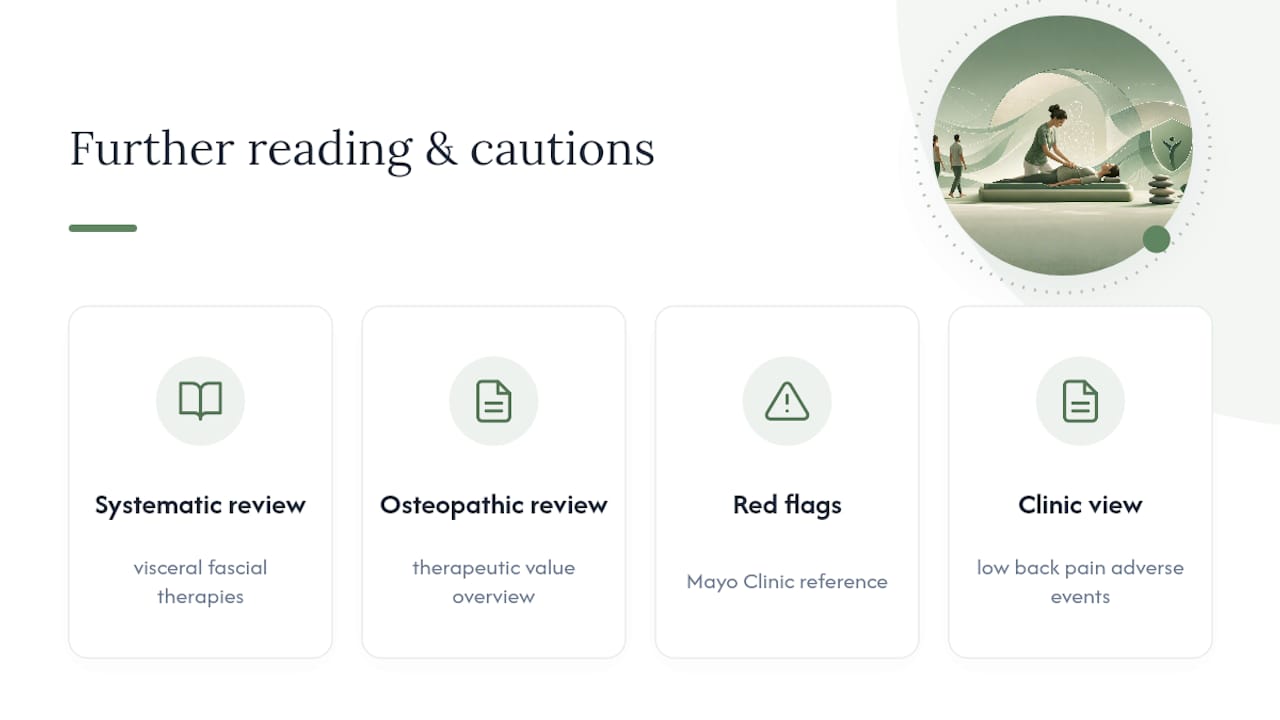
For deeper reading on the evidence base, the systematic review on visceral fascial therapies and the osteopathic review of therapeutic value are the strongest starting points. For red-flag symptoms tied to digestive and pelvic conditions, Mayo Clinic remains a reliable reference. You can also read our related coverage on visceral manipulation for chronic low back pain for a clinic-focused view of adverse events and evidence limits.
This article is general information, not a substitute for advice from a qualified doctor. Consult a qualified healthcare professional about your own circumstances before acting on anything here.
Sources
FAQ
Is Visceral Manipulation Legit?
It’s a real manual therapy technique used by trained physical therapists and osteopathic clinicians, not a fringe practice invented outside medicine. That said, the research evidence supporting it remains limited and low to very low certainty for most outcomes, so it’s best viewed as a complementary approach rather than a proven standalone cure.
Can I Do Visceral Manipulation on Myself?
Self-applied visceral techniques carry real risk because you can’t screen yourself for contraindications like active infection, malignancy, or vascular issues the way a trained clinician can. Gentle self-massage for general comfort is different from targeted visceral work, which should be left to a practitioner with proper training.
Can a Massage Therapist Do Visceral Manipulation?
Some massage therapists complete specialized visceral training through programs like the Barral Institute, but general massage licensure alone doesn’t qualify someone for this work. Always ask directly about a provider’s specific visceral training and how they screen for contraindications before booking.
What Are the Potential Side Effects of Visceral Manipulation?
Most people experience only mild, short-lived effects: localized soreness, fatigue, or a temporary change in digestion, typically resolving within 24 to 48 hours. Serious complications like organ injury are rare and documented mostly in isolated case reports, though inconsistent adverse-event reporting in trials makes it hard to say exactly how rare.
Recommended
Comments