
What Is a PT Evaluation? Your First Visit Explained

A physical therapy evaluation is a structured clinical assessment conducted by a licensed physical therapist to identify your physical impairments, understand your functional limitations, and build a personalized treatment plan. Known formally as an initial physical therapy evaluation, this process is the foundation of every rehabilitation program. Without it, treatment is guesswork. With it, your therapist has a clear, objective picture of where you are today and a measurable target for where you need to be. If you are considering physical therapy in Nassau County or Queens, knowing what to expect from your first visit removes the uncertainty and helps you get more from every session.
What is a PT evaluation and what does it include?
A PT evaluation is a comprehensive initial assessment that combines medical history, physical examination, functional testing, and collaborative goal setting to establish a documented treatment baseline. This baseline is not just a starting point. It becomes the reference your therapist uses to measure every improvement you make throughout your care.

The evaluation is primarily a diagnostic consultation, not a treatment session. Many patients arrive expecting hands-on therapy to begin immediately, but the first visit is focused on data gathering and clinical reasoning. Treatment typically starts during your second or third session, once your therapist has analyzed the findings and designed your plan of care.
A standard physical therapy assessment covers four core areas. First, your therapist reviews your medical history, including current symptoms, prior surgeries, medications, and how your condition affects your daily life. Second, a physical examination assesses posture, joint range of motion, muscle strength, and neurological function. Third, functional movement tests evaluate how your body performs tasks relevant to your life, whether that is walking, climbing stairs, or returning to a sport. Fourth, you and your therapist set goals together using SMART criteria, meaning goals that are specific, measurable, achievable, relevant, and time-bound.
A typical evaluation lasts between 45 and 60 minutes. Bring your insurance card, a photo ID, any relevant imaging reports such as X-rays or MRI results, and a list of current medications. Wearing comfortable, loose-fitting clothing allows your therapist to observe your movement without restriction.
Pro Tip: Write down your symptoms before you arrive. Note when pain started, what makes it better or worse, and how it limits your daily activities. This detail helps your therapist identify root causes rather than surface symptoms.
How are PT evaluations classified by complexity?
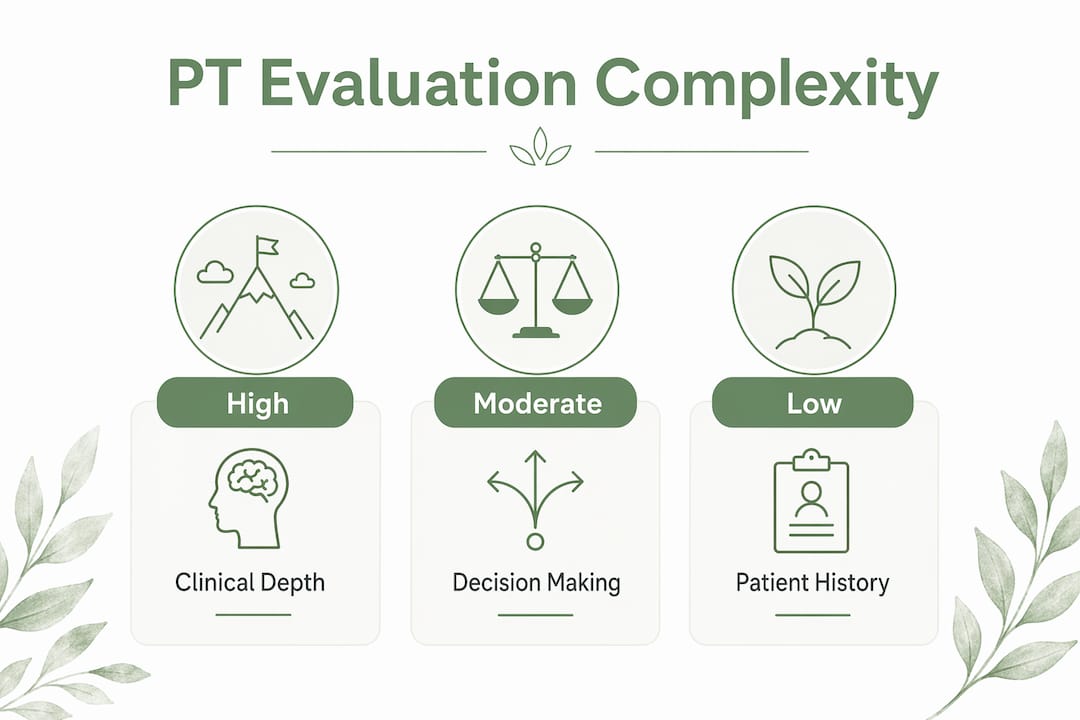
APTA guidelines define three complexity levels for PT evaluations: low, moderate, and high. Each tier reflects the clinical effort required to assess and plan care for a given patient. Understanding these tiers matters because they directly influence how your care is documented, billed, and structured.
The classification depends on three factors: the depth of patient history, the number of examination elements performed, and the complexity of clinical decision-making required. A patient with a single, straightforward injury and no significant medical history typically falls into the low complexity tier. A patient with multiple conditions, prior surgeries, or complex functional limitations requires a high complexity evaluation.
Complexity level | Patient profile | Clinical decision-making |
Low | Single condition, minimal history | Straightforward, limited examination elements |
Moderate | Multiple conditions or comorbidities | Moderate reasoning, several examination elements |
High | Complex history, significant functional loss | Extensive reasoning, comprehensive examination |
Accurate classification matters beyond billing. It shapes how thoroughly your therapist documents your condition, which in turn supports insurance compliance and treatment justification. If your insurer questions the medical necessity of your care, a well-documented evaluation at the correct complexity level is your therapist’s strongest defense.
Pro Tip: If you have multiple health conditions or a long medical history, tell your therapist upfront. This helps them allocate the right amount of time and ensures your evaluation captures the full picture of your health.
Why is the PT evaluation important for your recovery?
The importance of a PT evaluation goes well beyond paperwork. It is the clinical mechanism that connects your symptoms to a targeted, evidence-based plan. A strong PT evaluation improves patient outcomes by providing measurable baselines and guiding personalized care plans. That means your progress is tracked against real numbers, not impressions.
Here is what a thorough physical therapy assessment delivers for your recovery:
An objective baseline. Your therapist measures range of motion, strength, and functional performance at the start. Every follow-up session is compared against these numbers to confirm you are improving.
A personalized care plan. Generic exercise programs produce generic results. The evaluation reveals which specific impairments are driving your pain or dysfunction, so treatment targets the actual problem.
Better communication across your care team. PT evaluations create official, defensible medical records that your primary care physician, orthopedic surgeon, or specialist can reference. This keeps everyone aligned on your progress and goals.
Insurance and compliance support. Documented evaluations justify ongoing treatment to insurers. Without them, coverage for continued sessions can be denied.
“Viewing the PT evaluation as a structured process rather than a physical check-up increases patient engagement and goal participation.” — Kinvent
This shift in perspective is significant. Patients who understand why each test is being performed are more likely to engage honestly, set realistic goals, and follow through with their home exercise programs. Engagement is not a soft benefit. It directly affects how fast and how fully you recover. If you want a clearer picture of what recovery looks like step by step, the PT recovery checklist from Contemporaryrehabservices is a practical resource to review before your first visit.
How to prepare for your PT evaluation
Preparation is one of the most underrated parts of the physical therapy evaluation process. Arriving organized and informed allows your therapist to spend more time on clinical assessment and less time filling in background gaps.
Follow these steps before your appointment:
Document your symptom history in detail. Note when the problem started, what triggered it, how it has changed over time, and what your pain pattern looks like across a typical day. Sharing detailed symptom history including pain patterns and prior surgeries helps therapists identify root causes instead of surface symptoms.
Bring relevant imaging and medical records. Bringing diagnostic imaging reports to your evaluation helps correlate structural findings with functional limitations, leading to a more precise plan of care. If you have X-rays, MRI results, or surgical notes, bring copies.
Be honest during movement tests. Movement and functional tests have no pass or fail. Your therapist is documenting your current mobility and pain levels to track progress, not to judge your ability. Pushing through pain to appear capable actually produces inaccurate data and can delay your recovery.
Prepare your questions and goals. Think about what you want to achieve. Do you want to return to running? Reduce daily pain? Get back to work? Specific goals help your therapist build a plan that reflects your life, not a generic protocol.
Manage evaluation anxiety. It is normal to feel nervous. The evaluation is a conversation as much as a physical exam. Your therapist is on your side.
If you are new to physical therapy entirely, the step-by-step guide from Contemporaryrehabservices walks you through the full process from referral to first session.
Pro Tip: Arrive 10 to 15 minutes early to complete intake paperwork without rushing. A calm, unhurried start means your therapist can begin the clinical interview on time and give your case the attention it deserves.
Key takeaways
A PT evaluation is the clinical foundation that makes every subsequent treatment session more targeted, measurable, and effective.
Point | Details |
Evaluation before treatment | The initial visit focuses on assessment and clinical reasoning; hands-on treatment typically begins in later sessions. |
Four core components | Medical history, physical examination, functional testing, and SMART goal setting form every PT evaluation. |
Three complexity tiers | APTA classifies evaluations as low, moderate, or high complexity based on history, exam elements, and clinical reasoning. |
Preparation improves outcomes | Bringing imaging, documenting symptoms, and setting clear goals leads to a more accurate and personalized care plan. |
Documentation protects your care | Thorough evaluation records support insurance compliance, provider communication, and ongoing treatment justification. |
Why the evaluation is the most important hour in your recovery
I have seen patients arrive at their first PT evaluation expecting to leave with a treatment plan already in motion. When that does not happen, some feel frustrated. I understand that instinct. You are in pain, you want relief, and sitting through questions and movement tests feels like a delay. But that first hour is not a delay. It is the reason your treatment will actually work.
The physical therapy assessment is where a skilled therapist separates the symptom from the source. Knee pain is rarely just a knee problem. Shoulder dysfunction often traces back to thoracic mobility or rotator cuff imbalances that a surface-level exam would miss entirely. The objective assessment framework used by trained therapists follows a structured sequence from observation to functional testing, which avoids the cognitive shortcuts that lead to misdiagnosis.
What I find most valuable about a well-conducted evaluation is the goal-setting conversation. Patients who articulate specific, personal goals during that first session tend to adhere to their programs far better than those who leave with a vague plan to “get better.” That conversation is not a formality. It is the moment your therapist learns what recovery actually means to you. If you want to understand how patient education fits into that process, the patient education resource from Contemporaryrehabservices explains it clearly.
The evaluation is not a hurdle before treatment. It is the treatment, in its most diagnostic form.
— Tj
Start your recovery with a thorough PT evaluation at Contemporaryrehabservices
If you are ready to understand your condition and build a plan that actually fits your life, Contemporaryrehabservices offers patient-centered physical therapy evaluations at convenient locations in Nassau County. The team at Searingtown physical therapy and Albertson physical therapy conducts thorough initial evaluations that cover your full medical history, functional movement, and personal goals before recommending any course of treatment. Contemporaryrehabservices accepts Medicare, Aetna, Cigna, Emblem Health, and United Healthcare plans, making access to expert care straightforward for most patients in Queens and Nassau County.

Your recovery starts with one honest, thorough conversation with a licensed therapist who takes the time to understand your body and your goals. Schedule your evaluation today and find out exactly what is holding you back.
FAQ
What is a PT evaluation in simple terms?
A PT evaluation is your first appointment with a physical therapist, focused entirely on assessing your condition, movement, and goals before treatment begins. It combines a medical history review, physical examination, and functional testing to build your personalized care plan.
How long does a physical therapy evaluation take?
Most PT evaluations last between 45 and 60 minutes. Complex cases involving multiple conditions or significant functional limitations may require additional time to complete a thorough assessment.
Will I receive treatment during my PT evaluation?
Treatment typically begins after the evaluation, during your second or subsequent sessions. The initial evaluation is a diagnostic consultation focused on data gathering and clinical reasoning, not hands-on therapy.
What should I bring to my PT evaluation?
Bring your insurance card, a photo ID, any relevant imaging reports such as X-rays or MRI results, a list of current medications, and a written summary of your symptoms. Bringing diagnostic imaging helps your therapist correlate structural findings with your functional limitations.
Do PT evaluations affect my insurance coverage?
Yes. PT evaluations create the documented medical records that justify your ongoing treatment to insurers. Accurate documentation at the correct complexity level supports reimbursement and protects your access to continued care.
Recommended
Comments