
What Is Preventive PT and How It Keeps You Active
- tjdontplay
- 12 hours ago
- 11 min read

Preventive physical therapy, often called “pre-hab,” is a proactive approach where a licensed physical therapist (PT or DPT) identifies and corrects movement problems, strength imbalances, and postural issues before they develop into pain or injury. The APTA frames prevention and wellness as core PT responsibilities, not optional extras. If you are wondering whether this applies to you, the short answer is: if you move, it probably does.
Here is what you need to know right away:
Top benefits: Reduces injury risk, lowers fall risk in older adults, improves surgical outcomes, and preserves long-term mobility and independence.
Who it helps most: Older adults, athletes, workers with repetitive job demands, people preparing for surgery, and anyone with nagging stiffness or recurring tightness.
Your next step: Book a movement screening with a licensed PT. You do not need to be in pain to benefit.
If you notice recurring stiffness, a shoulder that always feels “off,” or a calf that tightens every time you ramp up your runs, that is your body signaling a compensation pattern. Early evaluation prevents those small problems from cascading into larger ones.
Table of Contents
What does preventive physical therapy actually cover?
Preventive PT, also called preventative physical therapy or prehabilitation, focuses on optimizing how your body moves before a problem becomes a diagnosis. That is the core distinction from reactive, or therapeutic, PT, which treats an existing injury or condition. Both are delivered by the same licensed professionals, but the timing, goals, and sometimes the billing differ.
Feature | Preventive PT | Reactive (Therapeutic) PT |
Timing | Before pain or injury develops | After injury, surgery, or diagnosis |
Primary goal | Reduce risk, maintain function | Restore function, manage symptoms |
Common trigger | Wellness visit, screening, pre-op prep | Pain, referral, post-surgical order |
Billing | May be self-pay or wellness benefit | Usually covered under medical necessity |
Typical length | Short blocks (4–6 weeks) or periodic check-ins | Varies by condition, often longer |
The 2025 primary care PT consensus definition positions physical therapists as first-contact providers capable of health promotion, routine screening, and disease-risk reduction as part of a broader care team. In practical terms, that means a PT can screen you for fall risk, assess your movement patterns, and design a prevention plan without waiting for a physician to identify a problem first.
In New York State specifically, PTs may provide preventive care without a physician referral for a limited duration under qualifying circumstances. That is a meaningful access point for patients in Nassau County and Queens who want to be proactive about their health.
What a preventive PT program typically includes
A well-designed prevention program is not a generic exercise handout. It is built around your specific movement patterns, lifestyle, and goals. Here is what you can generally expect:
Movement screening: A systematic assessment of how you squat, hinge, reach, and walk to identify asymmetries, compensations, or mobility restrictions.
Posture and ergonomic review: Evaluation of how your work setup, sport mechanics, or daily habits load your joints over time.
Strength and mobility work: Targeted exercises to address the specific deficits found in your screen, not a one-size-fits-all program.
Balance training: Particularly important for older adults and anyone returning from a lower-extremity issue.
Home exercise program: A written, progressive plan you can follow between visits to maintain and build on clinic gains.
Education: Guidance on body mechanics, load management, sleep, and activity pacing so you understand why you are doing each exercise.
Periodic re-screening: A follow-up assessment every few months to measure progress and adjust the plan.
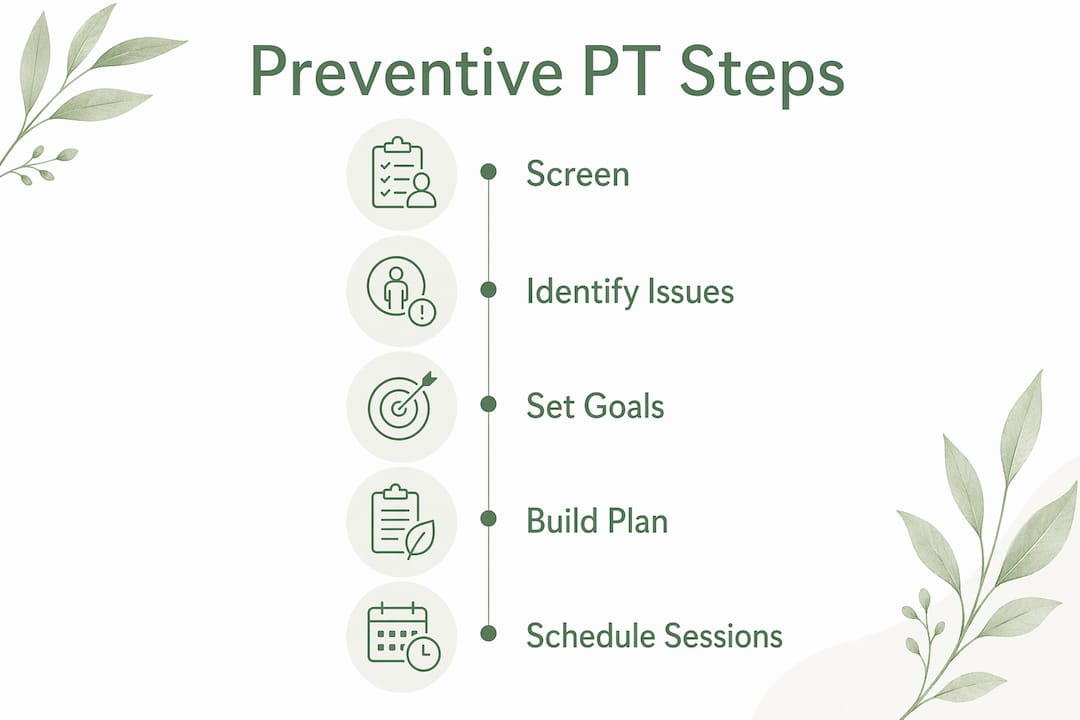
The typical workflow runs: screen → identify problem list → set measurable goals → build individualized plan → schedule follow-up. If the screening uncovers something that looks non-musculoskeletal, such as unexplained neurological signs or symptoms that suggest a systemic cause, your PT will coordinate a referral to the right provider. That triage role is part of what makes preventive physical therapy a genuinely efficient entry point into the health care system.
Who benefits from preventive PT?
Almost anyone who is physically active, aging, or facing a major medical procedure can benefit. A few groups stand out.

Older adults are the most studied population. Falls are a leading cause of injury in this group, and balance and strength training delivered by a PT directly addresses the physical factors that raise fall risk. Regular preventive PT helps older adults maintain the independence and mobility that make daily life manageable. The role of PT for older adults goes well beyond fall prevention, but that alone is a compelling reason to start early.
Athletes and active adults use pre-hab to address the small asymmetries that accumulate over a season. A runner with recurring calf tightness, for example, may be compensating for limited hip mobility. Left unaddressed, that pattern often produces a more serious injury. Addressing it in a 4–6 week prevention block before the problem peaks is far less disruptive than a full rehabilitation course mid-season. For athletes, sports injury prevention strategies are a natural complement to preventive PT.
Workers with repetitive job demands — office workers, nurses, construction workers, and others who perform the same motions for hours each day — accumulate strain gradually. An office worker with chronic neck fatigue and forward head posture is a classic candidate. A PT can identify the postural drivers, prescribe corrective exercises, and recommend ergonomic adjustments before that fatigue becomes a herniated disc. Overuse injuries are largely preventable with the right PT-guided approach.
People preparing for surgery benefit from prehabilitation, which builds strength and mobility before the procedure so recovery starts from a stronger baseline. Prehabilitation before surgery can reduce post-operative complications and shorten recovery time.
Feeling “fine but tight” is a completely valid reason to seek an evaluation. That low-grade stiffness is often the earliest signal of a compensation pattern worth addressing.
What should you expect at your first preventive PT visit?
Knowing what happens during that first appointment makes it much easier to show up prepared and get the most out of it.
Intake and health history: Your PT reviews your medical history, current medications, recent imaging, job demands, and activity level. Bring a list of medications and any relevant imaging reports.
Movement screen: You will perform a series of functional movements (squats, single-leg balance, overhead reach) while the PT observes for restrictions, asymmetries, and compensations.
Targeted tests: Based on the screen findings, the PT may assess specific joints, muscle groups, or neurological function in more detail.
Goal-setting: You and your PT agree on measurable, realistic goals — for example, improving single-leg balance time or reducing shoulder impingement risk before a swim season.
Exercise demonstration: The PT walks you through your initial exercises, corrects your form, and explains the rationale for each one.
Written home program: You leave with a clear, written plan so you can practice between visits.
For a typical prevention block, expect weekly visits over a month or more, followed by maintenance check-ins periodically. Understanding how PT treatment planning works helps you set realistic expectations from the start.
Red flags that change the plan immediately:
Acute neurological signs (sudden weakness, numbness, or loss of bladder/bowel control)
Unexplained weight loss alongside musculoskeletal complaints
Severe night pain that is not position-related
Symptoms that worsen consistently with rest
If any of these appear, your PT will pause the prevention program and coordinate urgent evaluation with the appropriate provider.
Insurance reminder: Call your insurer before your first visit. Ask whether your plan covers preventive PT visits, whether you need a referral, and what visit limits apply. In New York State, PTs can see you for prevention without a referral for up to 10 visits or 30 days, but billing rules differ from therapeutic PT. Preventive services billed concurrently as treatment for existing pathology are not permitted under state guidelines.

What does the evidence say about the benefits of preventive PT?
The case for preventive physical therapy is well-supported at the professional and clinical level. The APTA formally identifies prevention, wellness, and health promotion as core professional responsibilities for physical therapists, not optional services. That positioning matters: it means prevention is built into PT training and scope of practice, not added on as a wellness trend.
Physical therapists are well positioned to meet societal needs and reduce the global burden of noncommunicable diseases through the integration of evidence-based prevention, health promotion, and wellness activities into practice. — PMC / National Institutes of Health, Delphi Study on PT Prevention Competencies
Concrete outcomes supported by clinical guidance include:
Fall risk reduction in older adults through balance and strength training, one of the most consistent findings in PT prevention literature.
Improved surgical readiness and faster post-operative recovery when prehabilitation is completed before elective procedures.
Reduced spine symptom recurrence through targeted strengthening, posture correction, and a personalized home exercise program for back and neck health.
Lower overuse injury rates in active adults and athletes who address movement deficits before they compound.
Practitioner literature reports meaningful reductions in injury and fall risk measures across preventive physiotherapy programs for active adults and older populations. These outcomes are consistent with APTA guidance that consistent movement programs are key for managing age-related changes and maintaining independence.
Pro Tip: Prevention reduces risk and improves function, but it does not guarantee zero injuries. Consistency with your home program and periodic re-screenings matter as much as the initial evaluation. Think of it as maintenance, not a one-time fix.
Starter exercises your PT might prescribe
These are common examples grouped by goal. They are not a substitute for a personalized program, but they give you a sense of what preventive PT looks like in practice. Always start pain-free, and stop if a movement causes sharp or radiating discomfort.
Balance
Single-leg stand: Stand on one foot for 20–30 seconds, eyes open. Progress to eyes closed or a soft surface over 2–3 weeks.
Tandem walk: Walk heel-to-toe along a straight line for 10–15 steps. Progress by adding a slight head turn.
Core and strength
Dead-bug: Lie on your back, arms toward the ceiling, knees at 90 degrees. Slowly lower one arm and the opposite leg toward the floor, keeping your lower back flat. 3 sets of 8–10 reps.
Glute bridge: Lie on your back, feet flat, hip-width apart. Drive through your heels to lift your hips. Hold 2 seconds at the top. 3 sets of 12–15 reps.
Farmer carry: Hold a moderate weight in each hand and walk 20–30 feet with a tall posture. Builds grip strength, shoulder stability, and core endurance.
Mobility
Thoracic rotation: Sit upright in a chair, arms crossed over your chest. Rotate your upper body left and right through your comfortable range. 10 reps each side.
Hip flexor stretch: In a half-kneeling position, gently shift your hips forward until you feel a stretch in the front of the rear hip. Hold 30 seconds, 2 sets per side.
Pre-op conditioning
Gentle progressive loading of the surgical limb (e.g., mini-squats or straight-leg raises before a knee replacement) builds baseline strength that supports faster recovery after the procedure.
Pro Tip: Log your sets, reps, and how each exercise feels in a simple notebook or phone note. Tracking progress over 4–6 weeks gives your PT concrete data to adjust your program and keeps you accountable between visits.
How does insurance cover preventive PT, and how do you get started?
Coverage for preventive PT in the U.S. varies more than most patients expect. Many commercial insurance plans cover physical therapy when it is medically necessary, meaning there is a documented therapeutic need. Visits framed purely as “preventive” may not be covered under the same benefit, or may require different coding. Medicare covers PT services when medical necessity is established; purely wellness-oriented visits without a documented functional deficit are typically not reimbursable under standard Medicare Part B.
Questions to ask your insurer before booking:
Does my plan cover physical therapy for preventive or wellness purposes, or only for diagnosed conditions?
Do I need a physician referral, or can I self-refer to a PT?
How many PT visits does my plan cover per year, and do they reset on a calendar or plan year?
Are there specific CPT codes I should ask the clinic about?
Is there a deductible or copay I should expect?
In New York State, a qualified PT can provide prevention services without a physician referral for up to 10 visits or 30 days. That gives you a meaningful window to complete a prevention block and determine whether ongoing therapeutic care is warranted, without waiting for a referral.
What to bring to your first visit:
A list of current medications
Any recent imaging (X-rays, MRI reports)
Notes on your job demands, sport, or daily activity level
Your insurance card and a photo ID
When choosing a PT, look for a licensed Doctor of Physical Therapy (DPT), check that the clinic has experience in the area relevant to you (geriatrics, sports, pre-op conditioning), and confirm insurance participation before scheduling. Many clinics, including Contemporaryrehabservices in Albertson, NY, offer both in-person and virtual options, which makes it easier to complete a screening even with a busy schedule.
Key Takeaways
Preventive physical therapy is one of the most practical, evidence-backed ways to protect your body before small problems become serious ones.
Point | Details |
Clear definition | Preventive PT addresses movement deficits and imbalances before they become pain or injury. |
Who benefits most | Older adults, athletes, workers with repetitive demands, and pre-surgical patients all see meaningful gains. |
Evidence base | APTA formally identifies prevention as a core PT responsibility, supported by outcomes in fall reduction and surgical readiness. |
Insurance reality | Coverage varies; call your insurer before booking and ask about visit limits, referral requirements, and applicable codes. |
Contemporaryrehabservices | Offers in-person and virtual preventive PT screenings in Albertson, NY, accepting Medicare, Aetna, Cigna, Emblem, and UnitedHealthcare. |
Why starting before the pain arrives is the smarter move
Most people think of physical therapy as something you do after an injury. That framing is understandable, but it misses the point of what PTs are actually trained to do. The profession’s own governing body, the APTA, has positioned physical therapists as first-contact providers capable of screening, triaging, and managing health risks before they escalate. That is not a marketing claim. It is reflected in formal policy, clinical education standards, and state practice law.
What I find most overlooked in conversations about preventive PT is the cascade effect. A tight hip flexor does not stay a tight hip flexor. Over months, it changes how you load your knee, which changes how your lower back compensates, which eventually produces the pain that sends you to a clinic. By the time most patients book an appointment, they are managing the third or fourth consequence of a problem that started somewhere else entirely. A movement screen six months earlier would have caught it at step one.
The other thing worth saying plainly: you do not need to be an athlete or a senior to benefit. Office workers, parents who carry young children, people who stand for long shifts — anyone whose body absorbs repetitive load without a structured recovery plan is a candidate. The bar for “should I get screened” is much lower than most people assume. If something feels persistently off, that is enough.
Contemporaryrehabservices: preventive PT in Nassau County and Queens
Contemporaryrehabservices is a boutique physical therapy clinic in Albertson, NY, serving patients across Nassau County and Queens with both in-person and virtual appointments. For patients interested in preventive PT, the clinic offers individualized movement screenings, personalized prevention plans, manual therapy, and home exercise programs designed to address your specific risk factors before they become injuries.
The clinic accepts Medicare, Aetna, Cigna, Emblem, and UnitedHealthcare, as well as cash payments. Insurance coverage for preventive PT varies by plan, so the team recommends calling your insurer to confirm your benefits before your first visit. Whether you are preparing for surgery, managing the demands of an active job, or simply want to stay ahead of age-related changes, a screening visit is a low-commitment way to find out where you stand.
Ready to take that first step? Visit the clinic’s services page to learn more about available therapies and to schedule your screening appointment.
This article is for general informational purposes only and does not constitute medical or professional advice. Please consult a licensed physical therapist or qualified health care provider to determine what is appropriate for your individual situation.
Useful sources and further reading
APTA: Prevention and Wellness — The professional body’s official position on PT’s role in prevention, wellness, and health promotion; a reliable starting point for understanding scope and evidence.
APTA: PTs’ Role in Prevention, Wellness, and Health Promotion — Policy statement confirming prevention as a formal PT responsibility, not an optional service.
NYSED: Referral Not Required for Physical Therapy Prevention — New York State practice alert explaining the 10-visit/30-day no-referral window for preventive PT services.
Primary Care PT: 2025 Consensus Definition (APTA Federal) — Defines first-contact PT practice including preventive screening, triage, and team-based care.
National Spine Health Foundation: Preventative PT for Spine Health — Patient-friendly overview of how preventive PT supports back and neck resilience through exercise and home programs.
PMC: PT Prevention Competencies Delphi Study — Peer-reviewed research establishing consensus competencies for prevention and wellness in PT education; useful for understanding the evidence base.
Recommended