
What Is TMJ Physical Therapy? Your Relief Guide

TMJ physical therapy is a specialized, non-surgical treatment that targets the temporomandibular joint, the sliding hinge connecting your jaw to your skull, to relieve pain and restore normal jaw function. Clinically known as TMJ rehabilitation, this approach combines manual therapy, therapeutic exercises, and pain-relief modalities to address temporomandibular disorders (TMD). The American Physical Therapy Association recognizes physical therapy as a first-line treatment for TMD, and tools like ultrasound therapy, TENS (transcutaneous electrical nerve stimulation), and biofeedback are all part of the standard toolkit. If you are dealing with jaw clicking, facial pain, or difficulty chewing, understanding this treatment can help you take the right first step.
What is TMJ physical therapy and how does it work?
TMJ physical therapy is a structured program of hands-on treatment and guided exercise designed to reduce jaw pain, improve mobility, and correct the muscle imbalances driving your symptoms. A licensed physical therapist evaluates your jaw mechanics, neck posture, and muscle function before building a plan specific to your condition. Sessions typically run 45–60 minutes and combine in-clinic treatment with a home exercise program you follow between visits. The goal is to restore normal jaw movement without medication or surgery.
The temporomandibular joint works like a sliding hinge. It opens, closes, and shifts side to side with every bite, word, and yawn. When the muscles and connective tissue around it become strained or inflamed, the result is pain that can radiate into your ear, temple, or neck. Physical therapy addresses those root causes directly rather than masking the pain.

TMJ disorders are three times more common in women of childbearing age than in men. That statistic matters because it tells clinicians to screen for hormonal and postural factors that are often overlooked in standard dental evaluations.
Core techniques used in TMJ physical therapy
Physical therapists use several proven methods to treat TMD. Each technique targets a different aspect of the disorder, from tight muscles to restricted joint movement.
Manual Therapy and Myofascial Release
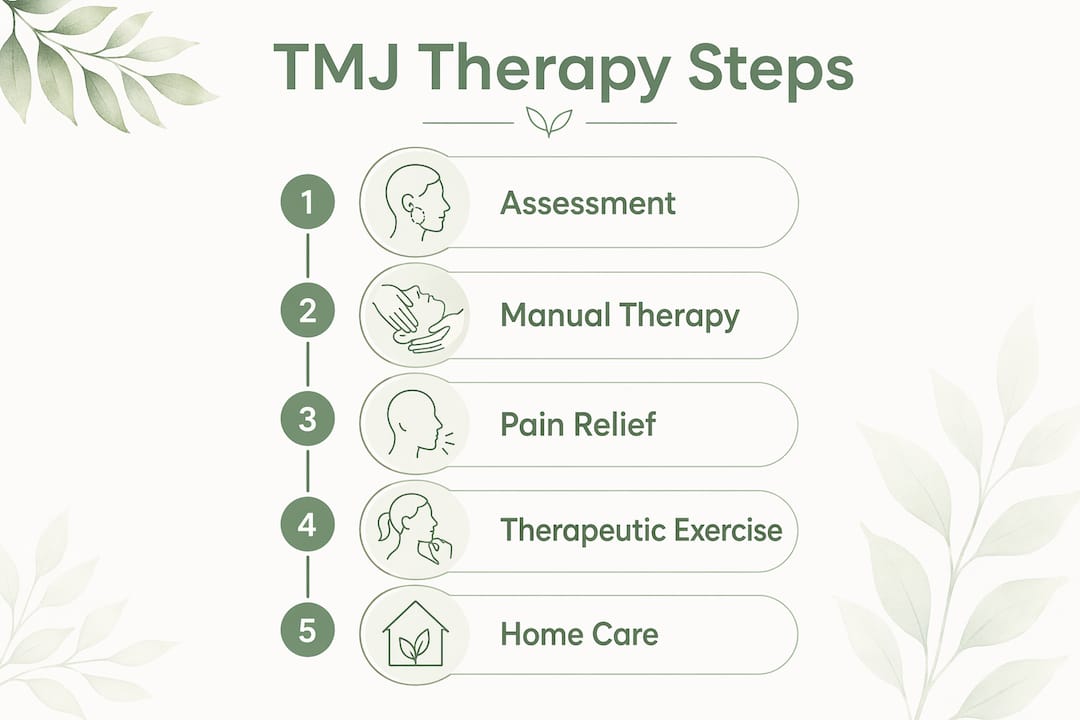
Manual therapy involves the therapist using their hands to mobilize the jaw joint and surrounding soft tissue. Myofascial release targets the fascia, the connective tissue wrapping your jaw and neck muscles, to reduce tension and improve range of motion. These manual therapy benefits are well documented for both pain relief and restored mobility in patients with TMD.
Therapeutic Exercises
Specific exercises are the backbone of any TMJ treatment plan. Two of the most commonly prescribed are:
Goldfish exercise: You place your tongue on the roof of your mouth, then partially open and close your jaw. This trains controlled movement and reduces clicking.
Resisted opening: You press your thumb under your chin while slowly opening your mouth. The resistance builds strength in the jaw depressor muscles.
Side-to-side movements: You move your jaw gently from left to right within a pain-free range to restore lateral mobility.
Chin tucks: You pull your chin straight back to correct forward head posture, which directly reduces strain on the TMJ.
Pain-Relief Modalities
Common modalities include ultrasound therapy for deep tissue heating, TENS for blocking pain signals, and electromyographic biofeedback for teaching muscle relaxation. Ultrasound penetrates deeper than a heating pad, reaching the joint capsule itself. TENS is particularly useful for patients who cannot tolerate hands-on work during a flare-up.
Pro Tip: Set a phone alarm for your home exercises. TMJ improvement depends on repetition throughout the day, not one long session. Three short sets spread across morning, midday, and evening outperform a single 15-minute block.
What are the benefits of TMJ physical therapy?
The evidence behind physical therapy for jaw pain is strong and growing. A systematic review of 51 randomized controlled trials from 2020 to 2025 found that physical therapy interventions including manual therapy, therapeutic exercises, and laser therapy provide effective short-term relief and improved jaw mobility in adults with TMD. That breadth of evidence means your therapist has multiple proven tools to draw from, not just one approach.
Beyond pain reduction, patients consistently report fewer headaches, less neck tension, and better sleep after completing a TMJ rehabilitation program. Those secondary benefits matter because TMD rarely travels alone. Jaw dysfunction often triggers tension headaches and disrupts sleep quality, creating a cycle that physical therapy can break.
Early physical therapy intervention is critical to avoid symptom progression and maximize recovery. Waiting too long allows compensatory muscle patterns to develop, which makes treatment harder and longer.
Outcome | What Research Shows |
Pain reduction | Manual therapy and exercise reduce jaw pain in the short term across multiple trial types |
Improved jaw mobility | Therapeutic exercises restore range of motion lost to muscle guarding and joint stiffness |
Fewer headaches | Addressing neck posture and jaw tension reduces referred headache frequency |
Reduced muscle tension | Biofeedback and myofascial release lower resting muscle activity in the masseter and temporalis |
Lower risk of surgery | Conservative therapy started early reduces the likelihood of needing invasive procedures |
“The most successful TMJ treatments combine patient self-care habits with therapist-led modalities rather than relying on any single method.” — Mayo Clinic
How long does TMJ physical therapy take?
Setting realistic expectations about your timeline helps you stay committed when progress feels slow. Here is how a typical TMJ rehabilitation program unfolds:
Initial evaluation (Week 1): Your therapist assesses jaw range of motion, muscle tenderness, posture, and any contributing neck dysfunction. This session shapes your entire treatment plan.
Active treatment phase (Weeks 2–6): You attend sessions one to two times per week. Your therapist applies manual therapy, progresses your exercises, and adjusts modalities based on your response.
Home exercise integration (Ongoing from Week 1): Success in TMJ physical therapy relies heavily on consistency with prescribed home exercises, often requiring multiple daily repetitions. Your home program is not optional. It is half the treatment.
Reassessment (Week 6–8): Your therapist measures your progress against baseline. Most patients see meaningful improvement within this window.
Maintenance phase (Month 3 onward): Sessions become less frequent. You manage symptoms independently using the tools and habits you have built.
Clinical guidelines recommend a trial of at least 2 months of conservative therapy before considering more invasive interventions like injections or surgery. That window gives physical therapy a fair chance to work and protects you from unnecessary procedures.
Pro Tip: Apply heat or ice for no longer than 10–15 minutes at a time, always with a towel barrier between the pack and your skin. Facial skin is thinner than skin on your back or knee, and burns happen faster than you expect.
TMJ exercises at home and self-care strategies
What you do between therapy sessions determines how fast you recover. Your therapist will prescribe a specific home program, but these general strategies support nearly every TMJ treatment plan.
Exercises to practice daily:
Controlled jaw opening: Open your mouth slowly to a pain-free range, hold for 5 seconds, and close. Repeat 10 times. This trains neuromuscular control.
Tongue-up opening: Keep your tongue pressed to the roof of your mouth as you open. This limits excessive jaw movement and reduces strain on the joint.
Neck stretches: Gently tilt your ear toward your shoulder and hold for 20–30 seconds per side. Tight neck muscles pull directly on the jaw.
Shoulder rolls: Roll your shoulders backward 10 times to release upper trapezius tension, which feeds into jaw tightness.
Lifestyle habits that protect your TMJ:
Avoid chewing gum entirely during treatment. Repetitive chewing is one of the fastest ways to aggravate an inflamed joint.
Cut food into small pieces and chew on both sides of your mouth evenly.
Sleep on your back or side rather than your stomach. Stomach sleeping forces your neck into rotation for hours at a time.
Manage stress actively. Jaw clenching is a stress response. Practices like diaphragmatic breathing or progressive muscle relaxation reduce nighttime bruxism.
A multimodal approach that combines self-care habits like resting jaw posture and avoiding gum chewing with professional therapy produces the best outcomes. Self-care is not a replacement for treatment. It is what makes treatment stick.
For a deeper look at how self-care and therapy work together for TMD, Contemporaryrehabservices has a dedicated resource covering the full picture of TMJ management in Albertson, NY.
Key takeaways
TMJ physical therapy works because it addresses the root causes of jaw pain, including muscle tension, joint restriction, and postural dysfunction, rather than treating symptoms alone.
Point | Details |
Definition matters | TMJ physical therapy targets the temporomandibular joint through manual therapy, exercises, and modalities. |
Evidence is strong | A 2025 systematic review of 51 trials confirms short-term pain relief and improved jaw mobility. |
Timeline is 2 months | Clinical guidelines recommend at least 8 weeks of conservative therapy before considering invasive options. |
Home exercises are non-negotiable | Consistency with daily home exercises is the single biggest predictor of treatment success. |
Self-care multiplies results | Combining therapist-led treatment with lifestyle changes like posture correction produces the best outcomes. |
What i’ve learned treating jaw pain over the years
The most common mistake I see with TMJ patients is treating the jaw in isolation. Jaw pain rarely lives in the jaw alone. Referred jaw pain often originates from cervical spine posture issues, and neck muscle strain contributes significantly to what patients feel in their face and ear. When a therapist only works on the jaw joint without addressing the neck, results plateau quickly.
The second thing I have learned is that early treatment changes outcomes dramatically. Patients who come in within the first few weeks of symptoms recover faster and with less intervention than those who wait months hoping the pain resolves on its own. Early intervention prevents symptom worsening and reduces the need for surgical procedures. That is not a minor point. It is the difference between a 6-week program and a 6-month one.
I also want to be honest about home exercises. Most patients do them inconsistently for the first two weeks, then stop. The patients who get the best results treat their home program like a prescription. They do not skip doses. If you are starting TMJ therapy, build the exercises into an existing habit, right after brushing your teeth or before your morning coffee. That small anchor makes the difference between a routine and a good intention.
Finally, patient education changes everything. When you understand why your jaw hurts and what each exercise is doing, you become an active participant in your own recovery rather than a passive recipient of treatment. That mindset shift is worth more than any single modality.
— Tj
Start your TMJ recovery at Contemporaryrehabservices
If jaw pain, clicking, or facial tension has been affecting your daily life, Contemporaryrehabservices in Albertson, NY is ready to help. The clinic’s therapists build personalized TMJ treatment plans using evidence-based modalities including manual therapy, therapeutic exercise, and craniosacral therapy, all tailored to your specific symptoms and goals.
Contemporaryrehabservices accepts Medicare, Aetna, Cigna, Emblem, and United Healthcare plans, making specialized care accessible for patients across Nassau County and Queens. Whether you are dealing with a recent flare-up or chronic jaw dysfunction, an evaluation is the right first step. Book your appointment at the Albertson, NY clinic or explore the full range of TMJ therapy services available at Contemporaryrehabservices today.
FAQ
What does a TMJ physical therapist actually do?
A TMJ physical therapist evaluates your jaw mechanics, neck posture, and muscle function, then applies manual therapy, prescribes targeted exercises, and uses modalities like TENS or ultrasound to reduce pain and restore normal jaw movement.
Can physical therapy fully resolve TMJ disorder?
Physical therapy resolves symptoms in many patients, particularly those who begin treatment early and follow their home exercise program consistently. Some patients require additional interventions, but conservative therapy is always the recommended first step.
How many sessions of TMJ physical therapy do i need?
Most patients attend one to two sessions per week for 6–8 weeks. Clinical guidelines from Penn Medicine recommend at least a 2-month trial before considering more invasive treatments.
Are TMJ exercises safe to do at home?
Yes, when prescribed by a licensed physical therapist. Exercises like the Goldfish exercise, resisted opening, and chin tucks are safe and effective for most TMD patients when performed within a pain-free range.
Does insurance cover TMJ physical therapy?
Many major insurance plans cover TMJ physical therapy when it is medically necessary. Contemporaryrehabservices accepts Medicare, Aetna, Cigna, Emblem, and United Healthcare, so coverage is available for most patients in Nassau County and Queens.
Recommended
Comments