
Why Seek Medicare PT: Benefits and Coverage in 2026

Medicare physical therapy coverage gives seniors access to medically necessary rehabilitation services that restore mobility, reduce pain, and support independent living. If you or a loved one is recovering from surgery, managing a chronic condition, or trying to prevent falls, understanding why seek Medicare PT is the first step toward using a benefit you have already paid into. This guide explains what Medicare covers, how costs work in 2026, and what documentation you need to avoid denied claims or surprise bills.
Why seek medicare PT for your health and independence
Physical therapy under Medicare is not a luxury. It is a medically supervised service designed to restore or maintain function when illness, injury, or surgery has limited your ability to move safely. PT reduces falls, hospitalizations, and nursing home admissions in older adults, making it one of the most cost-effective benefits Medicare offers. That means choosing to use this benefit is not just about feeling better today. It directly lowers your risk of a costly health crisis tomorrow.
Seniors who complete structured physical therapy after a hip replacement, stroke, or Parkinson’s diagnosis regain strength and coordination faster than those who skip it. For caregivers, getting a loved one into PT early often means fewer emergency room visits and a longer period of living at home. The importance of Medicare therapy goes beyond the clinic. It shapes the quality of daily life for months and years after treatment ends.

What conditions and services does medicare PT cover?
Medicare covers PT for post-surgical rehabilitation, stroke recovery, chronic pain management, fall prevention, and neurological conditions like Parkinson’s disease, when a qualified provider certifies medical necessity. That certification requirement is the key distinction. Medicare does not pay for general fitness classes or wellness programs. The therapy must address a specific medical condition and be expected to produce measurable functional improvement.
Here is a breakdown of the main service categories Medicare covers:
Outpatient PT under Part B: Includes therapeutic exercises, manual therapy, gait training, and neuromuscular reeducation performed at a clinic or outpatient facility
Home health PT under Part A: Available when you are homebound and a physician orders skilled therapy as part of a home health plan of care
Post-acute rehab: Covered in skilled nursing facilities under Part A following a qualifying hospital stay of at least three days
Fall prevention programs: Covered when ordered by a physician and tied to a diagnosed condition affecting balance or strength
Neurological and orthopedic rehab: Conditions like Parkinson’s, multiple sclerosis, post-fracture recovery, and joint replacement all qualify
Medical necessity is the cornerstone of every covered service. If your therapist cannot document that treatment is medically necessary and producing functional progress, Medicare will not pay, regardless of your diagnosis.
How does medicare part b pay for physical therapy?
Understanding the financial side of Medicare PT helps you plan without surprises. Medicare Part B covers outpatient PT after you meet the annual deductible of $283 in 2026. After that, Medicare pays 80% of the approved amount for each covered service. You pay the remaining 20% as coinsurance.
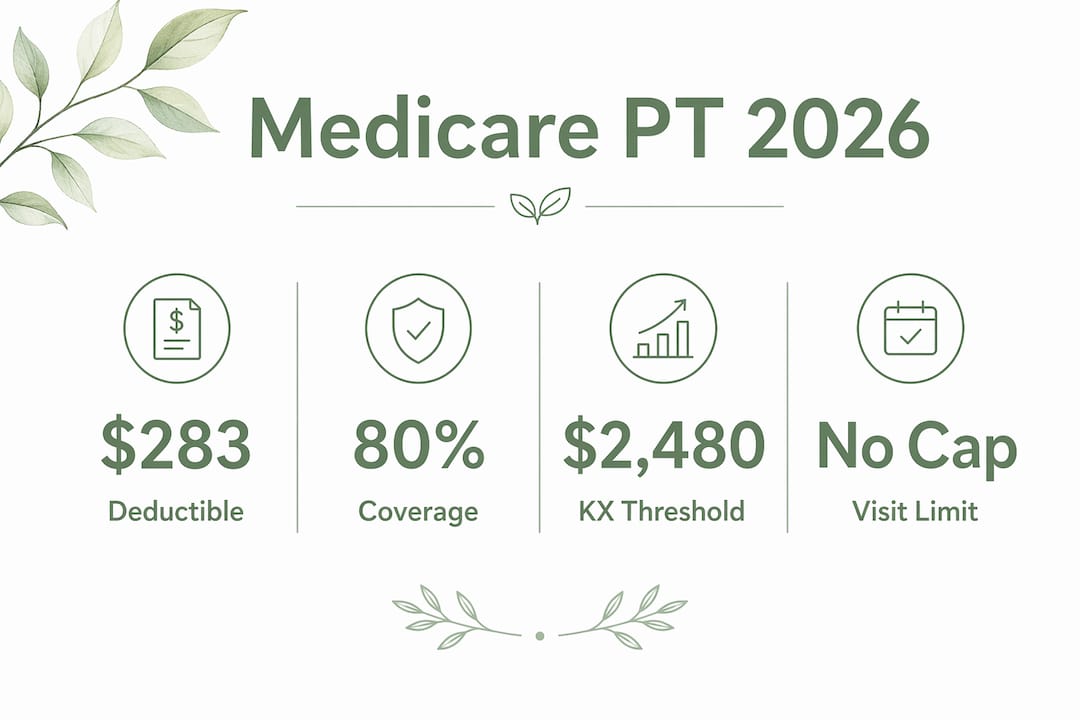
The table below summarizes the key cost thresholds for 2026:
Cost Element | Amount | What It Means |
Part B Annual Deductible | $283 | You pay this first before Medicare contributes |
Medicare Pays | 80% of approved amount | Applies after deductible is met |
Patient Coinsurance | 20% of approved amount | Your share for each covered visit |
KX Modifier Threshold | $2,480 (PT + SLP combined) | Documentation of medical necessity required above this amount |
Targeted Medical Review | Claims over $3,000 | Audit review, not a coverage cap |
Therapy Assistant Rate | 85% of standard rate | Applies when a PTA delivers services |
There is no hard annual dollar cap on Medicare PT. However, the KX modifier threshold of $2,480 applies to combined physical therapy and speech-language pathology services. Once your claims cross that amount, your therapist must add the KX modifier to each claim, attesting that continued treatment is medically necessary. Without it, the claim is automatically denied.
Claims exceeding $3,000 trigger a targeted medical review by Medicare. This is a documentation audit, not a coverage cutoff. If your records are thorough and accurate, continued treatment is approved. The review process protects Medicare from fraud while keeping coverage open for patients with genuine ongoing needs.
One more cost detail worth knowing: therapy services provided by a physical therapist assistant are reimbursed at 85% of the standard rate since 2022. That difference can affect how your clinic structures your care, so ask your provider who will be delivering each session.
Pro Tip: If you have a Medicare Supplement plan like Medigap, it may cover your 20% coinsurance, reducing your out-of-pocket cost to near zero. Ask your insurance carrier before your first PT appointment.
What documentation is required for medicare PT coverage?
Medicare PT coverage depends heavily on paperwork. Missing a single required element can result in a denied claim, even when the therapy itself is completely appropriate. Follow this process to keep your coverage intact:
Get a physician order. A doctor, nurse practitioner, or physician assistant must order PT and certify that it is medically necessary. Medicare requires this certification before treatment begins.
Confirm your therapist accepts Medicare assignment. Choosing a Medicare-assigned provider protects you from being billed above the Medicare-approved amount. Non-assigned providers can charge up to 15% more.
Track your spending against the KX threshold. Once combined PT and speech therapy claims reach $2,480, your therapist must add the KX modifier to every subsequent claim. Claims without the KX modifier are automatically denied, regardless of medical necessity.
Verify billing codes are correct. The 8-minute rule governs time-based billing codes like therapeutic exercise. Medicare bills in 15-minute increments, but a unit can be billed if at least 8 minutes of that service was provided. Incorrect application of timed versus service-based codes can trigger audits.
Request progress notes regularly. Your therapist must document functional progress at each visit. If progress stalls and documentation does not reflect a clinical reason for continuing, Medicare may deny further claims.
Appeal denied claims promptly. If a claim is denied, you have the right to appeal. Gather your physician order, progress notes, and any supporting clinical records. Most successful appeals hinge on thorough documentation, not the clinical facts themselves.
Pro Tip: Ask your therapist to walk you through the plan of care at your first visit. Understanding your treatment goals makes it easier to spot documentation gaps before they become billing problems.
You can also review how to check PT eligibility before your first appointment to confirm your specific coverage details.
Who needs medicare PT and what are the real benefits?
The seniors who benefit most from Medicare physical therapy are those recovering from acute events, managing progressive conditions, or at risk of losing independence. Accessing Medicare physical therapy early, rather than waiting until function declines significantly, produces better outcomes and lower total costs.
Here is who should actively pursue this benefit:
Post-surgical patients: Hip and knee replacement, spinal surgery, and rotator cuff repair all require structured rehab to restore full function
Stroke survivors: PT addresses weakness, coordination deficits, and gait problems that directly affect daily independence
Parkinson’s patients: Regular PT slows functional decline and reduces fall risk, which is the leading cause of injury-related death in seniors
Chronic pain patients: Conditions like osteoarthritis, spinal stenosis, and fibromyalgia respond well to targeted exercise and manual therapy
Fall risk patients: Balance training and strength work under a licensed therapist reduces fall frequency and severity
The financial value is real. Medicare PT is a covered benefit you have contributed to through payroll taxes and premiums. Using it for medically necessary care is not an extra expense. It is a return on a long-term investment. For families in Nassau County and Queens, physical therapy options for seniors are available locally, making access straightforward when you know where to look.
Selecting a therapist who specializes in geriatric care adds another layer of value. Geriatric-trained physical therapists understand age-related changes in muscle mass, bone density, and balance, and they design programs that account for those realities rather than applying a one-size approach.
Key takeaways
Medicare physical therapy is a medically necessary, physician-ordered benefit that covers 80% of approved costs after the $283 deductible, with no hard annual cap when documentation requirements are met.
Point | Details |
Coverage requires medical necessity | A physician must certify PT is medically necessary before Medicare pays for any service. |
Part B pays 80% after deductible | The 2026 deductible is $283; you pay 20% coinsurance on each covered visit. |
KX modifier is non-negotiable | Claims above $2,480 without the KX modifier are automatically denied, regardless of need. |
PT reduces serious health events | Physical therapy lowers falls, hospitalizations, and nursing home admissions in seniors. |
Choose Medicare-assigned providers | Medicare-assigned therapists cannot charge above the approved rate, protecting you from surprise bills. |
What i have learned working with medicare PT patients
Most seniors I speak with are surprised to learn there is no hard dollar cap on Medicare PT. The common assumption is that coverage runs out after a set number of visits or a fixed dollar amount. That misunderstanding causes people to stop therapy too early or avoid starting at all. The real barrier is documentation, not dollars.
What I have seen consistently is that patients who come in with a clear physician order, understand their diagnosis, and stay engaged in their plan of care get the most from this benefit. The ones who struggle are usually dealing with a provider who is not meticulous about billing codes or progress notes. One missing KX modifier can unravel months of approved claims.
My honest advice: do not wait for a crisis to start PT. If your doctor has mentioned balance issues, post-surgical weakness, or a progressive neurological condition, ask for a PT referral now. The benefit is there. The evidence supports early intervention. And the cost, with Medicare covering 80%, is manageable for most beneficiaries. If you are unsure whether your condition qualifies, choosing the right PT provider starts with a simple conversation with your doctor and your insurer.
— Tj
Start your medicare PT journey with Contemporaryrehabservices
Contemporaryrehabservices is a boutique physical therapy clinic in Albertson, NY, serving seniors and caregivers across Nassau County and Queens. The clinic accepts Medicare along with Aetna, Cigna, Emblem, and United Healthcare plans, and the team handles Medicare billing directly so you are never left guessing about coverage.

Whether you are recovering from surgery, managing a chronic condition, or working to stay active and independent, Contemporaryrehabservices offers personalized care from therapists experienced in geriatric rehabilitation. You can explore Searingtown physical therapy services or visit the Albertson location to schedule a consultation. The first step is simply making the call.
FAQ
Does medicare cover physical therapy with no visit limit?
Medicare Part B has no hard annual visit cap for physical therapy. Coverage continues as long as services are medically necessary and documentation requirements, including the KX modifier above $2,480, are met.
What is the medicare PT deductible for 2026?
The Part B deductible in 2026 is $283. After you meet that amount, Medicare pays 80% of the approved cost for covered PT services and you pay 20%.
Can medicare deny PT claims even if therapy is medically necessary?
Yes. Claims are automatically denied if the KX modifier is missing after the $2,480 threshold, or if documentation does not demonstrate functional progress, regardless of the clinical appropriateness of care.
Who qualifies for medicare physical therapy?
Any Medicare Part B beneficiary qualifies when a physician or qualified provider orders PT, certifies medical necessity, and the therapy targets a specific medical condition rather than general fitness or wellness.
How do i find a physical therapist who accepts medicare?
Search Medicare’s online provider directory or ask your physician for a referral to a Medicare-assigned therapist. Choosing a Medicare-assigned provider protects you from being billed above the approved rate.
Recommended
Comments