
4 Phase Clinic Backed Cervicogenic Headache Physical Therapy
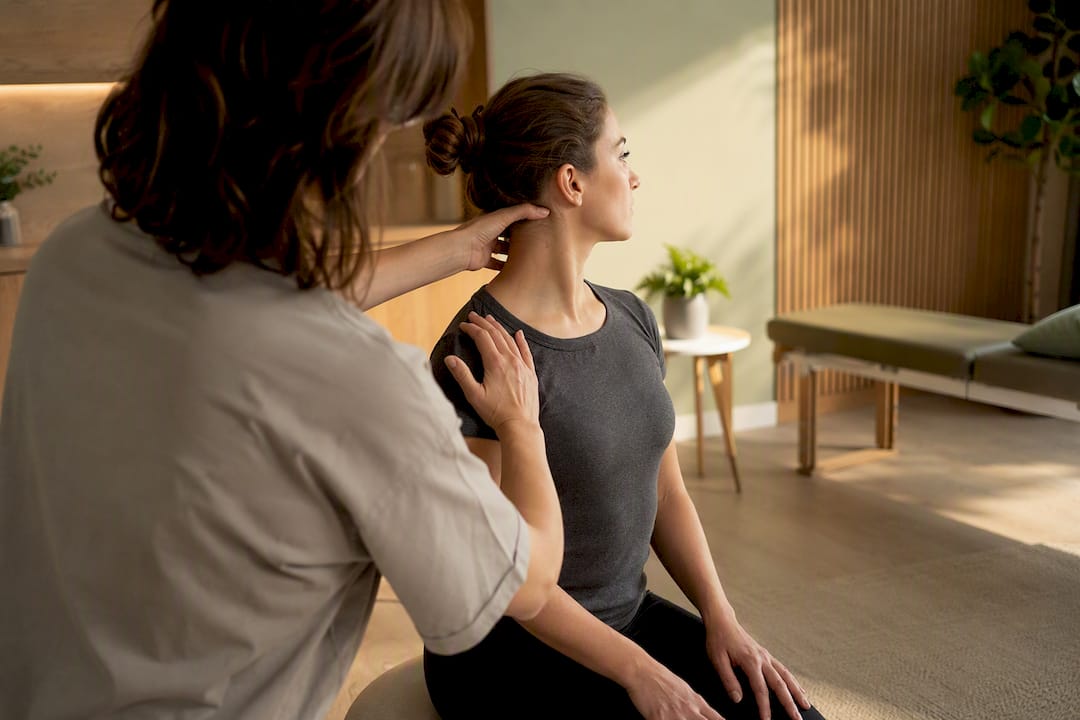
Physical therapy is the first-line, evidence-backed treatment for most cervicogenic headaches. You can start today with gentle mobility work and craniocervical flexion exercises, but see a clinician if pain persists past two weeks. A full program blends manual therapy, deep neck flexor retraining, scapular strengthening, and sensorimotor drills. Plans are built around your specific neck impairments, not a generic handout.
TL;DR:
Most patients with cervicogenic headaches see significant relief within 6 to 12 weeks of targeted physical therapy, especially with consistent deep neck flexor exercises.
Early symptom flare-ups are common after manual therapy but should subside; worsening beyond mild discomfort warrants medical evaluation before further treatment.
Proper diagnosis relies on a hands-on musculoskeletal exam, emphasizing upper neck movement restriction and provocation tests, not just imaging.
Preventative habits like optimal desk setup, sleep position, and regular low-intensity exercises help sustain long-term headache reduction.
Table of Contents
What Is Cervicogenic Headache Physical Therapy?
Cervicogenic headache physical therapy is a structured treatment approach that targets the joints, muscles, and motor control patterns in your neck that are actually driving your head pain. Unlike a headache that starts behind your eyes or pounds through your temples, a cervicogenic headache originates in the cervical spine and refers pain upward. That distinction matters because the fix is mechanical, not pharmacological. You are not chasing a nerve signal with medication. You are correcting a stiff joint, a weak deep neck flexor, or a set of overworked suboccipital muscles.
Here is a safe starting routine you can try before your first appointment, provided you have no red-flag symptoms (covered below).
Suboccipital release. Lie on your back, place two tennis balls or a small foam roller at the base of your skull, and let gravity apply gentle pressure for 60 to 90 seconds. Stop if you feel tingling or sharp pain.
Craniocervical flexion (CCF) hold. Lying down with a slight chin nod (as if gently nodding “yes”), hold for 10 seconds, repeat 10 times, twice a day. Keep the motion small. This is not a full chin tuck.
Upper trap and levator scapulae stretch. Tilt your head away from the tight side and slightly rotate toward it, holding 30 seconds per side.
Sternocleidomastoid (SCM) stretch. Gently rotate and extend your neck away from the tight muscle, holding 30 seconds per side.
Scapular squeezes. Pull your shoulder blades down and together, hold 5 seconds, for 2 sets of 10 to 15 reps to support posture during the day.
Stop immediately and call a clinician if you notice numbness, arm weakness, dizziness that worsens, or a headache pattern that changes shape. Those signs point past a simple cervicogenic headache and deserve a medical look before you push further into exercise.
How Does Physical Therapy Treat Cervicogenic Headache?
Physical therapists draw from a specific toolbox for cervical headache management, and the techniques are not interchangeable. Sustained Natural Apophyseal Glides (SNAGs) involve a clinician (or a trained self-SNAG technique) applying a sustained glide to a cervical segment while you actively move your head through a previously painful range. Joint mobilization uses graded, rhythmic pressure on stiff segments, typically in the upper cervical spine (C1 through C3), to restore movement without a high-velocity thrust. Spinal manipulation is a quicker, targeted thrust technique reserved for clinicians trained specifically in manual therapy, and it is used selectively, not as a default.
The evidence behind these techniques is more solid than most people expect from a “just stretch it out” condition.
A systematic review from the NCBI Bookshelf identifies manipulative therapy and structured exercise as first-line management, with one trial context showing 72% of patients achieving at least a 50% reduction in headaches at 12 months.
A PMC evidence review on cervicogenic headache management found that a 6-week craniocervical flexion program performed about as well as spinal manipulation, with benefits holding up to a year later.
A network meta-analysis published in Frontiers in Neurology ranked cervical spinal manipulation highly for short-term outcomes and found SNAGs produced meaningful improvement on pain scales, disability indices, and range-of-motion testing compared to control groups.
A meta-analysis in the Chiropractic & Manual Therapies journal found manual therapy combined with exercise typically outperforms exercise alone for short-term relief.
A quick statistic to hold onto: in the Jull-style trial cited by the PMC review, roughly seven in ten patients who completed manual therapy or a structured craniocervical flexion program reported cutting their headache frequency and intensity by half or more, and that improvement was still measurable a full year out.
None of this evidence is uniform, and you should know that going in. Trial designs vary in session count, therapist skill level, and how “improvement” gets measured, so the size of the benefit differs across studies. Some patients also feel a temporary flare in the first week or two of treatment, particularly after manual therapy sessions, before things settle. That is a documented, expected pattern, not a sign the treatment is failing.
How Do Clinicians Diagnose Cervicogenic Headache?
A clinician confirms cervicogenic headache through a hands-on musculoskeletal exam, not a scan. The hallmark pattern is a one-sided headache that starts in the neck or the base of the skull and spreads forward, often triggered or worsened by specific neck movements or sustained postures like looking down at a phone.
During assessment, a physical therapist checks:
Range of motion, looking for restriction, especially in upper cervical rotation and extension.
Provocation testing, reproducing your headache by pressing on or moving specific cervical segments.
Relief testing, checking whether a sustained glide or manual pressure on the same segment eases your symptoms in real time.
Postural and strength screening, since forward head posture and weak deep neck flexors are common contributors.
Differential screening against migraine and tension-type headache, since those conditions respond to different treatment entirely and can mimic cervicogenic patterns.
Certain symptoms override this whole process and require urgent medical evaluation instead of a PT evaluation:
Sudden, severe headache unlike any you have had before (“thunderclap” onset)
Fever, stiff neck, or confusion alongside headache
Head or neck trauma preceding the headache
Progressive weakness, numbness, vision changes, or slurred speech
Headache that wakes you from sleep or worsens steadily over days
If any of those apply, skip the exercises above and get evaluated by a physician first. Cervicogenic headache physical therapy is built for a mechanical, neck-driven headache pattern, not for ruling out something more serious.
What Does a Full Cervicogenic Headache Exercise Program Look Like?
A well-built program for headache relief therapy moves through four phases, and rushing the order is the single biggest reason people stall out or reinjure themselves.
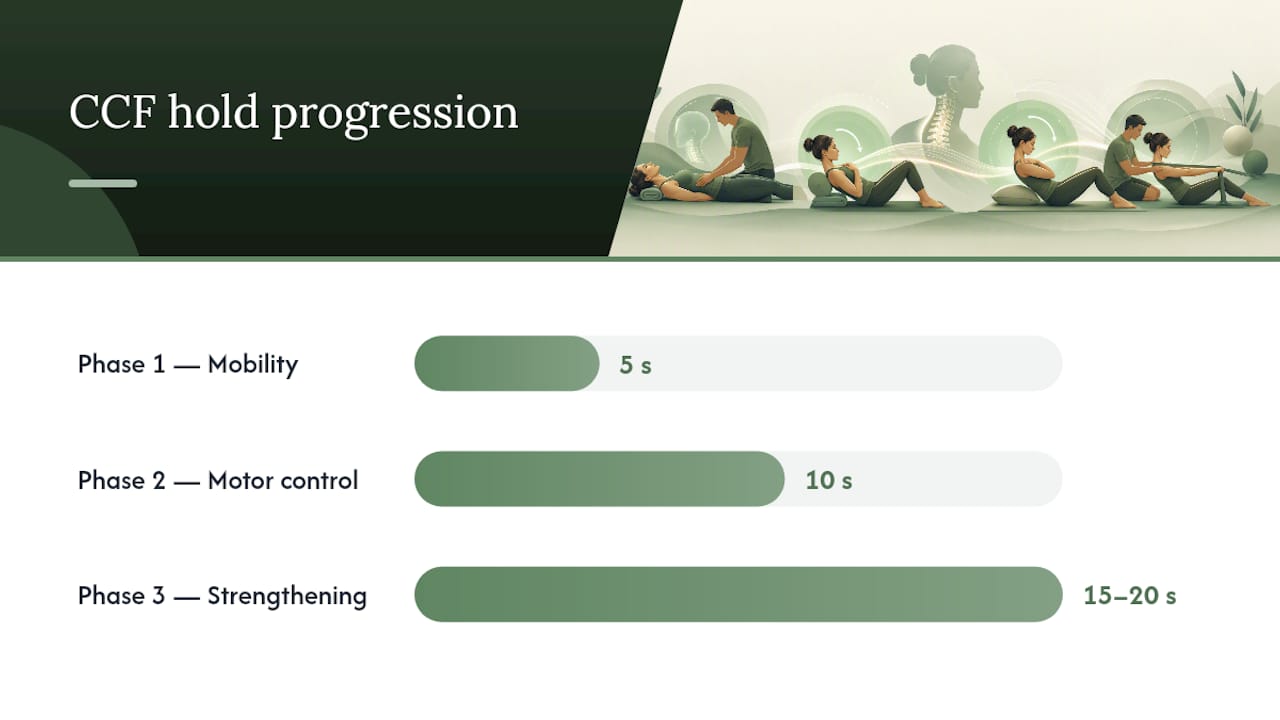
Phase 1: Mobility and pain control (roughly weeks 1 to 2). The goal here is calming things down, not building strength. Gentle upper cervical mobility drills, suboccipital release, and low-amplitude CCF holds dominate this phase. Sessions run short. A clinician typically has you perform CCF at low intensity, just enough to activate the deep neck flexors without provoking a symptom spike, and progresses only once you can hold the position with correct form.
Suboccipital self-release, 60 to 90 seconds, once or twice daily.
CCF holds at minimal intensity, 5 second holds, 8 to 10 reps, twice daily.
Gentle active range-of-motion circles and nods, avoiding end-range pain.
Phase 2: Motor control (roughly weeks 2 to 4). This is where craniocervical flexion training gets serious. If you have access to a pressure biofeedback unit, a clinician uses it to confirm you are isolating the deep neck flexors instead of substituting with the larger, more dominant muscles at the front of your neck. Without a sensor, a rolled towel under the neck and a cue like “nod gently, as if agreeing quietly” works nearly as well for home practice.
CCF holds progress to 10 seconds, 10 reps, twice daily.
Add slow head repositioning drills, returning to a neutral “neutral head on neck” position after looking side to side.
Introduce light resistance with a hand placed on the forehead for isometric holds.
Phase 3: Strengthening (roughly weeks 4 to 6). Deep neck flexor endurance work continues, but now it is joined by a low-load cervicoscapular strengthening program. This phase targets the muscles between your shoulder blades and along your upper back that stabilize your neck all day, not just during exercise.
Elastic-band rows, 2 to 3 sets of 12 to 15 reps, focusing on scapular squeeze at the end range.
Prone “Y” and “T” raises for the mid and lower trapezius, 2 sets of 10 to 12 reps.
CCF endurance holds extend to 15 to 20 seconds as tolerance allows.
Phase 4: Sensorimotor and functional return (roughly weeks 6 to 8 and beyond). This phase gets your neck ready for real life, not just a clinic mat. Balance and proprioception drills retrain the cervical spine’s sense of position, which tends to get disrupted after chronic neck pain. Standing lateral raises with light elastic tubing, performed briefly each day, showed measurable reductions in neck-shoulder pain and headache frequency among office workers in trial settings, according to the PMC evidence review.
Standing on an unstable surface (a foam pad or wobble cushion) while performing gentle head turns.
Brief daily standing lateral raises with light resistance tubing, 1 to 2 minutes.
Task-specific retraining, such as practicing sustained computer posture or a repeated work movement that previously triggered symptoms.
The most common error at every phase is skipping straight to strengthening because it feels more productive than “just holding my head still for 10 seconds.” Deep neck flexor endurance is the foundation. Building scapular strength on top of a neck that still substitutes with the wrong muscles just reinforces the faulty pattern that caused the headache in the first place.
Pro Tip: Set a phone reminder for your CCF holds instead of relying on memory. Two 10 to 12 minute sessions a day, done consistently for six weeks, produces far better results than one long, sporadic session whenever you remember.
How Long Until You Feel Relief From Cervicogenic Headache PT?
Most structured programs generally run several weeks and include multiple sessions, based on dosing patterns reported across multiple trials and guideline summaries. Some clinicians extend low-load endurance programs to the full 8 weeks when deep neck flexor deficits are significant.
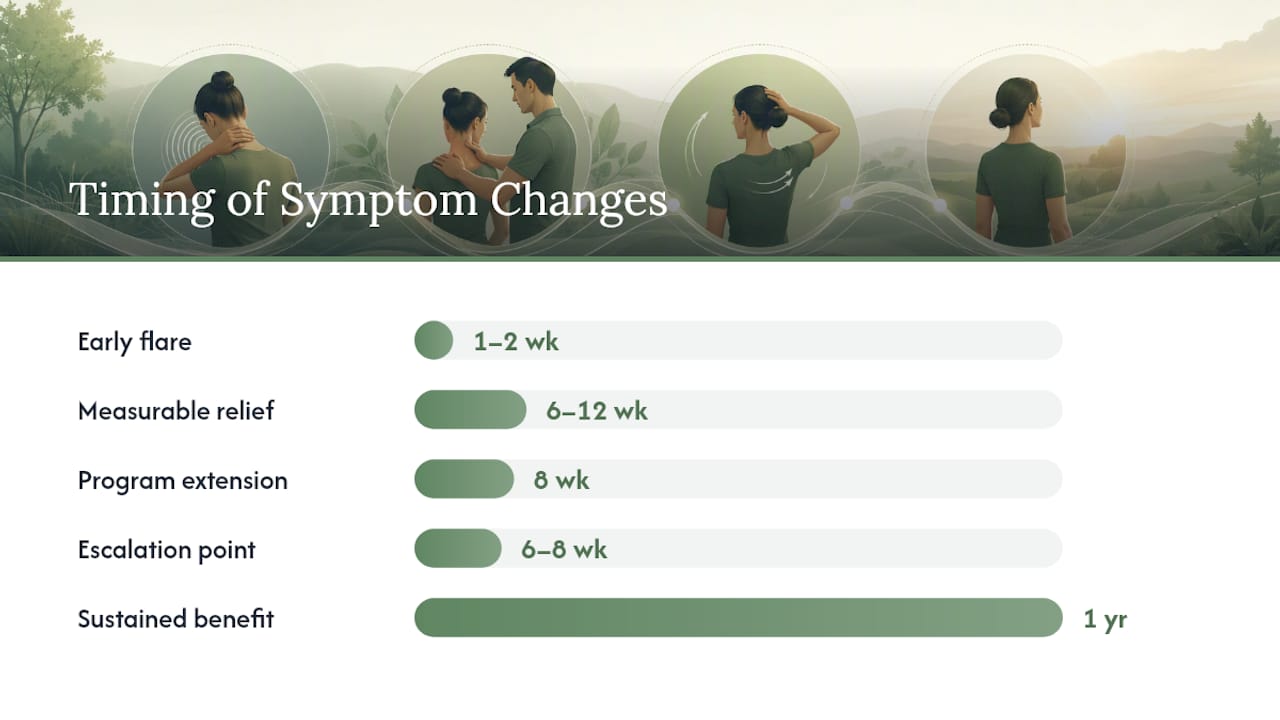
What the numbers actually show: trial data summarized in the PMC clinical management review points to measurable reductions in headache frequency and intensity typically appearing between 6 and 12 weeks into treatment, with some trials showing benefits sustained out to a full year for both manual therapy and craniocervical flexion programs.
A few practical guardrails matter here:
Early flare is common, not a failure. A temporary uptick in symptoms during the first one to two weeks, particularly after manual therapy, is a documented pattern noted in the NCBI Bookshelf overview. It usually settles as your tissues adapt.
If symptoms worsen beyond a mild, short-lived flare, reduce exercise intensity, contact your clinician before your next scheduled visit, and consider short-term adjuncts like TENS or over-the-counter analgesics under medical guidance.
If you show no meaningful change after 6 to 8 weeks of consistent, correctly performed exercise, that is the point to discuss imaging or a referral to a neurologist or pain specialist, not before.
How Can You Prevent Cervicogenic Headaches From Coming Back?
Recovery holds up better when your daily habits stop feeding the problem. Desk setup is the biggest lever most people ignore: your monitor top should sit at eye level, your elbows at roughly 90 degrees, and your ears should stack over your shoulders rather than jutting forward. A posture check every 30 to 45 minutes, even just a quick chin tuck and shoulder roll, keeps the deep neck flexors engaged instead of dormant. Readers rebuilding posture habits alongside their headache program often benefit from a closer look at posture correction physical therapy for the fuller picture.
Sleep position matters just as much as desk setup, since you spend roughly a third of your day there.
Sleep on your back or side, avoiding stomach sleeping, which forces prolonged neck rotation for hours at a time.
Choose a pillow that keeps your neck neutral, filling the gap between your ear and shoulder without tilting your head up or down.
Side sleepers typically need a slightly thicker pillow than back sleepers to maintain that same neutral line.
Beyond posture and sleep, a few lifestyle habits support the gains your exercise program builds. Regular aerobic activity, even brisk walking three to four times a week, improves blood flow to cervical tissues and reduces overall muscle tension. Diaphragmatic breathing exercises calm the accessory neck muscles that tend to overwork during stress. Managing stress directly matters too, since tension in the shoulders and upper neck often climbs during high-stress periods regardless of how well your exercise form looks on paper.
Should You Start PT Now or See a Doctor First?
Start physical therapy now if your headaches are recurrent, clearly linked to neck movement or posture, come with limited neck rotation, and are interfering with your work or sleep on a regular basis. That profile fits the mechanical pattern PT is built to address.
See a physician or go to urgent care first if you have any of the red flags covered earlier in this guide, fever, trauma, sudden severe onset, or progressive neurological signs, since those require ruling out more serious causes before any hands-on treatment begins.
PT and medicine are not competing paths here. When headaches prove resistant to a well-run exercise and manual therapy program, physical therapists often coordinate with neurologists or pain specialists who may consider nerve blocks or targeted injections. A therapist’s detailed movement assessment frequently informs that referral, giving the specialist a clearer picture of which cervical segments are actually driving the pain. For anyone managing overlapping neck and back issues, this practical guide to chronic neck and back pain walks through how that coordinated care typically unfolds.
What Does Treatment Look Like at CRS Wellness?
At CRS Wellness, the care pathway for cervicogenic headache starts with a detailed musculoskeletal exam to confirm the neck is actually the source of your pain, not a migraine or tension headache mimicking the pattern. From there, your therapist builds a plan combining hands-on techniques like manual therapy with progressive craniocervical flexion training, scapular strengthening, and sensorimotor retraining, adjusted session by session based on how your neck actually responds.
CRS Wellness accepts Medicare, Aetna, Cigna, Emblem, and United Healthcare, along with cash-pay options for patients without applicable coverage. Both in-person visits and virtual physical therapy sessions are available, which matters if a flare makes commuting difficult in a given week or your home program needs a quick form check between clinic visits.
What Should You Actually Prioritize in Your Recovery?
The conventional advice on cervicogenic headache leans too hard on generic neck stretches and not hard enough on deep neck flexor retraining, and that gap explains a lot of stalled recoveries. Stretching a tight suboccipital muscle feels productive, but if your deep neck flexors never learn to hold your head correctly, the tight muscle just tightens right back up within days.
Craniocervical flexion work deserves more patience than most people give it. It is slow, unglamorous, and does not produce the satisfying “crack and relief” feeling manual therapy sometimes does. But the trial evidence showing durable improvement at a full year points squarely at motor control, not passive treatment alone, as the piece that makes results stick.
If you take one thing from this guide, prioritize consistency over intensity. Two short daily sessions of correctly performed CCF, sustained for six weeks, will outperform an aggressive stretching routine done twice before you lose interest.
— CRS Wellness
How Do You Book a Cervicogenic Headache Evaluation?
Getting your neck properly evaluated is faster than most patients expect, and it is the step that actually determines whether your headaches are neck-driven in the first place. CRS Wellness offers in-person manual therapy, virtual PT sessions for home-program check-ins, and individualized home exercise plans built around your specific exam findings, not a generic printout.
Booking starts with a phone call or an online request, and most new patients are seen within the week. CRS Wellness accepts Medicare, Aetna, Cigna, Emblem, and United Healthcare, plus cash-pay for anyone outside those plans, so cost rarely has to be a barrier to getting an accurate diagnosis. You can review the full range of therapies offered, including manual therapy, craniosacral therapy, and neuromuscular re-education, before your first visit. If you are near the clinic’s service area, the Albertson location page has direct scheduling details, and patients closer to Great Neck can check the Great Neck Plaza page for the same booking options. Call today to get your neck evaluated before another headache derails your week.
Sources
The clinical claims in this guide draw from a mix of clinical overviews, systematic reviews, and randomized controlled trial data rather than any single source. For readers who want to dig into the primary literature:
This article is general information, not a substitute for advice from a qualified doctor. Consult a qualified healthcare professional about your own circumstances before acting on anything here.
Recommended
Comments