
Clinic Backed Vestibular Exercises for Dizziness: 12–40 Minutes a Day
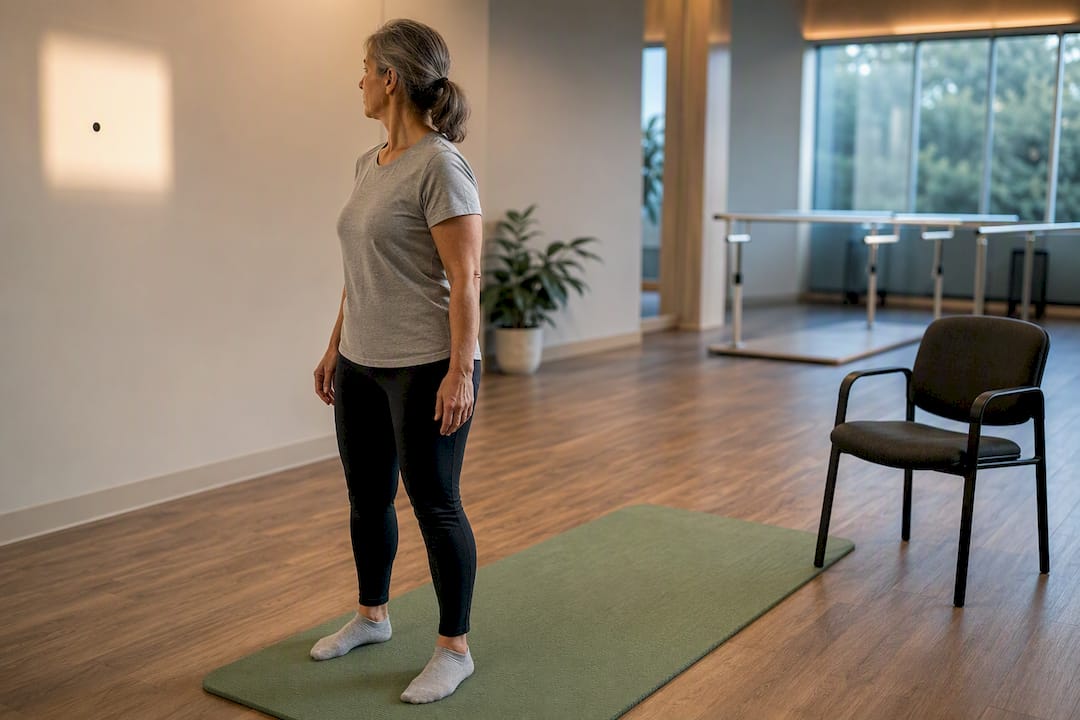
Vestibular rehabilitation exercises reduce dizziness and improve balance for most people with inner ear or balance disorders. Gaze stabilization, habituation, and balance and gait training make up the core toolkit, while canalith repositioning resolves positional vertigo (BPPV) in a clinic setting, often within one or two visits. See a trained vestibular therapist first for an accurate diagnosis and a dosing plan built around your specific symptoms before pushing into harder exercises on your own.
TL;DR:
Gaze stabilization exercises should be performed three to five times daily, with progressions from sitting to walking, to effectively strengthen the vestibulo-ocular reflex.
Habituation exercises must be specific to your triggers, such as head turns or visual motion, with careful dosing to avoid worsening symptoms or fatigue.
Balance and gait training should emphasize gradual progression, including static, dynamic, and perturbation exercises, typically for 20 minutes daily over several weeks.
BPPV usually responds rapidly to canalith repositioning, often resolving within one or two clinic sessions, but wrong canal identification can delay recovery.
Home exercises should be tailored, dosed appropriately, and performed consistently, as progress depends on cumulative practice rather than intensity or duration alone.
Table of Contents
What Vestibular Rehabilitation Exercises Actually Do
Vestibular rehabilitation is a structured exercise approach built on four components: gaze stabilization, habituation, balance and gait training, and walking-based endurance work. Each piece targets a different part of how your brain manages balance signals from your inner ear, eyes, and joints.
People with unilateral or bilateral vestibular hypofunction (reduced inner ear signal on one or both sides) tend to respond well, and so do many patients with BPPV, some central balance disorders, older adults with general imbalance, and people recovering from concussion. Vestibular dysfunction touches a surprisingly large slice of the adult population. Estimates in the Academy of Neurologic Physical Therapy’s clinical practice guideline suggest a large portion of adults may experience some degree of vestibular dysfunction over their lifetime, which is one reason this guideline carries so much weight among physical therapists. The same guideline confirms that exercise-based rehab measurably improves gaze and postural stability rather than just masking symptoms.
Gaze Stabilization Exercises: Where Most Programs Start
Gaze stabilization retrains your vestibulo-ocular reflex (VOR), the automatic system that keeps your eyes locked on a target while your head moves. Two mechanisms drive this: adaptation, which strengthens a weakened VOR signal through repeated head-eye movement, and substitution, which trains other systems (like quick eye movements) to compensate when the reflex can’t fully recover.
Three drills form the backbone of most home programs:
X1 viewing: Sit and hold a card with a letter at eye level. Keep your eyes fixed on the letter while turning your head side to side, then up and down, without letting the letter blur.
X2 viewing: Hold the target still while moving both your head and the target in opposite directions, a harder variation reserved for later stages.
Walking head turns: Walk in a straight hallway while turning your head left and right, keeping your eyes on a fixed point ahead.
Progression follows a logical ladder: master the drill sitting down, then standing, then walking, and only then add speed or a busier visual background (a patterned rug instead of a blank wall).
Pro Tip: Do gaze stabilization drills near a chair or wall for the first week, even if you feel steady. Dizziness during VOR training can spike faster than you expect, and having something to grab removes the guesswork.
The Academy of Neurologic Physical Therapy’s guideline recommends gaze stabilization exercises three to five times a day, totaling 12 to 40 minutes daily, with the higher end reserved for more chronic cases. One caution worth remembering: voluntary eye movements alone, without head movement, don’t build gaze stability. If an exercise only asks your eyes to track something while your head stays still, it isn’t doing the job.
Stop if any dizziness or nausea from the drill doesn’t settle back to your normal baseline within 15 to 20 minutes.
Habituation Exercises: Teaching Your Brain to Tolerate Triggers
Habituation works on repeated, controlled exposure to whatever movement or environment sets your dizziness off. If turning over in bed makes your head spin, you practice a milder version of that same motion, repeatedly, until your nervous system stops overreacting to it.
Common habituation drills include:
Repeated head nods or turns in the exact direction that triggers symptoms, typically 3 sets of 5 to 10 repetitions.
Bending over and standing back up, if that motion provokes dizziness.
Graded visual motion exposure, such as watching a busy screen, a scrolling pattern, or a crowded store aisle for short, increasing intervals.
The key is specificity. A vague exposure to “movement in general” doesn’t help nearly as much as exposure matched to your actual trigger, both in direction and intensity. Because it’s designed to provoke mild symptoms on purpose, habituation isn’t appropriate for people with severe, uncontrolled dizziness or anyone who hasn’t been properly diagnosed. A clinician who understands your specific trigger pattern should tailor the direction and intensity before you start.
Balance and Gait Training for Everyday Stability
Balance retraining rebuilds the coordination between your eyes, inner ear, and joints that keeps you upright without thinking about it. Progression should feel gradual, never like a test you’re failing.
Start with static balance: feet together, then a narrow stance, on a firm floor.
Progress to a foam pad or pillow to remove reliable ground feedback, then try short intervals with your eyes closed.
Add dynamic tasks: walking with head turns, walking while counting backward (dual-task training), and stepping over low objects.
Practice controlled perturbations, like a light nudge from a therapist, to rebuild your automatic righting response.
Layer in endurance walking, since general conditioning supports the whole recovery process, not just the balance-specific drills.
Pro Tip: Track your balance minutes the way you’d track a walking streak. Consistency across weeks matters more than any single hard session.
Guideline-based programs typically run balance exercises around 20 minutes daily for four to six weeks in chronic unilateral cases, sometimes extending to six to nine weeks for bilateral vestibular loss, according to the Academy of Neurologic Physical Therapy guideline.
Recognizing BPPV and Understanding Canalith Repositioning
Benign paroxysmal positional vertigo (BPPV) has a distinct signature: brief, intense spinning triggered by specific head positions, like rolling over in bed, looking up at a shelf, or tilting your head back in the shower. Unlike the steadier dizziness of vestibular hypofunction, BPPV episodes are short, usually lasting under a minute, and tightly linked to position rather than constant.
A clinician confirms BPPV using the Dix-Hallpike test, a positional maneuver performed in the clinic. Once diagnosed, canalith repositioning maneuvers, most commonly the Epley maneuver, move displaced inner ear crystals back where they belong. According to the Vestibular Disorders Association, most BPPV cases resolve within one or two clinic sessions using this technique.
If you suspect BPPV, avoid the temptation to self-diagnose and repeat maneuvers you’ve found online. Getting the correct canal identified matters, since the wrong maneuver for the wrong canal won’t help and can waste weeks.
How to Practice Dizziness Exercises Safely at Home
Dosing matters as much as technique. The clinical practice guideline generally supports 12 to 40 minutes of gaze stabilization daily and around 20 minutes of balance work, spread across several short sessions rather than one long one.
Before starting any home routine, set up your space:
Clear a path near a sturdy chair, countertop, or wall you can reach in one step.
Practice in a corner when working on harder balance tasks, so you have support on two sides.
Ask a family member to spot you for higher-risk exercises, especially eyes-closed balance work.
Keep footwear flat and non-slip. Bare feet or grippy socks work better than smooth-soled shoes on hard floors.
Know your stop signs. Mild, brief dizziness during an exercise is expected. Persistent chest pain, fainting, sudden severe headache, slurred speech, or new weakness on one side of the body are not, and they warrant a call to a clinician or emergency services immediately, not a wait-and-see approach. A physical therapist who understands your specific diagnosis can also help you set up a safer version of your home environment. For general precautions around home exercise setup, this guide to injury prevention habits covers similar ground on safe progression and environment awareness.
What Vestibular Physical Therapy Actually Looks Like
A first vestibular evaluation typically includes a detailed symptom history, positional testing to check for BPPV, VOR testing, and a functional gait and balance assessment, often on a variety of surfaces. Everything happens in a controlled clinic setup, frequently with support like parallel bars nearby for anyone at higher fall risk.
From there, most patients leave with a small, focused home program (commonly just two to three exercises rather than a long list) taking 5 to 20 minutes a day. Follow-up usually happens weekly at first, adjusting based on how symptoms and testing scores shift. Read more about what to expect from vestibular rehab timelines for a closer look at how programs evolve visit to visit.
Exercises for Cervicogenic Dizziness
Cervicogenic dizziness comes from the neck, not the inner ear. Stiff or irritated joints and muscles in the upper cervical spine send faulty position signals to the brain, producing a vague, unsteady sensation rather than true spinning. It often follows whiplash, prolonged poor posture, or degenerative neck changes.
Because the source is musculoskeletal, treatment leans more on manual therapy and targeted movement than on the VOR-focused drills used for inner ear issues. Common exercises include:
Cervical range-of-motion drills: slow, controlled neck rotations and tilts performed while seated, keeping movements well within a pain-free range.
Joint position error training: closing your eyes, turning your head, then opening your eyes to see how accurately you returned to a marked center point, repeated to sharpen neck-position awareness.
Deep neck flexor strengthening: gentle chin tucks that build endurance in the small stabilizing muscles at the front of the neck, which often weaken with forward head posture.
Combined cervical and gaze exercises: holding a visual target while slowly rotating the neck, which helps distinguish neck-driven dizziness from a true VOR problem during assessment.
A therapist typically pairs these drills with hands-on joint mobilization to reduce stiffness before movement retraining sticks. If your dizziness worsens specifically with neck movement or after long periods at a desk, cervicogenic causes deserve a closer look rather than assuming the inner ear is at fault.
Strengthening and Conditioning That Support Recovery
Vestibular rehab doesn’t happen in isolation from the rest of your body. Weak hips, ankles, and core muscles make every balance drill harder than it needs to be, since your body relies on strong, responsive muscles to execute the corrections your vestibular system calls for.
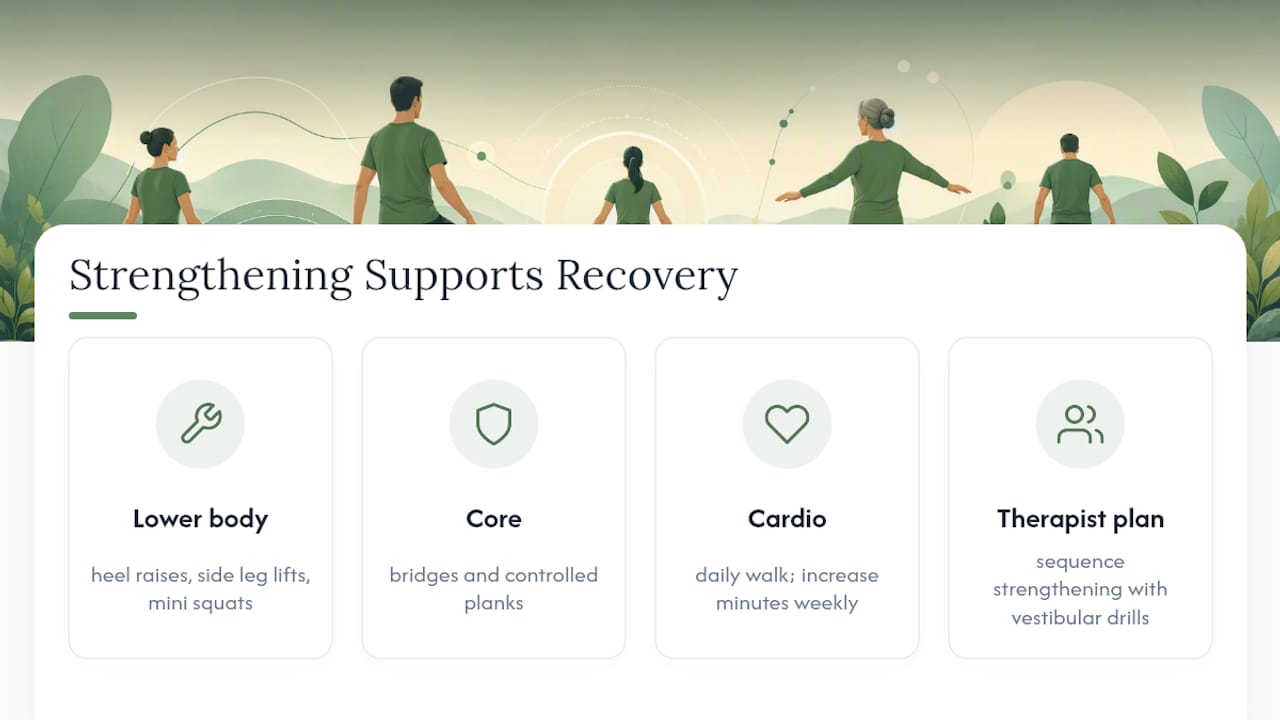
Lower-body strengthening, particularly hip abductor and ankle stabilizer work, gives your balance reflexes something to work with. Simple additions like standing heel raises, side-lying leg lifts, and mini squats build the strength base that makes dynamic balance training safer and more effective. Core strengthening, including basic bridges and controlled planks, supports the trunk stability that underlies every walking and turning task in a balance program.
General cardiovascular conditioning, even something as simple as a daily walk building toward more minutes over weeks, supports the overall recovery process and combats the deconditioning that often follows weeks of avoiding movement out of fear of dizziness. This is a real pattern worth naming: many patients unconsciously restrict activity after a dizzy spell, which leads to weaker muscles and worse balance, which then makes the next dizzy episode feel scarier. Strengthening work breaks that cycle directly.
A therapist typically sequences strengthening alongside vestibular-specific drills rather than as an afterthought, adjusting the mix based on which limitation, weakness or vestibular signal loss, is holding back your progress. This balance improvement guide walks through several strengthening-adjacent drills that pair naturally with a vestibular program.
Bringing Vision and Body Awareness Into the Program
Your brain doesn’t rely on your inner ear alone to keep you upright. It constantly blends signals from your eyes (vision) and from receptors in your joints and muscles (proprioception) with vestibular input. When one system underperforms, a well-built rehab program leans on the other two to help compensate.
Vision-based drills often involve practicing balance while tracking a moving target, or maintaining stability in visually busy environments, like a grocery store aisle or a crowded sidewalk, that would otherwise overwhelm someone with vestibular loss. Proprioceptive drills work the other side of the equation: standing on unstable or textured surfaces, walking heel-to-toe, or performing balance tasks barefoot to sharpen the feedback your joints send to your brain.
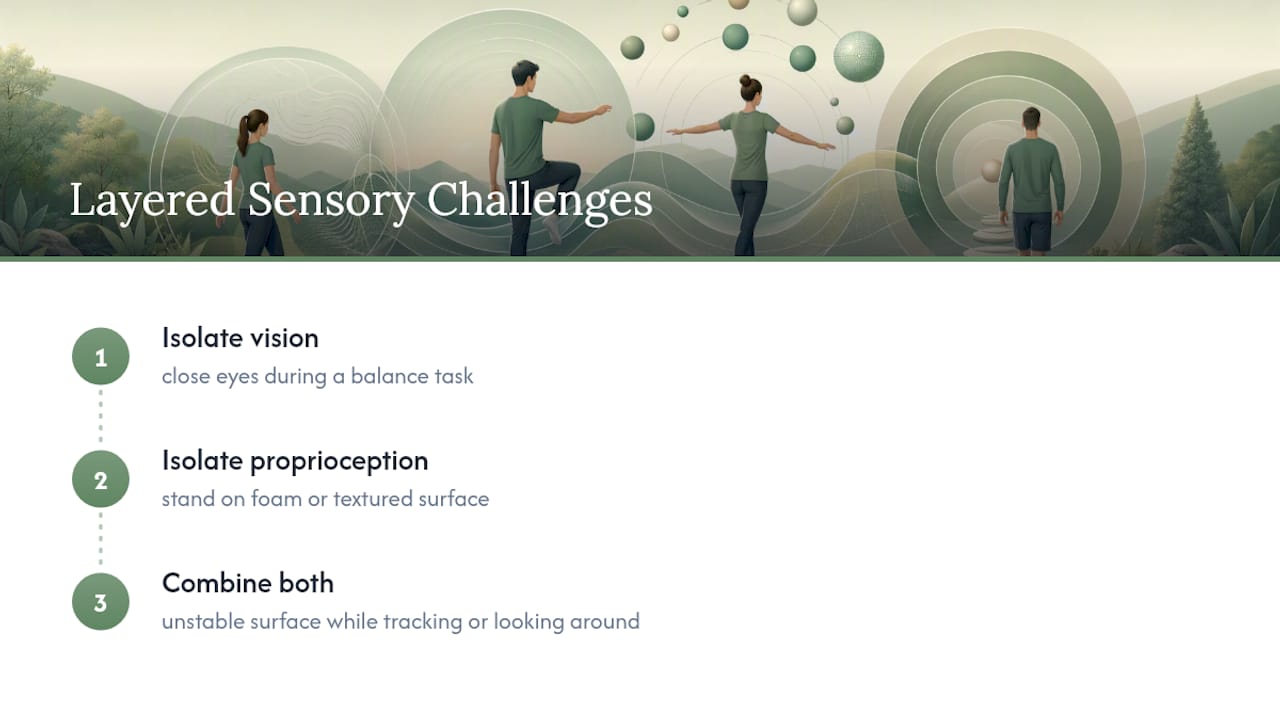
Combining the two matters more than training either alone. A program that only challenges vision, or only challenges proprioception, misses the real-world scenario where all three systems need to work together, like crossing an uneven parking lot while checking for traffic. Therapists often layer these challenges deliberately: first isolate vision by closing the eyes during a balance task, then isolate proprioception by standing on foam, then combine both to mimic daily conditions. This layered approach is part of why a supervised program tends to outpace an unsupervised one. It’s not that the individual exercises are secret, it’s that sequencing them correctly requires judgment a static list of drills can’t provide.
Biofeedback and Technology in Vestibular Rehab
Some clinics use technology to sharpen vestibular training, though it’s worth knowing what’s essential and what’s a nice extra. Force plate systems give visual feedback on weight shifting during balance tasks, letting patients see, in real time, whether they’re leaning more on one leg. Virtual reality and optokinetic stimuli (moving visual patterns projected around a patient) create controlled, repeatable visual motion challenges that would be hard to replicate with a busy store aisle alone.
These tools have real value for tracking objective progress and adding visual feedback loops that motivate consistent practice. That said, the Academy of Neurologic Physical Therapy’s own guideline notes that high-technology adjuncts aren’t necessary for effective balance progression. A wobble cushion, a hallway, and a willing family member to spot you accomplish most of what a force plate does, just with less precision in the numbers.
If your clinic offers biofeedback tools, they can help you see progress on hard days when symptoms feel unchanged but the data shows otherwise. If it doesn’t, a well-structured low-tech program built on the same principles works just as well for most people.
How Therapists Decide When to Progress or Modify Exercises
Progression isn’t based on how many weeks have passed. It’s based on specific markers a therapist tracks at each visit. Objective measures like dynamic visual acuity testing (checking whether you can read letters while your head moves) and bedside VOR tests give a clinician hard data on whether your gaze stability is actually improving, not just whether you feel better.
Patient-reported symptom and confidence scales matter just as much. A therapist watches whether an exercise provokes dizziness that resolves quickly (a good sign to progress) versus dizziness that lingers or worsens session over session (a sign to hold steady or scale back). This balance between objective testing and subjective report is what allows a program to advance without overshooting into prolonged symptom flares.
Typical progression triggers include:
Reduced symptom intensity or duration during a specific exercise across two or more sessions.
Improved scores on standardized balance or gaze tests.
A patient reporting more confidence with daily activities that used to trigger dizziness.
Modification, scaling an exercise back rather than pushing forward, happens just as often as progression and isn’t a setback. If a drill consistently produces symptoms that outlast the 15 to 20 minute window mentioned earlier, or if fatigue starts to compromise form during balance work, backing off protects the nervous system’s ability to actually adapt, rather than just tolerate stress.
Common Roadblocks During Dizziness Exercises
Plateaus happen, and they don’t always mean the program has failed. Vestibular compensation is a gradual process, and the research on compensation mechanisms makes clear that visible improvement often takes weeks, not days, since the brain is essentially rewiring how it weighs competing balance signals.
A few troubleshooting patterns come up often in practice:
Symptoms spike after a good week. This is common and usually means the exercise intensity outpaced the nervous system’s adaptation rate. Scaling back one level and holding there for a few extra days usually resolves it.
No progress after several weeks. This can signal an undiagnosed BPPV component hiding underneath a general vestibular hypofunction diagnosis, since positional vertigo needs repositioning, not gaze or balance drills, to resolve.
Anxiety around the exercises themselves. Fear of provoking dizziness leads some patients to perform movements too cautiously to be effective, which slows the whole compensation process down.
Inconsistent daily practice. Vestibular gains build cumulatively; skipping days repeatedly resets progress more than most patients expect.
Any of these patterns is a reasonable reason to check back in with your therapist rather than pushing through alone or quietly giving up on the program.
Clinician Viewpoint: Graded Challenge and Patience Win
The evidence keeps pointing to the same conclusion: gradual, supervised challenge beats aggressive self-guided pushing every time. Dizziness recovery rewards consistency over intensity. Track small wins, a few extra seconds of steady balance, a milder reaction to a known trigger, and keep showing up for the daily minutes. That’s what actually moves the needle.
— CRS Wellness
Getting Started With Vestibular Rehab at Contemporaryrehabservices
If you’ve read this far, you already know vestibular exercises work best when they’re diagnosed correctly and dosed to your specific case, not copied from a generic list. Contemporaryrehabservices builds vestibular-focused evaluations around exactly that: a full history, positional testing for BPPV, VOR and balance assessment, and a home program sized to fit your actual week, not an idealized one.
Sessions are available in person or virtually, with various payment options accepted. When you book, bring specific examples of what triggers your dizziness (rolling over in bed, looking up, busy stores), since that detail speeds up the diagnostic process significantly. Ask about coverage under your plan and request a printed home-exercise sheet so the routine your therapist builds actually makes it back to your living room. Start by scheduling an evaluation at the Albertson clinic, or browse the full range of available therapies to see how vestibular rehab fits alongside other care you might need.
Sources
This article is general information, not a substitute for advice from a qualified doctor. Consult a qualified healthcare professional about your own circumstances before acting on anything here.
FAQ
What does a physical therapist do for dizziness?
A vestibular physical therapist evaluates your history, tests for BPPV and VOR function, and prescribes a tailored mix of gaze stabilization, habituation, and balance exercises based on what’s actually causing your symptoms.
What exercise can I do to get rid of dizziness?
Gaze stabilization drills like X1 viewing, along with graded balance progressions, are common starting points, but the right exercise depends on your specific diagnosis, so a clinician evaluation before starting is worth the extra step.
Where do you press to stop dizziness?
There’s no acupressure point with reliable evidence behind it for stopping vestibular dizziness. The proven approach is targeted exercise or, for BPPV, a clinician-performed repositioning maneuver like the Epley.
What is the best therapy for dizziness?
For BPPV, canalith repositioning maneuvers typically resolve symptoms within one or two visits. For vestibular hypofunction or persistent imbalance, a structured vestibular rehabilitation program combining gaze stabilization, habituation, and balance training is the standard, guideline-backed approach.
How long does vestibular rehab take to work?
Most guideline-based programs run four to nine weeks depending on whether the case is unilateral or bilateral, though noticeable improvement often builds gradually over several weeks rather than appearing after a single session.
Recommended
Comments