
Get Walking Again in 6–8 Weeks: Lumbar Radiculopathy Physical Therapy

Physical therapy, built around education and a phased, exercise-led program, is the recommended first-line treatment for most people with lumbar radiculopathy. Start moving within your pain tolerance now, using gentle walking and position changes, and contact a physical therapist if symptoms limit your daily function or if any red-flag signs appear. Early supervised exercise consistently leads to more favorable long-term healthcare outcomes and improved odds of returning to work.
TL;DR:
Patients should prioritize movement within pain limits, such as gentle walking and position changes, and seek physical therapy if symptoms hinder daily activities or red flags appear.
Specific nerve root involvement guides targeted exercises and tests, with L4 causing thigh pain, L5 affecting the outer calf and foot, and S1 impacting the back of the leg and heel.
Red flag symptoms like saddle anesthesia, bowel or bladder changes, bilateral weakness, or worsening motor loss require immediate medical evaluation to prevent permanent damage.
Recovery typically spans several months with guideline-based active exercise and education, emphasizing gradual progression from symptom calming to functional return.
Avoid prolonged rest, aggressive stretching, or inactivity, as these hinder healing, while early supervised physical therapy improves outcomes and reduces healthcare reliance.
Table of Contents
What Is Lumbar Radiculopathy Physical Therapy Treating, Exactly?
Lumbar radiculopathy happens when a nerve root in your lower spine gets irritated or compressed, usually from a disc bulge or narrowing around the nerve’s exit point. That irritation sends pain, numbness, tingling, or weakness down a specific path in your leg, and the path depends on which nerve root is involved. This matters because it separates radiculopathy from ordinary low back pain, and getting that distinction right shapes everything your physical therapist recommends afterward.
An L4 nerve problem tends to cause pain down the front of the thigh and inner shin, sometimes with a weaker quadriceps and a dulled knee reflex. L5 involvement usually sends symptoms down the outer calf and into the top of the foot and big toe, often with difficulty lifting the foot upward (a “foot drop” pattern in more severe cases). S1 irritation classically produces pain down the back of the leg into the heel or outer foot, a weaker calf push-off, and a diminished ankle reflex.
Referred pain versus radicular pain: how to tell them apart. Referred pain from a joint or muscle in your back tends to feel dull, achy, and vague. It may spread partway down the thigh, but it rarely travels past the knee, and it doesn’t usually come with numbness or objective weakness. Radicular pain is sharper, more electric, and follows a defined line, and it’s frequently accompanied by sensory changes or measurable muscle weakness in a matching pattern. If you can trace your pain with one finger down a narrow strip of your leg, that’s a meaningful clue for your clinician.
Physical therapists confirm the pattern with a handful of standard tests:
Straight-leg raise test: lying on your back while the therapist lifts your leg; reproducing radiating leg pain between roughly 30 and 70 degrees suggests nerve-root tension.
Slump test: a seated, sequential stretch of the neural pathway that reproduces symptoms if a nerve root is sensitized.
Myotome testing: checking the strength of specific muscle groups (big-toe extension for L5, calf raises for S1) to localize weakness.
Reflex testing: a diminished or absent knee or ankle reflex points to a specific nerve level.
Dermatome mapping: light touch or pinprick testing across defined skin zones to confirm where sensation is altered.
None of these tests works in isolation. A physical therapist builds a clinical picture from the pattern across all of them, then designs your program around the specific nerve root involved rather than treating “back pain” as one generic problem.
What Symptoms Mean You Need Urgent Evaluation?
Most lumbar radiculopathy is safe to manage with physical therapy, but a small subset of presentations needs same-day medical attention. These are the findings clinicians call red flags, and they exist because a small number of nerve-root problems involve enough compression to threaten permanent function if left unaddressed.
Seek emergency care immediately if you notice any of the following:
Saddle anesthesia: numbness across the inner thighs, groin, or area you’d sit on a saddle with.
New bowel or bladder changes: difficulty initiating urination, loss of bladder or bowel control, or a sense that you can’t feel when your bladder is full.
Progressive bilateral leg weakness: weakness spreading to both legs rather than staying on one side.
Rapidly worsening motor loss: a foot drop or leg weakness that noticeably worsens over hours or a few days rather than staying stable.
Severe, unrelenting night pain paired with unexplained weight loss or fever, which can point to infection or a growth rather than a mechanical disc problem.
Progressive motor loss looks different from ordinary weakness caused by pain. Pain-related weakness tends to fluctuate. It’s worse after activity and improves with rest, and strength testing is limited mainly by discomfort. True progressive motor loss is a steady, measurable decline in a specific muscle group, evident even when pain is well controlled, and it can escalate within days.
Cauda equina syndrome, the condition behind saddle anesthesia and bladder changes, is rare, but delayed treatment carries a meaningful risk of permanent nerve damage. That single fact is why every reputable physical therapy intake includes a red-flag screening before the first exercise is ever prescribed.
If you notice any change, write down exactly what’s different: which muscle feels weaker, when you first noticed it, and whether it’s improving or worsening hour to hour. That timeline helps an emergency clinician assess urgency far faster than a vague “my leg feels off.”
How Does Physical Therapy Help Lumbar Radiculopathy?
Clinical practice guidelines are unusually consistent on this point. The management guideline published in PMC for low back pain and lumbosacral radicular syndrome recommends education and active exercise, including aerobic conditioning, strengthening, and movement control training, as the primary treatment approach. The same guideline advises against routine passive modalities, mechanical traction, prolonged bed rest, and routine imaging for uncomplicated presentations. That’s a meaningful departure from what many patients expect walking in the door.
The 2021 JOSPT clinical practice guideline revision goes further, matching specific exercise types (trunk coordination work, progressive strengthening, endurance training) to how a patient actually presents rather than prescribing one generic protocol for every radiating pain case. This is why two people with the same diagnosis code might leave their evaluations with fairly different exercise prescriptions.
Manual therapy and neural mobilization add measurable value, but the evidence is specific about how. A systematic review of conservative treatment strategies found that combined approaches, exercise plus manual therapy plus neural mobilization, produce measurable short-term improvements in pain and function, though trial variation limits how confidently that benefit can be generalized. A separate evidence summary on combined manual and active therapies reinforces that manual techniques work best as a supplement to active, patient-led exercise and psychosocial strategies, not as a stand-alone fix.
Manual therapy and neural mobilization are most effective when delivered alongside active, patient-led exercise, not as a replacement for it. The passive treatment gets you comfortable enough to do the active work; it doesn’t do the work for you.
What this means for your actual visits: expect your physical therapist to spend real time on education in the first session, teaching you what’s driving your symptoms and correcting fear that movement will cause damage. Expect an individualized exercise plan built around your directional preference (the specific movements that ease your leg symptoms), not a printed sheet of generic stretches. Expect manual therapy, if used, to be paired with homework you do between visits. And expect your therapist to actively discourage prolonged rest, since guideline-based care treats extended inactivity as a setback, not a treatment.
A role of physical therapy for spinal injuries overview covers how these evidence-based interventions apply more broadly across spinal conditions, if you want additional context on how PT approaches spine care as a category.
How Do You Build a Phased Exercise Program for Lumbar Radiculopathy?
Guideline-based rehab for lumbar radiculopathy moves through three distinct phases, and skipping ahead is one of the most common mistakes people make. Each phase has its own goal, its own exercises, and its own signal for when you’re ready to progress.
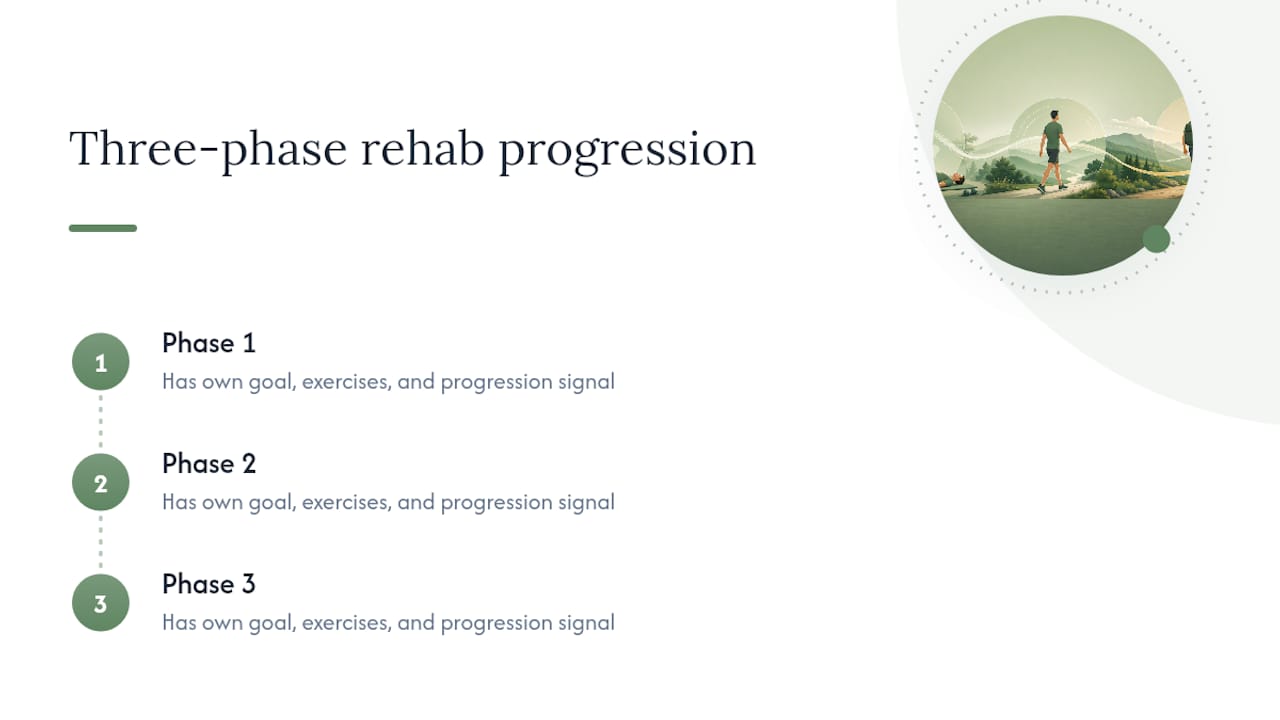
Phase 1: Acute (roughly weeks 1 to 2)
The goal here is calming symptoms and keeping you moving, not building strength. This phase leans heavily on finding your directional preference: the specific spinal position or movement (often extension, sometimes flexion) that reduces or centralizes your leg pain.
Position of comfort: spend several minutes a few times a day in whichever position (lying prone with props under your chest, or seated leaning back) reduces your leg symptoms most.
Gentle walking: 5 to 10 minutes, two to three times daily, at a pace that doesn’t spike your leg pain.
Introductory nerve sliders: gentle sciatic nerve glides, done in small, pain-free ranges, 1 to 2 sets of 10 repetitions.
Directional preference testing: with guidance, repeated movements (like prone press-ups or gentle flexion) to see which direction reduces or centralizes symptoms, done in sets of 10, several times a day if tolerated.
Sample two-week micro-program: days 1 to 3, position of comfort plus short walks only. Days 4 to 7, add nerve sliders once symptoms are stable. Days 8 to 14, add directional preference repetitions if a clear pattern has emerged, tracking whether pain is centralizing (moving up toward the spine and out of the leg).
Progress to Phase 2 when leg pain has started centralizing, or when your baseline pain is manageable enough to tolerate light loading without a flare lasting more than a few hours.
Phase 2: Recovery (roughly weeks 3 to 6)
This phase adds trunk motor control and more assertive neural mobilization, building the stability that protects the healing nerve root during daily activity.
Bridges: 2 to 3 sets of 10 to 15 repetitions, focusing on a slow, controlled lift and lower.
Bird-dog: opposite arm and leg extension from a hands-and-knees position, 2 to 3 sets of 8 to 10 per side, holding briefly at the top.
Progressive neural mobilization: transitioning from sliders to gentle tensioners under supervision, as tolerated, typically 1 to 2 sets of 10.
Flexibility work: hip flexor and hamstring stretching, held 20 to 30 seconds, avoiding aggressive end-range stretching that reproduces radiating pain.
Balance training: single-leg stance progressions, building toward 30 seconds per side.
Sample two-week micro-program: alternate bridge and bird-dog days with walking-focused recovery days. Add neural mobilization on non-consecutive days to gauge your nervous system’s response. By week 6, you should tolerate a full session without a symptom flare that outlasts the session itself.
Progress to Phase 3 when you can complete core stabilization exercises without symptom reproduction and your walking tolerance has meaningfully increased from your Phase 1 baseline.
Phase 3: Maintenance (roughly week 7 onward)
This phase is about returning to your actual life, whether that means lifting your kids, returning to a physical job, or getting back to a sport.
Progressive loading: gradually increasing resistance on squats, deadlift variations, or step-ups, tailored to your specific job or sport demands.
Functional drills: task-specific movements, like carrying groceries, floor-to-standing transitions, or sport-specific footwork.
Ongoing neural mobilization: maintained as a home program if it continues to help, typically 1 set of 10 once or twice a day.
Transition to a self-directed home exercise program, with your therapist checking in periodically rather than weekly.
Pro Tip: Track two numbers throughout every phase: total pain-free walking minutes and how many stairs you can climb without a symptom flare. Those two data points tell you more about real progress than a 0 to 10 pain score ever will, because pain fluctuates day to day while functional capacity trends steadily upward when your program is working.
Stop any exercise and contact your physical therapist if you notice new numbness, sudden weakness, or a pain spike that doesn’t settle within a couple of hours. Those aren’t signs to push through. They’re signs the current load is too much for where your nerve root is in its healing.
Are Neural Mobilization and Manual Therapy Safe to Use?
Neural mobilization techniques fall into two categories: sliders and tensioners, and the difference matters for safety. Sliders move the nerve through its surrounding tissue without adding significant tension, making them the safer starting point for anyone with high irritability (meaning your symptoms flare easily and take a while to settle). Tensioners stretch the nerve more directly and are typically introduced later, once your nervous system tolerates movement without a prolonged flare.
Manual therapy, joint mobilization, soft tissue work, and spinal manipulation, adds value specifically as a complement to exercise. Clinically meaningful short-term improvements have shown up in trials combining spinal mobilization with exercise compared to exercise alone, though the long-term advantage isn’t consistent across studies. That’s a realistic way to think about manual therapy: it can shorten your path to being able to exercise effectively, but it’s rarely the whole solution on its own.
Practical precautions matter here. If you’re a high-irritability patient, meaning even light activity provokes symptoms that take hours to calm down, your therapist should start conservatively with sliders and positional relief rather than aggressive stretching or manipulation. Signs to pause and reassess include increasing numbness, new weakness, or leg pain that spreads further down the limb rather than centralizing toward the spine.
Clinician-delivered techniques commonly include:
Lumbar joint mobilization: graded, rhythmic pressure applied to spinal segments to improve movement and reduce pain.
Soft tissue mobilization: manual pressure to reduce muscle guarding around the irritated segment.
Directed spinal manipulation: a higher-velocity technique used selectively based on presentation.
Guided nerve tensioning: a progression from sliders, done under supervision initially.
Home alternatives your therapist may teach you include self-administered nerve sliders, foam rolling for surrounding musculature, and positional stretches that mimic clinic-based mobilization without requiring hands-on treatment every session. A manual therapy overview covers how these hands-on techniques support mobility and pain relief in more general terms if you want the broader picture beyond radiculopathy specifically.
How Long Does Recovery From Lumbar Radiculopathy Take?
Most people see meaningful improvement within a few months, though the trajectory rarely moves in a straight line. Many patients notice functional gains, easier walking, better sleep, reduced reliance on pain medication, well before their pain score hits zero, and that’s a normal pattern rather than a sign something’s wrong.
Useful, objective ways to track your own progress include:
Pain-free walking minutes: how long you can walk before symptoms noticeably worsen.
Stair tolerance: how many flights you can climb without provoking leg symptoms.
Single-leg balance time: a simple proxy for improving neuromuscular control on the affected side.
Symptom centralization: whether leg pain is retreating toward your spine over successive weeks, a positive sign even if overall pain hasn’t dropped much yet.
Escalating care beyond physical therapy becomes appropriate under a few specific circumstances. If you’ve completed a genuine trial of guideline-based physical therapy (typically 6 to 8 weeks of consistent participation) and disability remains high, that’s a legitimate reason to discuss further options with your physician. Worsening motor deficits, rather than plateauing ones, are another clear signal to escalate sooner rather than waiting out the full trial period. And patient preference matters too. Some people, after weighing realistic expectations, choose to pursue an epidural steroid injection or a surgical consultation earlier in the process, and that’s a reasonable choice once they understand the tradeoffs.
Your physical therapist’s role doesn’t end if escalation becomes necessary. Good PT-physician coordination means your therapist documents your response to conservative care in enough detail that a referring physician can make a genuinely informed decision about injections or surgical evaluation, rather than starting from scratch. A complete rehabilitation guide covers general milestone tracking and recovery pacing if you want a broader framework for measuring progress across different injury types.
How Do You Manage Fear and Stay Consistent With Exercise?
Fear-avoidance, the instinct to stop moving because you’re afraid movement will cause more damage, is one of the biggest obstacles to recovering from lumbar radiculopathy. Psychological factors like this strongly influence return-to-work outcomes, and education aimed specifically at reducing that fear improves long-term participation in work and daily life.
Here’s a version of the explanation your physical therapist might use: most lumbar radiculopathy improves substantially within a few months, even without surgery, and staying appropriately active supports that healing rather than interfering with it. Pain during a prescribed exercise, as long as it’s not sharp, worsening, or accompanied by new numbness or weakness, doesn’t mean damage is occurring. It usually means the tissue is adapting.
Simple adherence tactics make a real difference in whether a home program actually gets done:
Habit pairing: attach nerve glides or bridges to something you already do daily, like right after brushing your teeth.
Short daily micro-sessions: 5 minutes twice a day beats one 30-minute session you keep skipping.
Objective tracking: log walking minutes or repetitions completed, not just pain scores, since visible progress on paper builds motivation pain scores can’t.
When fear-avoidance runs deep, or when pain persists despite a technically sound exercise program, adding cognitive-behavioral strategies or referring into multidisciplinary care (psychology, pain medicine, and physical therapy working together) often unlocks progress that exercise alone couldn’t reach. A PT patient education overview walks through how structured education sessions translate into better recovery outcomes in more depth.
Pro Tip: If a specific exercise consistently triggers apprehension rather than pain, ask your therapist to regress it one step and rebuild your confidence there first. Confidence and tissue tolerance often need to be trained separately, and skipping that step is why some home programs stall out.
How Does CRS Wellness Deliver Guideline-Based Radiculopathy Care?
This clinic offers boutique physical therapy services built around individualized, hands-on care. Sessions blend active exercise prescription with manual therapy approaches, tailored to each patient’s presentation.
For lumbar radiculopathy specifically, that means a treatment plan structured around the same phased framework covered above: symptom-calming strategies and directional preference testing early on, progressing into trunk stabilization and neural mobilization, and finishing with a functional home program built for your specific job or activity demands. They offer both in-person and telehealth sessions for physical therapy.
The clinic accepts a range of insurance plans and direct payments, and serves patients in Nassau County and Queens.
Why Do So Many Patients Rest Too Much, Too Long?
The single most common mistake I see in lumbar radiculopathy is prolonged rest disguised as caution. Patients hear “nerve pain” and assume stillness protects the nerve, when the opposite is usually true. Short, frequent movement breaks tied to daily tasks, standing up every 30 minutes, a short walk after each meal, do more for nerve-root recovery than a day spent motionless on the couch.
Track your walking minutes daily. It’s a better recovery gauge than your pain score, because pain fluctuates while function trends steadily in one direction when your program is working.
If your symptoms limit basic tasks, don’t wait weeks to call a physical therapist hoping it resolves on its own. And expect a bumpy recovery curve. Centralization, leg pain retreating toward your spine, is often the first real sign of progress, even on days your overall pain hasn’t budged.
— CRS Wellness
Ready to Start Your Recovery Plan?
Reading about nerve glides and directional preference testing only gets you so far. Getting the pattern right for your specific nerve root, at the right phase, under a clinician who adjusts it as you progress, is what actually shortens recovery. They provide one-on-one care with consistent therapist involvement during visits.
Your first visit includes a full assessment of your symptom pattern, directional preference testing to find which movements ease your leg pain, and an initial exercise prescription you can start immediately, whether you’re in the clinic or connecting through a telehealth PT session. If manual therapy or neural mobilization fits your presentation, it gets layered in as a support to that active plan rather than a substitute for it, drawing on the full range of manual therapy and rehabilitation services the clinic offers. The clinic accepts various insurance plans and direct payments.
If you’re near Williston Park or Albertson, book an in-person evaluation at the Williston Park location or the Albertson location to get your phased plan started this week.
This article is general information, not a substitute for advice from a qualified doctor. Consult a qualified healthcare professional about your own circumstances before acting on anything here.
Sources
FAQ
What Should You Avoid Doing With Lumbar Radiculopathy?
Avoid prolonged bed rest, aggressive stretching that reproduces sharp leg pain, and skipping movement entirely out of fear of causing damage. Clinical guidelines specifically advise against routine passive modalities and extended inactivity, since staying appropriately active supports recovery better than protecting the area through stillness.
How Long Does Recovery From L5 Radiculopathy Typically Take?
Most people with L5 nerve-root involvement see meaningful functional improvement within several weeks of consistent, guideline-based physical therapy. Recovery is rarely linear. Many patients notice easier walking and better sleep before their pain score fully resolves.
Which Exercise Is Best for Lumbar Radiculopathy?
There’s no single best exercise, since the right choice depends on your directional preference, the specific movement pattern that centralizes or reduces your leg pain. For many people, gentle prone extension or nerve sliders in the acute phase work well, progressing to bridges and bird-dogs as trunk control improves.
What Makes Lumbar Radiculopathy Pain Worse?
Prolonged sitting, aggressive stretching into painful ranges, and sudden heavy lifting without proper mechanics commonly aggravate symptoms. So does extended inactivity, which tends to stiffen surrounding tissue and can make the nerve more sensitive rather than less.
Does Physical Therapy Really Help Lumbar Radiculopathy More Than Rest?
Yes. Clinical guidelines identify education and active exercise as first-line treatment, while advising against extended rest for uncomplicated presentations. Early, supervised physical therapy is associated with better outcomes and less subsequent healthcare use compared with delaying care.
Recommended
Comments