
Seven Exercises for Golfer's Elbow: A Clinically Informed Roadmap

Start with activity modification and targeted physical therapy exercises, not rest alone. Most people with golfer’s elbow (medically known as medial epicondylitis) improve with this conservative approach within weeks to a few months, according to clinical review published by the National Center for Biotechnology Information. Contemporary Rehab Services and organizations like Mayo Clinic point to the same conclusion: surgery is rarely needed when rehab is done correctly and consistently.
TL;DR:
Proper rehabilitation involves staged exercises focusing on stretching, isometrics, eccentric loading, and functional grip work, avoiding heavy resistance early.
Adherence to a full 12-week phased program is crucial, as skipping stages or pushing through pain increases the risk of relapse or delayed recovery.
Short-term pain relief from corticosteroid injections or massage does not guarantee long-term benefits, and some treatments may weaken tendons over time.
Red flags like worsening weakness, numbness, or persistent pain after 6 to 12 weeks warrant prompt clinical evaluation.
Professional therapy offers tailored manual and loading exercises that identify mechanical flaws often missed in self-directed rehab.
Table of Contents
Golfer’s Elbow Therapy: Stretches and Exercises to Start Now
Medial epicondylitis develops from repetitive strain on the tendons that attach to the bony bump on the inside of your elbow, the medial epicondyle. That’s why therapy for golfer’s elbow works in stages, not all at once. Loading a tendon before it’s ready sets you back. Loading it too little keeps it weak.
Here’s the sequence physical therapists actually use, in the order your elbow needs them:
Wrist flexor stretch. Extend your affected arm, palm up, then gently pull your fingers and wrist back with your other hand. Hold 20 to 30 seconds, repeat 3 times, and do this 2 to 3 times daily.
Wrist extensor stretch. Same position, palm down this time, gently pulling the wrist into flexion. This balances tension across the forearm and preps the tissue for loading.
Isometric wrist flexion. Press your palm against a wall or your other hand without moving the joint, holding 10 to 15 seconds for 5 to 10 reps. Isometrics are the entry point for acute pain because they build tolerance without the tendon sliding under load.
Isometric pronation. Rotate your forearm against light resistance (a doorframe works fine) and hold. This targets the pronator teres, a frequent contributor to medial elbow pain that generic wrist exercises miss.
Eccentric wrist flexion. Once isometrics feel manageable, hold a light dumbbell (start at 1 to 2 pounds), lower your wrist slowly into extension over 3 to 4 seconds, then use your other hand to reset. Do 3 sets of 10 to 15 reps once daily, per the loading protocols outlined by StatPearls.
Resisted wrist flexion and extension. Add a resistance band or light dumbbell for concentric and eccentric reps together. Progress load only when 3 sets of 15 feel easy and pain stays under a 3 out of 10 during and after the session.
Functional grip work. Squeeze a stress ball or therapy putty, then progress to gripping tools you actually use, whether that’s a golf club, a hammer, or a laptop bag.
Pro Tip: Keep a simple pain log after each session. If soreness spikes above a 3 out of 10 or lingers past 24 hours, drop back one stage rather than pushing through.
Common mistakes that stall recovery:
Jumping straight to heavy resistance bands before isometrics settle the pain down.
Stretching aggressively into sharp pain instead of a mild pull.
Skipping the pronation work and only training wrist flexion and extension.
Training through a flare instead of scaling back for a day or two.
Golfer’s Elbow Rehabilitation: The Phased Recovery Timeline
Golfer’s elbow rehabilitation moves through three phases, and jumping ahead is the single biggest reason people relapse.
Weeks 0 to 2 (acute phase): Relative rest from the aggravating activity, ice for 15 to 20 minutes after use, and a counterforce strap worn just below the elbow to offload the tendon. This isn’t total immobilization. Gentle isometrics start here.
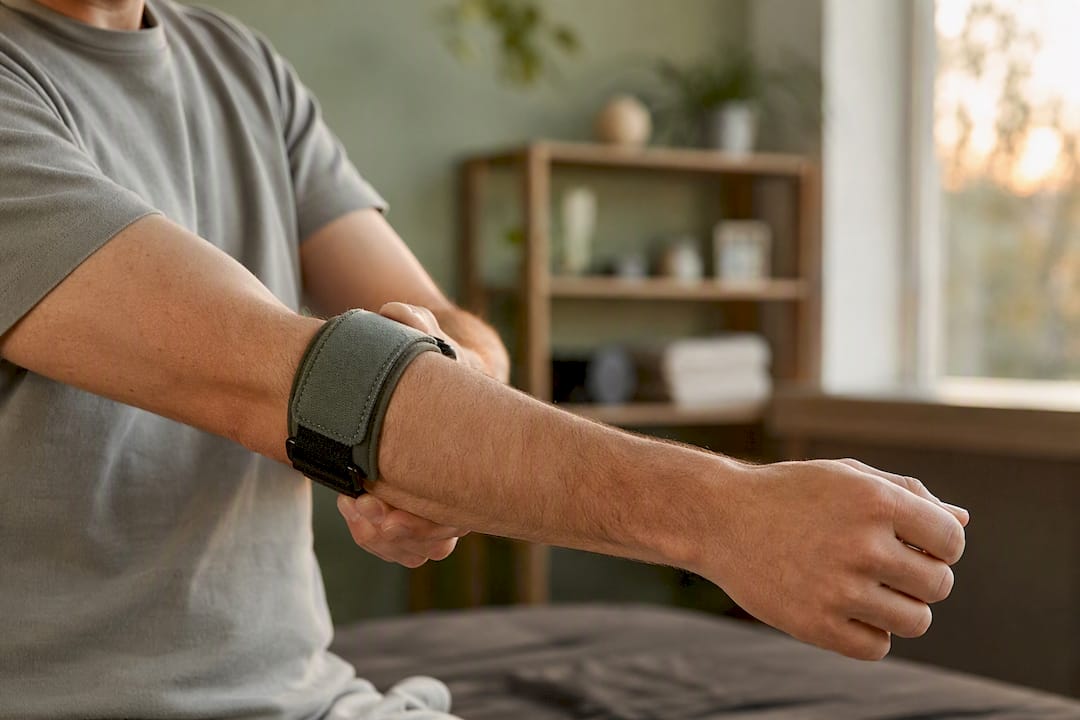
Weeks 2 to 6 (strengthening phase): Eccentric loading and resisted wrist work take over, progressing weight or band tension only when pain stays below 3 out of 10 and grip strength on the affected side approaches the unaffected arm.
Weeks 6 to 12+ (return to activity): Sport or occupation-specific drills, technique correction, and a graded return to your golf swing, typing load, or manual labor. Mayo Clinic emphasizes that correcting the underlying mechanical fault, whether it’s grip pressure, swing path, or keyboard position, is what actually prevents the next flare.
Most people with medial epicondylitis improve without surgery, according to the clinical review noted above.
That statistic comes with a condition: it assumes the rehab program is followed through all three phases, not abandoned once the sharp pain fades. If symptoms haven’t budged after a properly progressed 12-week program, that’s the point to discuss imaging or a specialist referral rather than extending home care indefinitely.
Adjunctive Treatments for Golfer’s Elbow: What the Evidence Actually Shows
Exercise is the foundation of golfer’s elbow treatment. Everything else is a supplement, not a substitute, and the evidence behind each option varies quite a bit.
Corticosteroid injections can quiet pain for a few weeks, but Mayo Clinic notes they lack durable long-term benefit and may raise recurrence risk or weaken the tendon over time. Clinicians tend to use them sparingly and pair them with loading, not in place of it.
Extracorporeal shockwave therapy (ESWT) has shown promising results in select trials. One randomized comparison found ESWT outperformed massage and corticosteroid injection at follow-up for epicondylitis, though protocols and outcomes vary considerably across studies.
PRP injections, dry needling, and percutaneous tenotomy (Tenex) are generally reserved for cases that haven’t responded to several months of structured rehab. These are second line options, not starting points.
Massage and soft-tissue mobilization help when layered onto an exercise program. Used alone, without progressive loading, massage doesn’t resolve the underlying tendon changes.
Clinicians typically weigh how long symptoms have lasted, whether a prior rehab attempt actually followed a proper loading progression, and how much the pain limits work or sport before adding any of these. You can read more about how therapists select modalities like ultrasound and shockwave for tendon injuries, and how nonsurgical options for tendon injuries get sequenced in similar overuse conditions elsewhere in the body.
When Should You See a Clinician for Elbow Pain?
Most golfer’s elbow cases respond to home exercises. Some don’t, and waiting too long on those cases just prolongs the problem.
Watch for these red flags:
Progressive weakness in the hand or forearm
Numbness or tingling into the ring and little fingers, which can signal ulnar nerve involvement
Pain that keeps worsening despite a properly structured 6 to 12 week rehab attempt
A clinical evaluation typically includes provocative maneuvers (resisted wrist flexion and pronation), grip and strength testing, and imaging only if the picture doesn’t fit typical tendinopathy. Bring an activity log, any prior imaging, and a timeline of when the pain started and what makes it worse. That information shortens the path to the right treatment plan considerably.
How Contemporary Rehab Services Approaches Golfer’s Elbow
We build golfer’s elbow rehab around the same phased roadmap outlined above: pain control first, then progressive loading, then correcting the swing, grip, or work mechanics that caused the strain in the first place. A lot of elbow pain traces back to shoulder or core weakness feeding poor mechanics down the arm, which is why we assess the whole kinetic chain, not just the elbow. Contemporary Rehab Services accepts Medicare, Aetna, Cigna, Emblem, and United Healthcare, with individualized in-person and telehealth sessions available.
— CRS Wellness
Get Hands-On Help for Golfer’s Elbow
Home exercises take you far, but a clinician catches the small mechanical errors, like a pronation deficit or a scapular weakness, that self-directed rehab often misses. Contemporary Rehab Services builds individualized programs around exactly the phased approach described above: manual therapy to calm irritated tissue, progressive loading exercises tailored to your grip strength and pain response, and return-to-sport or return-to-work retraining once you’re ready to push volume again.
If you’re in Nassau County or Queens and want supervised rehabilitation instead of guessing at load progression on your own, Contemporary Rehab Services works with Medicare, Aetna, Cigna, Emblem, and United Healthcare plans, plus direct cash pay. Explore our therapy services to see how manual therapy and individualized programs apply to your specific case, or check the Albertson location page to book an evaluation and get a personalized loading plan started this week.
Sources
Recommended
Comments