
1–5 Sessions a Week: Guideline Backed Hip Osteoarthritis Physical Therapy
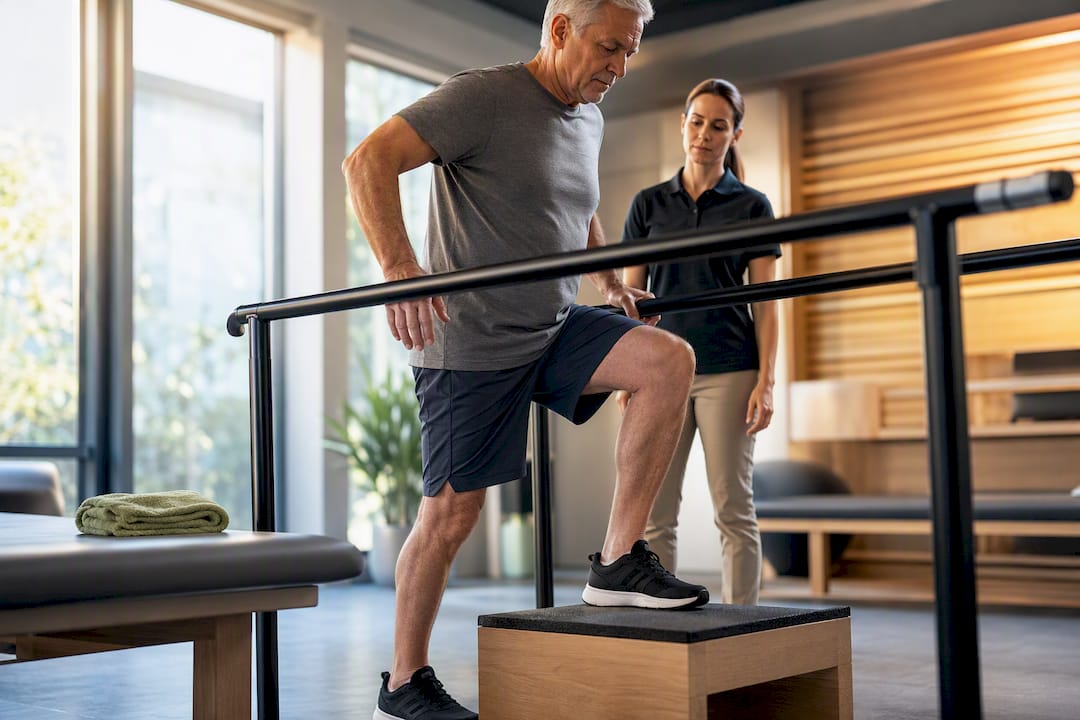
Physical therapy, built around an individualized exercise program plus manual therapy when needed, is the recommended first-line treatment for hip osteoarthritis. It isn’t a vague suggestion to “stay active.” A proper hip osteoarthritis physical therapy plan means a therapist-guided program with specific exercises, measurable goals, and a defined schedule, typically 1 to 5 sessions a week, 30 to 120 minutes each, over 5 to 16 weeks.
TL;DR:
Supervised, structured physical therapy with targeted exercises typically lasts 5 to 16 weeks, with 1 to 5 sessions per week and goal-based progressions.
Initial assessment includes evaluating hip mobility, strength, gait, and using standardized outcome measures to track improvements objectively.
Exercises progress from mobility drills to strengthening core hip stabilizers, then incorporate functional and balance training to improve real-world performance.
Manual therapy, such as joint mobilizations and soft tissue work, can enhance movement, reduce pain, and support exercise efforts, especially early on.
Exercise results are modest, with pain and function improving but rarely reversing the degenerative process, making consistency and adherence crucial for success.
Table of Contents
What Happens During a Hip Osteoarthritis Physical Therapy Evaluation
Your first visit sets the direction for everything that follows, so it goes deeper than a quick chat about where it hurts. A thorough evaluation reviews your medical history, symptom pattern, and any red flags, along with the activities you actually want to get back to, whether that’s walking the dog around the block or climbing stairs without wincing.
From there, the physical exam gets specific. Your therapist checks hip internal rotation, since limited rotation is one of the earliest and most reliable signs of hip joint restriction. They’ll test hip abductor strength (the muscles on the outside of your hip that keep your pelvis level when you walk), watch your gait for compensations like a Trendelenburg lean, and run balance tests to see whether instability is adding to your risk of falls or reinjury.
Good clinics don’t rely on guesswork to track your improvement. The ChoosePT physical therapy guide recommends a structured intake that pairs history and physical assessment with tools that generate an objective baseline. That’s where validated outcome measures come in:
HOOS (Hip disability and Osteoarthritis Outcome Score) or its shorter version, HOOS-PS, to quantify function and pain in daily tasks
NPRS (Numeric Pain Rating Scale), a simple 0 to 10 pain check used at rest and during activity
6MWT (six-minute walk test), which measures how far you can walk in six minutes as a proxy for endurance and functional capacity
These numbers aren’t paperwork. They’re what your therapist re-checks every few weeks to prove the plan is working, or to signal that it needs to change. The evaluation also sorts out what’s actually driving your symptoms. Is it primarily weakness in the gluteus medius, a mobility restriction in the joint capsule, or a gait abnormality that’s overloading one side? That prioritization decides which exercises come first and which wait until your body is ready for them.
Hip OA Exercises Physical Therapy Plans Actually Use
This is the part most people searching for hip arthritis rehab actually want: what exercises, how often, and in what order. A well-built exercises for hip osteoarthritis program moves through three connected phases: mobility, strength, and function. Supervised progressive strength training tends to outperform aerobic-only exercise for improving strength and function, and supervised programs consistently beat unsupervised home exercise for the same reason a coached workout beats a solo one: someone is checking your form and pushing your dose at the right time.
1. Mobility work comes first
Before you load a stiff joint, you need to move it through range. Typical drills include:
Seated or lying hip internal and external rotation, gently rocking the hip through its available arc
Supine hip flexion and extension with the knee bent, sliding the heel toward the buttock and back
Hip circles or pendulum-style swings in a pain-free range, done in short sets multiple times a day early on
These aren’t meant to burn. The goal is to nudge the joint capsule and surrounding tissue toward more range, typically 2 to 3 sets of 10 to 15 repetitions, once or twice daily during the first couple weeks.
2. Strength training targets the muscles that protect the joint
Once mobility work has restored a reasonable range, strengthening becomes the backbone of the program. The gluteus medius and gluteus maximus, along with the hip extensors and abductors, take priority because they stabilize the pelvis and reduce the load traveling through the joint with every step. Expect exercises like these, usually dosed at 2 to 3 sets of 8 to 15 repetitions, 2 to 3 times a week:
Glute bridges, lying on your back, feet flat, lifting your hips to build the glute max and hamstrings
Sidelying hip abduction (hip lifts), raising the top leg while keeping the pelvis stable, directly targeting the gluteus medius
Sit-to-stands and modified squats, which combine hip, knee, and ankle strength in a pattern you use dozens of times a day
Step-ups on a low box, progressing height and speed as tolerated
Standing hip abduction with a resistance band, adding external load once bodyweight versions feel easy
3. Functional and balance training closes the gap
Strength in isolation doesn’t always translate to confidence on stairs or uneven ground. Functional training folds strength gains into real movement patterns: practicing sit-to-stand transfers from different chair heights, step-ups that mimic curbs, and gait retraining to correct compensations your therapist spotted at evaluation. Balance drills, single-leg stance progressions, tandem stance, or light perturbation work, round this out and matter more than most patients expect, since poor balance both worsens gait mechanics and raises fall risk.
For patients whose pain limits land-based weight-bearing, aquatic therapy is a legitimate substitute rather than a consolation prize. Water’s buoyancy reduces joint loading while still letting you strengthen and condition, and it’s often where a therapist starts someone who can’t yet tolerate a full land-based squat pattern. Aerobic conditioning, whether that’s a stationary bike, an aquatic program, or a graded walking plan, gets layered in throughout to support overall function and weight management, which itself improves outcomes when embedded in a broader care plan.

Pro Tip: If a standard squat or step-up is too painful early on, don’t skip the movement pattern entirely. Regress the range (a shallower squat, a lower step) or add support (holding a countertop) so you keep training the pattern your hip needs for daily life, just at an intensity it can currently tolerate.
Progression follows a simple rule: once you can complete the prescribed sets and reps with good form and manageable soreness, your therapist increases resistance, range, or complexity before adding volume. That’s a different philosophy from “push through the pain,” and it’s part of why a supervised hip osteoarthritis physical therapy plan tends to produce steadier gains than a printed handout you’re left to interpret alone.
Manual Therapy: What It Adds and When Clinicians Use It
Exercise is the backbone of hip arthritis rehab, but hands-on techniques often make that exercise more tolerable and more effective, especially early in care when stiffness limits how much active work you can do.
Two techniques show up most often in a hip osteoarthritis physical therapy plan:
Joint mobilization, including mobilization with movement, uses graded, rhythmic pressure on the joint to reduce pain and improve range, often producing an immediate, if temporary, increase in motion you can then reinforce with exercise.
Long-axis distraction, a gentle traction pulling the femoral head away from the socket, comes in two flavors: higher-force distraction tends to gain range of motion, while lower-force distraction is better suited to short-term pain reduction.
Soft tissue work targeting the surrounding musculature, the hip flexors, TFL, and glutes, is a common adjunct as well; you can read more about how that manual therapy approach supports pain relief and mobility in general musculoskeletal care. The 2025 JOSPT clinical practice guideline specifically recommends manual therapy for patients with mild-to-moderate hip OA who present with clear mobility deficits, not as a universal add-on for every case. If you want a deeper look at how soft tissue mobilization works mechanically, that’s a useful companion read.
One adjunct worth knowing about, with appropriately modest expectations: dry needling of the iliopsoas, rectus femoris, TFL, and gluteus medius or minimus may produce short-term improvements, around three weeks, for some patients with Grade II to III hip OA. It’s not a stand-alone fix, and the benefit window is short, but it can be a useful bridge for patients who need a pain reduction to tolerate loading exercise sooner.
Assistive devices round out the toolkit. A cane, used on the side opposite the affected hip, can meaningfully reduce joint load during walking, and your therapist will train you on correct height and gait pattern rather than just handing one over. Bracing is discussed less often and isn’t considered a first-line intervention for hip OA the way it sometimes is for the knee, so don’t expect it to headline your plan.
What the Evidence Actually Says About Outcomes
Here’s the honest picture: hip osteoarthritis physical therapy works, but the effect sizes are modest, and knowing that up front helps you set realistic expectations instead of chasing a “cure” that exercise therapy was never going to deliver on its own.
A cumulative meta-analysis of exercise therapy for hip OA found a standardized mean difference of −0.38 for pain and −0.31 for function after treatment, both statistically significant but modest in size, with longer-term effects smaller still.
Translated out of statistics: exercise reliably helps, for most people, but it’s a meaningful improvement rather than a dramatic transformation. That’s consistent with how osteoarthritis behaves generally, a degenerative joint condition doesn’t reverse with exercise, but the pain and disability it causes can genuinely improve.
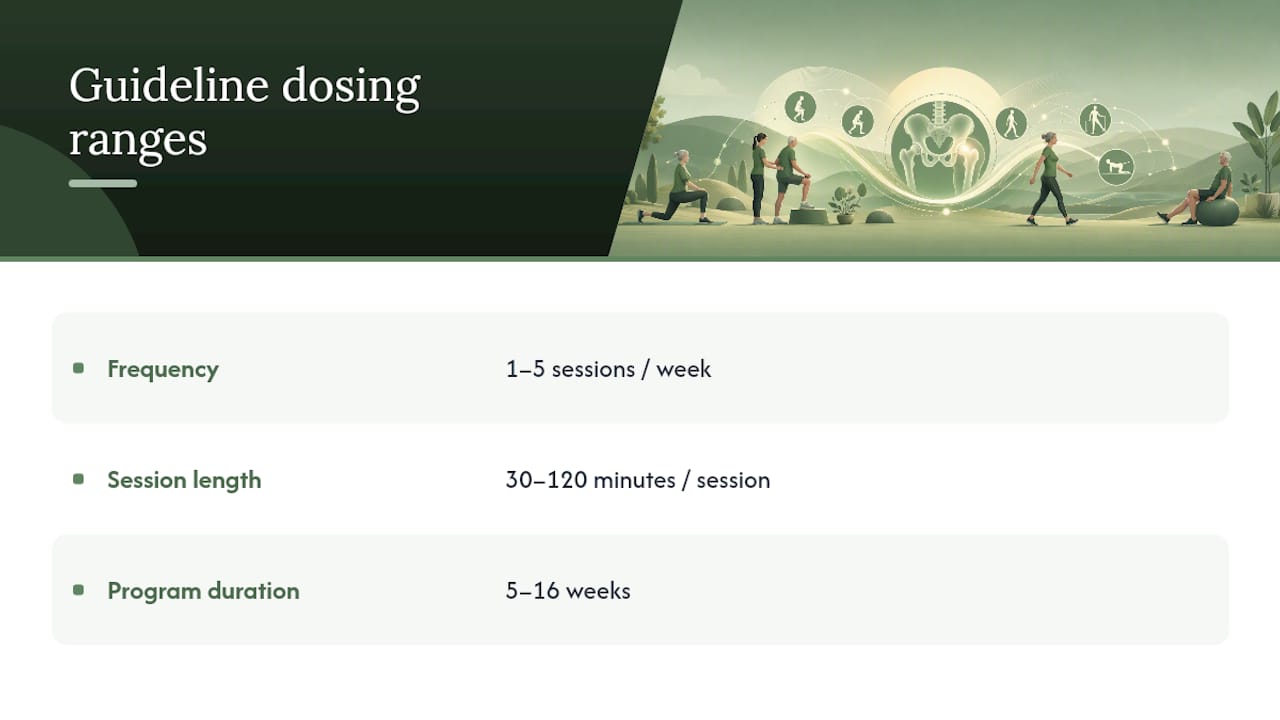
The 2025 JOSPT guideline frames the dosing that produces these results: 1 to 5 sessions per week, 30 to 120 minutes per session, across a program typically lasting 5 to 16 weeks. That’s a wide range on purpose, since dosing depends on symptom severity, how much supervision you need to progress safely, and how your schedule and insurance coverage line up.
Not everyone responds equally. Research suggests patients with higher baseline pain or greater functional limitation are somewhat more likely to see meaningful improvement from a supervised program, and better mental well-being alongside fewer coexisting health conditions correlates with stronger outcomes. Adherence matters just as much as the exercises themselves. Programs that pair exercise with patient education, weight management support, and behavioral coaching around goal-setting tend to outperform exercise prescribed in isolation, which is part of why a clinician who checks in on your progress tends to get better results than a home program you’re left to self-monitor.
Clinicians track whether a program is working using the same outcome measures from your evaluation, HOOS scores, NPRS ratings, and 6MWT distance, watching for changes that exceed measurement error and represent a real, clinically meaningful shift rather than day-to-day noise.
How Much Pain During Exercise Is Normal?
This is where a lot of home exercise attempts go wrong. People either stop the moment anything aches, stalling their progress, or push through sharp pain assuming “no pain, no gain” applies to an arthritic joint the way it might to a healthy one. Neither extreme serves you well.
A useful general rule, one physical therapists apply routinely: mild to moderate discomfort during exercise that settles within an hour or two afterward is typically acceptable and expected as your body adapts to new loading. Pain that spikes sharply during a movement, lingers into the next day, or causes you to limp afterward is a signal to modify the exercise, not to abandon exercise altogether.
Use pacing, breaking activity into shorter bouts with rest, rather than pushing through a long session that leaves you flared up for days.
Apply heat before activity to loosen stiff tissue, and ice afterward if swelling or sharp soreness follows a session.
A TENS unit can offer short-term pain relief for some patients as an adjunct, though it won’t replace the exercise itself.
Substitute a lower-impact version of an exercise (aquatic instead of land-based, a shallower squat) during a flare rather than skipping training entirely.
Flare-ups happen, and they don’t mean the program failed. Scaling back intensity for a few days while keeping gentle motion going usually gets you back on track faster than total rest does. If you’re unsure whether soreness after a session is normal, our guide on pain after physical therapy walks through what’s expected versus what’s worth flagging to your therapist.
Pro Tip: Keep a simple pain log for the first two weeks, rating pain before, during, and the morning after each session. Patterns in that log tell your therapist far more than a vague “it still hurts sometimes” at your next visit.
Certain symptoms are never just “part of the process.” Night pain that wakes you regardless of position, progressive numbness or weakness down the leg, fever, or unexplained swelling warrant a call to your therapist or physician before your next scheduled session.
When Hip Pain Needs More Than Exercise Alone
Physical therapy is first-line care, but it isn’t the right answer for every red flag. Certain findings mean you need medical evaluation before, or alongside, continuing a therapy program: signs suggesting infection (fever, warmth, and swelling around the joint), severe unexplained night pain that doesn’t track with activity, or a progressive neurologic deficit like worsening numbness or weakness.
Referral to a specialist, often for imaging or a surgical consult, typically comes up when conservative care has genuinely been given a fair trial and hasn’t produced meaningful functional improvement, or when persistent severe limitation makes daily activities like getting in and out of a car consistently difficult. Advanced imaging findings are usually discussed jointly between your therapist, your physician, and a surgeon rather than acted on in isolation.
Physical therapy still has a job to do even if surgery ends up on the table. Prehabilitation, strengthening the hip and surrounding muscles before a hip replacement, tends to support a smoother recovery, and postoperative therapy follows a fairly predictable arc: early mobilization within the first day or so, followed by progressive strengthening over the following weeks. If a hip replacement is part of your near-term picture, our breakdown of hip replacement physical therapy milestones covers what that timeline typically looks like.
What We See in the Clinic
Patients often arrive expecting either a miracle or a formality, and the reality lives in between. A well-run hip osteoarthritis physical therapy plan, blending individualized exercise with manual therapy where it’s indicated, tends to produce real, measurable gains in pain and function within a matter of weeks, not months. What actually determines success isn’t the cleverness of the exercise selection. It’s consistency.
Patients who show up, do the home program between visits, and stay engaged when the HOOS score or the six-minute walk test gets re-checked are the ones who report the biggest wins. The plans that blend manual therapy with a graded strengthening approach, matched to your specific mobility and strength deficits found at evaluation, consistently outperform generic exercise sheets. Set a measurable goal with your therapist early, walking a certain distance without stopping, climbing a flight of stairs without pain, and let that number guide the conversation at every visit.
— CRS Wellness
How Contemporary Rehab Services Builds Your Hip OA Program
You can access clinician-supervised programs combining individualized exercise with manual therapy delivered by consistent therapists rather than passed between rotating staff. For hip osteoarthritis specifically, programs may include in-person visits or telehealth PT sessions, alongside hands-on techniques such as joint mobilization, myofascial therapy, and neuromuscular re-education built into an individualized rehab plan.
Clinics may accept various insurance plans alongside cash payments, potentially reducing insurance barriers to starting therapy. The first visit typically includes evaluation of history, gait and strength assessment, and baseline outcome measures to build an individualized plan rather than a template. If you’re ready for a program with actual dosing, actual progressions, and a therapist tracking your numbers, you can book a physical therapy or telehealth session directly, or browse the full manual therapy and rehabilitation services offered for hip and joint conditions.
Sources
This article is general information, not a substitute for advice from a qualified doctor. Consult a qualified healthcare professional about your own circumstances before acting on anything here.
FAQ
What is the best treatment for osteoarthritis of the hip?
An individualized physical therapy program combining targeted exercise (mobility, strengthening, and functional training) with manual therapy when mobility deficits are present is the recommended first-line treatment. Surgery and injections remain options for cases that don’t respond adequately to conservative care.
Can exercise help osteoarthritis of the hip?
Yes. A cumulative meta-analysis found exercise therapy produces small but statistically significant improvements in both pain and function, with supervised progressive strengthening generally outperforming unsupervised or aerobic-only programs.
What are the different stages of osteoarthritis of the hip?
Hip OA is typically graded by imaging severity, from mild joint space narrowing to more advanced bone-on-bone changes with significant cartilage loss, and physical therapy remains appropriate across mild-to-moderate stages, with dry needling specifically noted as an option for Grade II to III presentations.
Can you walk with a bone-on-bone hip?
Many people with advanced, bone-on-bone hip changes on imaging can still walk, though often with pain or a limp, and physical therapy focused on strengthening the hip abductors and correcting gait mechanics can reduce discomfort even at this stage. Persistent severe limitation despite therapy is one of the signals that prompts a surgical consult.
How does Contemporaryrehabservices structure a hip osteoarthritis program?
Contemporaryrehabservices builds each plan around an initial evaluation of your history, gait, strength, and mobility, then combines individualized exercise progressions with manual therapy techniques like joint mobilization, delivered in-person or via telehealth PT sessions. Current pricing and insurance details are available directly on the Contemporaryrehabservices website.
Recommended
Comments