
How to Evaluate Therapy Results: A Patient's Guide

Evaluating therapy results means systematically measuring symptom changes and personal progress to determine whether treatment is working. The clinical standard for this process is called Measurement-Based Care (MBC), which pairs tools like the PHQ-9 (a depression scale) and GAD-7 (an anxiety scale) with Routine Outcome Monitoring (ROM) to track progress session by session. MBC implementation improved combined PHQ-9 and GAD-7 outcomes by 23.5%, which shows that structured tracking is not optional. It is the difference between guessing and knowing. Whether you are a patient, a caregiver, or someone considering therapy for the first time, knowing how to evaluate therapy results gives you real control over your care.
How to evaluate therapy results with standardized tools
Standardized measurement tools are the backbone of objective therapy tracking. The most widely used are the PHQ-9 for depression, the GAD-7 for anxiety, and the Outcome Rating Scale (ORS) for general well-being. Each tool converts your experience into a score that can be compared across sessions.
Two monitoring approaches work best together. The first is session-by-session monitoring using ultra-brief tools like the ORS, which takes under two minutes to complete. The second is periodic comprehensive assessment using the PHQ-9 or GAD-7 every two to four weeks. A hybrid approach combining both methods yields the most practical and data-rich picture of progress. This combination catches both slow-moving trends and sudden shifts.

The table below shows how these tool types differ in practice.
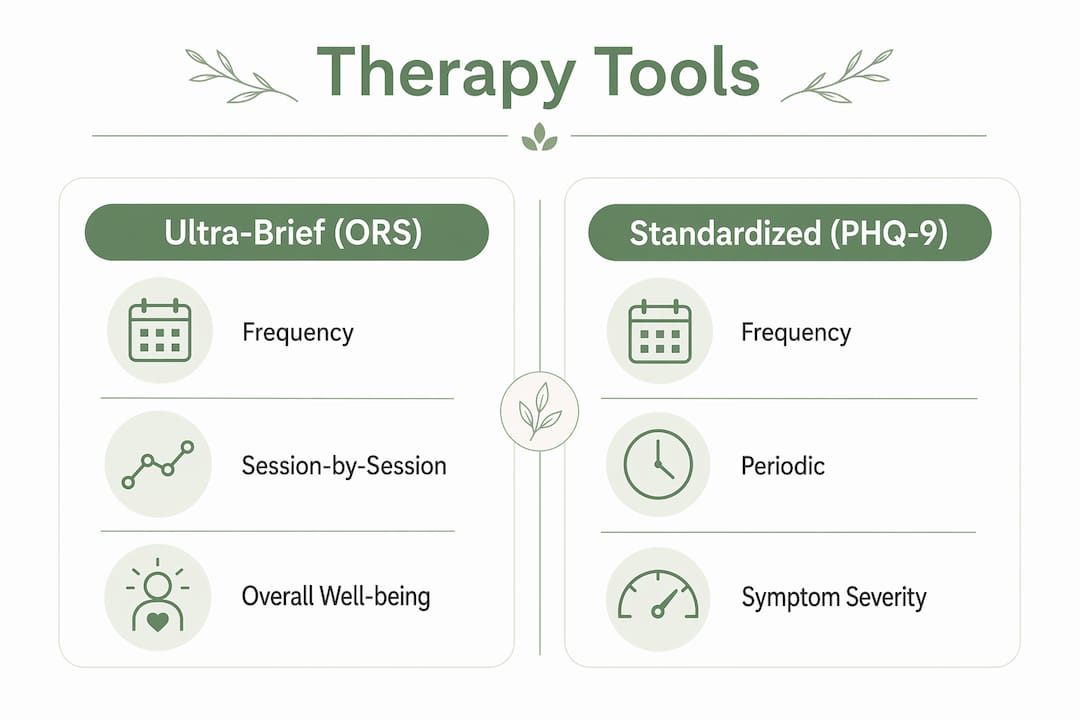
Tool type | Frequency | What it covers |
Ultra-brief (ORS) | Every session | Overall well-being, functioning |
Symptom-specific (PHQ-9) | Every 2–4 weeks | Depression severity |
Symptom-specific (GAD-7) | Every 2–4 weeks | Anxiety severity |
Comprehensive battery | Monthly or quarterly | Multiple symptom domains |
Understanding what score changes actually mean is equally important. Reliable change means a score shift exceeds measurement error, which confirms real improvement rather than random variation. Clinically significant change means your score moves from the clinical range into the non-clinical range. A PHQ-9 drop from 15 to 7, for example, crosses both thresholds and signals genuine recovery.
Pro Tip: Ask your therapist to show you your score trend line after every four sessions. A visual graph makes it far easier to spot real progress versus normal week-to-week fluctuation.
How do you set goals and timelines for measuring therapy effectiveness?
Clear goals and a defined timeline are what separate productive therapy from open-ended conversations with no endpoint. Before your second session, you and your therapist should agree on specific, measurable objectives. These might include reducing panic attacks from five per week to one, or sleeping through the night without waking. Vague goals like “feel better” produce vague results.
A practical timeline for evaluating therapy progress follows these steps:
Set baseline scores in session one using a standardized tool like the PHQ-9 or GAD-7.
Review early change by sessions 4–6. Early symptom movement by session 4–6 predicts better outcomes, so stagnation at this point is a signal, not a reason to panic.
Conduct a formal mid-point review at sessions 8–12. Experts recommend this as the checkpoint to decide whether to continue, adjust, or change approach.
Reassess goals after the mid-point review and set new targets if the original ones are met.
Plan a discharge or maintenance review to confirm that gains are holding.
If no measurable change appears by 8–12 sessions, the evidence supports reconsidering the approach or the provider. That is not failure. That is informed decision-making.
Questions worth asking your therapist at the start of treatment include: “What specific outcomes are we targeting?” “How will we measure progress?” and “At what point will we know if this approach is not working?” Transparency about goals and measurement is a marker of ethical, quality care. A therapist who cannot answer these questions clearly is worth questioning.
Pro Tip: Combine your score data with a brief weekly journal entry about how you felt. Numbers tell you what changed; your notes tell you why it matters.
How do you interpret progress data and know if therapy is working?
Progress in therapy is rarely a straight line. Scores may plateau for two weeks and then drop sharply after a session that felt difficult. Progress is often non-linear, and internal shifts like increased self-compassion appear before symptom scores change. Recognizing these quieter signs prevents you from abandoning effective treatment too soon.
Beyond scores, several qualitative indicators signal that therapy is working:
You notice your reactions to stress are less intense, even if anxiety scores have not dropped yet.
You catch negative thought patterns earlier and interrupt them more often.
Relationships feel slightly easier to navigate, even when they are still difficult.
You feel more willing to sit with discomfort rather than avoid it.
Sleep, appetite, or energy improves before mood scores reflect the change.
The therapeutic alliance, which is the quality of the working relationship between you and your therapist, is one of the strongest predictors of success. Therapeutic alliance strength correlates with positive outcomes across all therapy modalities. You can assess it simply by asking yourself: “Do I feel heard? Do I trust this person’s judgment? Do I feel safe being honest?” If the answer to any of these is consistently no, that matters as much as any score.
Discussing your progress scores openly with your therapist doubles the likelihood of a positive treatment outcome. Sharing the numbers creates a shared reference point. It also shifts the dynamic from passive patient to active participant, which research consistently links to better results. You can also explore treatment planning strategies to understand how goals are structured from the start.
What are the common pitfalls when assessing therapy outcomes?
The most common mistake patients make is relying entirely on gut feeling. Gut feeling is influenced by how likable your therapist is, how you felt on the day of the session, and whether you had a good week at work. None of those factors measure whether therapy is actually reducing your symptoms.
“Consistent objective measurement is the only reliable early detection system for therapy clients who worsen. Without it, deterioration goes unnoticed until it becomes a crisis.”
Between 5% and 10% of therapy clients experience reliable worsening during treatment. That figure is not alarming on its own. What is alarming is that most of those cases go undetected without regular monitoring. Routine outcome tracking catches this early, when a course correction is still straightforward.
Watch for these red flags in your therapy experience:
Your therapist cannot describe what specific outcomes you are working toward.
Sessions feel repetitive with no new strategies or insights after several months.
Your scores on a standardized tool are flat or rising (worsening) after 8 sessions.
You feel worse after most sessions and see no improvement between them.
Requests for progress updates are dismissed or deflected.
When you spot these signs, the corrective steps are direct. Ask your therapist to review your progress data together. Request a formal mid-treatment assessment. If communication stays vague, seek a second opinion or a routine outcome monitoring review from another provider. Changing therapists or approaches is not giving up. It is applying the same logic you would use for any medical treatment that is not producing results. You can also review how to maximize your therapy benefits to get more from every session.
Key Takeaways
Effective therapy evaluation requires combining standardized measurement tools, clear goals, defined timelines, and open communication with your therapist to make informed decisions about your care.
Point | Details |
Use standardized tools | PHQ-9, GAD-7, and ORS provide objective scores that reveal real symptom change. |
Set measurable goals early | Agree on specific targets and a review timeline before session two. |
Check progress by session 8–12 | No measurable change by this point is a signal to adjust the approach or provider. |
Watch for non-score indicators | Internal shifts like self-compassion and stress tolerance appear before scores improve. |
Monitor the therapeutic alliance | A strong working relationship with your therapist predicts success as reliably as any scale. |
What I have learned from years of watching patients track their progress
Most patients arrive at therapy with a passive mindset. They show up, talk, and wait to feel better. The ones who make the fastest and most lasting progress do something different. They treat therapy like a project with a goal, a timeline, and checkpoints.
I have seen patients stay in therapy for two years without measurable improvement because neither they nor their therapist ever stopped to ask “Is this working?” I have also seen patients make significant gains in 10 sessions because they came in asking exactly that question from day one. The difference is not the severity of the problem. It is the presence of a measurement framework.
The data supports what I have observed clinically. Early change by sessions 4–6 predicts better outcomes. Transparent score discussions double positive treatment likelihood. And objective monitoring catches the 5–10% of patients who worsen before the situation becomes serious. These are not abstract statistics. They describe real people whose outcomes changed because someone was paying attention.
My honest advice: do not wait for your therapist to bring up measurement. Ask for it. If they use standardized tools, great. If they do not, ask why. You are entitled to know whether the time and money you are investing is producing results. That is not demanding. That is being an informed participant in your own care.
— Tj
Therapy progress tracking at Contemporaryrehabservices
Contemporaryrehabservices, a boutique physical therapy clinic serving Albertson, NY, Queens, and Nassau County, builds outcome tracking into every treatment plan from day one. Patients receive clear, measurable goals and regular progress reviews so nothing is left to guesswork.

The clinic accepts Medicare, Aetna, Cigna, Emblem, and United Healthcare plans, making structured, data-informed care accessible to a wide range of patients. Every therapist at Contemporaryrehabservices works collaboratively with patients to set realistic targets and adjust treatment when progress stalls. Explore the full range of therapy services available and see how a transparent, measurement-based approach can make a real difference in your recovery.
FAQ
What does “reliable change” mean in therapy outcome measurement?
Reliable change means your score on a tool like the PHQ-9 has shifted enough to exceed measurement error, confirming real improvement rather than random variation. A clinically significant change means your score has moved from the clinical range into the non-clinical range.
How many sessions should I wait before evaluating therapy effectiveness?
Experts recommend a formal review at 8–12 sessions, but early change by sessions 4–6 is already predictive of outcomes. If nothing has shifted by session 6, raise the question with your therapist directly.
What questions should I ask my therapist about progress?
Ask “What specific outcomes are we targeting?”, “How will we measure progress?”, and “What would tell us this approach is not working?” Transparency about goals and measurement is a standard of quality care.
Can therapy make symptoms worse before they improve?
Yes, and between 5% and 10% of therapy clients experience reliable worsening during treatment. Regular monitoring with standardized tools is the most reliable way to catch this early and adjust the approach.
What are the signs that therapy is working even if scores have not changed yet?
Internal shifts like increased self-compassion, earlier recognition of negative thought patterns, and improved stress tolerance are early indicators of progress. These often appear before standardized symptom scores reflect improvement.
Recommended
Comments