
How to Select the Best PT Clinic for Your Recovery

Selecting the best physical therapy clinic means choosing one where qualified professionals deliver personalized care tailored specifically to your condition, goals, and lifestyle. The right clinic does more than treat your symptoms. It builds a plan around you, tracks your progress, and prepares you to stay healthy long after your last session. With so many options across Nassau County, Queens, and beyond, knowing exactly what to evaluate before you commit saves you time, money, and frustration. This guide gives you a clear, evidence-backed pt clinic selection guide built on 2026 standards for clinical excellence and patient-centered care.
How to select the best PT clinic: credentials and specializations
The foundation of any great physical therapy clinic is the qualifications of the people treating you. A Doctor of Physical Therapy (DPT) degree is the current entry-level standard for licensed physical therapists in the United States. Active state licensure is non-negotiable. You can verify a therapist’s license through your state’s physical therapy licensing board website, which takes less than five minutes and confirms the therapist is in good standing.

Beyond the DPT, board certifications like the Orthopedic Certified Specialist (OCS), Sports Certified Specialist (SCS), and Neurologic Certified Specialist (NCS) signal advanced expertise in specific areas. This matters enormously if you are recovering from a complex condition such as a rotator cuff repair, a stroke, or a chronic pain disorder. A generalist therapist may handle routine cases well, but a board-certified specialist brings deeper clinical reasoning to difficult presentations.
Here is what to confirm before your first appointment:
DPT degree from an accredited program
Active state licensure verified through your state’s licensing board
Relevant board certifications matched to your condition (OCS for joint issues, SCS for sports injuries, NCS for neurological conditions)
Continuing education in manual therapy, dry needling, or other evidence-based techniques
Years of experience treating your specific diagnosis
Pro Tip: Ask the clinic directly which therapist will treat you and request their credentials in writing. Some clinics advertise a senior specialist but assign you to a newer graduate for most sessions.
How do one-on-one care models compare with high-volume PT clinics?
This is one of the most important distinctions you will encounter when evaluating physical therapy options, and most patients do not know to ask about it. High-volume clinics operate by scheduling multiple patients simultaneously, rotating a single therapist between three or four people at once. One-on-one clinics assign your therapist exclusively to you for the full session.
The difference in outcomes is real. One-on-one sessions consistently produce better patient outcomes than high-volume, multi-patient treatment models because fragmented attention leads to heavier reliance on passive modalities like electrical stimulation and heat packs rather than skilled hands-on care. Passive modalities feel good in the moment but rarely drive lasting recovery on their own.
Feature | One-on-one clinic | High-volume clinic |
Therapist attention per session | Full session dedicated to you | Shared across 3-4 patients |
Treatment approach | Active rehab, manual therapy, movement training | Often passive modalities, machines |
Session length | Typically 45-60 minutes of direct care | Often 15-20 minutes of hands-on time |
Total visits needed | Fewer visits, faster recovery | More visits, slower progress |
Cost per visit | May be higher | Often lower per visit |
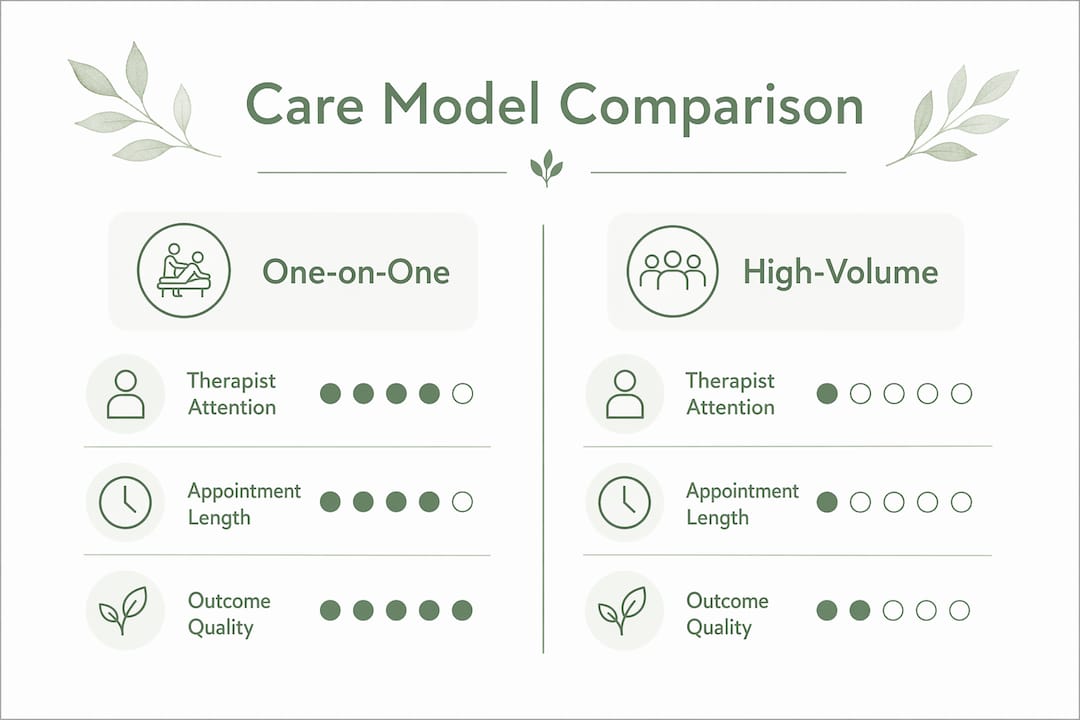
Out-of-network or cash-based clinics tend to focus on longer, individualized appointments with better outcomes, even though the per-visit cost can be higher. When you factor in fewer total visits, the overall cost often balances out or comes out lower. Insurance-based, volume-driven clinics prioritize throughput, which limits the one-on-one time your recovery actually requires.
Pro Tip: Call ahead and ask: “Will the same licensed therapist treat me for every session, and will I have their undivided attention?” The answer tells you everything about the clinic’s care model.
What elements define a thorough evaluation and personalized treatment plan?
Your first visit to a physical therapy clinic is a diagnostic appointment, not just paperwork and pleasantries. A high-quality initial evaluation includes a detailed patient history, a full movement assessment, and a tailored treatment plan. Rushed or generic first visits miss critical details that shape every session that follows.
A thorough evaluation and a strong treatment plan share these characteristics:
Comprehensive intake. Your therapist reviews your full medical history, prior injuries, surgical records, imaging results, and current medications before touching you.
Movement and functional assessment. Strength testing, range of motion, posture analysis, and functional movement screening identify the root cause of your problem, not just the symptom.
Clear diagnosis and explanation. Your therapist explains what is wrong, why it happened, and what the recovery path looks like in plain language you can understand.
Measurable milestones. A good plan includes specific, trackable goals such as returning to running by week six or achieving full shoulder rotation by week four.
Active rehabilitation focus. Manual therapy combined with movement training produces better outcomes than reliance on machines or passive modalities alone. Hands-on joint mobilization and targeted strength work should anchor your program.
A long-term independence plan. The best PT clinics incorporate a post-rehabilitation plan to promote independence and reduce recurrence, so you leave with the tools to stay well.
If your first visit ends without a clear explanation of your diagnosis and a written outline of your treatment plan, that is a warning sign worth taking seriously.
How to evaluate location, insurance, scheduling, and clinic environment
Clinical quality comes first, but practical factors determine whether you actually show up consistently. Adherence to your schedule directly affects how fast you recover, so convenience genuinely matters.
Here is how to evaluate the practical side of choosing a top physical therapy clinic:
Location and commute. Clinical quality beats proximity, but a longer commute for superior care is often more efficient in the long run. A 20-minute drive to a clinic that delivers real results beats a 5-minute walk to one that does not.
Insurance compatibility. Confirm the clinic accepts your specific plan before your first visit. Clinics that accept Medicare, Aetna, Cigna, Emblem, and United Healthcare plans reduce your out-of-pocket burden significantly. Use this insurance and therapy guide to understand your coverage before you call.
Billing transparency. Professional clinics verify insurance benefits, explain out-of-pocket costs upfront, and provide clear timelines. Vague billing answers at the front desk are a red flag, not a minor inconvenience.
Scheduling flexibility. Early morning, evening, and weekend slots matter if you work full time. Ask whether you can book recurring appointments at the same time each week.
Clinic environment. Clean, organized, and calm spaces reflect how the clinic operates overall. A patient-centered clinic culture reduces administrative friction and keeps the focus where it belongs: on your recovery.
What questions should you ask when evaluating a PT clinic?
Walking into a clinic without a list of questions is like buying a car without a test drive. You have every right to interview the clinic before committing. Here is a numbered list of the most important questions to ask, along with what a strong answer looks like:
“Will I see the same therapist every visit?” A yes confirms continuity of care. Frequent therapist changes disrupt your progress.
“How much one-on-one time will I have with my therapist each session?” Anything less than 30 minutes of direct, hands-on time per session warrants a follow-up question.
“What is your treatment philosophy: active rehab or passive modalities?” Strong clinics lead with movement, strength, and manual therapy.
“How do you measure progress?” Look for specific metrics: range of motion measurements, functional tests, pain scale tracking over time.
“Do you accept my insurance, and what will my out-of-pocket cost be?” Get a number, not a vague estimate.
“You are not locked into a clinic once you start. If you are not seeing measurable progress after three to four weeks, switching therapists is not giving up. It is smart patient advocacy.”
Avoid the sunk cost fallacy. If the connection is not there or progress has stalled, a change after a fair trial period leads to better results and higher satisfaction. You can also review this PT recovery checklist to benchmark what good care looks like at each stage of treatment.
Key takeaways
Selecting the best physical therapy clinic requires verifying credentials, confirming a one-on-one care model, demanding a thorough evaluation, and checking insurance and billing transparency before your first visit.
Point | Details |
Verify credentials first | Confirm DPT degree, active licensure, and relevant board certifications before booking. |
Prioritize one-on-one care | Clinics that dedicate full session time to one patient produce faster, more lasting results. |
Demand a thorough evaluation | Your first visit must include a movement assessment, clear diagnosis, and a written treatment plan. |
Check insurance and billing upfront | Transparent cost communication is a sign of a professional, patient-centered clinic. |
Know your right to switch | If progress stalls after three to four weeks, changing therapists is a legitimate and smart choice. |
Why the care model matters more than the clinic’s equipment
After years of working in physical therapy, the single most consistent pattern I have seen is this: patients who receive individualized, hands-on care recover faster and stay better longer than those who cycle through machines and passive treatments in a crowded gym-style clinic. Expensive equipment can look impressive on a clinic tour, but manual skills and clinical reasoning are typically more effective than high-end machines, which are sometimes used more as a marketing tool than a clinical one.
What I tell every patient who asks me how to find a good PT clinic is this: pay attention to how the therapist listens during your first visit. Do they ask follow-up questions? Do they explain their reasoning? Do they give you a home program and explain why each exercise matters? Those behaviors predict outcomes better than any piece of equipment in the room. You can also explore home PT exercises to understand what a strong between-session program looks like.
Trust your instincts. If a clinic feels rushed, impersonal, or evasive about costs and credentials, those feelings are data. You deserve a therapist who treats your recovery as a priority, not a billing unit.
— Tj
Experience patient-centered physical therapy at Contemporaryrehabservices
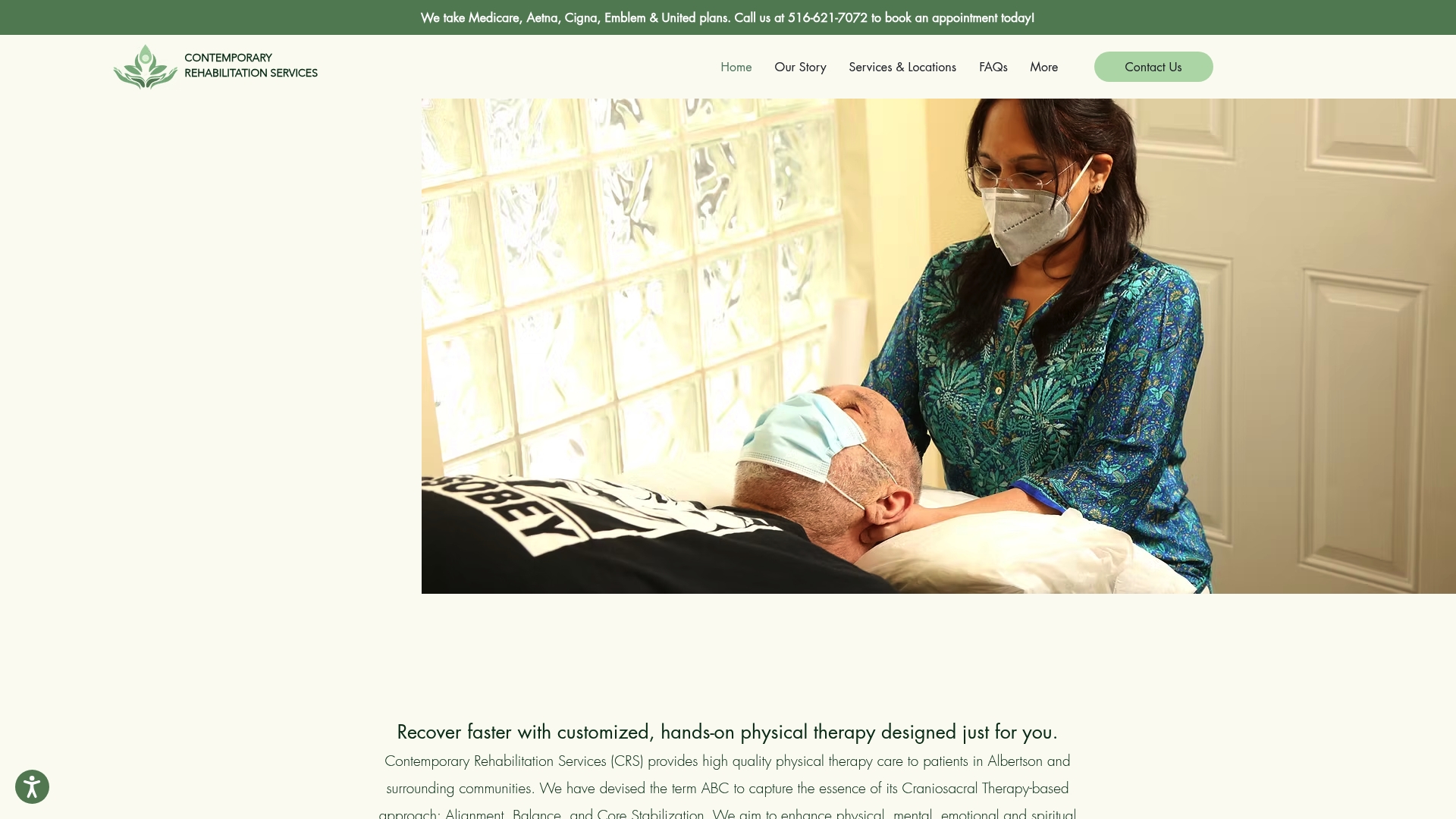
Contemporaryrehabservices is a boutique physical therapy clinic in Albertson, NY, serving patients across Nassau County and Queens with the one-on-one, evidence-based care this guide describes. Every session is delivered by a licensed, credentialed therapist dedicated entirely to you. The clinic accepts Medicare, Aetna, Cigna, Emblem, and United Healthcare plans, so insurance compatibility is rarely a barrier. Flexible scheduling and a calm, professional environment make it easier to stay consistent with your treatment. Explore physical therapy in Albertson or visit the Searingtown location to book your evaluation and start your recovery on the right path.
FAQ
What credentials should a physical therapist have?
A qualified physical therapist holds a Doctor of Physical Therapy (DPT) degree and an active state license. Board certifications such as OCS, SCS, or NCS indicate advanced specialization for complex conditions.
How do I know if a PT clinic offers one-on-one care?
Ask directly whether the same licensed therapist will treat you for the full session without splitting attention between multiple patients. One-on-one clinics will confirm this without hesitation.
What should happen during my first PT visit?
Your first visit should include a full medical history review, a movement and strength assessment, a clear diagnosis, and a written treatment plan with measurable goals. A rushed or generic first visit is a warning sign.
Does insurance cover physical therapy at most clinics?
Coverage varies by plan and clinic. Clinics that accept Medicare, Aetna, Cigna, Emblem, and United Healthcare cover a large portion of patients. Always confirm your specific benefits and out-of-pocket costs before your first appointment.
When is it appropriate to switch physical therapists?
If you are not seeing measurable progress after three to four weeks of consistent treatment, switching therapists is appropriate and often leads to better outcomes. You are not obligated to continue care that is not working.
Recommended
Comments