
Medicare Physical Therapy Cap 2026: The $2,480 Threshold Explained

There is no hard dollar cap on medically necessary outpatient physical therapy under Medicare in 2026. What exists is a set of thresholds. At $2,480 for physical therapy and speech-language pathology combined, your therapist adds a billing modifier that confirms your care is still medically necessary. At $3,000, claims become eligible for a closer review. If you are in Queens or Nassau County and worried that therapy will stop partway through your recovery, this guide explains what the numbers mean and how to keep your care on track.
TL;DR
Medicare does not stop covering medically necessary outpatient PT at a set dollar amount. Medicare.gov states there is no yearly limit on what it pays for such services.
For 2026, the KX modifier threshold is $2,480 for PT and speech-language pathology combined. Past it, your therapist must document medical necessity on the claim.
Claims above $3,000 become eligible for targeted medical review, so clear records matter more than ever.
After your Part B deductible, you generally pay 20% of the Medicare-approved amount.
Craniosacral therapy is generally not covered by Original Medicare, so ask your provider how the visit will be billed before it starts.
Table of Contents
Is there still a Medicare therapy cap in 2026?
Not in the old sense. Many people still remember a hard annual limit that could leave a patient paying the full cost mid-treatment. That limit was lifted in 2018, and the thresholds that replaced it do not cap coverage. CMS explains that when services exceed the threshold, the claim must carry the KX modifier. The modifier is the therapist’s attestation that the services are medically necessary and supported by the medical record. Without it, the claim may be denied.

So the practical question is not “When does my coverage run out?” It is “Does my chart show why I still need skilled care?” That is a documentation question, and a good clinic handles it with you from the first visit.
The 2026 numbers at a glance
Threshold | 2026 amount | What happens when you cross it |
KX modifier threshold (PT and speech-language pathology combined) | $2,480 | The claim must include the KX modifier confirming medical necessity |
Targeted medical review threshold | $3,000 | Claims become eligible for targeted medical review |
Both figures come from CMS’s therapy services page. Occupational therapy is tracked under its own separate threshold. The dollar amounts are adjusted from year to year, so if you are reading this in a later year, confirm the current figure on that CMS page.
What counts toward the threshold
The thresholds apply to expenses for covered outpatient therapy services that are medically necessary. Think of it as the allowed amount Medicare tracks for your therapy during the calendar year, not the amount you personally pay out of pocket. The count restarts each January.
Services outside medical therapy do not belong in this system. Medicare does not cover general fitness, wellness programs, or services that do not require a therapist’s specialized skills. If you also spend on wellness equipment, a breakdown of compression therapy cost shows how people weigh those out-of-pocket purchases separately from covered care.
What the KX modifier means for you
You will rarely see the modifier yourself. Your therapist’s billing adds it once your year-to-date therapy passes $2,480. Here is what it means in plain terms:
Your therapist is stating that the care is still reasonable and necessary.
Your chart must back that up with objective findings, goals and progress.
Your Medicare contractor still decides whether the claim is payable. The American Physical Therapy Association points out that submitting the modifier does not bind the contractor.
The takeaway is reassuring. If you are making measurable progress and your therapist documents it, crossing the threshold is a normal part of a longer course of care, such as recovery after surgery or a fall.
Why $3,000 matters
Once your total passes $3,000, claims are eligible for targeted medical review. Eligible does not mean every claim is pulled. It means a reviewer may ask for your records. Clinics that write thorough, individualized notes are well prepared for that, and it is one more reason to choose a practice where the same clinician evaluates, treats and documents your care.
What Medicare requires before it pays for outpatient PT
Medicare’s rules are more about paperwork and necessity than about dollars. Here are the main requirements, in the order you will meet them.
A written plan of care
Outpatient therapy must be furnished under a written plan of care, established by a physician, a non-physician practitioner, or the qualified therapist providing the services. CMS lists what it should contain: diagnoses, long-term goals, the type of service, and the amount, frequency and duration of treatment. It also needs the signature and professional identity of the person who established it, plus the date.
Physician or practitioner certification
The initial plan of care must be certified by a physician or non-physician practitioner within 30 calendar days of the first day of treatment. The certifying provider’s name and NPI also appear on the claim. In everyday terms, your doctor or nurse practitioner signs off on the plan your therapist wrote.
Skilled care and progress reports
CMS documentation guidance asks for records that show the skilled contribution of a qualified clinician, a reasonable amount, frequency and duration of service, and comparable objective or functional measures at your prior level, your initial evaluation and each progress report. Progress reports are required at least every 10 treatment days.
For you, that translates into a few things you will notice at a well-run clinic:
A thorough first evaluation with measurements of pain, motion, strength or balance
Goals that tie to real life, such as climbing your stairs or walking to the corner
Regular re-checks, so you and your therapist can see what is improving
Our own guide to PT treatment planning walks through what a good plan looks like from the patient’s side.
Do you need a referral in New York?
This is a separate question from Medicare’s certification rule, and it trips people up. Under New York State rules, a physical therapist with at least three years of full-time experience may treat you without a referral for up to 10 visits or 30 days, whichever comes first, as long as you sign a Notice of Advice form. Beyond that, treatment must follow a referral from an authorized provider such as a physician, nurse practitioner, podiatrist, dentist or midwife.
With Medicare, the two pieces fit together this way: you may be able to begin evaluation under New York direct access, and your doctor or practitioner then certifies the plan of care within the 30-day window. We cover the state rules in more depth in our guide to physical therapy referrals and direct access in New York.

Original Medicare vs. Medicare Advantage
Everything above describes Original Medicare. Medicare Advantage plans may have different coverage rules, so check with your plan about visit limits, authorizations, copays and which clinics are in network. Our guide to checking PT eligibility step by step helps you gather the right questions before your first call.
We accept Medicare, Aetna, Cigna, Emblem and United Healthcare plans, and we also see patients on a cash basis. Our front desk can help you sort out which category your card falls into.
What you pay
Medicare Part B covers medically necessary outpatient physical therapy, and your doctor or other qualifying provider must certify the need. After the Part B deductible, you generally pay 20% of the Medicare-approved amount. Many patients have a supplemental plan that helps with that share, so look at your own plan documents.
If you want a view of local pricing outside of insurance, see our overview of physical therapy costs in New York. For a wider look at how benefits fit together, our 2026 Medicare PT benefits guide and our list of Medicare-covered therapy types are good next reads.
Craniosacral therapy and Medicare: plan ahead
Craniosacral therapy is a gentle, hands-on technique, and it is one of our areas of specialty. It is also worth knowing how Medicare treats it. CMS’s outpatient therapy coverage policy lists craniosacral therapy as non-covered under Original Medicare, and including it in a medically necessary PT plan does not change that. Medicare may still cover the separately qualifying PT services in the same plan.
Here is how to handle it so there are no surprises:
Ask your provider, before the visit, which parts of your session are billed to Medicare and which are not.
If Medicare is expected to deny a service, the provider should give you a written Advance Beneficiary Notice (ABN) first. Per Medicare.gov, if you choose to receive that service, you pay its full cost.
If you have a Medicare Advantage plan, ask the plan whether it covers the service, since it may confirm something different.
This kind of clear conversation up front is part of how we work. You decide with full information, and your covered physical therapy continues alongside.
Our perspective
We hear the same worry from many Medicare patients in Albertson, Queens and across Nassau County: “Will I run out of therapy?” Our answer is that the number on the page is not the thing to watch. What matters is whether your care is individualized, measurable and well documented. We are a boutique, mother-daughter clinic, and every session is one-on-one. That means the clinician who examines you is the one who treats you and writes your notes. Your goals, your progress and your reasons for continuing are known to the person in the room, not pieced together later. We also believe hands-on care deserves a place in a rehabilitation plan. Myofascial therapy, joint mobilization, neural mobilization, visceral therapy, neuromuscular re-education and craniosacral therapy are part of how we help people with pain, injury and movement problems. Our ABC Approach to rehabilitation and our exercise guides help you carry progress home between visits. If you are unsure how a service will be billed, ask us. We would rather explain coverage at the start than leave you guessing at the end. CRS Wellness
See a Medicare-friendly PT in Nassau County or Queens
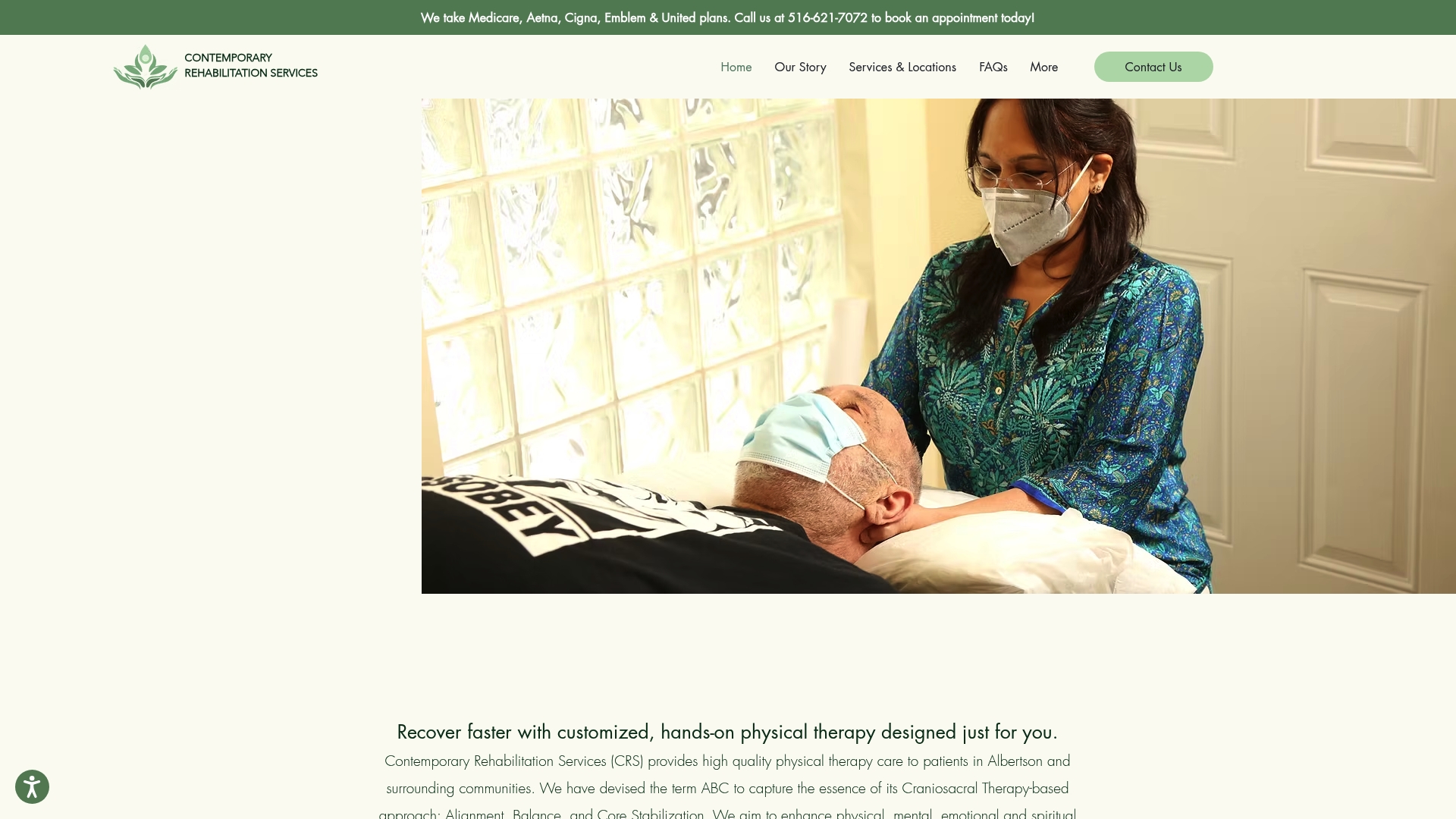
Contemporary Rehab Services is a boutique physical therapy clinic in Albertson, NY, serving Queens and Nassau County. We offer in-person and telehealth sessions, and we accept Medicare, Aetna, Cigna, Emblem and United Healthcare, as well as cash payments.
If you are ready to start, or just want to learn how your plan applies, visit our physical therapy and telehealth page or browse our full list of services. If you prefer to meet from home, our guide to telehealth physical therapy coverage explains what to expect.
How to protect your therapy benefit this year
A few simple habits keep your care smooth, whether you are near $2,480 or far from it.
Start with a complete evaluation. Baseline measurements make later progress visible, and Medicare’s documentation rules rely on them.
Keep your doctor in the loop. The plan of care needs certification, and your practitioner’s name and NPI go on the claim.
Attend consistently and do your home program. Steady progress is the strongest support for continued care.
Ask for a progress review. Reports are required at least every 10 treatment days, and you can ask what they show.
Know which services Medicare does not cover. Ask about the ABN and your options before the visit.
Check your plan type. Original Medicare and Medicare Advantage can differ, so confirm with your plan.
If you want more on getting value from your coverage, read our piece on making the most of Medicare therapy in 2026 and why seeking Medicare PT can make sense. Not sure it is time to book? Our list of signs you need physical therapy can help.
A note on staying out of the “outlier” category
One rehab industry writer frames the goal well: the best protection under the threshold system is clear documentation of medical necessity rather than trying to avoid the limits. For patients, that means choosing a provider who explains the reason for each phase of care and who records your functional progress in plain terms you can follow.
FAQ
Is there a Medicare cap on physical therapy in 2026?
No. Medicare.gov says there is no limit on how much Medicare pays for medically necessary outpatient therapy in a calendar year. There are thresholds, at $2,480 and $3,000, that trigger a modifier and eligibility for review, but they do not end your coverage.
What happens when I pass $2,480?
Your therapist adds the KX modifier to your claims to attest that the care is medically necessary and documented. CMS notes that claims without it may be denied once the threshold is exceeded. You do not need to do anything except keep attending and keep progressing.
Do I need a doctor’s referral for Medicare physical therapy in New York?
Not always at the start. A New York therapist with enough experience can treat you without a referral for up to 10 visits or 30 days, with your signature on a Notice of Advice form, per state rules. Medicare still requires a physician or practitioner to certify the plan of care, within 30 days of your first treatment.
Will Medicare pay for craniosacral therapy?
Generally no under Original Medicare, because CMS lists it as non-covered. Qualifying PT services in the same plan can still be billed to Medicare. Ask your provider to separate the two and to give you an ABN if a denial is expected.
Do Medicare Advantage plans follow the same rules?
Not necessarily. Medicare Advantage plans may have different coverage rules, so call your plan about authorizations, copays and in-network clinics before you book.
Sources
Medicare Payment Thresholds for Outpatient Therapy Services | APTA
The KX Modifier and Medicare Therapy Thresholds | Rehabilitation Health
MLN905365: Complying with Outpatient Rehabilitation Therapy Documentation Requirements | CMS
Billing and Coding: Outpatient Physical and Occupational Therapy Services | CMS
Billing and Coding: Medical Necessity of Therapy Services | CMS
LCD: Outpatient Physical and Occupational Therapy Services | CMS
Referral for Physical Therapy Treatment | NYS Office of the Professions
Recommended
Comments