
240 MET Minutes: Multiple Sclerosis Physical Therapy to Reduce Fatigue
Physical therapy helps people with multiple sclerosis improve mobility, reduce fatigue, and maintain independence. Systematic reviews and National MS Society guidance both support physical therapy as a core part of MS management, from newly diagnosed relapsing-remitting cases to more advanced progressive disability. The practical next step is simple: get an assessment from a physical therapist experienced in neurologic conditions, ideally soon after diagnosis rather than after mobility problems set in.
TL;DR:
Exercise dose is key, with most programs aiming for around 240 METs-minutes weekly, achievable through about 60 minutes of brisk walking or cycling spread out.
Robot-assisted gait training benefits those with more advanced disability, especially with EDSS scores of 6.0 or higher, by improving gait and balance measures.
An initial assessment involves measuring walking speed, balance, strength, and daily activity goals to tailor a plan that adapts over time as symptoms change.
Combining aerobic, resistance, balance, and mind-body exercises in a personalized program produces better results than relying on a single modality.
Heat sensitivity affects most people with MS, so planning exercise in cooler parts of the day and using cooling aids can help prevent symptom flare-ups.
Table of Contents
How Does Physical Therapy Help MS?
Multiple sclerosis physical therapy works by targeting the specific systems the disease disrupts: muscle strength, balance, walking speed, and energy regulation. A systematic review of physiotherapy interventions for gait impairment in MS found consistent improvements in activity and participation measures across studies, meaning people didn’t just test better in the clinic. They moved more easily through daily tasks like getting up from a chair, walking to the mailbox, or navigating stairs.
The evidence gets more specific when you look at outcome measures therapists actually use to track progress. The 6-Minute Walk Test (6MWT) measures how far someone walks in six minutes and reflects real-world endurance. The Timed 25-Foot Walk (T25FW) captures walking speed over a short, controlled distance, a number that tends to shift early when a treatment plan is working. The Berg Balance Scale scores a person’s ability to perform 14 balance-related tasks, from standing with eyes closed to reaching forward without losing footing. A therapist who sees a patient’s T25FW drop by even a second or two, or Berg Balance Scale scores climb by a few points, is watching a genuinely meaningful functional gain, not statistical noise.
By the numbers: A network meta-analysis of 84 studies covering 3,786 participants with MS found that mind-body exercise, resistance training, and combined exercise programs all produced significant reductions in fatigue, with an estimated dose of exercise energy expenditure linked to the strongest fatigue benefit.
Evidence strength varies by intervention and disease severity. Robot-assisted gait training (RAGT), which uses a motorized exoskeleton or treadmill harness system to guide stepping patterns, shows particularly strong results for people with more advanced disability, including measurable gains on the 6MWT and Berg Balance Scale in cohorts with EDSS scores of 6.0 or higher (EDSS, the Expanded Disability Status Scale, is the standard tool neurologists use to rate MS-related disability). Conventional walking training and general aerobic conditioning, meanwhile, show broader benefit across almost every disease stage, which is why most PT programs blend both approaches rather than betting on one.
What Exercise Modalities Do PTs Use for MS?
A well-built multiple sclerosis rehabilitation plan rarely relies on one type of exercise. Most experienced therapists rotate through several modalities depending on symptoms, disability level, and what a patient can tolerate on a given day.
Aerobic training. Stationary cycling, treadmill walking, or arm-crank ergometry for 20 to 30 minutes, typically two to three times a week, targeted at a moderate intensity (roughly 12 to 14 on the Borg Rate of Perceived Exertion scale, or 50 to 70 percent of estimated maximum heart rate).
Resistance training. Two to three sessions weekly, one to three sets of 8 to 15 repetitions using resistance bands, weight machines, or bodyweight movements, with load increased gradually as strength improves.
Balance and task-specific training. Practice on uneven surfaces, single-leg stance work, and functional drills like sit-to-stand transitions, chosen to mirror the exact movements that trip patients up at home.
Aquatic therapy. Water-based sessions that reduce joint loading and support balance work, often useful for patients whose weight-bearing tolerance or heat sensitivity limits land-based exercise.
Mind-body practice. Yoga and tai chi, which the network meta-analysis on exercise modalities ranked among the most effective categories for cutting fatigue, alongside measurable gains in balance and flexibility.
Robot-assisted gait training. Reserved mainly for patients with more significant gait impairment, delivering repetitive, supported stepping practice that would be difficult or unsafe to replicate manually.
Pro Tip: If cold water bothers your joints but warm pools trigger heat sensitivity, ask your clinic about aquatic therapy in a temperature-controlled pool kept around 84 to 86 degrees Fahrenheit. That range works for most people with MS without provoking symptom flares.
Session structure matters as much as the exercise itself. A therapist experienced with MS exercise programs will typically build in rest intervals between bouts of activity rather than pushing straight through a session, since interval-style pacing tends to produce better tolerance and fewer next-day setbacks than continuous exertion.
What Happens During an Initial PT Assessment?
Your first visit isn’t a workout. It’s a data-gathering session that shapes everything that follows.
Baseline testing. Your therapist measures walking speed and distance (T25FW and 6MWT), balance (Berg Balance Scale), strength through manual muscle testing, and how you perform transfers like moving from a chair to standing.
Functional and cognitive screening. Expect questions about daily activities, fatigue patterns, and sometimes a brief cognitive check, since MS-related fatigue and cognitive load directly affect how a home program should be paced.
Goal-setting conversation. You and your therapist identify what matters most, whether that’s walking a full block without resting, climbing stairs at home safely, or reducing fall risk during transfers.
Plan design. Based on your results, your therapist selects exercise types, frequency, and any assistive devices worth trialing, then sets a follow-up schedule to reassess.
Coordination with other providers. If your evaluation reveals needs outside physical therapy scope, such as fine-motor difficulty or swallowing concerns, your PT will typically flag a referral to occupational therapy, speech therapy, your neurologist, or a durable medical equipment (DME) supplier.
This process repeats every few months, since MS physical therapy is not a one-time fix but a plan that gets recalibrated as symptoms shift or disability progresses.
How Much Exercise Should You Do Each Week?
The National MS Society’s guidance points to a target of a moderate amount of exercise each week, combined with everyday lifestyle activity, adjusted based on disability level and how symptoms fluctuate day to day. That number isn’t arbitrary. It mirrors general public health exercise guidance while accounting for the reality that MS fatigue can make a flat weekly quota unrealistic on bad days.
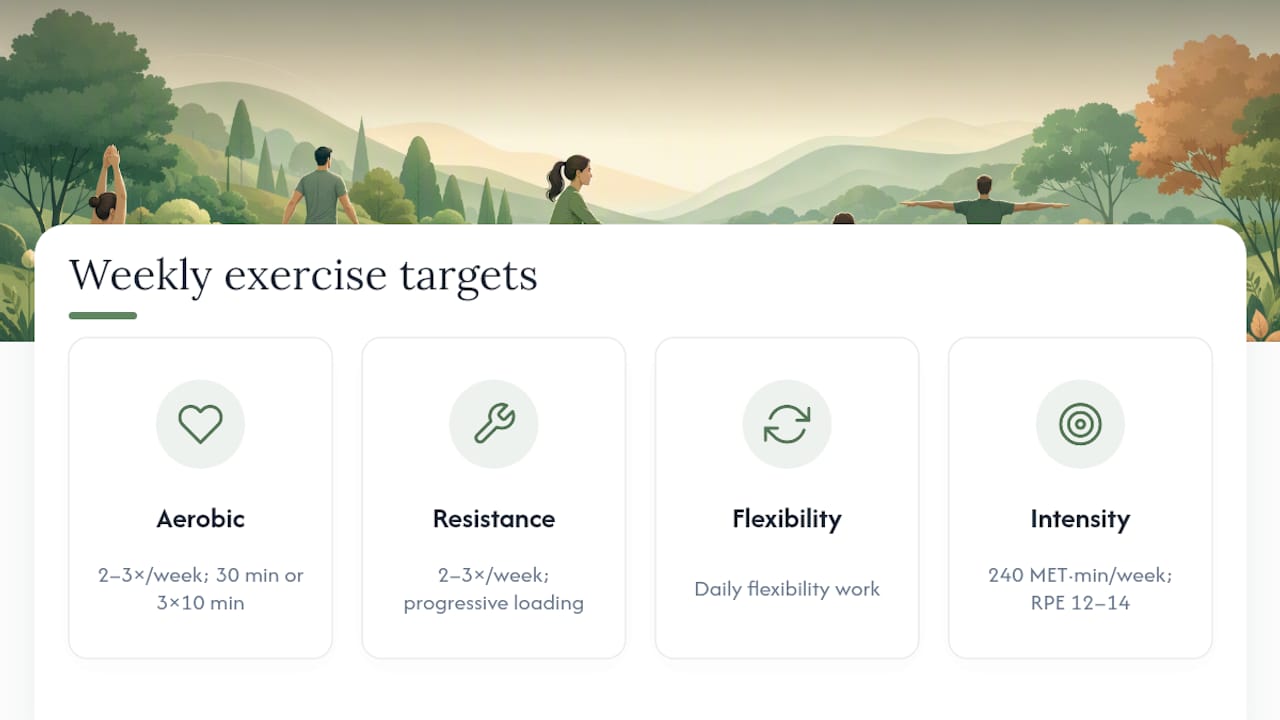
Consensus recommendations for exercise across the MS disease course break this down further: aerobic exercise two to three times weekly, resistance training two to three times weekly, and flexibility work daily, all tailored to EDSS score. Someone with mild disability might handle 30-minute continuous aerobic sessions, while someone with more significant mobility limitation might do better with three 10-minute bouts spread through the day.
Dose matters: The same network meta-analysis found that even 240 METs-minutes per week, a moderate dose achievable through about 60 minutes of brisk walking or 40 minutes of cycling spread across the week, was enough to produce measurable fatigue improvement. You don’t need to hit an elite training volume to see benefit.
Monitoring intensity matters more than chasing a specific number. Rate of Perceived Exertion (RPE) gives patients a simple 6 to 20 scale for gauging effort without needing a heart rate monitor, and most MS exercise programs target a 12 to 14 range, moderate but sustainable. Warning signs to scale back include unusual dizziness, a spike in muscle spasticity, or fatigue that doesn’t resolve within an hour of stopping.
After a relapse, returning to exercise should happen gradually. Most therapists restart at 50 to 70 percent of pre-relapse volume and intensity, then rebuild over two to four weeks depending on how the body responds. Patients managing comorbidities like cardiovascular disease or osteoporosis need modified programs, which is exactly why a supervised MS rehab exercise plan outperforms a generic workout printout.
Why Does Heat Make MS Symptoms Worse, and What Helps?
About a large proportion of people with MS experience heat intolerance, a temporary worsening of symptoms like vision blurring, weakness, or cognitive fog when body temperature rises even slightly. This isn’t a new relapse or permanent damage. It’s a known physiological response called Uhthoff’s phenomenon, and it typically resolves once body temperature drops back down.
Managing it comes down to timing and preparation rather than avoiding exercise altogether.
Schedule sessions in the morning or evening when ambient temperature is lower.
Use cooling vests or neck wraps during and immediately after exercise.
Keep a fan or air conditioning running in the exercise space, and hydrate before, during, and after sessions.
Break longer activities into shorter intervals with seated rest between bouts.
Cool down actively after exercise rather than stopping abruptly in a warm room.
Energy conservation works alongside heat management, not as a separate concept. Pacing means spreading demanding tasks across the day instead of front-loading them, prioritizing what actually matters that day, and building in rest breaks before fatigue hits rather than after.
Pro Tip: Keep a simple fatigue log for two weeks, noting energy levels by hour. Most patients discover a predictable low point, often mid-afternoon, and can schedule PT exercises and errands around it instead of fighting it.
When Do You Need a Cane, Walker, or Wheelchair?
Assistive devices come into the conversation when a therapist identifies a specific, measurable problem, not simply because someone has had MS for a certain number of years. A cane might get trialed after a Berg Balance Scale score dips into a range associated with fall risk. A walker becomes relevant when endurance testing shows someone can’t complete a 6MWT distance safely without support. Ankle-foot orthoses (AFOs), braces that stabilize the ankle and prevent foot drop during walking, often get introduced when gait analysis reveals a specific mechanical problem rather than general weakness.
Home safety changes typically follow the same evidence-based logic:
Grab bars near the toilet and shower reduce fall risk during transfers, one of the highest-risk moments in a home.
Removing loose rugs and improving lighting in hallways addresses two of the most common tripping hazards.
Raised toilet seats and shower chairs reduce the physical demand of transfers that otherwise drain energy fast.
A properly fitted rolling walker with a seat allows rest breaks mid-task without returning to a chair.
Trialing a device in the clinic before buying it matters. A therapist trained in balance-focused rehabilitation can watch how a patient actually moves with a cane or walker and catch compensation patterns, like leaning too heavily on one side, that create new problems down the line. PT-led training on using a device safely in real environments, stairs, uneven sidewalks, crowded stores, closes the gap between owning equipment and actually trusting it.
How Do You Find a PT Experienced With MS?
Early referral matters. The National MS Society’s guidance emphasizes starting physical therapy early rather than waiting until mobility problems become obvious, since PT is effective at every disease stage when the program is adapted to current needs.
Look for neurologic specialization. A physical therapist with training in neurologic conditions, or board certification as a Neurologic Clinical Specialist, will understand MS-specific considerations like heat sensitivity and fatigue patterns that a general orthopedic PT might miss.
Ask about telehealth options. Virtual PT sessions work well for exercise coaching, form checks, and home program adjustments, particularly useful for patients managing fatigue or transportation limits.
Verify insurance coverage before booking. Call ahead and confirm your plan covers the visit type and number of sessions authorized.
Bring a short list of questions to your first visit: What outcome measures will you track? How often will the plan be reassessed? What should I do if I have a relapse mid-program?
How CRS Wellness Applies Multiple Sclerosis Physical Therapy
CRS Wellness (Contemporaryrehabservices) offers both in-person and virtual physical therapy, along with manual therapies including craniosacral therapy, myofascial therapy, joint mobilization, neuromuscular re-education, and visceral therapy, all of which can factor into a rehabilitation plan for someone managing MS symptoms alongside pain or movement restriction.
A typical patient pathway starts with a full evaluation covering strength, balance, gait, and functional goals, similar to the assessment structure described earlier in this guide. From there, the clinic builds a tailored plan combining in-clinic sessions with a home exercise program, then adjusts that plan at regular follow-ups as function changes.
CRS Wellness accepts Medicare, Aetna, Cigna, Emblem, and United Healthcare plans, along with direct cash payment, which removes one of the more common barriers to starting consistent PT for neurological conditions.
What the Research Actually Tells Us to Prioritize
The biggest disconnect between conventional advice and the actual evidence is this: most patients hear “stay active” as vague encouragement, when the research supports something far more specific. Dosing matters. Modality selection matters. An approximately 650 METs-minute weekly target for fatigue reduction isn’t a suggestion, it’s a number drawn from real trial data, and generic advice to “exercise more” gets people nowhere near it.
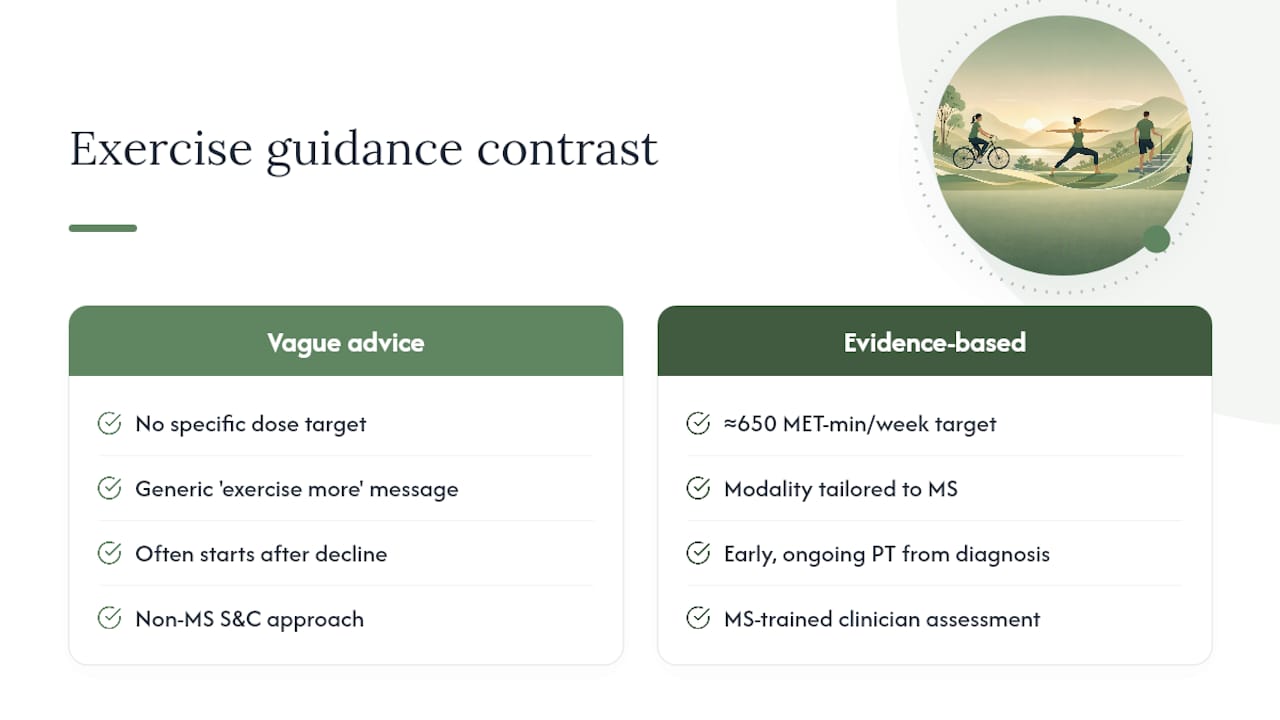
The second gap is timing. Too many people wait until a fall or a major mobility decline before seeking physical therapy, treating it as a late-stage intervention rather than a standing part of MS management from diagnosis onward. The evidence doesn’t support that pattern. Early, tailored PT changes the trajectory more than PT started after damage accumulates.
If there’s one priority worth acting on immediately, it’s getting an assessment with someone who actually understands MS, not a generic strength-and-conditioning approach borrowed from sports medicine. The dosing science is solid. What’s missing for most patients is a clinician translating it into their specific week.
— CRS Wellness
Ready to Start Physical Therapy for MS?
CRS Wellness gives you something a self-directed exercise plan can’t: a therapist who actually measures your walking speed, balance score, and fatigue pattern before deciding what your program should look like, then adjusts it as your needs change.

If you’re in Nassau County or Queens, evaluation and follow-up care are available at clinic locations including Albertson, Great Neck Plaza, and Russell Gardens. Before your first visit, call your insurance provider to confirm your physical therapy benefit, and bring a brief symptom diary noting when fatigue, balance issues, or heat sensitivity tend to hit hardest during your day. That single piece of information often shapes the entire first session. You can review the full list of therapies offered and reach out to schedule your evaluation directly.
This article is general information, not a substitute for advice from a qualified doctor. Consult a qualified healthcare professional about your own circumstances before acting on anything here.
Sources
FAQ
What Is the Best Physical Therapy for MS?
There’s no single best approach. The strongest evidence supports a combination of aerobic training, resistance exercise, and balance work tailored to your EDSS disability level, with robot-assisted gait training added for more significant mobility impairment.
What Precautions Should Someone With MS Take During Exercise?
Watch for heat sensitivity, since about 85 percent of people with MS experience temporary symptom worsening when overheated, and pace exercise using RPE rather than pushing through unusual dizziness, spasticity spikes, or fatigue that lingers.
What Is the Best Exercise for Multiple Sclerosis?
Mind-body practices like yoga and tai chi, along with resistance training, rank among the most effective for reducing fatigue, though most effective programs combine several modalities rather than relying on one.
Do People With MS Go to Physical Therapy?
Yes, and guidance from the National MS Society recommends starting early rather than waiting for mobility problems to appear, since PT adapts to every stage of the disease. CRS Wellness offers evaluations for patients across Nassau County and Queens who want to start this process.
Recommended
Comments