
Rotator Cuff Physical Therapy: Your Phased Recovery Roadmap
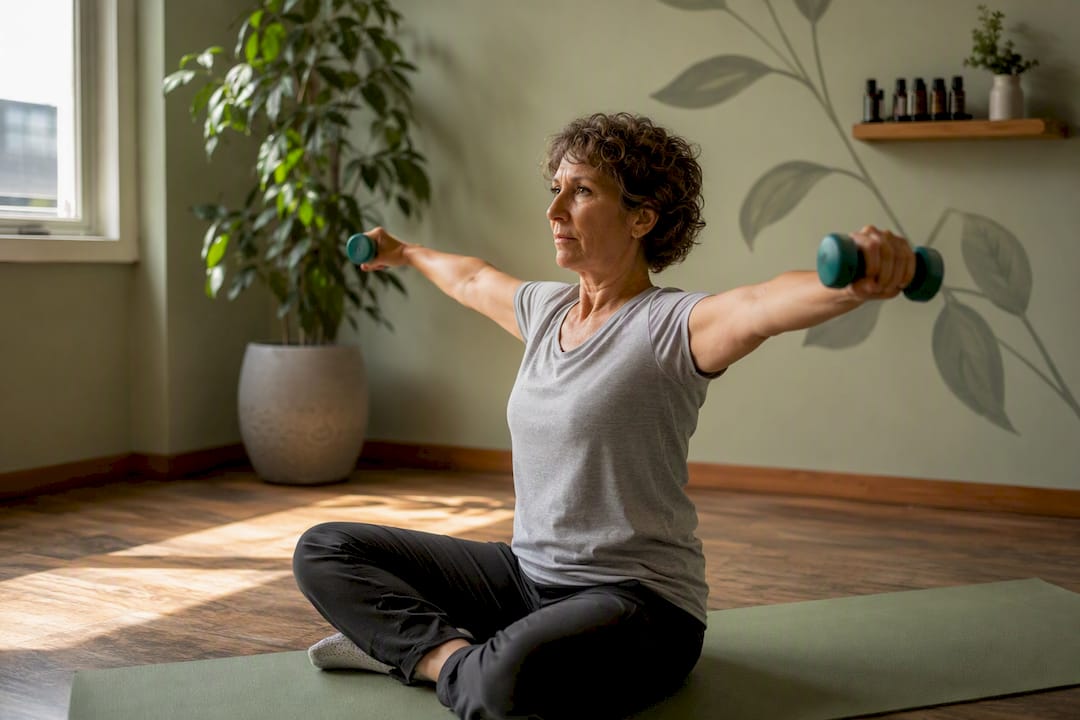
For most people with a rotator cuff injury, physical therapy is the right place to start, not a fallback after surgery fails. A 2-year study of 190 patients found that non-surgical and surgical treatment produced comparable functional improvement for the majority of patients, though surgery edged ahead on pain relief for certain full-thickness tears. That single finding reframes the whole conversation: rotator cuff physical therapy isn’t a consolation prize; it’s often the smartest first move.
Surgery tends to move to the front of the line in specific situations:
A full-thickness tear that hasn’t improved after 3 to 6 months of structured PT
Significant weakness that limits basic daily tasks like reaching overhead or lifting
A traumatic, acute tear in an active or younger patient
Imaging showing a tear that’s likely to worsen without repair
If none of those apply to you, your next move is simple: get evaluated by a physical therapist and begin protected motion under their guidance. Waiting rarely helps a shoulder injury; guided movement almost always does.
Key Takeaways
Rotator cuff physical therapy succeeds when a staged plan, protection, active-assisted motion, strengthening, and return to activity, is matched to objective milestones rather than a fixed calendar.
Point | Details |
PT is first-line | Most rotator cuff injuries respond to physical therapy before surgery becomes necessary. |
Phases beat timelines | Progress from protection to strengthening based on pain-free milestones, not just weeks passed. |
Watch for red flags | Worsening night pain, new numbness, or sudden weakness need prompt clinical evaluation. |
Adherence drives outcomes | Consistent home exercise completion predicts recovery more than any single exercise choice. |
CRS Wellness offers phased care | Contemporaryrehabservices provides in-person and virtual PT with insurance coverage across Nassau County and Queens. |
Table of Contents
What Are the Phases of Rotator Cuff Physical Therapy?
Rotator cuff rehabilitation isn’t one program, it’s four overlapping phases, each with its own goals, milestones, and rules for moving forward. Clinicians don’t advance you by the calendar alone. They advance you when your shoulder meets specific, measurable criteria, and consensus guidance like the ASSET statement on post-repair rehabilitation exists precisely so therapists don’t guess at that timing.
Protection and passive motion (roughly weeks 0 to 4 to 6): The priority is calming inflammation and protecting healing tissue while a therapist or you (with guidance) move the joint through a passive range. Active lifting is off the table.
Active-assisted motion (roughly weeks 4 to 12): You start contributing more of the movement yourself, with a wand, pulley, or the opposite arm assisting. Light isometric holds for the rotator cuff muscles often begin here.
Strengthening (roughly weeks 8 to 16, or 12+ after surgical repair): Resistance bands and light weights build endurance and strength in the rotator cuff and scapular stabilizers.
Return to activity (typically 4 to 6 months, sometimes up to a year for surgical repairs): Sport-specific or job-specific drills, higher-load strengthening, and functional testing before full clearance.
Phase | Typical timeline | Key milestone to progress |
Protection/passive | Weeks 0–6 | Pain-free passive range, minimal swelling |
Active-assisted | Weeks 4–12 | Active-assisted range near full, no substitution patterns |
Strengthening | Weeks 8–16+ | Pain-free resisted movement, improving strength ratios |
Return to activity | Months 4–12 | Strength within 90% of the uninjured side, task-specific tolerance |
These ranges shift based on tear size, tissue quality, and whether surgery was involved. Post-op protocols often keep patients in a sling through the first 4 to 6 weeks, according to documented rehabilitation timelines for arthroscopic repair, while non-surgical cases can often skip straight to active-assisted work within the first couple of weeks. Pain rules matter more than dates: if an exercise consistently spikes pain above a mild, short-lived level, your therapist holds you at that phase rather than pushing forward.
What Exercises Come First in Rotator Cuff Rehab?
The earliest phase of rotator cuff rehab exercises is about restoring safe motion, not building strength. Everything here should feel gentle. If it doesn’t, that’s your cue to stop and check in with your therapist.
Pendulum swings: Lean forward, let your arm hang, and use gentle body momentum to swing it in small circles or front-to-back arcs. No muscle effort in the shoulder itself.
Passive range of motion (PROM): A therapist, or your uninjured arm with a wand, moves the injured shoulder through flexion and external rotation without your rotator cuff muscles firing.
Scapular squeezes: Sit or stand tall, pull your shoulder blades gently toward each other, hold for 5 seconds, release. This wakes up the stabilizers around the shoulder blade without stressing the cuff.
Grip and elbow range of motion: Simple fist clenches and elbow bends keep the rest of the arm mobile while the shoulder itself stays protected.
Dosage in this phase is usually light and frequent: pendulum swings for 1 to 2 minutes, several times daily; PROM for 10 to 15 repetitions per direction, once or twice daily; scapular squeezes in sets of 10, a few times per day. Consistency beats intensity here.
Pro Tip: Keep a simple log of which exercises you did and how your shoulder felt afterward. Bring it to your next session. Therapists adjust your program faster when they can see a pattern instead of relying on your memory of “it hurt sometimes.”
Stop and call your therapist if you notice new sharp pain during passive movement, increasing swelling, or a sensation of the shoulder catching or giving way. Those aren’t normal adaptation signs.
How Do You Progress to Active Shoulder Movement?
Once passive motion is comfortable and your therapist clears you, usually somewhere between weeks 6 and 12, the goal shifts to doing more of the movement yourself and waking up the rotator cuff muscles at low loads. This is where frozen shoulder physical therapy and rotator cuff rehab often overlap in technique, since both need controlled active-assisted work before true strengthening begins.
Wand or pulley active-assisted range of motion (AAROM): Using a stick or overhead pulley, you actively guide the injured arm through flexion and abduction with help from the stronger arm or the pulley system.
Side-lying external rotation: Lying on your uninvolved side, elbow tucked at 90 degrees, you rotate the top arm upward against light resistance or gravity alone.
Prone rows: Leaning face-down on a table or bench, you pull the arm up and back, targeting the mid-back and rotator cuff stabilizers together.
Scapular stabilizer work: Wall slides and light rows reinforce the shoulder blade’s control, which the rotator cuff depends on for proper mechanics.
Form matters more than resistance right now. If you notice your shoulder hiking up toward your ear or your torso twisting to “help” the arm move, that’s compensation, and it usually means the load or range is too aggressive for where you are. Bands typically start at the lightest resistance level available and increase only when 15 to 20 repetitions feel controlled and pain-free. Consensus guidance recommends selecting exercises based on how much electrical activity they demand from the healing tissue, easing into isometric holds before introducing dynamic, isotonic loading, an approach detailed in the ASSET consensus framework.
Pro Tip: If a home exercise looks easy in a video but feels off in your own shoulder, don’t push through it. Ask your therapist to watch you do it in session. Small form errors compound over dozens of daily repetitions.
What Does Advanced Rotator Cuff Rehabilitation Look Like?
By week 12 or later, if your shoulder has met earlier milestones, the plan shifts toward building real strength, endurance, and the capacity to handle daily or athletic demands without flaring up.
Progressive resistance work: Bands and dumbbells increase in load gradually, targeting internal rotation, external rotation, and overhead pressing patterns as tolerated.
Closed-chain endurance drills: Wall push-ups and modified planks build stability through the shoulder girdle under sustained load.
Sport or job-specific progressions: For throwing athletes or laborers, this phase introduces graded plyometric or lifting drills that mimic real-world demands.
Functional and strength testing: Therapists commonly look for strength within roughly 90% of the uninjured side before clearing higher-demand activity, alongside pain-free performance on movements specific to your work or sport.
Maintenance after discharge usually means keeping 2 to 3 rotator cuff and scapular exercises in a weekly routine indefinitely, not just until symptoms disappear. Rotator cuff tissue doesn’t develop the same durability as before an injury overnight, and skipping post-op therapy or cutting it short raises the risk of stiffness and incomplete strength recovery, a pattern well documented in post-surgical rehabilitation literature. A short, boring maintenance routine beats a dramatic re-injury.
How Do You Manage Pain Safely During Rehab?
Some discomfort during rotator cuff rehab is expected. Mild, dull soreness that fades within a few hours, or by the next morning, usually just means your tissue is adapting. Sharp pain during a movement, pain that lingers or worsens over the following day, or pain that wakes you at night is a different signal entirely, and it means the exercise or load needs adjusting.
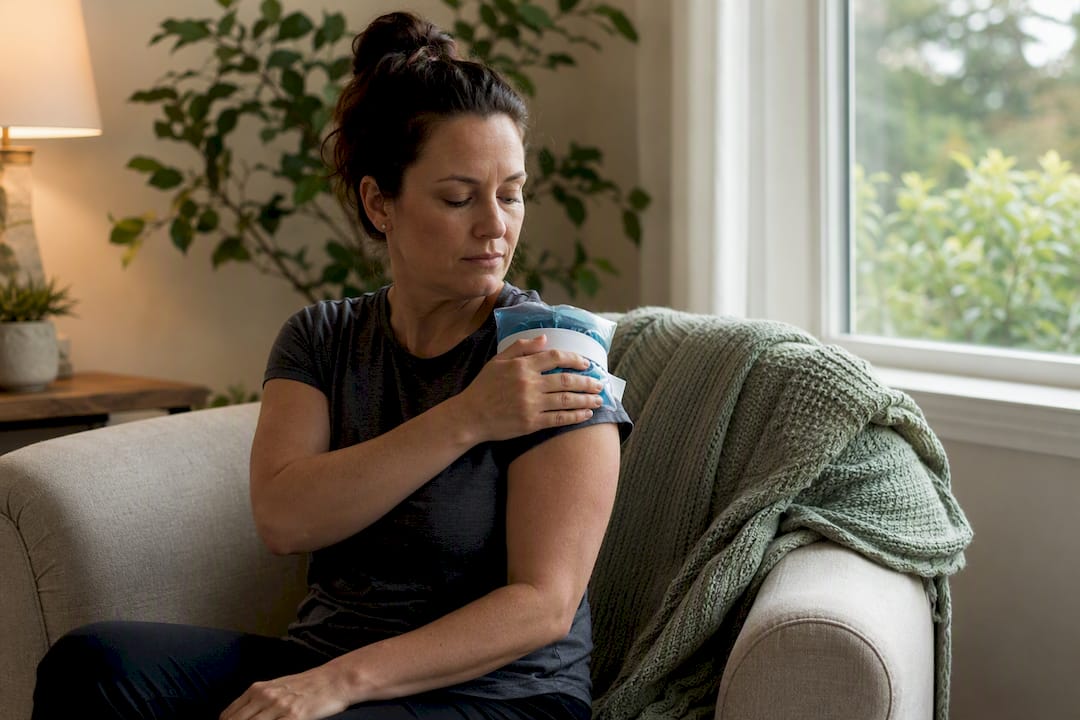
Ice after activity can calm an irritated shoulder, while heat before a session often loosens stiff tissue and makes range-of-motion work more comfortable. Over-the-counter medication and modalities like heat, ice, or occasionally guided taping can support the process, but they’re adjuncts, not the treatment itself. Real progress comes from the movement plan, and you can read more about how PT supports pain management without relying on medication as the primary strategy. Modifying daily activity, such as avoiding overhead reaching or heavy carrying, gives inflamed tissue room to settle without full inactivity.
Certain symptoms deserve prompt clinical attention rather than a wait-and-see approach:
Night pain that’s worsening rather than improving over several weeks
New numbness, tingling, or weakness spreading down the arm
A sudden loss of the ability to lift the arm after previously being able to
Swelling, warmth, or fever alongside shoulder pain
If you’re unsure whether soreness after a session is normal, that uncertainty itself is worth raising, and understanding what post-treatment pain typically feels like can help you tell the difference before it becomes a bigger question.
Should You Choose Physical Therapy or Surgery?
The honest answer is that the evidence doesn’t point to one universal winner. Systematic reviews comparing surgical and non-surgical treatment for rotator cuff disease have repeatedly found no consistent superiority for either approach, with many outcome differences falling below what’s considered clinically meaningful.
The clearest signal across the research isn’t “surgery wins” or “PT wins.” It’s that for many patients, both paths lead to similar functional outcomes, and the decision should hinge on tear size, symptom severity, and what matters most to the individual patient.
Where surgery earns its place is with full-thickness tears that haven’t responded to a genuine trial of conservative care, or when pain reduction specifically is the priority and imaging supports a repair. Even then, the work isn’t over once surgery happens. Post-operative outcomes depend heavily on committed rehab, often stretching from 4 to 6 weeks of protection through 6 to 12 months of progressive strengthening. If you go the surgical route, expect the real recovery timeline to be measured in months, not weeks, and expect PT to be just as central afterward as it would have been on its own.
How Do You Get the Most Out of Physical Therapy?
A well-designed program only works if you actually do it. Adherence to the home exercise program is one of the strongest predictors of a good outcome, according to clinical consensus among rehabilitation professionals, more so than which specific exercises land on your sheet.
Build a home program you’ll actually finish. Ten focused minutes done daily beats a 30-minute routine you skip three days a week. Ask your therapist to trim your list if it feels unrealistic.
Track what you do. A simple notebook or phone note logging sets, reps, and pain levels turns vague memory into useful data for your therapist, and structured checklists make this easier to maintain.
Ask specific questions at each visit. What’s my current milestone? What movements should I still avoid? What number or test tells us I’m ready for the next phase?
Use telehealth sessions deliberately. Have your resistance bands, a mirror, and good lighting ready so your therapist can actually see your form, not just hear you describe it.
Small adjustments to how you prepare for and structure your sessions often move the needle more than any single exercise swap.
What Evidence Guides CRS Wellness’s Rehab Approach?
CRS Wellness, the clinical team behind Contemporaryrehabservices, builds every rotator cuff plan around staged progression rather than a fixed calendar. That approach isn’t a house style, it follows published consensus guidance.
Recovery timelines vary by tear size, tissue quality, and patient goals, but the sequence, protect first, restore motion second, build strength third, stays consistent across the evidence.
The clinic’s protocols draw on:
The ASSET consensus statement for staged progression and exercise selection after repair
Peer-reviewed comparisons of surgical versus non-surgical outcomes to set realistic patient expectations
Documented post-operative timelines for pacing milestone-based progression
A grounded note on shoulder recovery
Rotator cuff recovery rarely moves in a straight line, and that’s normal, not a setback. Most patients see steady, if uneven, progress across months rather than weeks. If your shoulder isn’t tracking the way this article describes, that’s exactly the conversation to bring to a clinician who can adjust your specific plan.
— CRS Wellness
Getting started with Contemporary Rehab Services
Contemporaryrehabservices gives you something a generic exercise sheet can’t: a licensed therapist who adjusts your rotator cuff program in real time, in person or by video, based on how your shoulder actually responds week to week. The practice offers both in-person and virtual sessions covering manual therapy, joint mobilization, neuromuscular re-education, and individualized rehab programs, and it accepts Medicare, Aetna, Cigna, Emblem, and United Healthcare, along with direct payment.
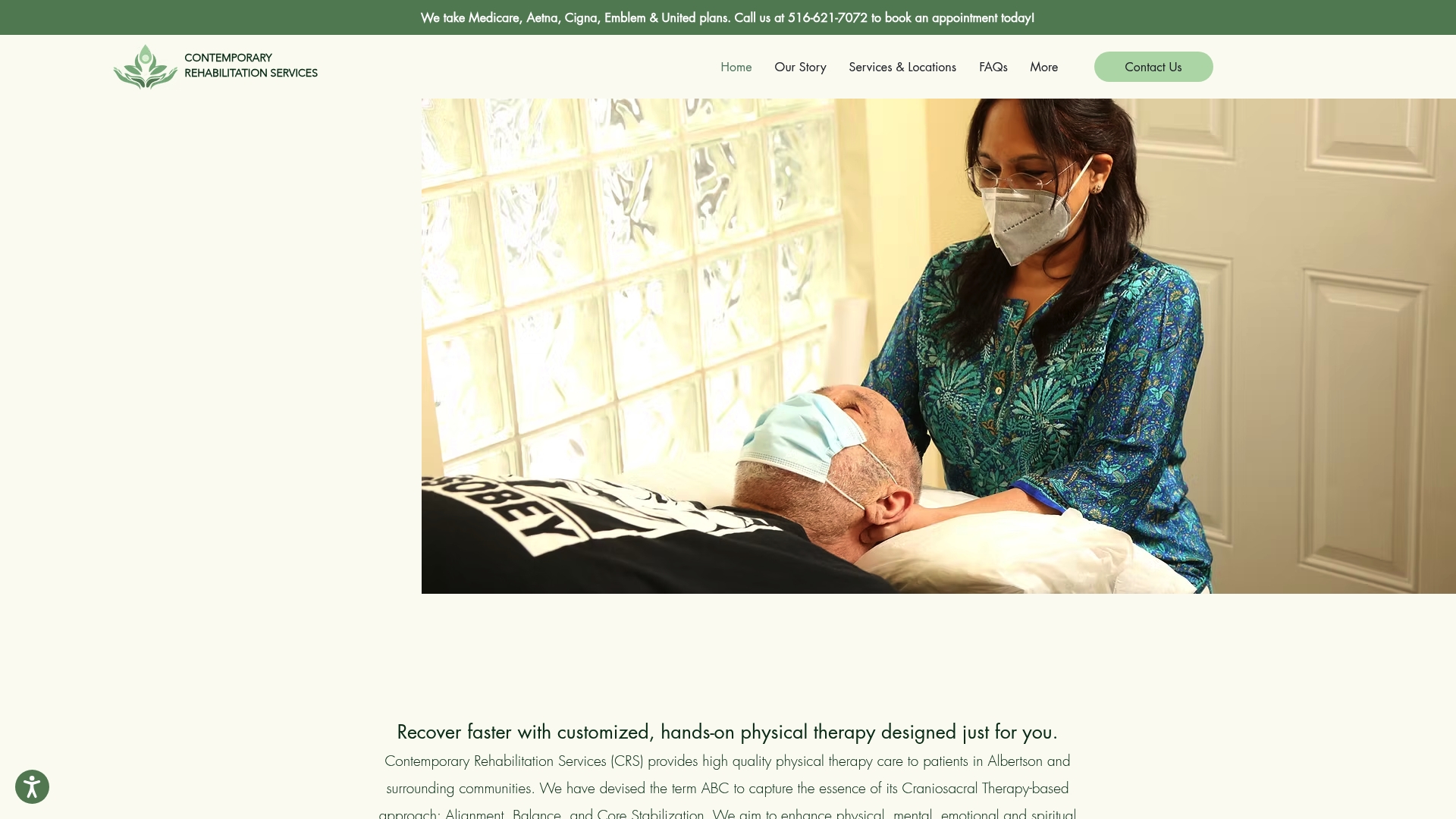
At your first visit, expect a hands-on assessment of your shoulder’s range, strength, and movement patterns, followed by a phased plan built around your specific tear type or diagnosis, whether that’s a rotator cuff issue, adhesive capsulitis, or a herniated disc affecting shoulder mechanics. You’ll leave with clear milestones instead of a generic handout. If you’re near Albertson, NY, or anywhere across Nassau County or Queens, you can review the full range of treatment options or book directly through the Albertson clinic page to get an evaluation on the calendar.
Sources
This article is general information, not a substitute for advice from a qualified doctor. Consult a qualified healthcare professional about your own circumstances before acting on anything here.
Recommended
Comments