
Guideline Backed, Phase Based Shoulder Pain Physical Therapy

Physical therapy is the best first-line treatment for most shoulder pain, and the cornerstone is progressive, exercise-based rehabilitation that restores scapular control and rotator cuff strength. Manual therapy, ice, heat, and other short-term adjuncts can ease symptoms along the way, but they support the active work rather than replace it. For the vast majority of people with rotator cuff pain, impingement, or a stiff, guarded shoulder, this is the path that gets you moving again.
TL;DR:
Most shoulder pain benefits from a structured, exercise-based rehabilitation approach focusing on scapular control and rotator cuff strengthening, not passive treatments alone.
Rehabilitative exercises are phased, starting with gentle mobility, then activation, strengthening, and finally sport- or work-specific movements, guided by pain levels.
Recovery times range from 2 to 6 weeks for rotator cuff injuries to several months for frozen shoulder, with adherence and addressing underlying issues being crucial.
Manual therapy and modalities support active rehab but do not replace it, and short-term injections are only a temporary aid to participate in therapy.
Early evaluation and consistent participation are key to faster, more complete shoulder recovery, with urgent medical attention required for red-flag symptoms.
Table of Contents
What Does Shoulder Pain Physical Therapy Actually Treat?
Not every shoulder problem responds the same way, but the list of conditions that improve with structured shoulder pain physical therapy is longer than most people expect. Rotator cuff related pain sits at the top of it, followed closely by subacromial impingement, adhesive capsulitis (frozen shoulder), shoulder instability, acromioclavicular joint irritation, and biceps tendinopathy. These conditions share a common thread: the muscles and connective tissue around the joint have lost coordination, strength, or mobility, and a therapist’s job is to rebuild all three.
The evidence backing this approach is not thin. A clinical practice guideline on rotator cuff tendinopathy recommends progressive exercise and patient education as first-line care, and specifically cautions against leaning too heavily on passive treatments. A narrative review of non-operative shoulder management goes further, concluding that exercise-based rehabilitation is the cornerstone across nearly every major shoulder pathology and can produce results comparable to surgery for some subacromial disorders. That is a striking claim for a treatment that costs a fraction of an operating room.
Education and activity modification round out the picture. A therapist doesn’t just hand you a band and a sheet of exercises. Part of the job is explaining which movements are aggravating the tissue, which ones are safe, and how to adjust your daily habits, whether that’s how you reach overhead at work or how you sleep, so the shoulder gets a chance to calm down while you rebuild it.
Conditions that respond well to a structured PT program include:
Rotator cuff related shoulder pain, from mild tendinopathy to partial tears
Subacromial impingement syndrome
Adhesive capsulitis (frozen shoulder), particularly in its early and middle stages
Shoulder instability following a subluxation or dislocation
Acromioclavicular (AC) joint pathology
Biceps tendinopathy, often alongside rotator cuff involvement
The Core Components of a Shoulder Rehab Program
A well-built shoulder pain treatment plan is not one thing. It is a sequence of decisions a therapist makes based on what your shoulder can tolerate today versus six weeks from now.
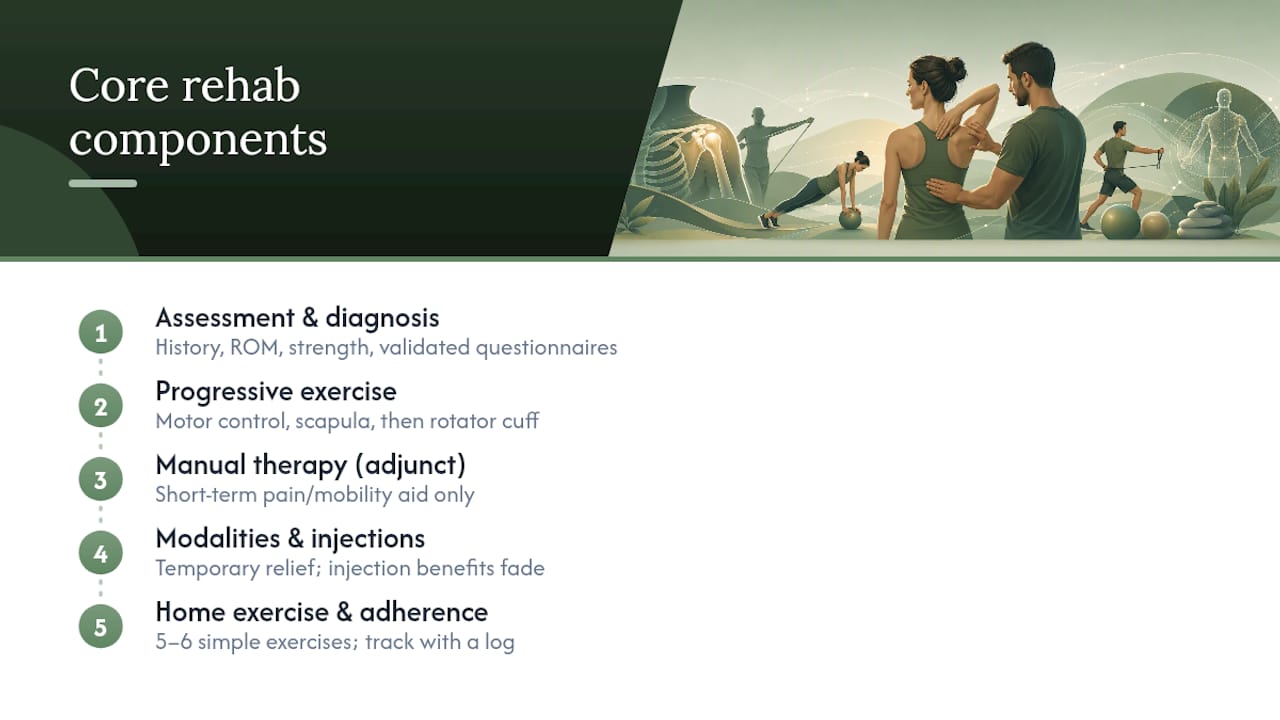
1. Assessment and diagnosis. Every effective program starts with a detailed evaluation: your history of pain and injury, a functional movement screen, and objective measurements of range of motion and strength. Guidelines call for validated outcome questionnaires, not just a therapist’s impression, because tracking numbers over time shows whether the plan is working or needs to change. This assessment also screens for red flags that would point toward imaging or a specialist referral instead of PT alone.
2. Progressive exercise therapy. This is the engine of recovery. Therapists build programs around motor control and scapular stabilization first, then layer in rotator cuff strengthening as tolerance improves. Load progresses in small, deliberate steps, more repetitions before more resistance, then more resistance before more range, because jumping straight to heavy loading on an irritated shoulder tends to backfire.
3. Manual therapy as an adjunct. Joint mobilization, soft tissue work, and similar hands-on techniques can reduce pain and improve short-term mobility, which makes it easier to perform the active exercises that actually drive long-term change. A network meta-analysis of 54 studies covering nearly 3,900 participants found that shoulder-specific exercise reduced pain for up to 52 weeks, while adding manual therapy or other adjuncts provided only marginal extra benefit. Manual therapy earns its place, but as a supporting act.
4. Modalities and injections. Heat, ice, electrical stimulation, and ultrasound can take the edge off pain during a flare, and short-term corticosteroid injections can buy someone weeks to months of relief that makes participating in rehab far more tolerable. The same narrative review notes that injection benefits tend to diminish over time, which is why repeated injections without reassessment are discouraged. These tools create a window; the exercise work is what you do inside that window.
5. Home exercise program design and adherence. The plan you do three times a week in the clinic matters less than the plan you do consistently at home. Therapists design home programs that are specific enough to matter but simple enough to stick with, usually five or six exercises rather than fifteen.
Pro Tip: Keep a simple log of your home exercises, even just checkmarks on a calendar. Therapists routinely find that patients who track adherence progress faster, because gaps in the program become obvious before they turn into setbacks.
Which Shoulder Exercises Actually Get Prescribed?
The exercises themselves follow a phase-based logic, and understanding the sequence helps you make sense of why your therapist won’t hand you a resistance band on day one.
Phase 1: Early mobility (pain-limited). When the shoulder is angry, the goal is gentle motion without provoking symptoms. The pendulum exercise, where you lean forward and let your arm swing loosely in small circles, is a staple here because gravity does the work instead of your muscles. Passive range of motion, sometimes with a caregiver or the opposite arm assisting, and gentle scapular mobility drills round out this stage. A doorway stretch, standing in a doorframe with your forearm against the frame and gently rotating your body forward, helps restore stretch to the anterior shoulder without loading the rotator cuff directly.
Phase 2: Activation and isometrics. Once acute pain settles, the focus shifts to waking up the muscles that stabilize the shoulder blade. Scapular squeezes, pinching your shoulder blades together and holding, and submaximal isometric holds in multiple directions (pushing gently into a wall or a therapist’s hand without moving the joint) rebuild neuromuscular control without aggravating irritated tissue.
Phase 3: Progressive strengthening. This is where visible strength gains happen. Resisted external rotation with a band, seated or standing rows, and prone horizontal abduction (lying face down and lifting the arm out to the side) target the rotator cuff and scapular stabilizers directly. Load increases gradually: more resistance band tension, then added dumbbell weight, then higher volume, always guided by whether pain stays at a manageable level during and after the session.
Phase 4: Advanced loading and return to activity. For athletes, laborers, or anyone whose job demands overhead reaching, this phase adds sport- or work-specific drills, plyometric loading, and higher-velocity movement patterns that mimic real-world demands.
Here is a general progression sequence therapists use as a guide:
Establish pain-free range of motion with pendulums and assisted stretches.
Introduce scapular activation and low-level isometrics once irritability drops.
Add resistance band and light dumbbell work for rotator cuff and scapular muscles.
Increase load and complexity as strength and control improve.
Layer in activity-specific or sport-specific movement patterns before full return.
Guideline-based rehab consistently identifies scapular stabilization and progressive rotator cuff strengthening as the two elements most tied to clinically meaningful improvement, more than any single passive treatment.
Progression should be pain-guided, not calendar-guided. A useful rule many therapists teach patients: mild discomfort during an exercise that settles within an hour is acceptable; pain that lingers into the next day, or sharp pain during the movement itself, means you back off the load or range and reassess. Stop and check in with your therapist if you notice new numbness, tingling down the arm, or a sudden loss of strength, since those signs suggest something beyond simple muscular fatigue.
How Long Does Shoulder Pain Recovery Take?
Most people notice meaningful change faster than they expect, but full recovery is a longer arc than a quick fix. For rotator cuff related pain and impingement, patients typically report noticeable improvement in pain within 2 to 6 weeks of starting a structured program, with meaningful gains in strength and function by 6 to 12 weeks. Adhesive capsulitis runs on a different clock entirely. Because frozen shoulder involves capsular tightening rather than just muscle weakness, recovery often stretches into several months, with mobilization and stretching layered in stages as the joint slowly regains range.
Several factors can slow this timeline:
Chronic symptoms present for many months before starting PT tend to take longer to resolve than acute injuries.
Comorbidities like diabetes are strongly associated with adhesive capsulitis and can extend its course.
Inconsistent adherence to the home exercise program is one of the most common reasons progress stalls.
Psychosocial factors, including fear of movement or high stress levels, can slow functional recovery even when tissue healing is on track.
Short-term adjuncts like corticosteroid injections play a specific timing role in this process: they are often used early, when pain is limiting participation, to create a window where a patient can tolerate the active exercise that drives lasting change. Used that way, an injection is not competing with physical therapy for shoulder pain, it is clearing a path toward it.
When Should You See a Physical Therapist for Shoulder Pain?
Start physical therapy when shoulder pain limits your daily activity, persists beyond a couple of weeks, or interferes with sleep and work. Waiting it out rarely helps a shoulder problem; movement quality tends to get worse the longer compensations set in, since the body finds workaround patterns that create new problems elsewhere.
Certain symptoms call for urgent medical evaluation before, or alongside, starting PT:
Suspected fracture, such as pain after a fall or direct impact with visible deformity or inability to move the arm.
Signs of infection, including fever, redness, or warmth around the joint.
Progressive neurological deficit, like worsening weakness or numbness spreading down the arm.
Systemic symptoms such as unexplained weight loss or night sweats alongside shoulder pain.
Referral for imaging or a surgical opinion typically comes into play after 8 to 12 weeks of appropriate nonsurgical care that hasn’t produced meaningful change, or when there’s objective, progressive weakness or recurrent instability episodes. If you’re unsure whether your shoulder falls into the “wait and see” category or the “get evaluated now” category, these signs are worth reviewing before you decide.
How Contemporary Rehab Services Approaches Shoulder Rehab
The clinic builds its shoulder programs around what the guidelines above actually recommend: individualized assessment first, then progressive, exercise-focused rehabilitation, with manual therapy used deliberately as a supporting tool rather than the whole plan. That structure is part of what the clinic calls its ABC Approach, blending hands-on techniques like joint mobilization and myofascial work with the active strengthening that guideline evidence points to as the real driver of recovery.
Patients can access this care in person or through telehealth PT sessions, and insurance coverage may be accepted along with direct cash payment. For a look at how a phased rotator cuff plan unfolds week by week, the clinic’s rotator cuff rehab roadmap breaks down what to expect at each stage.
What the Evidence Gets Right (and What Patients Get Wrong)
The biggest misstep patients make isn’t skipping physical therapy. It’s treating manual therapy, ice, or a single injection as the treatment itself instead of the on-ramp to active rehab. The second most common misstep runs the opposite direction: loading a still irritated shoulder too aggressively because progress feels slow. Both mistakes come from the same place, wanting a shortcut that doesn’t exist. The shoulders that recover fastest belong to patients who show up consistently for unglamorous scapular work and treat their home program as non negotiable homework. Seek evaluation early rather than waiting for pain to become disability. The guideline evidence is consistent on this point, even when it’s not what patients want to hear.
— CRS Wellness
Ready to Start Your Shoulder Recovery?
If you’re weighing whether to power through shoulder pain on your own or get a professional evaluation, the honest answer is that a proper assessment saves you months of guesswork. The clinic offers in-person and telehealth PT sessions built around a guideline-backed progression, plus manual therapy options like craniosacral therapy, myofascial therapy, joint mobilization, and neuromuscular re-education when additional support is needed alongside the active work.
Insurance coverage may help make access easier, with various plans often accepted. Booking begins with a straightforward evaluation of your range of motion, strength, and pain patterns, the same objective measures the clinical guidelines call for, so your plan is built around your shoulder rather than a generic template. Explore the full range of manual therapy services available alongside your rehab program, or visit the Contemporaryrehabservices site to schedule your first session and get a plan moving in the right direction.
This article is general information, not a substitute for advice from a qualified doctor. Consult a qualified healthcare professional about your own circumstances before acting on anything here.
Sources
FAQ
What Are Some Good Exercises for a Painful Shoulder?
Pendulum swings, doorway stretches, and gentle scapular squeezes are commonly prescribed in the early stages because they restore motion without heavy loading. As pain settles, resisted external rotation with a band and prone horizontal abduction help rebuild rotator cuff strength.
Does Physical Therapy Really Help Shoulder Pain?
Yes. Clinical practice guidelines and reviews consistently identify exercise-based rehabilitation as first-line care for most shoulder conditions, often producing outcomes comparable to surgery for some subacromial disorders. Most patients notice improvement within 2 to 6 weeks of starting a structured program.
What Is Better for a Sore Shoulder, Ice or Heat?
Ice tends to work best for acute flares and swelling, while heat can loosen stiff, guarded muscles before exercise. Neither replaces active rehab. They are short-term tools that make it easier to do the strengthening work that actually drives recovery.
What Helps Severe Shoulder Pain?
Severe or persistent shoulder pain usually needs a combination approach: an assessment to rule out red flags, short-term relief through ice, heat, or in some cases a corticosteroid injection, and a progressive exercise program to address the underlying weakness or stiffness. Contemporaryrehabservices builds this kind of individualized plan starting with an evaluation of your range of motion and strength.
Recommended
Comments