
Clinic Backed TENS vs EMS: TENS for Pain, EMS for Muscle
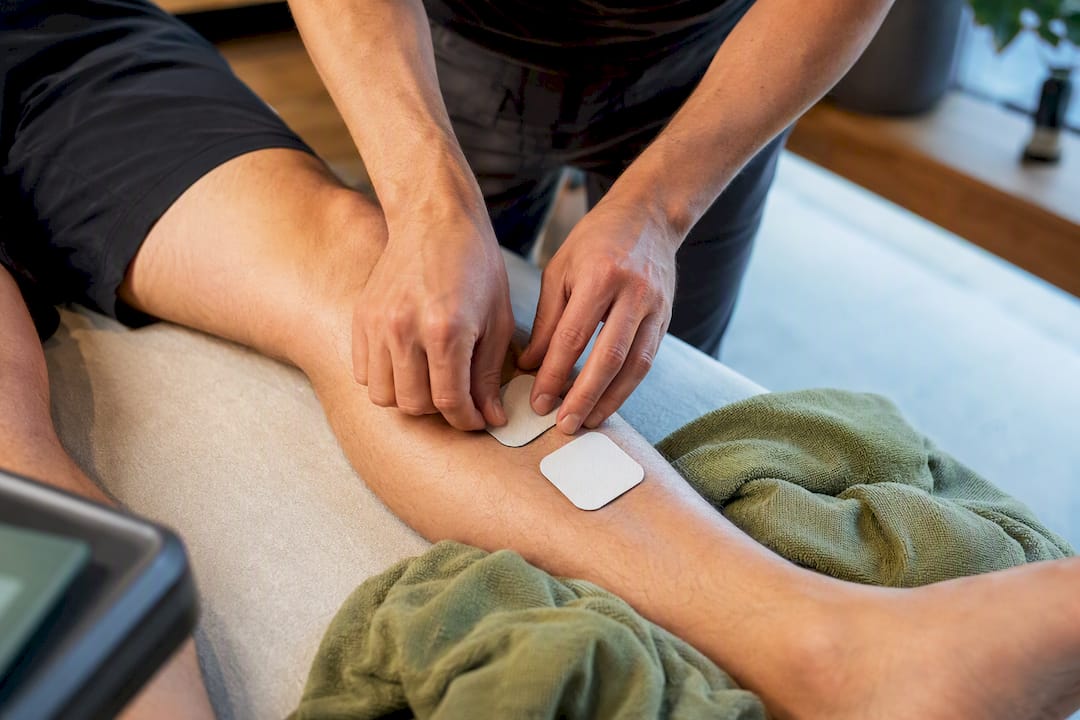
TENS calms pain by stimulating sensory nerves, producing a tingling sensation with no muscle movement. EMS stimulates motor nerves to create visible muscle contractions for strengthening or rehabilitation. Choose TENS when you need symptom relief; choose EMS when the goal is muscle activation or recovery after injury, and check with a clinician before using rehab-grade EMS on your own.
TL;DR:
TENS targets sensory nerves to relieve pain without causing muscle contractions, making it suitable for symptom management rather than tissue repair or muscle strengthening.
EMS stimulates motor nerves to produce muscle contractions, often used after surgery or injury for muscle re-education, but does not cause fat loss or significant body shaping.
Clinical EMS devices generally require higher current and proper placement over motor points, while TENS electrodes are placed along nerve or referral zones to target pain pathways.
Evidence shows TENS provides small, short-term pain relief, whereas EMS may improve pain and muscle function more effectively in targeted contexts, though results vary.
Home devices are affordable but less customizable; supervised clinical sessions offer tailored settings and placement adjustments crucial for effective and safe treatment.
Table of Contents
TENS vs EMS: What Is EMS and How Does Muscle Stimulation Work?
How Do Clinics Like CRS Wellness Actually Use These Modalities?
Do TENS and EMS Devices Really Differ in Hardware and Electrode Placement?
What Do TENS and EMS Devices Cost, and Where Can You Get Them?
Get Supervised TENS or EMS Care Through Contemporaryrehabservices
TENS vs EMS: What Is TENS and How Does It Work?
TENS, short for transcutaneous electrical nerve stimulation, works on your sensory nerves rather than your muscles. The current interrupts pain signals traveling to your brain, a mechanism often explained through gate-control theory, and can trigger a modest release of your body’s own pain-blocking chemicals. You will feel tingling, buzzing, or a light pins-and-needles sensation. There is no contraction, according to Healthline’s comparison of the two therapies.
Sessions typically run from several minutes to longer durations, and settings vary depending on the goal.
Conventional (high-frequency) TENS: fast pulses, comfortable tingling, used for quick, short-term pain relief.
Low-frequency (acupuncture-like) TENS: slower pulses, stronger sensation, sometimes preferred for deeper or more persistent pain.
Burst mode: pulses grouped in bursts, a middle ground some patients tolerate better.
TENS manages symptoms but does not repair tissue, correct posture faults, or fix the underlying mechanical problem causing your pain, so it works best alongside other care, not instead of it.
TENS vs EMS: What Is EMS and How Does Muscle Stimulation Work?
EMS, or electrical muscle stimulation, targets motor nerves instead of sensory ones. The current recruits muscle fibers directly, producing a contraction you can see and feel. That is the core physiological line separating TENS vs EMS: one calms nerves, the other moves muscle.
Clinical EMS, often called neuromuscular electrical stimulation (NMES), typically uses these parameters:
Frequency: commonly 35 to 80 Hz for strengthening protocols.
Pulse pattern: on/off cycles (contraction, then rest) to avoid fatigue.
Intensity: dialed up until a strong, tolerable contraction appears, not just a tingle.
Clinicians reach for EMS after surgery to re-educate a muscle that has “forgotten” how to fire, to slow atrophy in an immobilized limb, or to calm muscle spasm. What EMS will not reliably do is melt fat or reshape your body: the FDA notes that no EMS devices have been cleared for weight loss or significant girth reduction, despite what plenty of ab-belt ads imply.
How Do TENS and EMS Compare on Settings and Results?
The clearest way to separate these two therapies is by what they target and what you feel. TENS works on sensory nerves and produces tingling with no movement. EMS works on motor nerves and produces a visible or palpable contraction, a distinction confirmed across comparisons of the two e-stim therapies.
Feature | TENS | EMS |
Nerve target | Sensory | Motor |
Sensation | Tingling, buzzing | Muscle contraction |
Typical frequency | in a broad low to high range | commonly mid-frequency ranges |
Primary goal | Pain relief | Muscle activation/strength |
Visible effect | None | Yes |
A few practical differences matter beyond the numbers:
Pulse width and intensity shape how deep the current travels; EMS generally needs more amplitude to reach and recruit muscle fibers.
Combo devices that offer both modes vary widely in quality. Cheaper units often underdeliver on true EMS contraction strength even when they promise both functions.
Decision heuristic: if you want relief from an ache, reach for TENS. If you want to wake up or strengthen a muscle, EMS is the tool suited to that job.
When Do Clinicians Choose TENS, EMS, or Both?
Physical therapists rarely see these as competing options. They see them as tools for different problems, and the choice usually follows a simple pattern:
Chronic or acute pain with no structural weakness: TENS as an adjunct alongside manual therapy or exercise, not as the main event.
Post-surgical or immobilized muscle that will not fire on command: EMS for re-education, often paired with active movement as strength returns.
Pain plus inhibited muscle activation (a common combo after knee surgery, for example): TENS first for immediate comfort, then EMS to help the muscle engage during rehab exercises.
Spasm or guarding limiting range of motion: EMS or TENS depending on whether the goal is relaxation or activation.
If you are experimenting at home, keep sessions short, log how you respond, and hold modest expectations. E-stim supports a rehab plan; it rarely replaces one. For a broader look at how these tools fit into hands-on care, this guide to physical therapy for chronic neck and back pain walks through the multimodal approach clinicians typically build around TENS.
Does the Research Actually Support TENS and EMS?
The evidence for TENS is genuinely mixed. One meta-analysis on chronic low back pain found pain relief of less than one point on a 1 to 10 scale, and researchers describe the overall quality of TENS studies as inconsistent. That does not mean TENS is worthless. It means the effect tends to be small and short-lived rather than a durable fix, and patients often report immediate relief that fades once the unit turns off.
EMS fares somewhat better in targeted contexts. A randomized trial pairing EMS with active stretching found significant, immediate improvements in pain intensity and pressure pain threshold for myofascial trigger points, outperforming both a sham treatment and TENS on those short-term measures. Broader reviews of transcutaneous electrotherapies similarly find EMS outperforms passive controls for pain, though it does not always beat active exercise alone.
Why do studies disagree so often? Three reasons keep surfacing:
Stimulation parameters vary wildly between trials, making comparisons unreliable.
Sample sizes tend to be small.
Study endpoints differ; some measure pain, others measure function, others measure strength.
The realistic takeaway: expect e-stim to help you tolerate or accelerate a broader rehab plan, not to cure the underlying issue by itself.
Is TENS or EMS Safe for You? What the FDA Says
Most people tolerate TENS and EMS well, but the risks are real enough to respect. Skin irritation and mild burns show up most often, usually from electrodes left in one spot too long or intensity set too high for the skin underneath. Placing pads incorrectly over an implanted device is a separate and more serious concern.
You should skip electrical stimulation, or use it only under direct clinician guidance, if you have:
A pacemaker or implantable cardioverter defibrillator (ICD).
Active infection, open wounds, or unhealed skin at the placement site.
Certain pregnancy considerations, particularly placements over the abdomen or lower back.
Epilepsy or a history of seizures, without medical clearance first.
In the United States, EMS devices fall under FDA oversight, and many clinical-grade EMS units are intended for use under a healthcare professional, while over-the-counter versions carry narrower, consumer-level claims. That regulatory gap is exactly where marketing tends to overpromise.
Pro Tip: Before buying any device, look up its FDA clearance and read the actual intended use statement, not just the box copy. If a product promises fat loss or dramatic body reshaping from EMS alone, that claim is not supported.
How Should You Decide Between TENS and EMS?
Start with your goal, not the device aisle. Follow this sequence before you spend a dollar:
Identify the problem. Persistent ache with no weakness points toward TENS. A muscle that will not activate after injury or surgery points toward EMS.
Check for red flags. Structural injury, recent surgery, or a suspected tear means a professional assessment comes first, not a home unit.
Ask the right questions of any clinician or vendor: What is this device cleared for? What parameters do you recommend for my situation? What is the return policy if it does not help?
Start conservative. Short sessions, moderate intensity, and a simple log of what changed and what did not.
Pro Tip: If you are unsure whether your pain is coming from a joint, a nerve, or a muscle imbalance, that uncertainty itself is a sign to book an evaluation rather than guess with a home unit. Supervised dosing lets a therapist adjust frequency, placement, and intensity in ways an OTC device’s preset programs cannot.
How Do Clinics Like CRS Wellness Actually Use These Modalities?
In a real rehab plan, e-stim rarely stands alone. A typical visit follows assessment, then a modality like TENS or EMS to manage pain or wake up a muscle, then active exercise and manual therapy, then reassessment to see what actually changed.
TENS often opens a session to reduce guarding before manual work begins.
EMS supports muscle re-education once acute pain has settled enough to tolerate contraction.
Progress gets tracked visit to visit, not assumed from the modality alone.
The availability of insurance coverage can remove barriers for patients who might otherwise skip supervised care in favor of a home unit alone.
Where Did TENS and EMS Technology Come From?
Electrical stimulation for pain and muscle control is older than most people assume. Ancient physicians reportedly used electric fish for pain relief, but the modern story starts in the 20th century with research into nerve conduction and muscle physiology. Gate-control theory, published by Melzack and Wall in 1965, gave TENS its scientific foundation by explaining how non-painful input could block pain signals at the spinal cord level. Commercial TENS units followed in the 1970s, initially built to test whether patients would tolerate implanted stimulators before surgery, then adopted as a standalone therapy once clinicians noticed it worked on its own.
EMS traces back further in concept, since researchers have manipulated nerve and muscle tissue with electricity since the 18th century, but clinical NMES protocols matured alongside sports medicine and post-surgical rehab in the latter half of the 20th century. “Russian stimulation” protocols, developed for athletic training, popularized the on/off contraction cycling still used in clinics today.
Devices have shrunk dramatically since then. What once required bulky, clinic-only equipment now fits in a pocket, with programmable waveforms and app-connected settings. That miniaturization is also what opened the door to a crowded consumer market, one where marketing claims often outpace what the hardware, or the underlying research, actually supports.
Do TENS and EMS Devices Really Differ in Hardware and Electrode Placement?
Yes, and the differences go beyond the label on the box. EMS units generally need to deliver more current and sustain a broader pulse width to recruit enough motor fibers for a visible contraction. TENS units are built to stay comfortable at lower intensities for longer stretches, since the goal is sensory input, not muscle work. A device engineered for one job rarely excels at the other, which is why cheap combo units often disappoint on the EMS side even when the TENS mode feels fine.
Electrode placement matters just as much as the device itself. For EMS, the standard approach places one electrode (the cathode) over the muscle’s motor point, the spot where a small current produces the biggest contraction, with the second electrode placed proximally along the same muscle belly. Get this wrong and you will need far more intensity to achieve the same contraction, which raises discomfort and skin irritation risk for no added benefit.
TENS placement follows different logic entirely. Instead of chasing a motor point, you target dermatome lines, the skin regions tied to specific spinal nerve roots, or the direct pain referral pattern itself. Placing pads along the path pain radiates, rather than only at the point it hurts most, often improves results.
This is also where a clinician’s eye adds real value. Contemporaryrehabservices’ guide to common physical therapy modalities covers how placement decisions get made in practice, something a printed instruction sheet in a home unit’s box cannot fully replicate.
What Do People Get Wrong About TENS and EMS?
A few myths persist stubbornly enough that they deserve direct correction.
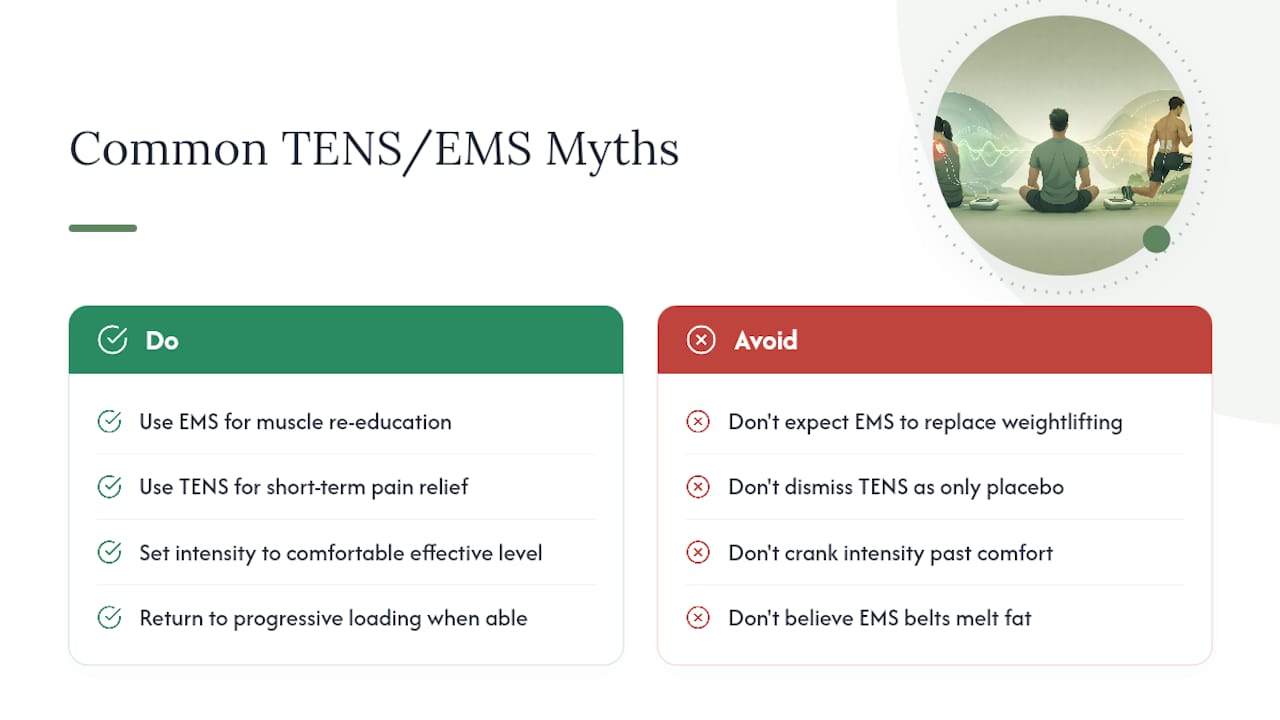
Myth: EMS builds muscle the way weightlifting does. EMS activates fibers, which helps with re-education and slowing atrophy, but it does not replicate the full metabolic and mechanical stimulus of voluntary resistance training. It supports strength recovery; it does not substitute for progressive loading once you are able to exercise normally again.
Myth: TENS is a placebo with nothing behind it. The evidence for long-term relief is genuinely weak, but short-term pain reduction shows up often enough in trials that dismissing TENS entirely overstates the case in the other direction.
Myth: stronger intensity always works better. Both modalities have a point of diminishing return. Cranking EMS intensity past what a muscle can comfortably contract against just adds discomfort and irritation risk, not extra benefit.
Myth: EMS belts melt fat. This is the most persistent myth of all, and regulators have been explicit that it is not supported.
Myth: TENS and EMS are interchangeable “e-stim” settings on the same dial. They target different nerve types entirely. A device that only tingles is not going to produce the contraction EMS is meant to deliver, no matter how high you turn the intensity.
What Side Effects Should You Watch For?
Most side effects with TENS and EMS are minor and preventable with basic care. Skin irritation under the electrodes is the most common complaint, usually from adhesive sensitivity, prolonged wear at one site, or pads that have dried out and lost proper conductivity. Rotating pad placement slightly between sessions and replacing electrodes once they stop adhering well cuts this risk substantially.
Burns are rarer but more serious, and they typically trace back to intensity set too high, a moist pad creating an uneven current path, or a unit left running unattended for far longer than intended. Keep sessions within the recommended window, usually 15 to 40 minutes, and never fall asleep with a unit still active.
Muscle soreness after EMS sessions is normal, similar to the soreness that follows unfamiliar exercise, and it usually resolves within a day or two. Soreness that intensifies or lingers longer than that is a signal to dial back intensity or frequency rather than push through it.
A few best practices lower risk across both modalities:
Start at the lowest intensity that produces the intended sensation, then adjust gradually.
Check skin at the electrode sites before and after each session.
Avoid placement directly over broken skin, active infection, or implanted medical devices.
Give skin a rest day between sessions if irritation appears.
If you are managing pain alongside another electro-based therapy, it is worth understanding how different modalities interact; this overview of PEMF therapy benefits covers a related but distinct approach and where its safety considerations overlap with e-stim.
What Do TENS and EMS Devices Cost, and Where Can You Get Them?
Home TENS units sit at the affordable end of the market, with basic dual-channel models widely available at pharmacies and general retailers. EMS units marketed for consumer use span a wider range, and combo devices claiming both functions vary enormously in build quality, as noted earlier: cheap combo units frequently underdeliver on true EMS contraction strength even when the TENS side performs adequately.
Clinical-grade EMS equipment, the kind used in a supervised rehab setting, sits in a different category entirely. It is not something most patients purchase directly, and that is by design. Professional units typically offer finer control over frequency, pulse width, and ramp settings than consumer devices, along with a clinician who can adjust those settings in real time based on how your muscle actually responds.
Availability is not really the bottleneck for most people. The gap is knowing which settings and placements fit your specific problem, and recognizing when a home unit’s generic presets are not enough. That is precisely where a supervised session with a licensed therapist adds value a retail device cannot: a trained eye adjusting parameters visit to visit, informed by how your body is actually recovering, not by a preset program.
Realistic Expectations from CRS Wellness
TENS and EMS work best as supporting tools inside a real rehab plan, not as stand-alone fixes. Correct dosing and placement matter more than the device itself. If pain or weakness is holding you back, talk with a licensed physical therapist about where e-stim fits into your specific plan.
— CRS Wellness
Get Supervised TENS or EMS Care Through Contemporaryrehabservices
Home units can dull pain or wake up a lazy muscle for a while, but they cannot adjust settings based on how your body responds session to session, and they cannot catch the structural issue underneath the symptom. Physical therapy clinics offer in-person and virtual physical therapy including hands-on techniques like myofascial therapy, joint mobilization, and neuromuscular re-education alongside electrical stimulation, often accepting major insurance plans and cash payment.
A first visit typically starts with a full assessment of your pain pattern or muscle weakness before any modality gets applied, so the settings you receive are built around your actual injury, not a generic preset. If you are in Nassau County or Queens and want to know whether TENS, EMS, or a combined approach fits your situation, explore Contemporaryrehabservices’ full range of therapies or check availability at the Albertson location to book an evaluation.
This article is general information, not a substitute for advice from a qualified doctor. Consult a qualified healthcare professional about your own circumstances before acting on anything here.
Sources
Recommended
Comments