
Top physical therapy questions: how to choose the right path

Choosing the right physical therapy provider in Queens or Nassau County feels overwhelming when you’re already dealing with pain, limited mobility, or a complicated insurance situation. You might be researching craniosacral therapy (a gentle, hands-on approach that works with the body’s natural rhythms to relieve tension and pain), wondering whether Medicare will cover your visits, or simply trying to figure out which treatment will actually help. The good news is that with the right questions and a clear framework, you can cut through the confusion and find a provider who fits your needs, your coverage, and your recovery goals. This article gives you exactly that.
Table of Contents
Key Takeaways
Point | Details |
Know your insurance coverage | Verify what therapies are covered and how many sessions are allowed to avoid billing surprises. |
Ask targeted questions | Prepare focused questions about modalities, outcomes, and experience with your condition at your first PT visit. |
Choose specialized providers | Prioritize PT clinics with expertise in your area of need, such as craniosacral therapy or chronic pain. |
Progress is often gradual | Most patients see modest yet meaningful gains over time, especially with chronic conditions. |
Convenience boosts results | Selecting a convenient location helps ensure ongoing attendance and therapy success. |
Key criteria for choosing a physical therapist
Now that you understand the challenge, let’s break down what to look for in a physical therapy provider. Not every clinic is the same, and in a region as diverse as Queens and Nassau County, your options range from large hospital-based departments to smaller, boutique practices that offer highly personalized care.
Here are the most important factors to evaluate:
Insurance acceptance. Before anything else, confirm that the clinic accepts your specific plan. Medicare, Aetna, Cigna, Emblem Health, and United Healthcare all have different coverage rules. Calling the clinic directly to verify is always worth the five minutes.
Experience with your condition. A therapist who regularly treats chronic low back pain, neck stiffness, TMJ disorder, or post-surgical recovery will have refined techniques and realistic timelines for your specific situation.
Specialty services. If you’re considering craniosacral therapy or other manual therapies, confirm that the clinic has certified practitioners. Not every PT clinic offers this.
Provider credentials and reviews. Look for licensed physical therapists (LPTs or DPTs) with relevant certifications. Patient reviews on Google or Healthgrades can reveal patterns in communication style and care quality.
Location and accessibility. Consistency matters enormously in PT. A clinic that’s easy to reach from your home or workplace in Floral Park, Williston Park, or Albertson means you’re far more likely to complete your full treatment plan.
Research note: Studies comparing physical therapy to cognitive behavioral therapy (CBT) for chronic low back pain show that PT produces modest improvements in function and pain levels. These gains are real and meaningful, but it’s important to set realistic expectations from the start.
Understanding the expert physical therapy benefits of working with skilled, credentialed providers reinforces why credential-checking matters. A therapist’s training directly shapes the quality and safety of your care.

Pro Tip: Ask the front desk which specific therapist would handle your case, not just whether the clinic accepts your insurance. You want to know that the actual person treating you has experience with your condition.
When you evaluate providers using these criteria together, you move from guessing to making a genuinely informed choice. Skipping even one of these steps, especially the insurance verification piece, can lead to unexpected out-of-pocket costs or a mismatch between what you need and what the clinic offers.
Common patient questions answered: What to ask your PT
Once you know your criteria, you’ll want to ask smart, targeted questions. Walking into your first appointment with a prepared list of questions signals to your therapist that you’re an engaged participant in your own recovery. That matters more than most patients realize.
How many sessions will I need?
This depends on your diagnosis, severity, and how your body responds to treatment. For chronic conditions, a typical course of care might run anywhere from 8 to 20 sessions over several weeks. Your therapist should give you a realistic estimate and reassess at regular intervals.
What are the most effective modalities for my condition?
Physical therapy in New York typically draws on a combination of therapeutic exercise, neuromuscular re-education (retraining the nervous system and muscles to move correctly), and manual techniques like soft tissue mobilization. Research supports modest gains in function and pain with these approaches for chronic low back pain, though results vary based on study size and individual factors. Ask your therapist to explain specifically which tools they plan to use and why.
Is craniosacral therapy covered by my insurance?
Coverage varies by plan and by how the service is billed. When craniosacral therapy is performed by a licensed physical therapist as part of a broader PT plan of care, some insurers will cover it. Ask your clinic to check your specific benefits before your first session.
What benchmarks should I expect for progress?
This is one of the most underasked questions. You deserve to know what “getting better” looks like at weeks 2, 4, and 8. Ask your therapist to identify measurable goals, such as increased range of motion, reduced pain scores, or improved ability to perform daily tasks.
Understanding therapy outcome benchmarks helps you track whether your treatment is working, which empowers you to speak up if progress stalls. For a detailed breakdown of how this applies to back and neck conditions, the chronic neck and back pain guide is a solid starting point.
“The best outcomes come from patients who ask questions and therapists who answer them honestly.” This simple dynamic, built on open communication, consistently outperforms any single treatment technique.
Pro Tip: Write your questions down before your first visit and bring the list with you. It’s easy to forget things when you’re anxious or in pain. Your therapist will respect your preparation.
Knowing what to ask transforms you from a passive patient into an active partner. That shift alone can improve your outcomes by keeping you motivated, accountable, and realistic about your progress.
Comparison of popular physical therapy approaches
To make the best decision, it helps to see your options side by side. Physical therapy is not a single, uniform treatment. It’s a broad category that includes several distinct approaches, each with different goals, methods, and levels of evidence.
Approach | Methods used | Best for | Insurance coverage | Evidence level |
Traditional PT | Therapeutic exercise, manual therapy, patient education | Musculoskeletal pain, post-surgery, functional deficits | Widely covered by Medicare and most private plans | Strong, especially for chronic low back pain |
Craniosacral therapy | Light touch to skull, spine, and sacrum; releases tension in connective tissue | Headaches, TMJ pain, chronic tension, nervous system dysregulation | Varies; covered when billed as part of PT plan | Emerging; patient satisfaction is high |
Exercise-focused PT | Strength training, mobility work, cardiovascular conditioning | Orthopedic recovery, general deconditioning, chronic pain maintenance | Covered when medically necessary | Strong for long-term functional improvement |
Neuromuscular re-education | Movement retraining, proprioceptive exercises, balance work | Neurological conditions, post-injury coordination deficits | Covered under most plans as a PT procedure | Moderate to strong |
Research comparing PT to cognitive behavioral therapy shows modest functional improvements with physical approaches for chronic low back pain. That doesn’t mean PT is inferior; it means realistic, incremental progress is the norm, not a dramatic overnight transformation.
Key takeaways from this comparison:
Traditional PT has the broadest insurance coverage and the strongest evidence base for most musculoskeletal conditions.
Craniosacral therapy fills an important gap for patients with tension-related pain, headaches, or conditions that don’t respond fully to standard exercise programs.
Exercise-focused PT is especially valuable for long-term maintenance once acute symptoms are managed.
Neuromuscular re-education is particularly relevant for patients recovering from injuries that disrupted their movement patterns.
If you’ve been curious about whether craniosacral therapy could complement your current treatment, the detailed explanation at craniosacral therapy and chronic pain walks through the mechanism and clinical applications clearly.
Personalized recommendations: Matching therapy to your needs
Knowing the differences, here’s how to connect your needs to the best therapy options. Generic advice only goes so far. What matters is how the evidence and available modalities map onto your specific situation.
Here’s a practical, scenario-based guide:
Chronic low back pain. Look for a PT with documented experience in evidence-based chronic pain care. Research shows no hard caps on Medicare PT but there are billing thresholds. Clinics that understand the KX modifier process (a billing code that allows Medicare to continue covering PT beyond a certain dollar threshold when medically necessary) can help you maximize your covered sessions without interruption.
Craniosacral therapy interest. Confirm that the therapist holds specific training in craniosacral techniques. Ask whether the service will be integrated into your broader PT plan of care or billed separately. Also ask your insurer directly whether CST is covered under your policy.
Medicare or private insurance coverage. Call your insurance provider before your first visit. Ask specifically about your annual deductible, whether a referral is required, and how many sessions are pre-authorized. Don’t wait until you’ve already started treatment to clarify the financial picture.
Knee, hip, or joint pain. These conditions often respond well to a combination of manual therapy and strengthening exercises. Practical information on knee pain treatment tips gives you a clearer picture of what recovery typically looks like.
Location and commute. If you live or work in areas like New Hyde Park, Garden City, Floral Park, or Manhasset, prioritize clinics in Nassau County that are accessible by car or public transit. Missing sessions because the commute is too long is one of the most common reasons PT plans fail.
Complex or multi-symptom conditions. If you’re dealing with something like TMJ disorder alongside neck pain or chronic headaches, seek out a boutique PT practice with experience across multiple specialties. Larger facilities may route you to different departments, which fragments your care.
Pro Tip: Ask your primary care physician for a referral that specifies your diagnosis in detail. A vague referral for “back pain” gives the therapist less to work with than one that says “chronic lumbar pain with radiculopathy.” The more specific, the better your plan of care will be from day one.
Matching the therapy to your needs is ultimately about being honest with yourself and your provider. Tell them what your daily life looks like, what you’ve already tried, and what matters most to you in terms of recovery goals.
A physical therapist’s perspective: What truly makes the difference
Beyond comparisons, it’s worth considering a therapist’s real-world experience. After working with patients across Nassau County and Queens dealing with everything from chronic neck pain to post-surgical recovery, one truth stands out: the therapy modality matters far less than most people think. What matters most is the relationship between therapist and patient.
We see this consistently. A patient who understands why their progress is modest but real, rather than dramatic and fast, tends to stay motivated and complete their plan of care. Research confirms that modest gains in function and pain are the realistic norm for chronic low back pain, not a failure of treatment. Patients who internalize this stay in therapy longer, do their home exercises, and ultimately report higher satisfaction with their outcomes.
Contrast that with the patient who comes in expecting to feel completely better after three sessions. When that doesn’t happen, they stop coming. They assume the therapy isn’t working. But the truth is that physical recovery, especially from chronic conditions, is slow and cumulative. Understanding this going in is one of the most powerful tools you have.
The best PTs in New York don’t just apply a textbook protocol. They listen. They adjust. They notice when a patient is favoring one side, or when their anxiety is affecting their breathing and muscle tension. These are the small, human observations that data can’t capture but that change outcomes. Strategies for lasting pain relief almost always involve this personalized attention as a core ingredient.
Here’s the real truth: picking the “perfect” modality, whether craniosacral therapy, traditional PT, or neuromuscular re-education, matters far less than finding a therapist who communicates clearly, adjusts your plan regularly, and treats you as a whole person. Don’t spend all your energy comparing modalities. Spend it finding someone who listens.
Get expert, individualized physical therapy in Queens and Nassau
If you’ve been searching for physical therapy that actually fits your life, your insurance, and your recovery goals, you don’t have to keep searching. Contemporary Rehabilitation Services offers craniosacral therapy in Albertson and evidence-based PT across multiple Nassau County locations, including Williston Park, Searingtown, and Herricks.
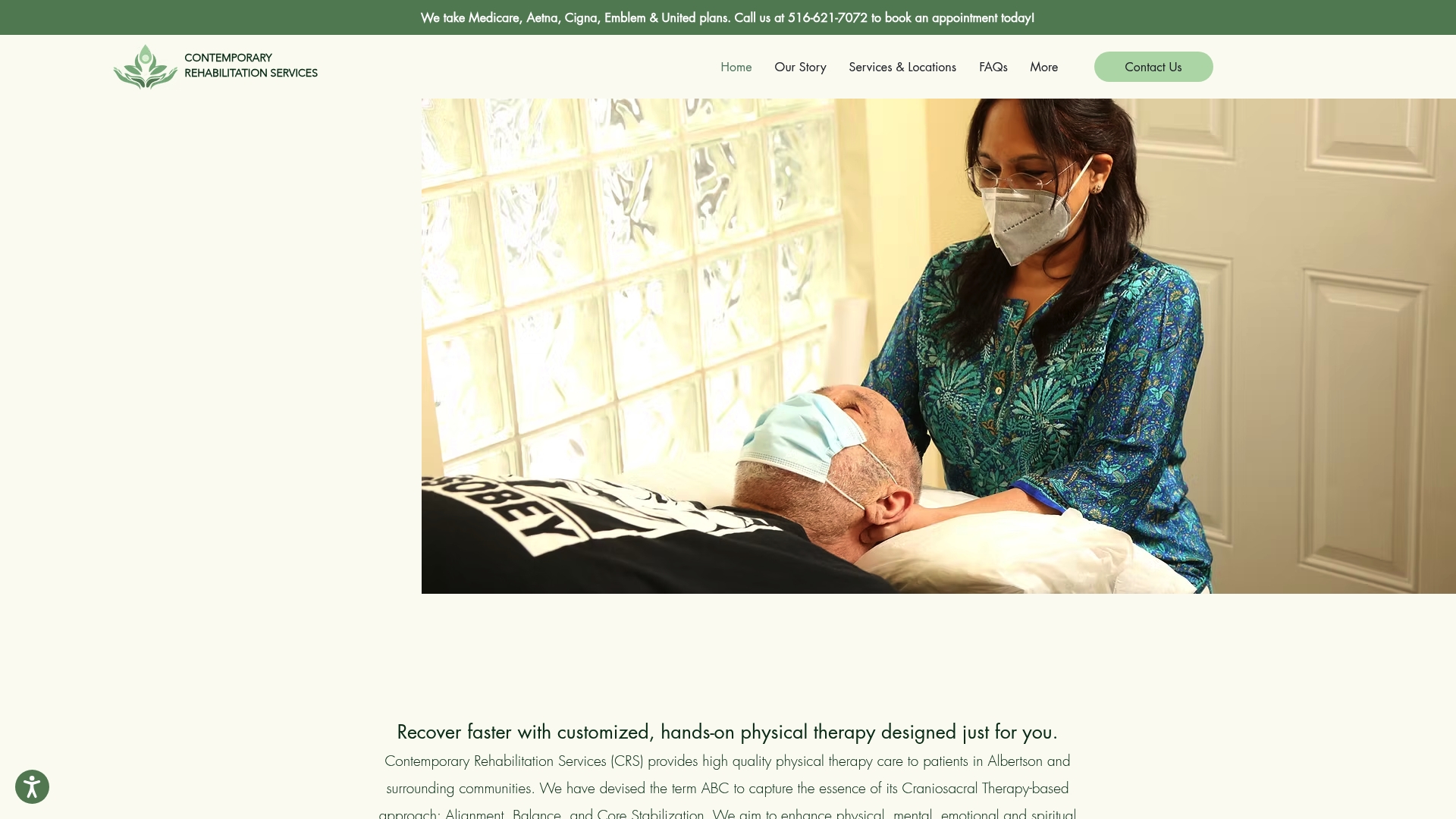
We accept Medicare, Aetna, Cigna, Emblem Health, and United Healthcare, so most of our patients can access care without unexpected out-of-pocket costs. Our team builds individualized plans for chronic pain, post-surgical recovery, TMJ disorder, and complex multi-symptom conditions. Explore our full range of comprehensive therapy treatments or browse all therapy services in Nassau County to find the right fit for your specific needs. We’re here to help you move better, hurt less, and feel confident about your path forward.
Frequently asked questions
Is craniosacral therapy covered by insurance?
Coverage depends on your specific plan; some insurers cover it when a licensed physical therapist provides it as part of a broader PT plan of care. Always call your insurer to verify before your first visit.
How many physical therapy sessions does Medicare cover?
Medicare covers medically necessary PT without a hard annual cap, but providers must use the KX modifier for extended care when billing beyond threshold limits to demonstrate continued medical necessity.
Does physical therapy help chronic pain more than medication?
PT can deliver modest improvements in function for chronic pain conditions and is often preferred as a long-term strategy over relying solely on medications, particularly for musculoskeletal issues.
What questions should I ask at my first PT visit?
Ask about your specific treatment plan, expected outcome benchmarks, which modalities will be used, how many sessions are anticipated, and exactly what your insurance covers before treatment begins.
Is it better to choose a physical therapist close to home?
Yes, proximity significantly helps you attend every scheduled session without the burden of a long commute, and consistent attendance is one of the strongest predictors of positive outcomes.
Recommended
Comments