
Why Local Physical Therapists Make a Real Difference
Most people assume physical therapy works or doesn’t based on the treatment itself. But the research tells a different story. The reason why local physical therapists matter so much comes down to one factor that gets surprisingly little attention: whether you actually show up consistently enough for the treatment to work. If you live in Queens, Nassau County, or anywhere on Long Island, the distance between your home and your therapist’s clinic has a measurable impact on your recovery. This article breaks down exactly how that works, and what to look for when finding a physical therapist nearby.
Table of Contents
Key takeaways
Point | Details |
Attendance drives outcomes | Patients who attend at least 75% of PT sessions see meaningfully greater pain reduction and functional gains. |
Proximity reduces barriers | Transportation difficulties are a documented cause of missed or delayed care in musculoskeletal conditions. |
Direct access saves time | Local PT clinics offering direct access reduce unnecessary GP visits by 10 to 30% without compromising care quality. |
Wellness plans need local fit | Exercise programs tailored to your neighborhood’s resources and environment produce better long-term adherence. |
Communication matters as much as location | Flexible scheduling and easy therapist contact improve attendance beyond what proximity alone can provide. |
Why local physical therapists improve your recovery results
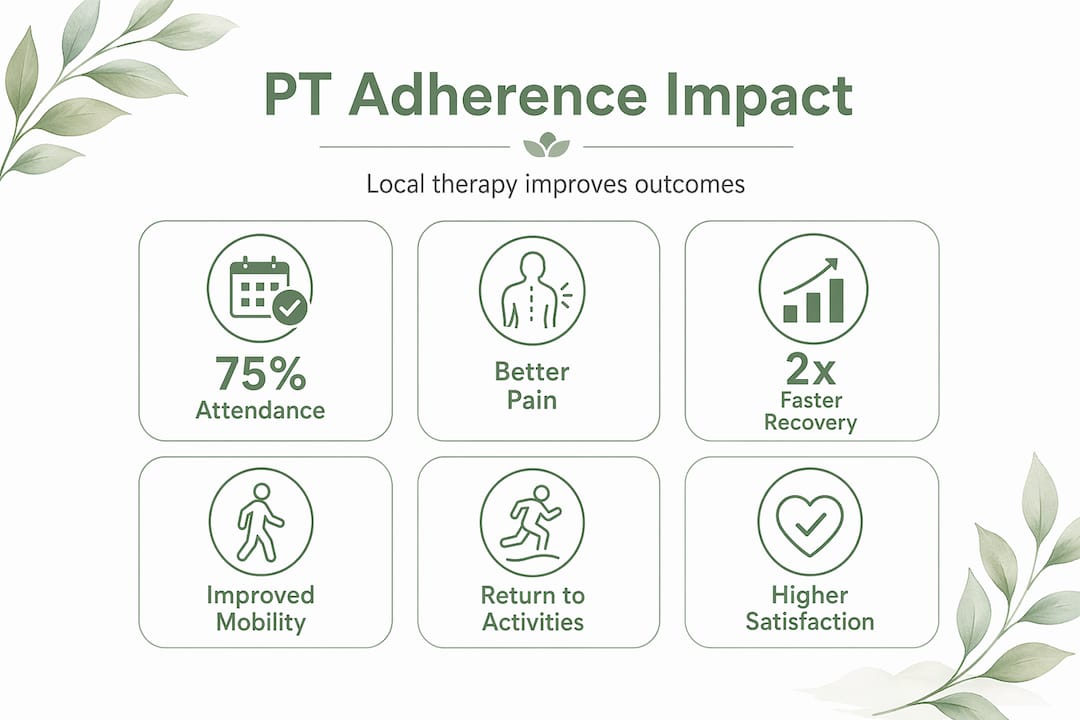
Here is the statistic worth knowing before anything else: ≥75% PT attendance significantly improves pain reduction and clinical outcomes in spine rehabilitation. A 2025 study of 21,362 adults found that adherent patients had a mean pain score reduction of 4.35 points on the numeric pain rating scale, compared to 4.17 for non-adherent patients. That gap also translated into higher rates of achieving a meaningful clinical improvement, 83.9% versus 82.1%.
Those numbers might not look dramatic in isolation. But when you consider that the difference between those two groups was simply showing up consistently, the implication is clear. The benefits of local physical therapists are largely about removing the friction that stops people from getting to their appointments.
Transportation is one of the most concrete barriers. National survey data from 2011 to 2017 links transportation barriers directly to delayed care and reduced therapy participation in musculoskeletal conditions. If your clinic is 45 minutes away in traffic, canceling once becomes a habit quickly. When your therapist is 10 minutes from your front door, that habit never forms.
The advantages of local therapy extend to motor learning as well. Clinicians recognize that the local advantage in rehab lies in maintaining a steady therapy cadence that exploits the brain’s motor learning windows. Disruptions to that cadence, even a few missed sessions, can undo progress that took weeks to build.
Pro Tip: When choosing a clinic, prioritize one within 15 minutes of where you spend the most time each week, whether that’s home or work. The easier your path to recovery feels logistically, the more likely you are to complete your full course of treatment.
Patients who attend more sessions reach functional milestones faster
Proximity lowers the psychological barrier to rescheduling after a setback
Consistent attendance keeps therapeutic gains compounding rather than resetting
Local access supports early PT initiation, which research shows improves outcomes significantly after injuries like rotator cuff repair
On that last point, a 2026 cohort study found that high-adherence patients returned to independent daily activities in a median of four weeks post rotator cuff surgery, with a large effect size (Cohen’s d = 1.12). Early initiation and consistent follow-through were the defining variables.
Common barriers that block PT access and how local clinics solve them
Even when people want to attend physical therapy, they run into obstacles that have nothing to do with motivation. Appointment booking difficulties and limited therapist availability are among the strongest predictors of irregular attendance. A clinic with a two-week wait for rescheduling after a missed session might as well be in another city.
Local physiotherapy services solve this in specific, practical ways. Here is how the difference usually plays out:
Shorter wait times for initial appointments. A clinic serving your immediate community has fewer referral overflow issues and can often schedule a first visit within days. Getting started early matters a great deal for recovery speed.
Easier rescheduling when life intervenes. Local clinics often have more scheduling flexibility than large hospital-based outpatient departments. When your child gets sick or a work meeting runs long, a quick call or text to reschedule keeps your care on track rather than derailing it.
Direct therapist communication. Easy rescheduling and communication between patient and therapist are among the most effective tools for maintaining consistent attendance. In a boutique or community-based clinic, you are more likely to reach your actual therapist rather than a general receptionist queue.
Reduced transportation burden. When a clinic is close to home, transportation stops being a reason to skip. That is especially relevant in dense areas like Queens where parking and transit time add up fast.
Pro Tip: Before committing to any clinic, ask directly: “If I need to reschedule, how quickly can I usually get back in?” A clinic that can get you back within three to five days keeps your therapy for recovery on track. One that books two weeks out puts your progress at risk.
The importance of local rehab goes beyond convenience. It is about building a care structure that is realistic for your actual life, not an idealized version of it. The best physical therapy plan in the world fails if you cannot consistently execute it.
Local PT and wellness beyond injury recovery
Physical therapy is not only for recovering from surgery or acute injury. For many people in Queens and Long Island, local physiotherapy services fill a genuine gap in wellness care, addressing chronic pain, preventing new injuries, and building the physical capacity to stay active as they age.
Here is where the local element becomes even more specific. Neighborhood-specific factors influence physical activity engagement significantly. A therapist who practices in your community understands what resources are available to you, which parks are safe for walking, which gyms are accessible, and what your daily environment actually looks like. That knowledge shapes better, more realistic exercise plans.

The CDC’s guidelines recommend both aerobic activity and muscle-strengthening work for chronic disease prevention. But guidelines are generic. A local therapist translates those guidelines into a program you can actually follow given where you live, what you have access to, and what your schedule allows.
Practical examples of how this plays out in real life:
A therapist near Albertson or Williston Park can recommend walking routes that are genuinely flat and safe for someone recovering from knee surgery, not a generic “walk 30 minutes daily”
They can suggest bodyweight strength exercises suited to a small apartment if you don’t have gym access
They can incorporate community wellness programs already operating in Nassau County into your care plan
They understand local weather patterns and seasonal activity shifts that affect what you can realistically do outdoors
Tailored local exercise plans improve feasibility and adherence by matching your program to your real environment rather than an idealized one. That specificity is one of the clearest advantages of local therapy for long-term wellness.
Direct access vs. referral-based PT: what you need to know
One of the most meaningful shifts in physical therapy over the past decade is the expansion of direct access models. In New York, you can access physical therapy without a physician referral for an initial evaluation period. Understanding how to use local direct access services well can dramatically change how quickly and effectively you get care.
Access model | How it works | Key benefit | Potential drawback |
Traditional referral | Physician refers you to PT after diagnosis | Clear medical coordination | Delays care; requires extra appointments |
Direct access (local PT) | You book directly with the PT clinic | Faster entry into care; fewer unnecessary visits | May still need referral for insurance after initial eval |
Hospital-based outpatient PT | Referral-based through a hospital network | Access to specialized equipment | Often longer waits; less scheduling flexibility |
Boutique local clinic | Direct or referral; personalized scheduling | Flexible, personal, community-rooted care | Smaller staff capacity |
A systematic review of 21 studies covering 90,401 patients found that direct access physiotherapy reduces GP consultations by 10 to 30%, with no compromise in clinical outcomes. Patients got better just as well, and the system handled it with fewer unnecessary steps.
For residents of Queens and Nassau County, this means you do not always need to wait for your primary care doctor to tell you that your back hurts enough to warrant therapy. You already know. A local clinic with direct access lets you act on that knowledge quickly.
How to choose the right local physical therapist
Knowing why choose local therapists is one thing. Actually picking the right one requires a little more thought. Here are the factors that matter most, based on what the research and clinical experience consistently show:
Location relative to your daily routine. Proximity to work often beats proximity to home for people with demanding schedules. Think about where you spend most of your weekdays.
Therapist availability and caseload. A clinic where you see the same therapist at every visit produces better outcomes than one where you rotate through different providers. Ask about this directly.
Scheduling flexibility. As discussed above, this is critical. Look for same-week rescheduling options and clear communication channels.
Insurance acceptance. In the Queens and Nassau County area, clinics that accept Medicare, Aetna, Cigna, Emblem, and United Healthcare plans remove financial friction from the equation. That matters for long-term adherence.
Personalized care approach. Ask whether your therapist will design a program specific to your goals or whether the clinic uses a standard protocol for your diagnosis. The former produces meaningfully better results.
Pro Tip: Questions for physical therapists that reveal the most are behavioral: “How do you adjust the program if I’m having a hard week?” and “What does a typical session look like?” Answers to these tell you whether a clinic values your individual progress or is simply processing patients.
Beyond choosing the clinic, your own engagement matters. Home exercise quality and behavior change are necessary for functional improvements that last. Attending sessions is the floor, not the ceiling. The fastest recovery comes from patients who bring the work their therapist gives them into daily life.
My honest take on local physical therapy
I’ve seen patients arrive at clinics with genuinely good treatment plans that still failed. Not because the therapy was wrong, but because the logistics weren’t sustainable. A 45-minute commute for a three-times-per-week prescription is a problem from day one, and it rarely gets better.
What I’ve learned is that proximity alone is not enough. I’ve seen well-located clinics with terrible scheduling systems that effectively negate the geographic advantage. The real benefit of working with a local therapist comes when location, scheduling flexibility, and therapist communication all work together. When those three things align, attendance becomes natural rather than forced.
In Queens and Long Island specifically, I’ve found that patients who commit to boutique community clinics tend to build a genuine therapeutic relationship with their provider. That relationship matters more than most people realize. When your therapist knows your history, your lifestyle, and what motivates you, they calibrate your care in ways that a rotating roster of practitioners simply cannot.
The research supports what I’ve observed. But experience adds one thing the data doesn’t capture: the difference between a patient who finishes their plan of care and one who drops out after four sessions often has nothing to do with clinical factors. It has everything to do with whether the care felt manageable in their actual life.
— Tj
Convenient local PT care in Queens and Long Island
If you’re looking for local physiotherapy services that fit your real schedule and your insurance plan, Contemporaryrehabservices is worth a serious look. Their boutique clinic in Albertson, NY serves Queens and Nassau County with personalized care built around your recovery goals, not a one-size-fits-all protocol.
They accept Medicare, Aetna, Cigna, Emblem, and United Healthcare, removing one of the most common reasons people delay starting therapy. You can explore their Albertson PT clinic or check their Searingtown location if that’s closer to you. For a full picture of what they offer, their therapy services page covers everything from injury rehabilitation to wellness programs designed for long-term health.
Getting started locally is easier than most people expect. The clinic’s scheduling flexibility and direct therapist access are exactly the kind of structural advantages that make consistent attendance possible.
FAQ
Why do local physical therapists improve recovery outcomes?
Local physical therapists make consistent attendance easier by reducing transportation and scheduling barriers. Research shows that patients who attend at least 75% of their sessions achieve significantly better pain reduction and functional gains.
How does finding a physical therapist nearby affect adherence?
Proximity reduces the friction that leads to missed sessions. Transportation barriers are directly linked to delayed care and reduced therapy participation, so choosing a clinic close to home or work supports more consistent attendance.
What is direct access PT and why does it matter?
Direct access means you can book physical therapy without a physician’s referral. A systematic review of 90,401 patients found this model reduces GP consultations by 10 to 30% while delivering equivalent clinical outcomes.
What questions should I ask when choosing a local therapist?
Ask about same-week rescheduling availability, whether you will see the same therapist at every visit, and how your program will be adjusted based on your progress. These answers reveal whether the clinic’s model supports real-world adherence.
Can local PT help with wellness, not just injury recovery?
Yes. Local therapists who understand your neighborhood’s resources can design exercise programs matched to your actual environment, which significantly improves long-term adherence compared to generic wellness guidelines.
Recommended
Comments