
Your Guide to Home PT Exercises for Real Recovery

A home physical therapy exercise program, known clinically as a Home Exercise Program (HEP), is a medically prescribed set of exercises tailored to your specific deficits, recovery phase, and rehabilitation goals. This guide to home PT exercises gives you the structure, safety rules, and progression strategies you need to recover from injury or manage chronic pain without leaving your house. You will learn what equipment you actually need, how to read your body’s pain signals, and how to build a routine that holds up over weeks and months. Tools like resistance bands, yoga mats, and video instructions all play a role, but the real foundation is knowing how to use them safely.
What equipment and space do you need to start home PT exercises safely?
Starting home PT exercises does not require a fully equipped gym. A safe exercise environment is built from a few basic items and a small amount of floor space. Getting this right from the start protects you from falls, compensatory movements, and unnecessary setbacks.
Here is what most home PT programs rely on:
Resistance bands (light, medium, and heavy) for strengthening exercises
Yoga mat or non-slip mat to prevent slipping during floor work
Ankle weights for lower extremity strengthening
A sturdy chair for seated exercises and balance support
A foam roller for soft tissue work and mobility
If you do not have access to resistance bands or ankle weights, elastic bands or loaded backpacks can substitute effectively without compromising safety or results. A chair with armrests replaces a parallel bar for balance drills. Stairs in your home become a step platform for calf raises and step-ups. The adaptation matters more than the equipment brand.
Your space matters just as much as your tools. Clear the floor of rugs, cords, and furniture within a six-foot radius of where you exercise. Use proper lighting so you can see your footing clearly. Keep your phone nearby in case you need to stop and call for help.

Equipment | Household substitute |
Resistance band | Nylon stocking or bicycle inner tube |
Ankle weight | Sock filled with rice or sand |
Foam roller | Tightly rolled bath towel |
Step platform | Bottom stair with handrail nearby |
Exercise mat | Folded blanket on a non-slip surface |
Pro Tip: Ask your physical therapist to review your exercise space during your next visit or via a telehealth session. A two-minute walkthrough can prevent weeks of avoidable injury.
How to perform home PT exercises safely using pain monitoring
Safe execution of home physical therapy exercises depends on one skill above all others: reading your pain accurately. The traffic-light pain model gives you a clear, practical framework for making that call in real time.
Here is how the model works:
Green light: Mild discomfort or muscle fatigue that stays below a 3 out of 10 on a pain scale. Continue your exercise as planned.
Yellow light: Moderate pain between 3 and 5 out of 10, or pain that lingers for more than 30 minutes after exercise. Modify the movement by reducing range, slowing your tempo, or decreasing resistance.
Red light: Sharp, stabbing, or intense pain above 5 out of 10, or any joint locking, swelling, or numbness. Stop immediately and contact your therapist before continuing.
Beyond pain signals, form and pacing protect you from setbacks. Move slowly and deliberately through each repetition. Rushing through exercises is the most common mistake people make at home, and it shifts load onto the wrong tissues. Breathe steadily throughout each movement. Holding your breath raises blood pressure and reduces muscle control.
“Pain must be integrated into dose adaptations. Clear guidelines on modifying range, load, reps, and tempo prevent fear and injury during home therapy.” — Pain During Activity: Should You Push Through or Stop?
Always warm up for five to ten minutes before starting your exercises. Light walking in place, gentle shoulder rolls, or ankle circles raise tissue temperature and reduce injury risk. Skipping the warm-up is the single fastest way to turn a manageable session into a painful one.
Pro Tip: Keep a simple pain log next to your exercise space. Write down your pain score before and after each session. Patterns in that data will tell you and your therapist more than memory ever will.
How to structure and progress your home PT exercise routine
Structure is what separates a home exercise program from random movement. Optimal adherence happens when sessions last 15 to 30 minutes with about 2 to 3 exercises per session. Exceeding three exercises in a single session typically reduces completion rates. That finding is counterintuitive for motivated patients, but it reflects how real life works.
Follow this sequence when building your routine:
Warm-up (5 minutes): Light movement to prepare your joints and muscles.
Primary exercises (15 to 20 minutes): Complete your 2 to 3 prescribed exercises with full attention to form.
Cool-down and stretching (5 minutes): Gentle range-of-motion work to reduce post-exercise soreness.
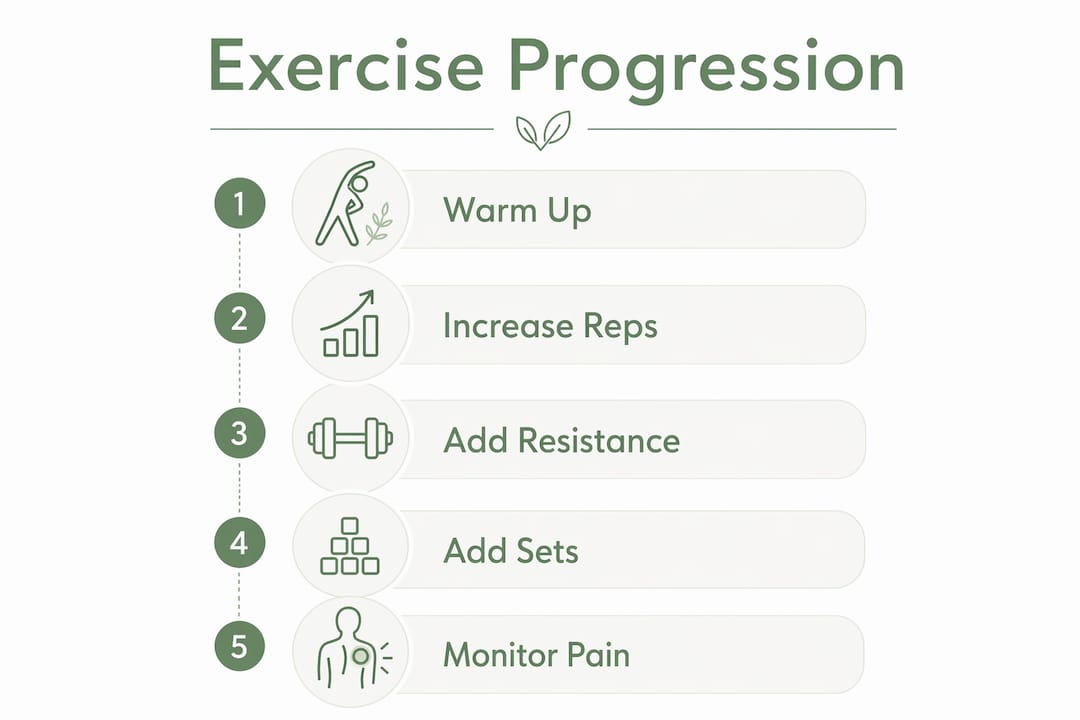
Progression is where most self-guided programs fall apart. Without a clear plan, you either stay at the same level too long and plateau, or you push too hard and flare up. The most important element of any home PT program is a specific progression rule that tells you exactly what to change and when.
Stage | What to progress | How to know you are ready |
Early recovery | Increase reps before adding resistance | Pain stays at green light for 3 consecutive sessions |
Mid recovery | Increase resistance or range of motion | No increase in soreness 24 hours after exercise |
Late recovery | Add speed, load, or functional movement | Full range of motion achieved with minimal discomfort |
If a symptom flare-up occurs, drop back one stage and reduce your session frequency to every other day. Do not stop entirely unless your therapist advises it. Stopping completely often makes returning harder both physically and psychologically.
Pro Tip: Written instructions alone are not enough. Ask your therapist for short video demonstrations of each exercise. Patients who use both written and video instructions complete their programs at significantly higher rates.
What types of exercises belong in a home PT program?
Home physical therapy exercises fall into four main categories, and most effective programs draw from all four depending on your condition and recovery stage.
Range of motion exercises restore flexibility and joint mobility after injury or surgery. Examples include pendulum shoulder swings after rotator cuff repair, ankle alphabet tracing after a sprain, and cervical side bends for neck stiffness. These exercises are typically the starting point in early recovery because they do not load damaged tissue heavily.
Strengthening exercises rebuild muscle around injured joints using resistance bands, bodyweight, or ankle weights. Clamshells and side-lying hip abduction target the glutes for knee and hip conditions. Straight leg raises protect the knee after ACL injury. Scapular retractions address shoulder instability. A medically prescribed HEP selects these based on your specific tissue healing needs, not general fitness goals.
Balance and stability drills rebuild proprioception, which is your body’s ability to sense joint position. Single-leg standing, tandem stance, and heel-to-toe walking are beginner-level options. These exercises matter enormously for ankle sprains, knee replacements, and any condition that has disrupted your normal movement patterns. Proprioception loss is often invisible but dramatically increases re-injury risk.
Stretching routines reduce muscle tension and maintain the mobility gains you build during other exercises. Hip flexor stretches, calf stretches against a wall, and doorway chest openers are staples in most programs. Stretching works best when held for 30 to 60 seconds per position and performed after your body is already warm. For more guidance on faster recovery strategies, combining these categories in the right sequence makes a measurable difference.
How do you stay motivated and stick to your home PT routine?
Exercise adherence drops to roughly 50% after six months without follow-up or motivation strategies. That statistic applies directly to home PT programs, and it explains why so many people start strong and then quietly stop. The solution is not willpower. It is structure.
These strategies work in practice:
Tie exercises to an existing habit. Do your morning exercises immediately after brushing your teeth or before your first cup of coffee. Habit stacking removes the decision-making step.
Set a specific, measurable goal. “Walk to the mailbox without pain by the end of the month” is more motivating than “get better.”
Use a tracking sheet or app. Checking off completed sessions creates a visual record of progress that reinforces consistency.
Schedule follow-up appointments. A follow-up plan is as important as the exercise set itself for sustaining long-term adherence.
Reduce complexity. Patients fail to complete home programs due to complexity rather than lack of intent. Fewer, clearer, and trackable exercises improve completion rates significantly.
Digital tools now make self-guided physical therapy more manageable. Platforms that deliver video instructions, send session reminders, and allow you to message your therapist between visits close the gap between clinic visits and home practice. If your current program feels overwhelming, that is feedback worth sharing with your therapist. Adjusting the program is not failure. It is good clinical practice.
Pro Tip: Tell one person in your household about your exercise schedule. Social accountability is one of the most reliable predictors of follow-through, and it costs nothing.
Key takeaways
A structured, personalized home exercise program with clear progression rules and pain monitoring is the most effective way to recover from injury or manage chronic pain at home.
Point | Details |
Keep sessions short | Sessions of 15 to 30 minutes with 2 to 3 exercises maximize completion rates. |
Use the traffic-light model | Green means continue, yellow means modify, red means stop and reassess with your therapist. |
Progress deliberately | Increase reps before resistance, and drop back one stage during flare-ups rather than stopping entirely. |
Substitute freely | Loaded backpacks, chairs, and towels replace gym equipment without reducing effectiveness. |
Plan for follow-up | Adherence drops sharply without scheduled check-ins; build follow-up into your program from day one. |
What I have learned from watching patients do this at home
After working with patients across Nassau County and Queens, the pattern I see most often is this: the people who recover fastest are not the ones who do the most exercises. They are the ones who do the right exercises consistently and stop when their body tells them to stop.
The biggest mistake I see is treating a home exercise program like a workout. A workout is about pushing limits. A home PT program is about respecting them. When you push through red-light pain because you want to “make progress,” you are not accelerating recovery. You are extending it.
The second thing I have noticed is that patients who understand why they are doing each exercise stick with the program far longer than those who just follow instructions. When you know that a clamshell exercise is protecting your knee by strengthening the hip, you do not skip it on a busy day. You understand what skipping it costs you.
Customization and progression are not optional features of a good home PT program. They are the program. A generic list of exercises downloaded from the internet is not a home exercise program. It is a starting point at best and a liability at worst. If your current program does not tell you exactly when and how to progress, that is the first conversation to have with your therapist. For more on choosing the right PT path, the decision is simpler than most people think.
— Tj
Start your recovery with support from Contemporaryrehabservices
Contemporaryrehabservices is a boutique physical therapy clinic serving Albertson, Queens, and Nassau County, and the team specializes in building personalized home exercise programs that actually get completed. Whether you are recovering from a recent injury or managing a long-term condition, the clinic creates tailored care plans that include clear progression rules, video instruction support, and scheduled follow-up to keep you on track.
Contemporaryrehabservices accepts Medicare, Aetna, Cigna, Emblem, and United Healthcare plans, making professional guidance accessible without financial stress. Locations in Searingtown, Albertson, and Herricks serve the broader Long Island and Queens community. Reach out today to schedule a consultation and get a home exercise program built around your specific recovery needs.
FAQ
What is a home exercise program in physical therapy?
A home exercise program (HEP) is a medically prescribed set of exercises tailored to your specific injury, recovery phase, and rehabilitation goals. It differs from general fitness routines because every exercise is selected based on clinical assessment and tissue healing needs.
How many exercises should I do per home PT session?
Research shows that 2 to 3 exercises per session lasting 15 to 30 minutes produces the best adherence rates. Adding more exercises per session typically reduces how consistently patients complete their program.
What do I do if an exercise causes pain at home?
Use the traffic-light model: mild discomfort below a 3 out of 10 is acceptable, moderate pain between 3 and 5 means modify the movement, and sharp or intense pain above 5 means stop and contact your therapist before continuing.
Do I need special equipment for home PT exercises?
Most home PT programs require only resistance bands, a non-slip mat, and a sturdy chair. Loaded backpacks, rolled towels, and household stairs are effective substitutes when standard equipment is unavailable.
How do I stay consistent with my home PT routine long-term?
Tie your exercises to an existing daily habit, use a tracking sheet, and schedule regular follow-up appointments with your therapist. Adherence drops to around 50% after six months without structured follow-up and goal setting.
Recommended
Comments